
You’re viewing a previously saved calculation
Sales Margin Calculator for Amazon
Estimate your sales margin on Amazon for FREE.
Knowing how much you'll profit from selling your products on Amazon can ensure that your campaign is cost-effective. Our margin-per-sale breakdown will help you spot inefficiencies in the cost of your Amazon products, and help you earn more revenue over time.

Amazon Sales Margin Calculator
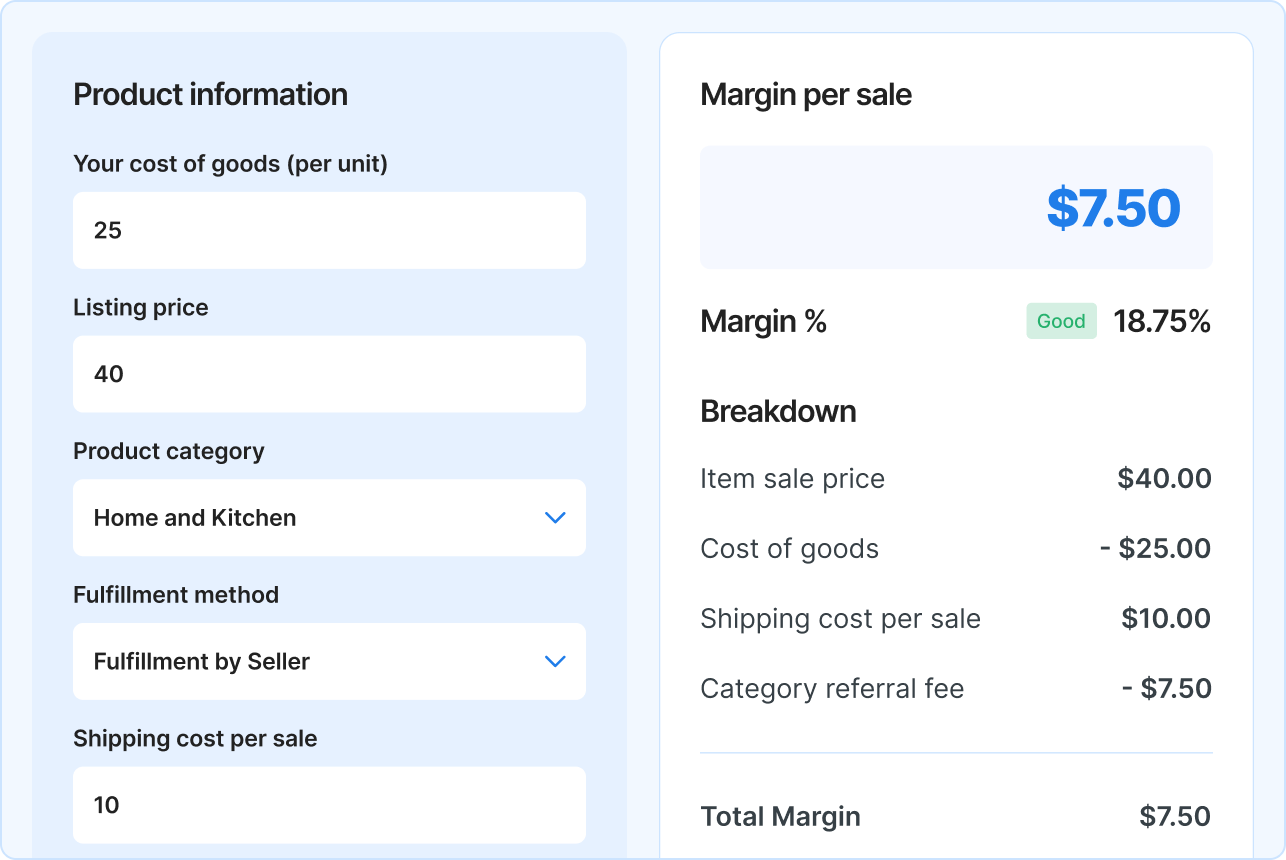
Margin per sale

$0.00
Breakdown
- Item sale price $0.00
- Cost of goods $0.00
- Shipping cost per sale $0.00
- Category referral fee $0.00
- Total Margin $0.00

Need help improving your Amazon sales margin?
How do I use WebFX’s sales margin calculator for Amazon?
Get started with WebFX’s sales margin calculator for Amazon by:
- Entering your cost of goods per unit (how much you pay)
- Selecting your product’s category on Amazon (to determine Amazon’s referral fee)
- Selecting your fulfillment method
- Entering your shipping cost per sale (for Fulfillment by Seller) or product size and weight (for Fulfillment by Amazon)
Your results will then generate, providing your margin per sale, plus a breakdown of the math behind the calculation.
Frequently Asked Questions
How do I use WebFX’s sales margin calculator for Amazon?
Get started with WebFX’s sales margin calculator for Amazon by:
- Entering your cost of goods per unit (how much you pay)
- Entering your listing price (how much users pay)
- Selecting your product’s category on Amazon (to determine Amazon’s referral fee)
- Selecting your fulfillment method
- Entering your shipping cost per sale (for Fulfillment by Seller) or product size and weight (for Fulfillment by Amazon)
Your results will then generate, providing your margin per sale, plus a breakdown of the math behind the calculation.
How do I interpret my results?
First, understand that this Amazon sales margin calculator does not include other cost factors, like ad spend promoting product listings (though you can include this in your cost of goods calculation).
Then, interpret your result using the following table:
| Cost of goods (per unit) | Healthy margin per sale | Poor margin per sale | Negative margin per sale |
|---|---|---|---|
| $15-20 | $4-8+ | $2-3 | Below $1.50 |
| $25-35 | $8-14+ | $3-6 | Below $2.50 |
| $50-75 | $15-25+ | $7-12 | Below $5 |
What is a good sales margin per sale for an Amazon seller?
Use the following table to understand what a good sales margin per sale looks like for Amazon sellers:
| Listing price | Strong margin per sale | Good margin per sale | Poor margin per sale |
|---|---|---|---|
| $10-15 | $6+ | $3-5 | Below $1.50 |
| $20-25 | $5-8 | $9+ | Below $3 |
| $30-40 | $8-12 | $13+ | Under $5 |
| $50-75 | $15-20 | $21+ | Under $8 |
| $100+ | $25-35 | $40+ | Under $15 |
How can I improve my Amazon sales margin?
Improve your Amazon sales margin with the following tactics:
- Negotiate a better Cost of Goods Sold (COGS)
- Optimize packaging and product weight for a lower FBA tier
- Test higher listing pricing (such as by $2-3)
- Cut wasted ad spend to achieve a lower advertising cost of sale (ACoS)
- Improve product descriptions to reduce return rates
- Use promotions to eliminate aged inventory fees
If you’re needing help improving your ad performance (or offloading optimizing your product listings), WebFX’s advertising services for Amazon can help.
What mistakes do sellers most often make when trying to improve their sales margin?
The most common mistakes sellers make when trying to improve their sales margin include:
- Making aggressive cuts to ad spend
- Reducing product quality
- Overstocking to receive volume discounts
- Switching fulfillment options
The problem with these approaches is that sellers are often too aggressive with them. For example, switching fulfillment options requires research and forecasting, as does reducing ad spend.
How do I calculate my sales margin as a percentage?
Calculate your sales margin as a percentage using the following formula:
Per sale profit margin / Listing price x 100 = Sales margin (%)
What is an excellent sales margin (%) as an Amazon seller?
An excellent sales margin as an Amazon seller is above 25%.
What is a good sales margin (%) as an Amazon seller?
A good sales margin for an Amazon seller is between 15% to 25%.
What is a bad sales margin (%) as an Amazon seller?
A bad sales margin for an Amazon seller is less than 10%.
What do sales margins (%) look like across product categories?
Use the table below to compare your sales margin against some of the most popular product categories on Amazon:
| Product category | Average profit margin |
|---|---|
| Baby Products | 18-28% |
| Health & Personal Care | 18-30% |
| Home & Kitchen | 15-25% |
| Industrial & Scientific | 20-35% |
| Electronics | 5-12% |
| Clothing & Accessories | 8-18% |
When should I calculate my Amazon sales margin?
Sellers should calculate their Amazon sales margin in the following scenarios:
| Scenario | Reasoning |
|---|---|
| During product research | Determine if the product is viable before you scale |
| Before placing manufacturer orders | Model margin at floor, launch, and target pricing |
| When Amazon updates fees | Remodel pricing to maintain profit margins |
| After adjusting pricing | Determine if price changes are sustainable and generate the necessary sales |
| Before running promotions | Understand how the promotion will impact profit margins |
| During SKU reviews | Flag profit margin declines early |
| When scaling inventory | Determine if the product and/or product bundles will maintain or improve margins |
How do Amazon fees influence Amazon sales margins?
Amazon fees influence Amazon sales margins significantly.
That’s because Amazon’s referral fees (and shipping fees for those using Fulfillment by Amazon) consume 30-50% of a seller’s listing price. That’s why it’s important for sellers to optimize their listings and ad performance.
Is it more cost-effective to use Fulfillment by Amazon (FBA) or Fulfillment by Seller?
Fulfillment by Amazon is more cost-effective for small, lightweight products that sell fast. Seller by Amazon is more cost-effective for heavy, oversized items that take longer to sell.
However, it’s common for Amazon sellers to use both.09r45
How can I improve my sales margin through ad campaigns?
Sellers can improve their sales margin through ad campaigns (if they’re advertising) using the following tactics:
- Add negative keywords weekly
- Target high-converting keywords with exact match
- Target low-competition, high-intent keywords
- Lower bids on low-converting keywords
- Use dayparting to deliver ads at the highest-converting hours
- Cancel campaigns with zero conversions, but high spend
- Pause campaigns above your ACoS break-even point for 45 or more days
- Promote slow-moving inventory to avoid Amazon’s storage fees