What is ChatGPT Ads Manager? ChatGPT Ads Manager is OpenAI’s self-serve advertising platform launched in beta on May 5, 2026, allowing U.S. businesses to create and manage ad campaigns that appear inside ChatGPT conversations with CPC bidding, measurement tools, and no minimum spend requirement.
Who can currently access the platform? The beta is open to U.S.-based businesses of all sizes, agency partners like Dentsu and Omnicom, and technology partners including Adobe and Criteo, with ads appearing to Free and Go tier users in the U.S., Canada, Australia, and New Zealand.
How does the campaign creation process work? Advertisers create campaigns through a three-level hierarchy (campaign, ad group, ad) using conversational targeting based on context hints rather than keywords, with all campaigns requiring review before serving and appearing as clearly labeled units below relevant ChatGPT conversations.
Which brands should test ChatGPT Ads Manager first? B2B SaaS companies, professional services firms, education providers, and high-consideration ecommerce brands are best positioned to test the platform because their customers research before buying, aligning with ChatGPT’s conversational research behavior.
Why does ChatGPT Ads Manager matter for marketers now? Early advertisers can capture lower CPCs, build optimization data, and gain platform-specific creative experience before competition increases, especially since ChatGPT accounts for 82.6% of all generative AI traffic and OpenAI projects $2.5 billion in ad revenue for 2026.
ChatGPT Ads Manager snapshot:
What it is: OpenAI’s self-serve advertising platform for running ads inside ChatGPT conversations.
Who can use it: Approved U.S. advertisers can sign up at ads.openai.com as the beta expands.
How buying works: Run CPC or CPM campaigns, submit them for review, and track results through UTMs, the pixel, and the Conversions API.
Best fit: B2B SaaS, professional services, education, and high-consideration ecommerce brands.
Who should wait: Local service businesses and regulated categories like healthcare and finance.
ChatGPT Ads Manager is OpenAI’s self-serve advertising platform, launched in beta on May 5, 2026, that lets U.S. businesses create and manage ad campaigns directly. Approved campaigns then serve as ads inside ChatGPT conversations, complete with CPC bidding, expanded measurement tools, and no minimum spend requirement.
This is the moment the ChatGPT ads pilot stops being an agency-only experiment and becomes a real platform any qualified advertiser can test. Here’s what the OpenAI Ads Manager Beta includes today, how the platform actually works, and which brands should jump in early:
ChatGPT Ads Manager is the self-serve portal where advertisers create, launch, and manage ad campaigns that appear inside ChatGPT conversations. The platform, available at ads.openai.com, gives businesses direct control over campaign objectives, budgets, bidding, ad creative, and performance tracking, without requiring an agency partnership or a managed-service relationship with OpenAI.
OpenAI opened the beta on May 5, 2026, after running a managed pilot since February with brands like Best Buy, Lowe’s, VistaPrint, Target, Albertsons, and Williams-Sonoma. The shift to self-serve is significant for two reasons: the $50,000 minimum spend that gated the pilot has been removed, and CPC bidding now joins CPM as a buying option. That combination opens the door for SMBs, startups, and in-house teams that previously had no path into ChatGPT advertising.
The May 5 launch also brought three platform-level upgrades that move ChatGPT advertising closer to a traditional media buying environment:
CPC bidding joins CPM. Advertisers can now buy ChatGPT ads on a cost per click (CPC) basis, choosing the Clicks objective when building a campaign. The recommended starting max bid is $3 to $5 per click, while the default max bid for cost per mille (CPM) campaigns is $60. The platform uses a relevance-weighted second-price auction to select the best ad for each eligible conversation.
Conversions API and pixel-based measurement. Advertisers can measure purchases, sign-ups, leads, and other meaningful actions after ad engagement. Reporting is aggregated, meaning advertisers see campaign-level performance without access to individual ChatGPT conversations or personal user data.
Self-serve access with no minimum spend. The $50,000 minimum that gated the managed pilot is gone. Any approved advertiser can launch a campaign with whatever budget fits their test.
The platform kept moving fast after that initial launch. By late July, OpenAI had added conversion-based bidding, geographic targeting exclusions, and bulk campaign management tools, then followed with budget pacing controls, additional ad formats, and expanded API access.
Each addition closes a gap between ChatGPT Ads Manager and the mature feature sets advertisers already expect from Google Ads and Meta, which strengthens the case for testing now rather than waiting for the platform to fully mature.
OpenAI’s head of monetization, Asad Awan, has framed the rollout as a measured one. Access is gradual, the beta is still being refined, and campaigns are submitted for review before they can serve.
Who can use ChatGPT Ads Manager right now?
The ChatGPT Ads Manager Beta is currently open to advertisers in the United States, with gradual access rolling out as OpenAI tests and refines the platform. Businesses can sign up directly at ads.openai.com or work through agency and tech partners that already have access.
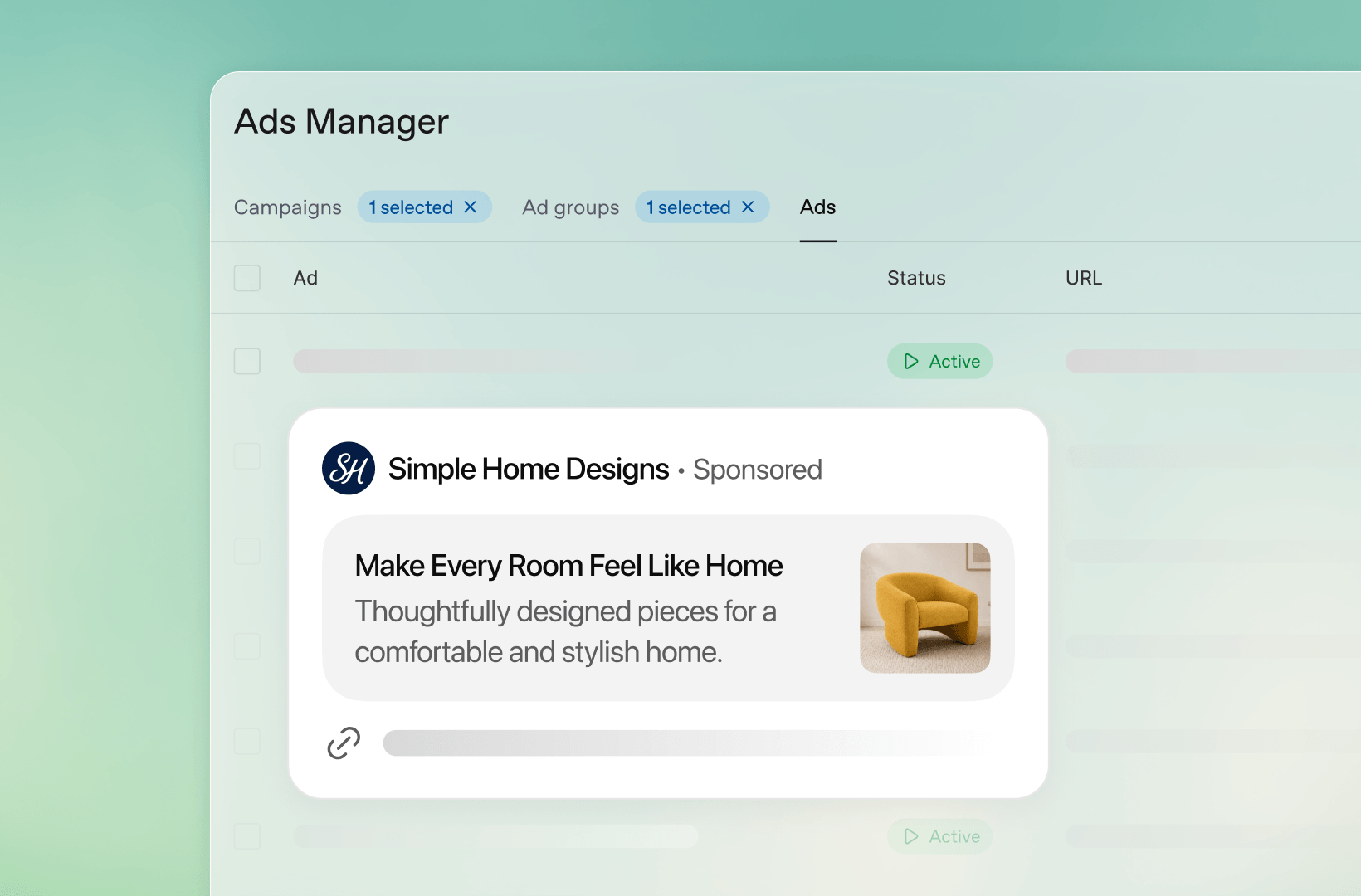
A preview of OpenAI’s ChatGPT Ads Manager interface, shared on ads.openai.com.
Who can advertise on ChatGPT today:
U.S.-based businesses of all sizes, from SMBs and startups to global brands
Agency partners including Dentsu, Omnicom, Publicis, and WPP
Technology partners including Adobe, Criteo, Kargo, Pacvue, and StackAdapt
Who sees the ads:
ChatGPT ads appear to Free and Go tier users in the United States, Canada, Australia, and New Zealand. They are not shown to Plus, Pro, Business, or Enterprise users, or to anyone OpenAI predicts is under 18. The Go tier, priced at $8 per month, sits between the free plan and Plus, and represents a self-selected audience of frequent ChatGPT users who research and decide inside the platform.
OpenAI also expanded the ads pilot on May 7 to the United Kingdom, Mexico, Japan, Brazil, and South Korea, signaling that international advertiser access is on the near horizon.
How ChatGPT Ads Manager works
ChatGPT Ads Manager works through a three-step flow: create an account, build a campaign, then launch and monitor performance through the dashboard. Every campaign follows the same hierarchy that advertisers already know from Google Ads and Meta Ads Manager, with one key twist: targeting is conversational, not keyword-based.
Step 1: Account setup
Sign in with an existing OpenAI account or create a new one at ads.openai.com. Complete onboarding and verification, add an advertiser name and favicon (which appear in every ad unit), set up a billing profile, add a payment method, and invite team members.
Account-level settings also include API keys for advertisers who want to integrate ChatGPT Ads Manager into their existing tech stack. OpenAI’s Ads Manager Beta account setup guide walks through each step.
Step 2: Campaign creation
Every campaign in OpenAI Ads Manager Beta follows three levels:
Campaign: defines the objective (Reach for CPM, Clicks for CPC), budget, dates, and overall targeting
Ad group: a collection of ads organized around a theme, with context hints describing the conversations, topics, or keywords where the ads should appear
Ad: the creative shown in ChatGPT, including the title, copy, image, landing page URL, and advertiser favicon
Advertisers can build campaigns through a guided workflow or upload them in bulk using a campaign schema template. All campaigns are submitted for review before they can serve.
Targeting also expanded beyond context hints. OpenAI added custom audiences, which let advertisers upload their own customer or prospect lists using email addresses or phone numbers, including hashed versions, to include or exclude specific groups from a campaign.
Advertisers can also apply bid multipliers at the ad group level to bid more aggressively for high-value customers or pull back for lower-priority audiences. Each audience needs at least 25,000 matched users before it’s usable, so this is a better fit for advertisers with a sizable existing customer list than for small local businesses just getting started.
Step 3: Launch and monitor
Once approved, campaigns serve and report through the Ads Manager Beta dashboard. Performance is tracked across three formats:
Table view by campaign, ad group, and ad
Trend charts over time
CSV exports for daily or cumulative reporting
How the ads appear in ChatGPT
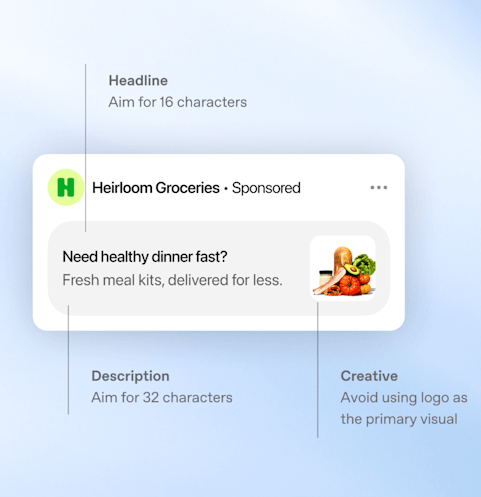
Approved ads appear below relevant ChatGPT conversations as clearly labeled, visually distinct units. Each ad includes:
Advertiser name
Favicon (advertiser logo)
Title (headline, aim for 16 characters)
Copy (description, aim for 32 characters)
Image asset (creative)
Landing page link
An example of a ChatGPT ad unit, as shared by OpenAI in their Help Center.
The ad system matches ads to conversations based on context hints, landing page content, ad title, and ad copy, not exact-match keywords. That conversational targeting model is a meaningful departure from how Google Ads or Microsoft Ads work, and it requires a different creative approach. We covered the creative side in detail in our earlier piece on how ChatGPT ads work and why a Google Ads playbook won’t translate.
OpenAI has also started surfacing two ads from different advertisers in the same results footer, so a single response can now carry more than one sponsored placement.
Which brands should test ChatGPT Ads Manager first
The brands best positioned to test ChatGPT Ads Manager right now are B2B SaaS companies, professional services firms, education and online learning providers, and consideration-stage ecommerce brands. These categories align with how ChatGPT users actually behave, with research, comparison, and decision-making rather than impulse buying.
Advertiser type
Fit
Reason
B2B SaaS
Strong
High-consideration purchases align with conversational research behavior
Professional services
Strong
Users ask complex questions, making contextual targeting precise
Education and online learning
Strong
ChatGPT is heavily used for learning and skill development
High-consideration ecommerce
Moderate
Works for researched purchases, weaker for impulse buys
Local service businesses
Wait
Geo-targeting granularity not yet mature
Regulated categories (healthcare, finance)
Wait
Policy clarity on category rules still developing
The rule is simple: if your customers research before they buy, ChatGPT Ads Manager fits their behavior. If they buy impulsively, the current platform format and targeting maturity may not yet justify meaningful budget allocation.
How to measure ChatGPT ads performance
ChatGPT Ads Manager reports performance across impressions, clicks, spend, CTR, average CPC, average CPM, conversions, Attributed Sales Value, and Sales ROAS, with additional tracking available through the Conversions API, pixel-based measurement, and UTM parameters on landing page URLs.
Attributed Sales Value and Sales ROAS were added after launch, giving advertisers a direct revenue metric instead of relying solely on conversion counts. Setting up tracking before campaigns launch is non-negotiable because retroactive attribution is not possible.
Here are five tracking steps every advertiser should complete before launching a campaign:
Add UTM parameters to every landing page URL with clear source, medium, and campaign values
Set up Conversions API or pixel tracking to capture purchases, sign-ups, leads, or other actions
Use dedicated landing pages rather than generic homepages, so engagement quality is measurable
Pull CSV reports for daily and cumulative performance views
Build view-through and assisted conversion windows into the attribution model, since ChatGPT users often return to a brand later in the buying cycle. Conversion value tooltips now break this out directly in the dashboard, showing View-Through Attribution (VTA) and Click-Through Attribution (CTA) values separately, so you don’t have to estimate the split yourself
The cleaner the tracking, the faster the optimization cycle. Wait for “better data,” and you miss the early-mover window entirely.
Why ChatGPT Ads Manager matters for marketers right now
The launch of a self-serve ChatGPT Ads Manager turns a closed pilot into an open advertising channel. Test now, and you lock in lower CPCs, faster learning curves, and platform-specific creative experience before competition catches up. According to Axios, OpenAI projects $2.5 billion in ad revenue this year and $100 billion by 2030.
Reach is already concentrated, too. Our analysis of 2.3 billion sessions found ChatGPT accounted for 82.6% of all generative AI traffic from 2024 to 2025, far ahead of Perplexity, Google Gemini, and every other AI assistant. Most AI-driven discovery is already happening on ChatGPT, and that makes Ads Manager the highest-leverage AI advertising bet today.
Expert insights from
Kayla J.PPC Specialist at WebFX
“A lot of advertisers are buzzing about the self-serve ads manager now available in ChatGPT — and it’s easy to see why. If they work as promised, ChatGPT ads would act as a logical “next step” for users who have asked a relevant question and might be ready to convert.
That said, the self-serve platform’s targeting options seem like a bit of a black box right now, and I could easily see the ads feeling forced or only partially aligned to the conversational context. I would suggest testing cautiously to gauge results before going all-in.”
That trajectory creates a window. Early advertisers on every major ad platform, from Google AdWords to Meta Ads to TikTok Ads, captured lower costs and built optimization data while competition was thin. The same pattern is forming inside ChatGPT.
But paid presence inside ChatGPT can only get you so far. The bigger win is showing up inside ChatGPT’s actual responses and not just alongside them. This is why when it comes to ChatGPT ads vs. GEO, it’s essential to use both to maximize your reach and visibility.
Pair ChatGPT advertising with AI search optimization and platforms like OmniSEO®, and you get both the sponsored placement and the organic AI citation. Skip either one and you lose ground in the conversations your customers are already having.
ChatGPT Ads Manager is OpenAI’s self-serve advertising platform at ads.openai.com, where U.S. businesses create, launch, and manage ad campaigns that appear inside ChatGPT conversations. The beta launched on May 5, 2026.
ChatGPT ads use a relevance-weighted second-price auction with two bidding options. The recommended starting max bid for CPC campaigns is $3 to $5 per click, and the default max bid for CPM campaigns is $60.
No. The $50,000 minimum that gated the managed pilot was removed when self-serve launched, so any approved advertiser can set a budget that fits their test.
ChatGPT ads appear below relevant conversations, clearly labeled and visually separated from ChatGPT’s organic responses. They include the advertiser name, favicon, title, copy, image, and a landing page link.
ChatGPT Ads Manager is currently open to U.S. advertisers, with the ads pilot expanded to the United Kingdom, Mexico, Japan, Brazil, and South Korea as of May 7, 2026.
Sign up at ads.openai.com using an OpenAI account, complete onboarding and verification, add advertiser details, set up billing, and invite team members. Campaigns can launch once the account is approved and reviewed.
Looking to test ChatGPT Ads but don’t know where to start?
WebFX takes a methodical approach to testing this new channel to give your business the best shot at success.
Get ahead of the ChatGPT Ads Manager learning curve
The self-serve ChatGPT Ads Manager is open. The advertisers testing now are stacking up data, creative learning, and platform familiarity that compound as competition catches up. Sit out the early-mover window, and the catch-up cost only grows.
Need a partner to map the strategy? WebFX has 30+ years of experience helping businesses stay ahead of major shifts like this. Our team of 750+ digital experts can help develop a strategy for emerging platforms like ChatGPT Ads Manager.
Craft a tailored online marketing strategy! Utilize our free Internet marketing calculator for a custom plan based on your location, reach, timeframe, and budget.
Craft a tailored online marketing strategy! Utilize our free Internet marketing calculator for a custom plan based on your location, reach, timeframe, and budget.







 Albert Dandy Velasquez blends SEO strategy with compelling storytelling to help businesses boost their visibility and revenue online. With a B.A. in English and certifications from HubSpot, Semrush, and Google Analytics, he has written and optimized hundreds of articles on organic SEO, content strategy, and user experience. He regularly contributes to the WebFX blog and SEO.com, creating content that helps readers turn marketing goals into measurable results. When he’s off the clock, he’s usually exploring new neighborhoods on two wheels, filming travel content, or chasing golden hour with a coffee in hand. View full profile