
-
 Based on 28 years and
3,212,407 hours of expertise


Table of Contents
- Step 1: Audit your campaign data
- Review your tracking setup
- Assess the full funnel
- Check the budget breakdown
- Evaluate reporting quality
- Check your own contributions to the partnership
- Step 2: Have a strategy alignment meeting with your agency
- What to bring to the meeting
- Checklist of questions to ask
- What a strong response should look like: a data-backed approach to addressing performance gaps
- A response that shows it’s time to move on: defensiveness and vague answers
- Step 3: Make a data-backed decision
- Signs your marketing agency is worth keeping
- Signs it's time to find a new agency
- If you decide to switch agencies, protect your business and part on good terms
- What to look for in a new agency
- Step 4: Run a revenue-focused audit to reset the partnership
- Audit your revenue-tied performance metrics
- What a healthy agency partnership looks like in practice
- Red flags to watch out for
- FAQs
- Partner with a marketing agency that has driven $10 billion in revenue for its clients
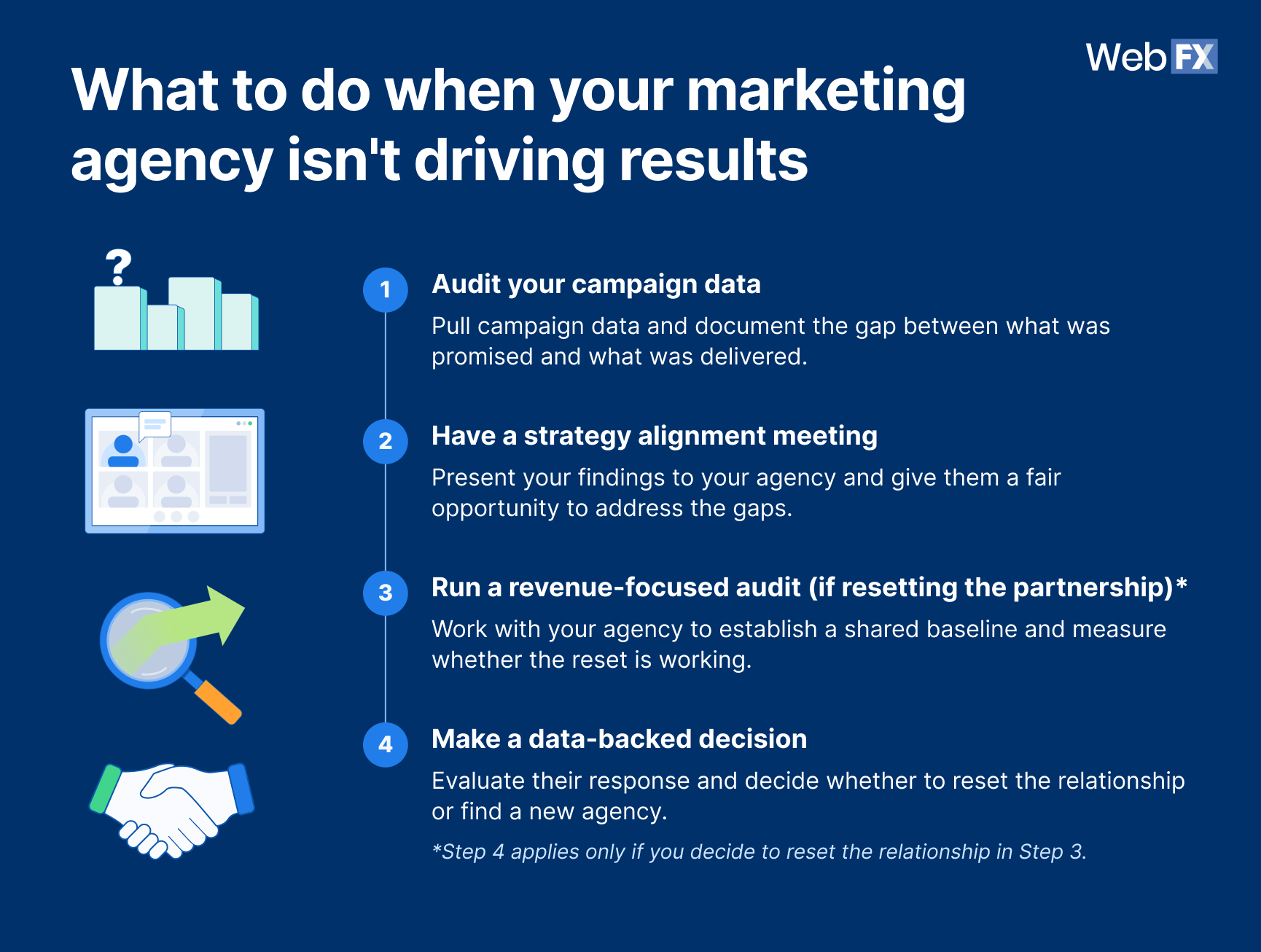
When a marketing agency falls short of expectations, the root cause could be a misaligned strategy, a reporting problem, or a poor fit, which means the agency isn’t experienced in your industry or specializes in a different type of service. Identifying which applies to your situation is the first step toward fixing it.
The steps below give you a framework for working through the situation methodically, so you make the right call for your business.
Step 1: Audit your campaign data
Before you schedule a difficult conversation or start interviewing new agencies, run an audit.
Going into any performance discussion without data puts you at a disadvantage, and good agencies will push back on vague dissatisfaction. Audit your campaign data so that when you talk with your agency, you have concrete numbers, which can result in a productive discussion.
When auditing, do the following:
Review your tracking setup
Do you have proper attribution in place?
If you’re running multiple campaigns simultaneously but your analytics aren’t connected to your customer relationship management (CRM) platform, neither you nor your agency can accurately attribute leads to specific campaigns.
That being said, a broken tracking setup is a shared problem — your agency should have flagged it, but it’s worth owning your part of it.
Assess the full funnel
Where are your leads dropping off? Map the journey from first touch to closed deal, and identify where volume shrinks.
If you’re generating a healthy number of marketing qualified leads (MQLs) but few convert to sales qualified leads (SQLs), the issue may be targeting. It could be that your agency is driving the wrong audience.
If your lead drops off after the form fill, you may need to improve your lead nurturing or your sales process.
Check the budget breakdown
Request a full breakdown of where your spend went over the last 90 days by channel, campaign, and ad group.
Are the channels receiving the most budget also generating the most pipeline? For example, if 70% of your budget goes to display advertising but your CRM data shows that paid search drives 80% of your closed deals, that’s a misallocation your agency should address.
Evaluate reporting quality
Pull the last three months of reports and ask: Are these reports tracking revenue-tied key performance indicators (KPIs) such as qualified leads, cost per qualified lead, pipeline contribution, or return on investment (ROI)? Or are the reports simply summarizing activity metrics?
“Unclear reporting is one of the biggest telltale signs that a marketing agency may not be driving results for your business,” Trevin S., VP of Sales, says. “You get a bunch of numbers, but you don’t know what they mean.”
Pro tip: Make sure your agency’s reports track the same metrics month over month. Inconsistent reporting signals that your agency lacks the technology or discipline to measure results properly.
Check your own contributions to the partnership
Before you put the full weight of the problem on your agency, ask yourself whether you’ve given them what they need. Remember: The strongest agency partnerships involve regular sales feedback loops.
Did you clearly communicate revenue goals with the agency? Did you provide feedback on lead quality by telling them which leads converted and which didn’t? Your agency should also have access to your CRM or revenue data.
If the agency isn’t aware of your revenue goals, didn’t get feedback on lead quality, or didn’t have access to your revenue data, that may partly explain the results gap.
As you work through each area, watch out for these specific warning signs:
- Focus on vanity metrics over revenue-tied KPIs: The reports focus on traffic, impressions, and engagement with no attribution to pipeline, qualified leads, or closed revenue.
- Static strategy with no evidence of testing: You see no record of A/B tests, campaign pivots, or optimization decisions in the past 60 to 90 days.
SEO activity without ranking or traffic gains: You see updates on content published and links built, but no measurable improvement in organic visibility or qualified traffic. - No AI search visibility: Your brand doesn’t appear in AI Overviews, ChatGPT responses, or Perplexity results for your target queries, which increasingly influence how buyers discover vendors.
- No clear ROI attribution: Your agency can’t connect marketing spend to closed revenue or demonstrate which campaigns are generating pipeline.
An agency that hasn’t driven results can show you a list of activities, but can’t tie them to pipeline or revenue growth.
Once your audit is complete, document the gap between what your agency promised and what it delivered — qualified leads generated, cost per lead, pipeline contribution, and ROI. That documentation gives you the foundation for Step 2.
Step 2: Have a strategy alignment meeting with your agency
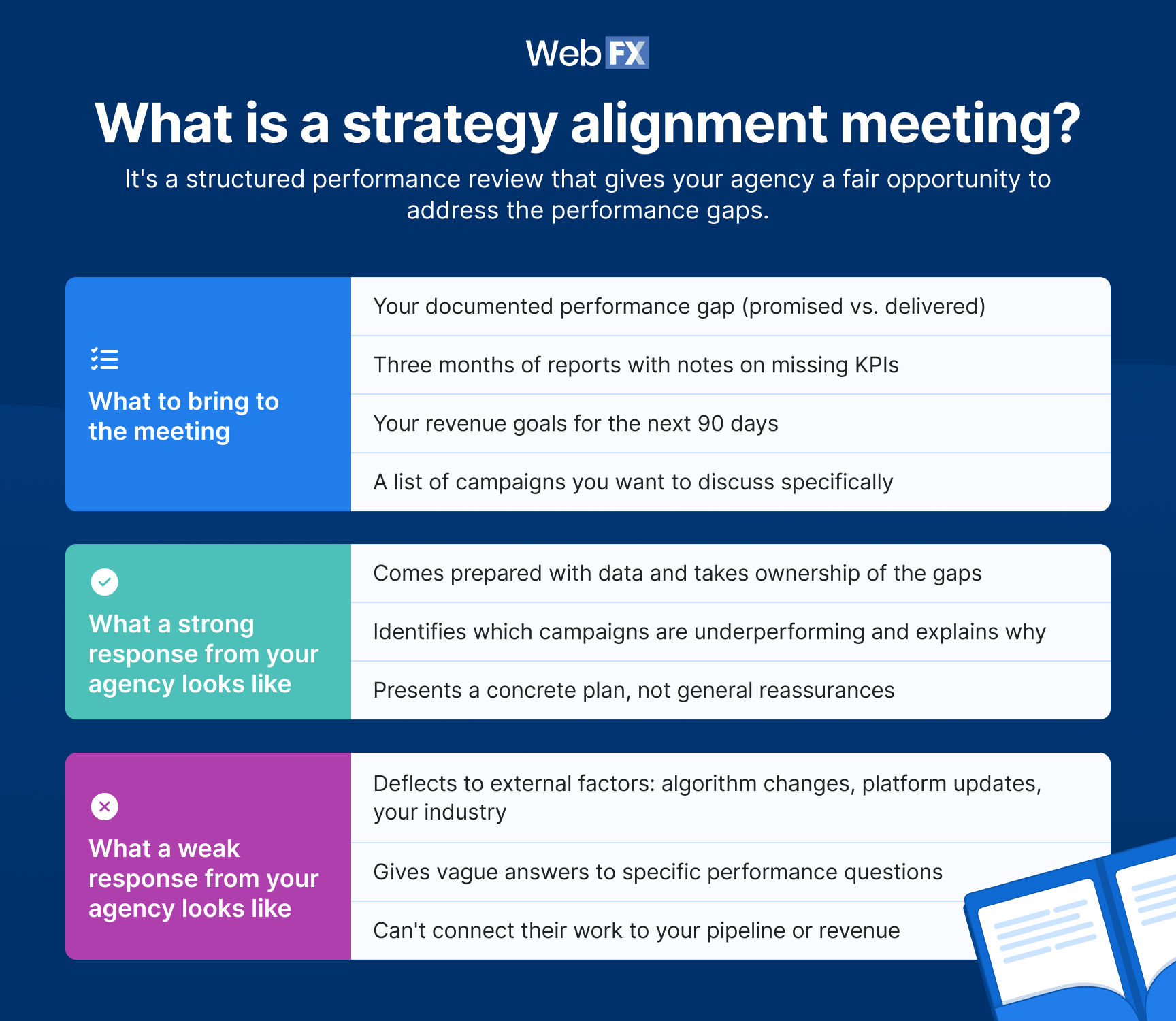
Think of your strategy alignment meeting as a structured performance review of your agency and your partnership.
Come equipped with data and a clear agenda to show your agency that you’re a serious client who expects a serious response. It also gives your agency a fair opportunity to address the gaps before you decide the future of the partnership.
Schedule this meeting after your audit, so you can come prepared with data. Request a dedicated call specifically to review performance. It shouldn’t be your regular monthly check-in.
What to bring to the meeting
- Your documented performance gap (promised vs. delivered, with specific numbers)
- Three months of reports with your annotations on which KPIs are missing
- Your revenue goals for the next 90 days
- A list of campaigns you want to discuss specifically
Checklist of questions to ask
- What does success look like to you for this account in the next 90 days?
- Which campaigns are currently generating qualified leads and which ones are not?
- How are you tracking pipeline impact, not just marketing activity?
- What has changed in our strategy in the last 60 days, and why?
- What does your optimization process look like? What did you test last month, what did you learn, and what changed because of it?
- If you could reallocate our budget today based on what’s working, what would you change?
What a strong response should look like: a data-backed approach to addressing performance gaps
A positive sign is when your agency comes prepared with data, takes ownership of the gaps, and proposes specific changes.
If they can tell you which campaigns are underperforming and why, it’s a good sign that they understand what’s lacking. Another good sign is that they come prepared with a concrete plan outline, ready to run it by you to address the gaps.
Watch out for general reassurances, which can be empty promises.
A response that shows it’s time to move on: defensiveness and vague answers
You know it’s time to move from a marketing agency when they get defensive during your alignment meeting. If they give you vague answers to specific questions or refuse to connect their work to your pipeline, you’ll likely get the same unclear reports moving forward.
If the agency blames external factors like algorithm changes, platform updates, the volatile economy, or your industry, it may also be a sign that it’s time for you to move on from the partnership. Good agencies don’t deflect accountability and push back constructively.
Step 3: Make a data-backed decision
Your audit is complete, and your strategy alignment meeting is done. Now you have enough information to make a clear-headed call without second-guessing yourself or acting out of frustration.
The decision comes down to one question: Did your agency respond to the data with ownership and a concrete plan, or with deflection and reassurances?
Signs your marketing agency is worth keeping
After your alignment meeting, assess their responses. Did they arrive at the meeting prepared? Did they acknowledge their accountability and offer solutions to ensure they’ll deliver results moving forward?
If they did, it’s a good sign. Here’s a list of what to review so you don’t miss anything:
- Accountability: Your agency took ownership and proposed specific, measurable changes.
- Revenue focus: They demonstrated understanding of your revenue goals, not just your marketing KPIs.
- Transparency: They showed a willingness to connect their work to your CRM, pipeline data, and revenue.
- Fixable root cause: The problem was a tracking gap, a budget misallocation, or a strategy drift, and not a pattern of avoidance and deflection.
Signs it’s time to find a new agency
Sometimes, the best next step is to move on from the partnership. You’ll know when you observe the following throughout the engagement or during your strategy alignment meeting:
- Lack of communication: Your agency doesn’t keep you updated, doesn’t assign a consistent point of contact, and takes days to respond to straightforward questions.
- Lack of proper reporting: Reports track inconsistent metrics, don’t connect to revenue, or your agency can’t explain what the numbers mean.
- No industry understanding: Your agency doesn’t understand your customers’ needs, can’t speak to seasonal shifts in your market, and produces generic campaigns that don’t get your customers’ attention.
- Unmet performance expectations: After several months without disruptive external factors, your agency consistently falls short of the targets they set for themselves.
- Defensiveness during the alignment meeting: When you presented performance data, your agency identified external factors such as algorithm changes as the primary explanation for missing targets, rather than taking ownership and proposing a specific plan to deliver results.
- No concrete plan after the conversation: Your agency acknowledged the performance gaps during the meeting, but couldn’t produce a specific, measurable action plan with a clear timeline. Without a clear plan, they might not deliver results.
If you decide to switch agencies, protect your business and part on good terms
Before you terminate your contract with your agency, here are a few things to do to part ways amicably and secure your accounts:
- Review your contract: Check the termination clauses in your contract to determine whether you need to stay with the agency for a fixed amount of time or can leave after giving notice within a certain period.
- Communicate professionally: Communicate your decision about terminating your working relationship with your firm professionally. Explain why you decided to leave to help them improve their services.
- Prepare for a counteroffer: Your marketing agency will likely try to win you back by pitching again. Listen to their pitch. However, ensure you make the best decision to grow your business, not out of pity or guilt.
- Secure your accounts: Before the official last day of your partnership, ensure you have access to all your accounts and know how to remove your agency’s access. If the firm created accounts for you, ask them for the credentials so you can log into them yourself.
- Transfer your ongoing campaigns: If you have ongoing campaigns, you may need to pause them as you transfer ownership to your team or your new marketing agency. If you have unfinished projects, set a deadline for a successful transfer to your in-house team or new marketing agency.
What to look for in a new agency
Take your time finding agencies that fit your needs and can deliver the results you want. Here’s what you should look for:
- They ask about your revenue goals before proposing tactics
- They commit to specific, revenue-tied KPIs — not just activity benchmarks — at the start of the engagement
- They connect to your CRM and revenue reporting tools from day one
They provide consistent, readable reports that tie marketing spend to pipeline and closed revenue - They proactively bring optimization recommendations to you, rather than waiting for you to ask
Pro tip: Make sure the agencies you shortlist next would work as a strategic extension of your marketing team. They shouldn’t just be vendors executing a task list.
Step 4: Run a revenue-focused audit to reset the partnership
If your strategy alignment meeting reveals that you and your agency aren’t fully aligned on goals or that you’ve agreed to reset the relationship and tackle the problems together, your next step is a formal marketing audit.
While the first audit in Step 1 was an in-house one, this next audit is a shared exercise between you and your agency. Running it together gives both sides an objective picture of what’s working, what isn’t, and how you’ll both work together to get your desired results.
It also establishes a clean baseline so you can measure whether the reset is actually working.
Audit your revenue-tied performance metrics
- Channel performance vs. goals: For each active channel (SEO, PPC, social media, and email), compare current performance against the targets set at the start of the engagement. For example, if your SEO campaign was meant to grow organic traffic by 20% in six months and you’re at 4%, that gap needs an explanation and a revised plan.
- Conversion funnel drop-off points: Use Google Analytics 4 or your CRM to identify where potential customers exit the funnel. If your landing page attracts many visitors who don’t fill out your form, it may be a conversion issue.
- Lead quality (MQL-to-SQL conversion rate): A high volume of leads means nothing if your sales team rejects most of them. For example, if your cost per lead looks efficient but your sales team closes fewer than 10% of them, your agency may be optimizing for quantity over quality.
- Cost per qualified lead vs. cost per lead: These are different numbers. Cost per lead (CPL) measures volume, while cost per qualified lead measures value. Make sure your agency tracks both.
- ROI by channel: Which channels are contributing to closed revenue? For example, if your CRM shows that email marketing drives 40% of your closed deals but receives 10% of your budget, that’s an optimization opportunity your agency should have identified.
What a healthy agency partnership looks like in practice
When a reset is working, the first thing you’ll notice is improved cost efficiency over time. Your cost per qualified lead should trend downward as your agency refines targeting, tightens messaging, and reallocates budget away from underperforming channels.
The second sign is a real test-and-learn cadence. A results-focused agency runs experiments to test new ad copy, revised landing pages, and adjusted audience parameters. Then, they analyze the results and bring recommendations.
The third signal is proactive communication. Your agency reaches out between scheduled check-ins and reporting when something changes: a platform update, a budget opportunity, or a campaign that’s outperforming projections. This kind of initiative is the difference between an agency executing a task list and one that’s invested in your revenue growth.
Red flags to watch out for
The clearest sign that a reset isn’t working is that your budget remains concentrated in channels with minimal pipeline contribution. If your agency agreed to reallocate spend toward higher-performing channels but the next 90-day breakdown looks identical to the last one, nothing much changed.
The second red flag is the lack of evidence of optimization decisions. Pull your campaign history and look for changes, such as paused keywords, revised ad copy, adjusted bids, or new audience segments.
A results-focused agency leaves a trail of decisions. If the campaign settings look untouched since your alignment and audit meetings, your agency hasn’t been optimizing your campaigns.
The third red flag is inconsistent reporting. If the metrics being tracked shift from one report to the next (or if new metrics appear that happen to look better while the revenue-tied metrics you care about disappear), your agency is trying to make its report look good. It’s a sign to move on.
🎥Watch: What To Do If Your Marketing Agency Isn’t Driving Results
FAQs
How long should I give my marketing agency to show results?
The right timeline depends on the channel.
PPC can generate data and early leads within a few weeks, while SEO typically takes three to six months to produce meaningful ranking and traffic gains. Content marketing and brand-building efforts often take six to 12 months before compounding results appear.
That said, “results” doesn’t have to mean revenue in month one. In the first 30 to 60 days, your agency should demonstrate progress indicators such as improved tracking setup, a clear strategy with defined KPIs, early campaign data, and a reporting cadence.
If you’re three months into an engagement with no pipeline contribution and no explanation of why, you should ask your agency for updates.
What metrics should my marketing agency be reporting?
Your agency should report on metrics tied to pipeline and revenue, not just marketing activities. The table below summarizes what to track by goal:
| Goal | Revenue-tied Metrics to Track |
| Traffic and visibility | Organic sessions, qualified traffic by channel, and AI search impressions |
| Lead generation | CPL, cost per qualified lead, MQL volume, MQL-to-SQL conversion rate |
| Advertising performance | Return on ad spend (ROAS), cost per acquisition (CPA), cost per click (CPC) |
| Revenue impact | Pipeline contribution by channel, customer acquisition cost (CAC), ROI, customer lifetime value (CLV) |
| Email marketing | Open rate, click-through rate (CTR), unsubscribe rate, revenue attributed to email |
Make sure your agency tracks the same metrics consistently month over month. If the metrics they report change monthly, it’s a sign that they want the report to make them look good and that they’re not consistently tracking the metrics most important to your business.
What warning signs should I look out for to see if my marketing agency is overpromising?
Watch for these red flags during the sales process and early in the engagement:
- Guaranteed organic rankings or overnight results: Legitimate SEO takes time. Any agency that promises page-one rankings in 30 days is selling a result they can’t control.
- No discussion of ROI or revenue: An agency that focuses entirely on traffic, followers, or impressions during the sales conversation without connecting those metrics to revenue goals isn’t thinking strategically about your business. A marketing agency should help you grow your bottom line or fill your pipeline.
- One-size-fits-all proposals: If the agency pitches a package without asking first about your industry, audience, sales cycle, or goals, the campaign they build is probably a template that may not suit your business.
- Vague timelines and deliverables: A credible agency sets specific expectations: What they’ll deliver, when, and how success will be measured.
- Reluctance to share case studies: Agencies are proud of the results they’ve delivered for clients and should share them readily.
Can I improve results by adjusting my internal processes before switching agencies?
Yes. It’s worth evaluating your internal processes before making a final call.
The strongest agency partnerships require active collaboration from the client side. If any of the following apply to your situation, adjusting your internal processes could meaningfully improve results without a full agency switch:
- You haven’t shared lead quality feedback with your agency.
- Your agency doesn’t have access to your CRM or revenue data.
- Your business goals have shifted, but your agency is still working toward outdated targets.
- Your team hasn’t been responsive to agency requests for approvals, assets, or information.
That being said, internal adjustments can only go so far. If your agency hasn’t flagged these gaps proactively, or if the issues above don’t apply and you’re still not getting results, the problem is more likely on their side.
What questions should I ask a new marketing agency?
When you’ve decided that it’s time to switch to a new marketing agency, have this list of questions for them to ensure you’re shortlisting firms that meet your needs:
1. How do you monitor results and performance?
Find out how an agency tracks the performance of their clients’ campaigns.
Ask about the metrics they track for different objectives and strategies. This way, you’ll find out if you’re both aligned with what success means to your business.
It’s also important to know if the agency uses marketing technology tools that can monitor campaign performance and identify bottlenecks in the customer journey. That way, they can optimize your campaigns and make informed decisions.
2. How do you communicate with your clients?
Setting expectations on how your marketing agency communicates with you is important. Find out:
- How often they send reports
- How their clients reach out to them for questions or clarifications
- How to set meetings
When you know these details, you’re both aligned on how and how often you can reach each other. If you want to be hands-on with your campaigns, you may prefer a marketing agency that communicates with you more often and regroups with you regularly.
3. How well do you know my industry?
When you’re looking for another marketing agency, consider their experience in your industry or related niche. Each field has different needs and customers.
If they have limited experience in your niche, ask about the different industries they’ve had experience in and how they work in new fields. That way, you can gauge their flexibility and see if they can adapt to your industry.
4. Do you have testimonials?
Check out their testimonials or case studies pages to see what their clients say about their experience with the marketing agency.
These pages should give you an idea of how they delivered results to their clients. It must also give you an idea of what their customers like best about the firm: Is the marketing agency responsive? Does the firm understand its clients’ target audience?
If you’re hiring an agency for website design, research their client’s websites to check out the final product.
5. When can we expect results?
When researching a new marketing agency, ask them about their timeline for your project or campaigns.
If it’s a website redesign, ask when the new site can be up and running. If you’re hiring an SEO agency, find out when you can expect organic site visit growth and increased leads from organic traffic.
Make sure the agency sets realistic timelines and results, and doesn’t lure you by overpromising quick results.
How do I end my partnership with my marketing agency?
Ending your working relationship with your marketing agency doesn’t have to be a painful breakup. Here’s how you can end things amicably and make a painless transition with a new firm:
- Review your contract: Check termination clauses for notice periods, cancellation fees, and fixed-term requirements before you communicate your decision.
- Communicate your decision directly: Tell your agency clearly and professionally. Explain your reasons to help them improve. Doing so also protects your professional reputation.
- Prepare for a counteroffer: Most agencies will pitch to keep you from churning. Listen with your audit data in hand, and make the decision that’s right for your business.
- Secure all your accounts: Confirm admin access to every platform before the relationship ends. If the agency created accounts on your behalf, request the credentials.
- Transfer ongoing campaigns: Set a deadline for their handover. Pause active campaigns if necessary to avoid gaps in tracking or attribution during the transition.
What should I look for in a new marketing agency to avoid similar issues?
The best way to avoid repeating a frustrating agency experience is to screen for accountability and transparency before you sign. Look for an agency that:
- Asks about your revenue goals before recommending tactics
- Commits to specific, revenue-tied KPIs at the start of the engagement and not just activity benchmarks
- Connects to your CRM and revenue reporting tools from day one
- Provides consistent, readable monthly reports that tie spend to pipeline and closed revenue
- Proactively brings optimization recommendations to you between reporting cycles
- Has documented results of pipeline and revenue number growth from clients in your industry or a related one
That being said, even the right agency won’t perform without your input. Make sure you’re prepared to share lead quality feedback, give access to your revenue data, and keep them updated on your goals as your business evolves.
How often should I review marketing results with my agency?
Review performance monthly. A monthly report keeps you aligned on progress and looming issues and provides your agency with regular feedback on lead quality.
For campaigns in active testing phases or higher-spend engagements, check in with your agency biweekly. This cadence gives your agency enough time to gather meaningful data between conversations while keeping optimization decisions moving quickly.
Beyond the scheduled reviews, your agency should proactively reach out if a campaign underperforms, a platform makes a significant change, or an opportunity to reallocate budget arises. Proactive communication is one of the clearest signals of a results-focused agency.
Your Revenue Growth Starts Here
Tell us about your business, and we’ll create a custom plan to grow your traffic, leads, and predictable revenue.
Partner with a marketing agency that has driven $10 billion in revenue for its clients
Choosing the right marketing agency — and knowing when to course-correct — is one of the most consequential decisions a marketing leader makes.
If your marketing agency isn’t driving results, use the framework above: identify the warning signs, run an honest audit, have a strategy conversation, and then decide with data.
Whether that leads to a reset with your current agency or a transition to a new partner, the goal is the same: a marketing investment that drives qualified leads, grows your pipeline, and contributes to your bottom line.
If you’re looking for a full-service digital marketing agency that can help you grow your revenue, look no further than WebFX. Our team has driven over $10 billion in revenue for clients across various industries — and every engagement starts with learning your business, your goals, and the results that actually matter to you.
Contact us online or call us at 888-601-5359 to speak with a strategist!