How to Convince Your Boss You Need SEO: Your Guide to Showing Decision-Makers the Value of SEO















Table of Contents
- Step 1: Know your boss before you pitch
- 4 questions to ask before you build your pitch
- Step 2: Pitch the revenue potential
- How to build a lead projection your boss can act on
- Step 3: Show what your competitors are doing
- Step 4: Your buyers are discovering brands through AI — and SEO can help you show up
- Step 5: Propose a pilot initiative
- How to measure the success of your pilot
- How to handle pushback and other concerns
- 1. "SEO is too expensive"
- 2. “SEO won't give us the results we want"
- 3. “We're already ranking well"
- 4. "SEO takes too long"
- How to propose SEO to your boss (with downloadable checklist)
- 1. Executive summary
- 2. SEO objectives
- 3. Strategy and tactics
- 4. Timeline and milestones
- 5. Budget and resources
- 6. KPIs and measurement
- FAQs
Here are five steps to build a business case and get leadership’s approval.

How to convince your boss you need SEO
Step 1: Know your boss before you pitch
The biggest mistake marketers make when pitching SEO — or any strategy — is leading with tactics before they understand their boss’s perspective. Take time to understand how your boss thinks, what they care about, and what might make them hesitant — then build your pitch around that.
4 questions to ask before you build your pitch
Before you build your pitch, answer these questions to know your boss better. That way, you can tailor your pitch accordingly:
1. How does your boss make decisions?
Some leaders want data like traffic projections, conversion benchmarks, and competitor rankings. Meanwhile, others make decisions based on gut instinct and trust your read of the market. A few want to understand the mechanics before they commit.
Understand which type your boss is, as it will shape your pitch: the evidence you lead with, the depth of explanation you provide, and how you frame the ask.
2. What's their history with SEO?
Find out if your boss was previously burned by a bad agency that promised quick results and got a Google penalty.
If that’s the case, you must acknowledge their experience directly, explain what has changed, and show them what you’re doing differently. Skipping this step is how a good pitch dies in the first two minutes.
3. What do they care about most right now?
Identify the most important problem weighing in on your boss. It could be budget pressure, customer acquisition costs, or competitors taking market share.
The more precisely you can connect SEO to the problem sitting on their desk today, the shorter the path to yes.
4. What objections are they likely to raise?
Anticipate their objections, and prepare your responses. That way, you won’t get caught off guard when the conversation gets uncomfortable.
Will they say SEO takes too long or it’s expensive? We’ll cover the most common objections and how to handle them later in this guide.
Step 2: Pitch the revenue potential
Leadership approves budgets for revenue outcomes. To make a compelling case for SEO, show your boss how it directly contributes to business growth: through qualified leads, lower acquisition costs, and returns that build over time.
Reframe the conversation around four things your boss already cares about:
- Qualified leads. SEO attracts buyers who are already looking for your product or service. That means the leads coming through organic search tend to be higher quality or people with genuine purchase intent.
- Revenue and profit. Because SEO can drive qualified leads to your site, this strategy increases your chances of getting more conversions. And more conversions mean potentially more revenue.
- Customer acquisition cost. Once a well-optimized page starts ranking, it can continue driving qualified traffic and leads for months, without you having to feed it with ad money to generate results.
- Compounding returns. A well-executed, ongoing SEO strategy is a self-sustaining asset. It can keep generating leads and revenue as your efforts continue. It’s a growing return on a single investment.
How to build a lead projection your boss can act on
Make it easy for your boss to say “yes” with a lead projection. Here’s how to build one using numbers your business already has:
- Know your organic traffic’s sessions and conversions. Using GA4, get the number of your site’s sessions and conversions from organic traffic for the past three months.
- Calculate your conversion rate. Use our Conversion Rate Calculator and input your data: industry, sessions, and conversions.
Conversion Rate Calculator
- See what a moderate organic traffic increase could mean for your leads. A 10% lift in organic traffic is a realistic outcome for a three-month focused SEO effort. Estimate the number of leads you’ll get if your organic traffic increases by 10% by multiplying your conversions by 1.1.
- Bring this projection into your pitch. A realistic estimate of what 10% more organic traffic could mean for your leads gives your boss something concrete to evaluate.
Step 3: Show what your competitors are doing
Nothing accelerates a budget conversation like showing your boss a competitor gaining ground in search they should be holding.
Use our free SEO Checker to run a quick audit of your own site, then look at how your competitors compare. Identify two or three businesses currently outranking you for keywords your customers are actively searching.
Show your boss the organic traffic those competitors are capturing, and what it would cost to generate that same traffic through paid ads. That comparison makes the value of organic search immediately visible.
If you’re already ranking for some of those keywords, that’s a good starting point, but it’s not a reason to stop investing. Rankings aren’t permanent.
One moment you’re ranking, but algorithms changes, competitor activities, and changes in search behavior can erode your rankings.
Ranking for relevant keywords is an ongoing effort. If you stay still, another business can topple you from the top of the SERPs.
There’s also a dimension of competition that traditional rankings don’t show: AI search results. Strong organic rankings don’t guarantee visibility in Google AI Overviews, ChatGPT, or Perplexity, platforms your customers are increasingly using to research and make decisions. That’s what the next step is about.
Step 4: Your buyers are discovering brands through AI — and SEO can help you show up
More of your potential customers are now turning to AI platforms to research products, compare options, and make purchasing decisions. In fact, traffic from generative AI surged to 796% from January 2024 to December 2025, with visitors converting at approximately 1.2 times the rate of organic search visitors.
The businesses appearing on AI platforms are there because of SEO. That’s because generative engine optimization (GEO), the practice of optimizing your site and content to appear in AI-generated results, builds on SEO.
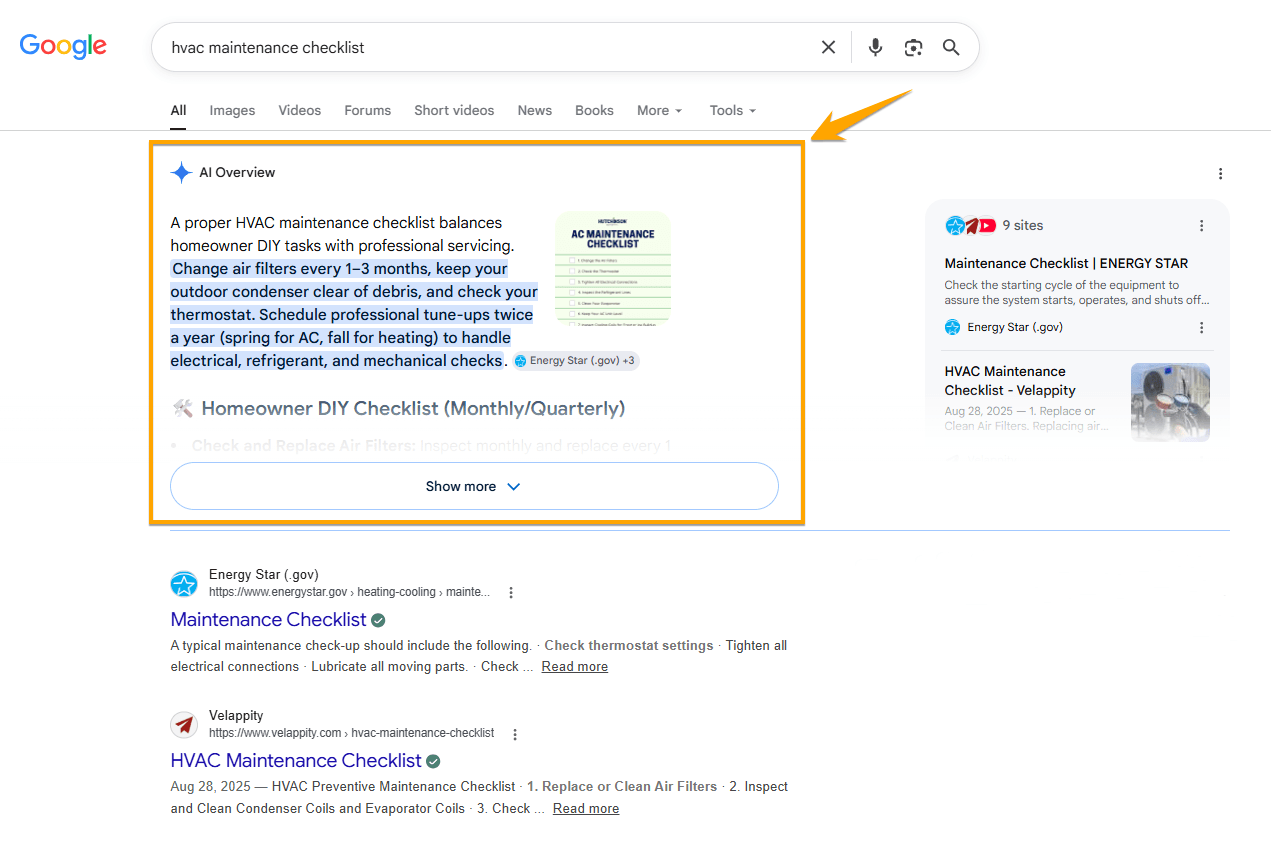
To make this concrete in your pitch, search your most important keywords and show your boss where AI Overviews appear and which competitors are being cited. Then make the point plainly: Those citations came from SEO investment, and your business can earn them, too.
Step 5: Propose a pilot initiative
For budget-conscious or risk-averse bosses, a full SEO engagement can feel like a big leap. A pilot initiative lowers the stakes and lets the results make the case for a larger investment.
Use the lead projection you built earlier in your pitch. That 10% lift becomes the target your pilot is designed to hit.
Start with a focused cluster of high-impact pages, such as your:
- Primary product or service category page
- Two to three supporting product or service pages under that category
- Your pricing page
Propose a 90-day optimization sprint across those pages: technical fixes, content improvements, internal linking, and where appropriate, a targeted link-building push. Then, measure the results of your pilot testing.
How to measure the success of your pilot
Define what success looks like before the pilot begins. Here’s how:
- Define your KPIs, and tie them to what your boss cares about. Skip vanity metrics like total impressions. Focus on outcomes leadership tracks, such as qualified leads generated from organic search, organic conversion rate, and revenue attributed to organic. If your boss cares about pipeline, track pipeline contribution, too.
- Define what success looks like before you start. Use the 10% lead increase from your earlier projection as your starting target within 90 days. Pre-agreed targets give you a clear benchmark.
- Set a clear timeline. Set a 90-day timeline for your pilot testing, but check in every 30 days to review your progress and make adjustments if needed.
- Decide in advance what happens next. If the pilot testing hits its targets, define the next step. For example, if you hit the 10% increase in organic leads from your target pages in 90 days, you’ll scale it to include other pages and measure the results in six months.
How to handle pushback and other concerns
No matter how strong your pitch is, your boss may have other concerns or objections. Here’s how to respond to the most common ones:
| Common SEO objection | Response |
| “SEO is too expensive.” | Prove SEO is an investment, not a sunk cost. |
| “SEO won’t give us the results we want” | Show a realistic timeline and a pilot testing initiative to prove it. |
| “We’re already ranking well” | Rankings aren’t permanent, and must be protected with ongoing SEO. |
| “SEO takes too long” | Point out the early wins while the long-term plan builds |
1. “SEO is too expensive”
Cost is the most visible part of any strategy pitch and the most uncomfortable one if the company is cutting down costs. During your pitch, your boss sees SEO as an expense. To convince them, you have to prove that SEO isn’t a sunk cost.
How to respond
Think of SEO like establishing a fitness routine. You start small by doing quick technical fixes and on-page optimization on high-priority pages.
You won’t wake up the next day fitter and stronger after walking a mile on day one, but your small, consistent efforts compound over time.
With SEO, you won’t get thousands of leads overnight, but your well-optimized pages will keep attracting qualified leads after your initial work is done. What you optimize in month one is still working in month 12, without requiring the same spend every month just to maintain it.
If your budget’s tight, ask for a pilot initiative. A scoped, lower-cost test gives your boss real evidence before fully committing to the strategy.
Also highlight the cost of waiting: Every month a competitor outranks you for a high-intent keyword is a month of leads going to someone else.
2. “SEO won’t give us the results we want”
Your boss could be expecting SEO to behave like paid search, which drives a quick, visible spike in leads. Then they get discouraged when that doesn’t happen.
Or your boss could have accepted that SEO takes time but doubt it’ll fill your pipeline or drive revenue.
How to respond
If the expectation is speed, get specific about the real timeline. In months three through six, you’ll typically see rankings and traffic improvement. In 12 months, the compounding effect of consistent optimization shows up in your pipeline and revenue.
If the doubt is about delivering your desired results, build a value proposition tied to pipeline and revenue. Mention that your proposed 90-day pilot initiative is an excellent way to see how SEO can potentially fill your pipeline and drive revenue growth.
Then, include the KPIs you’ll track, such as organic conversion rate and leads from organic search.
3. “We’re already ranking well”
If your website is currently ranking well for important keywords, it makes SEO look less urgent and unnecessary.
How to respond to this objection
Start by saying that rankings are never permanent.
Search algorithms change, and a top SERP position today can slide to page two tomorrow. In addition, other factors you can’t control (like your competitors’ SEO activity and evolving user search behavior) can affect your rankings.
To maintain your strong ranking, you need an ongoing SEO strategy to protect your visibility in the SERPs, AI Overviews, and other generative AI platforms. Scaling your SEO investment while your rankings are strong is easier than trying to get back lost positions because you stopped optimizing your website.
4. “SEO takes too long”
This objection is worth acknowledging because it’s true: SEO isn’t a short-term strategy. It typically takes six to 12 months for businesses to see results from SEO.
How to respond
Not every SEO result takes 12 months, though. Quick technical fixes can improve your page load times and get more of your pages indexed within weeks. With faster pages, you keep your visitors from bouncing off your site. Your indexed pages become eligible to show up in search.
Optimizing existing pages for keywords you’re already close to ranking for can move your rankings upward within one to two months. That’s because you’re improving pages that are already partway there rather than starting from scratch.
Point out these quick wins to your boss to show that SEO is producing results while the long-term SEO work is underway. You can also present a phased roadmap:
- Quick wins in the first two months
- Content and link-building momentum in months three through six
- Compounding returns from month six onward
How to propose SEO to your boss (with downloadable checklist)
You’ve made your case and answered your boss’s objections. Now it’s time to put your proposal in writing.
Your written proposal gives your boss something to review in their own time, share with other stakeholders, and come back to when they have questions.
Structure your proposal around these six sections:
Download Your Free SEO Proposal Checklist
1. Executive summary
In this one-page summary, state what you’re proposing, why it matters, and the specific outcome you’re aiming for, which could be:
- Increased qualified leads
- Higher organic revenue
- Stronger visibility against competitors
When writing the executive summary, imagine the reader won’t read past this page, so they should get the gist here. If your boss only reads one page of your entire proposal, this is the one, so make every sentence earn its place.
2. SEO objectives
Your objectives are the specific, measurable outcomes you’re committing to over the agreed upon period.
Tie each one directly to a business goal that your boss already cares about. Some example objectives are:
- “Increase organic leads by 10% in three months,” which connects to your pipeline growth
- “Rank in the top three for our five highest-value keywords in 12 months,” which is tied to competitive positioning
- “Increase revenue from organic traffic by 10% in 24 months,” which connects to your revenue growth
Pro tip: Have at most three primary SEO objectives, so you can focus on them. Keeping your list short also makes it easier to track your progress later.
3. Strategy and tactics
This section of your proposal scopes what you’ll actually do. It can be the following:
- Technical SEO
- On-page SEO
- Content creation
- Link building
- Local SEO, if applicable
Pro tip: Make this easy to understand for your boss. Explain why each strategy is important to your goal. For example: “Technical SEO can fix the backend issues that are keeping our highest-value pages from ranking.”
4. Timeline and milestones
Timelines are important to manage your boss’s expectations. They also help you track your progress, so you can make adjustments to your tactics if necessary.
Map your timeline with clear deliverables every 30 days throughout the planned period, and tie each milestone back to your objectives.
Here’s an example of how you can set your milestones:
- Day 30: Complete technical fixes and on-page optimization
- Day 60: Measure ranking improvement on optimized pages
- Day 90: Measure traffic growth from those ranking gains, and use it to project the lead and revenue impact going forward
5. Budget and resources
State your projected SEO investment and what it would deliver. If you’re reallocating budget from another channel, show the math here.
If you’re hiring an agency or freelancer to do SEO for your brand, explain the scope of work and what it costs.
Not sure how to start shortlisting SEO agencies? Our guide to choosing an SEO agency can help you evaluate partners. It comes with a free checklist, too!
🎥Watch: What a Good SEO Agency Does To Grow Your Business
6. KPIs and measurement
Based on your goals, identify two to three metrics you’ll measure monthly. It could be organic conversion rate or leads from organic traffic.
Having a regular monthly report lets you review your ROI and demonstrate results over time.
FAQs
How can I convince my boss to invest in SEO if they say we can't afford it?
Explain to your boss that SEO isn’t a sunk cost.
Think of SEO like building a fitness routine. You start small by optimizing a few high-priority pages, fixing technical issues, and improving your content.
You won’t see dramatic results overnight, but your small, consistent efforts compound over time. The gains you’ve built for months won’t immediately disappear when you miss one workout.
With SEO, your pages won’t stop attracting qualified leads a week after you’ve optimized them. You might even see more leads come in.
If your company is cutting costs, propose a scoped pilot program focused on a handful of high-priority pages. A lower-stakes test gives your boss real evidence before committing to a full investment — and gives you a concrete result to point to in 90 days.
How can I convince my boss that we need SEO help from an agency or freelancer?
Start with a conversation about your team’s capacity and the ongoing work that SEO requires.
SEO isn’t a one-and-done project. It requires ongoing technical work, content optimization, link building, and other optimization tasks. These tasks require expertise and time, which can overwhelm your in-house team that has other priorities.
An experienced, dedicated SEO partner works as an extension of your team. They bring the expertise your team needs and help execute your day-to-day SEO tasks, so your team can stay focused on other priorities.
If your boss is hesitant about the cost, propose a scoped pilot initiative. The smaller engagement lets you evaluate the partnership on real results before investing in a long-term SEO partnership.
How do I measure SEO success for my boss?
Provide a regular monthly report of your SEO’s results.
The report should focus on metrics that connect directly to business outcomes, not SEO-specific vanity metrics.
The most persuasive KPIs for leadership are organic leads generated, organic conversion rate, and revenue attributed to organic search.
Pro tip: Agree on the metrics you’ll track monthly before the investment begins so you’re on the same page on what success looks like.
Learn how we increased month over month SEO quote requests by 217% for a client.

Ready to pitch SEO to your boss?
Convincing your boss to invest in SEO is a business case problem. Leadership approves SEO budgets when they see revenue projections, competitive data, and a clear accountability plan. Now you have all three.
If you need more resources to prepare for your pitch, download our free SEO guides. You can also contact our team online or call us at 888-601-5359 to speak with a strategist about the best next steps!
Table of Contents
- Step 1: Know your boss before you pitch
- 4 questions to ask before you build your pitch
- Step 2: Pitch the revenue potential
- How to build a lead projection your boss can act on
- Step 3: Show what your competitors are doing
- Step 4: Your buyers are discovering brands through AI — and SEO can help you show up
- Step 5: Propose a pilot initiative
- How to measure the success of your pilot
- How to handle pushback and other concerns
- 1. "SEO is too expensive"
- 2. “SEO won't give us the results we want"
- 3. “We're already ranking well"
- 4. "SEO takes too long"
- How to propose SEO to your boss (with downloadable checklist)
- 1. Executive summary
- 2. SEO objectives
- 3. Strategy and tactics
- 4. Timeline and milestones
- 5. Budget and resources
- 6. KPIs and measurement
- FAQs