



AI platforms are becoming a new storefront for ecommerce brands. Shopify now allows businesses to sell directly through AI platforms like ChatGPT, with additional integrations expanding to tools like Microsoft Copilot and Gemini.
This shift toward AI-driven commerce changes how customers discover and buy products. Instead of starting on Google or a brand’s website, shoppers increasingly ask AI assistants for recommendations and purchasing guidance.
Shopify’s latest update helps products appear directly inside AI-generated answers with real-time details and purchase paths, shortening the distance between discovery and conversion.
How Shopify turned ChatGPT into a storefront
Shopify has made it possible for its merchants to show up directly inside AI platforms like ChatGPT, Gemini, Microsoft Copilot, and Google AI Mode. Right now, Shopify’s ChatGPT agentic storefront is the live integration for eligible stores, but other AI channels remain in early access and may use different checkout flows.
That means customers don’t have to search, click through links, and browse multiple websites anymore. They can discover products in a single conversation and move straight into checkout without interrupting the buying experience.
For eligible merchants, it’s just as simple. Their products can now appear in these AI-driven environments without needing separate integrations or complex setups. Even brands that don’t use Shopify as their main ecommerce platform can add their products to the Shopify catalog and become visible across these channels.
As a result, a number of eligible Shopify products are now accessible to ChatGPT’s 100 million active weekly users, and shoppers can move from question to purchase without ever leaving the chat.
What does the ChatGPT storefront look like in practice?
Let’s say someone asks, “What are the best running shoes for women under $500?”
Instead of getting a list of links, they see a short list of products that match exactly what they asked for. These recommendations include real-time details like pricing and availability, making it easier to compare options and decide quickly.
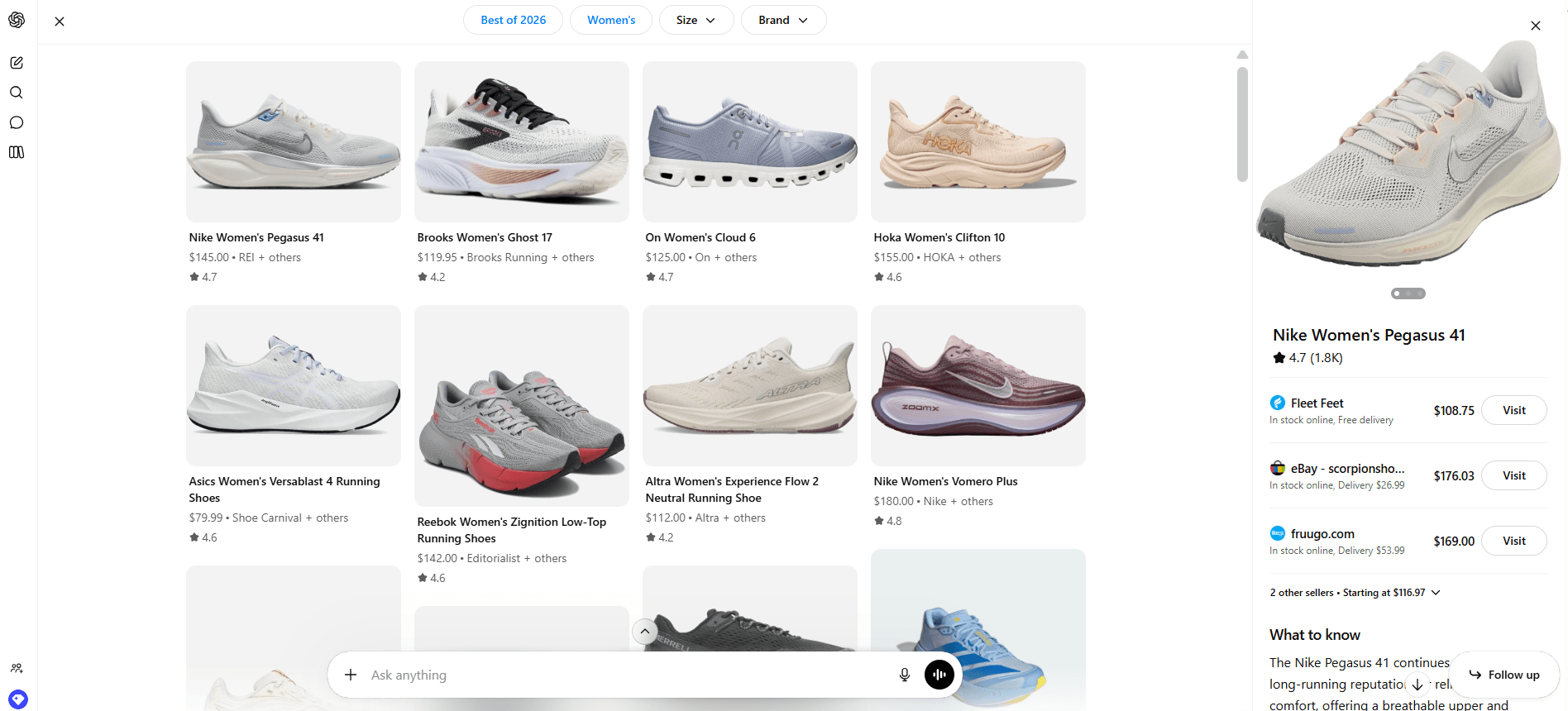
When they click on a product, they’re taken straight to the merchant’s store to complete the purchase.
Behind the scenes, Shopify organizes and standardizes product data so AI systems can understand it and match it to user requests. That’s what allows these platforms to surface the right products at the right time.
For shoppers, it feels seamless.
For businesses, it means their products can show up exactly when someone is ready to buy.
In-chat purchases powered by Agentic Commerce Protocol (ACP)
The Shopify shopping experience in ChatGPT is supported by the Agentic Commerce Protocol (ACP), which was developed by OpenAI in collaboration with partners like Shopify and Stripe.
The ACP helps connects AI platforms like ChatGPT directly to your existing commerce infrastructure, so you can reach customers in these new environments without giving up control of your business.
What that means for you as a merchant is straightforward:
- When a customer decides to buy a product they found in ChatGPT, the transaction connects directly to your existing setup. This could mean either opening your online store checkout interface in a ChatGPT in-app browser or in a new tab when customers use the ChatGPT web.
- Payments still go through the providers you already use, like Stripe, Apple Pay, or Google Pay, and orders flow into your Shopify admin just like any other sale. There’s no new payment flow to manage and no disruption to how you operate.
For you as a merchant, you keep full visibility into every transaction. You can see exactly how much revenue is coming from AI-driven discovery channels and continue managing the customer relationship through fulfillment and post-purchase.
For the customer, the experience feels simple. They can go from asking a question to completing a purchase in the same conversation, without switching platforms or starting over.
The ACP is part of a larger ChatGPT ecosystem taking shape. Innovative ChatGPT apps from partners across travel, retail, and fitness categories are already live, and OpenAI has announced plans to support the Agentic Commerce Protocol across the full app platform — enabling instant checkout as a native feature for all app categories.
As more AI-native shopping experiences roll out across platforms like Microsoft Copilot, this flow may continue to move closer to where the conversation starts.
Perplexity in-chat shopping is already live as a parallel example — using PayPal rather than ACP but delivering full end-to-end checkout inside a single chat thread with no external redirect required.
Why the Shopify ChatGPT agentic storefront matters for ecommerce businesses
Shopify’s ChatGPT storefront experience does more than introduce a new sales channel. It connects discovery and conversion into a single, continuous flow.
For consumers, the experience resembles a personal shopper who can also complete the purchase. They can ask for recommendations, refine their preferences, and get a link to checkout to the relevant website within the same interaction. This reduces friction at every step of the journey.
For merchants, this creates a direct path from intent to revenue by closing the traditional gap between discovery and conversion. Instead of relying on users to click through, browse, and return later, businesses can capture demand at the moment it forms.
Here’s how:
- Orders initiated through ChatGPT flow into the Shopify admin alongside other sales.
- Merchants continue using their existing payment providers, including Stripe, Apple Pay, and Google Pay.
- The checkout experience becomes more efficient with prefilled details for ChatGPT users and secure payment handling.
How to show up in the new storefront
If AI is now the storefront, visibility depends on how well your business can be understood, evaluated, and selected by these systems.
This requires a shift from optimizing for clicks to optimizing for generative engines.
1. Structure your products for machine understanding
Describe your products in a way that makes it easy for AI search systems to understand and recommend your products, including what you’re selling, who it’s for, and when it should be recommended.
This is true across every AI shopping platform — from ChatGPT to Amazon Rufus AI, which also surfaces products based on how clearly listings communicate what’s being sold, who it’s for, and when it’s most relevant.
The more structured your data, the easier it becomes for AI to match your offering to user intent. So your product information needs to be clear and explicit, not implied.
That looks like:
- Including clear product titles and descriptions
- Clearly defining what the product is
- Stating who it’s for and what problem it solves
- Including key details like price, features, variants, and availability
- Keeping that information consistent across your site, feeds, and listings
2. Align your content with how people ask
People aren’t searching the way they used to. They’re not typing in short phrases and clicking through results. They’re asking full questions, detailing exactly what they need, like “What’s the best moisturizer for dry skin under $50?” and expecting a direct answer.
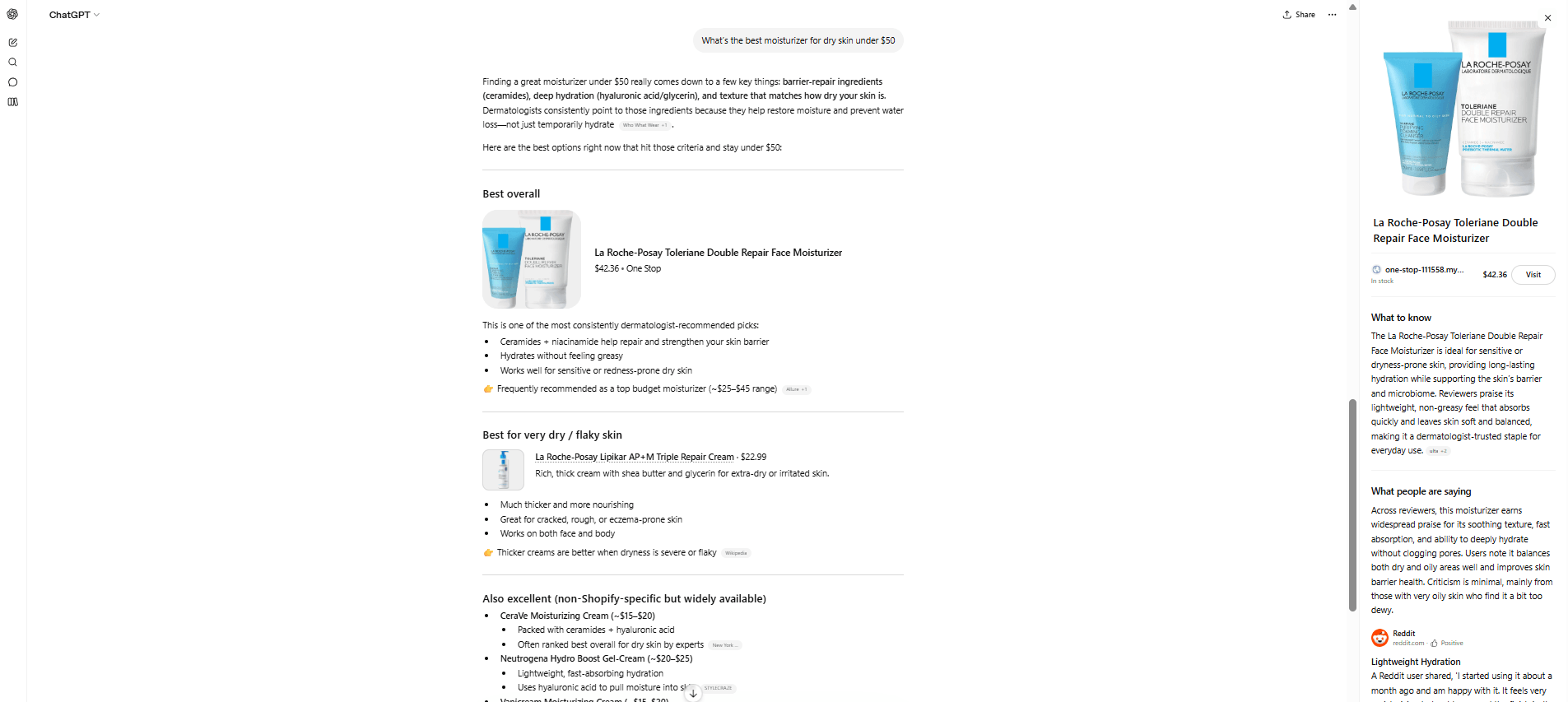
Your content should answer those exact types of questions, clearly and directly. Here’s the kind of content that gives AI systems clear, reusable answers:
- Product and service pages that clearly explain what you offer, who it’s for, and when it should be used.
- Comparison content that helps differentiate between options, like “Which is better for sensitive skin: Gel moisturizer or cream moisturizer?”
- Use-case content that maps to real scenarios, such as “moisturizer for sensitive skin that won’t cause breakouts.”
- FAQ sections that directly answer common decision-stage questions, like “Is this product good for sensitive skin?”
3. Build signals AI can trust
AI pulls from multiple sources to decide what to recommend. It looks for consistency, clarity, and credibility across everything it can access.
For AI to more easily recognize your business as a credible option and include it in recommendations, here are some signals to reinforce:
- Reviews and ratings: Maintain strong, recent, and consistent feedback across platforms
- Third-party mentions: Get featured in industry sites, directories, and trusted publications
- Consistent business information: Keep descriptions, categories, and positioning aligned across your website, listings, and profiles
- Clear product and brand positioning: Use precise language so AI can confidently understand what you offer
4. Reduce friction in fulfillment and checkout
AI-driven commerce ranks and recommends businesses that can move from recommendation to fulfillment without delays. Additionally, your ability to convert depends on how seamlessly users can complete the transaction.
Ensure that:
- Payment options are fast and reliable
- Inventory and availability are accurate in real time
- Order processing integrates smoothly with your existing systems
On Perplexity, the Perplexity merchant program handles the checkout friction problem at the catalog level — Pro users can complete purchases with one-click “Buy with Pro” checkout directly inside Perplexity, with no additional setup required from merchants beyond enrollment.
Time to get your business ready for AI-native commerce
AI platforms are quickly becoming the place where customers discover, evaluate, and decide what to buy. If your products and content aren’t structured for these environments, you risk missing high-intent opportunities before users ever reach your website.
Adapting to this shift requires a clear strategy across your product data, content, and brand signals so AI systems can understand, trust, and recommend your business.
Don’t know where to start? WebFX can help.
With over 7+ years of experience investing in AI and 16 in ecommerce, WebFX is best equipped to help you enjoy the early gains of AI visibility and discoverability.
Contact WebFX today to build an AI-ready strategy that helps you reach more qualified buyers, increase conversions, and grow your revenue.
-
 Lornah Ngugi is a seasoned digital marketing writer with 6+ years of experience translating complex marketing strategies into engaging, results-driven content. She holds a B.S. in Business Information Technology and is certified in HubSpot Academy, Google Analytics, LinkedIn Marketing, and Google Digital Academy. Lornah regularly contributes to the WebFX blog and SEO.com, where she’s authored hundreds of marketing guides that help readers turn their goals into measurable results through practical, data-informed insights. When she’s not writing, you’ll find her enjoying a quiet walk in the park, sipping black coffee, or finding creative inspiration in a good chocolate bar.
 -

WebFX is a full-service digital marketing agency delivering revenue-driving strategies across online advertising, SEO and AI search optimization, and digital marketing. Backed by 1,100+ client reviews, a 4.9-star rating on Clutch, and proprietary revenue-tracking technology, our team helps businesses grow visibility and revenue across platforms, from Google to ChatGPT to LinkedIn. Discover how our expert team and revenue-accelerating tech can drive results for you. Learn more

Try our free Marketing Calculator
Craft a tailored online marketing strategy! Utilize our free Internet marketing calculator for a custom plan based on your location, reach, timeframe, and budget.

Share this article


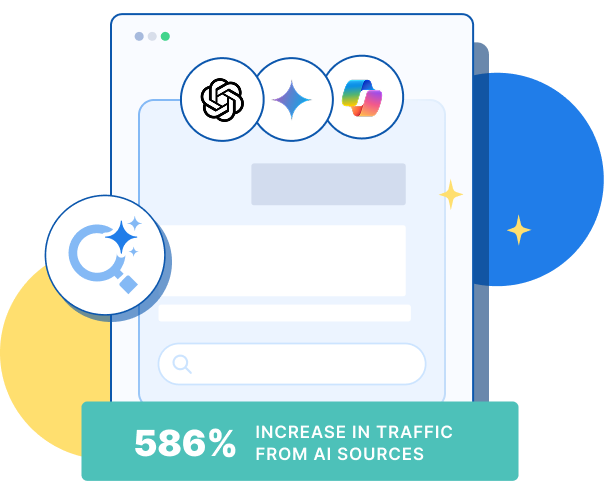
See AI Marketing in Action
Explore how WebFX helped a regional brand get discovered in AI search experiences — proving what’s possible with today’s AI-driven marketing!
Try our free Marketing Calculator
Craft a tailored online marketing strategy! Utilize our free Internet marketing calculator for a custom plan based on your location, reach, timeframe, and budget.




FAQs about AI-driven commerce
Why did Shopify integrate with ChatGPT?
Shopify integrated with ChatGPT to meet customers where discovery is increasingly happening. As more users rely on AI assistants to research and evaluate products, this integration allows merchants to appear at the exact moment buying intent is formed, rather than relying on traditional search and website visits.
How is ChatGPT a storefront for Shopify merchants?
The Shopify–ChatGPT integration allows merchants to surface their products directly within AI-generated responses. Shopify structures and shares product data so platforms like ChatGPT can understand what you sell and match it to relevant user queries.
When a user asks for a product recommendation, ChatGPT can display matching items with real-time details like pricing and availability, along with a direct path to purchase.
Who is eligible to use the ChatGPT agentic storefront for Shopify?
To use Shopify’s ChatGPT agentic storefront, your store needs to meet a few requirements:
- Sell to customers in the United States: Your business can be based outside the U.S., but your store must sell to U.S. customers.
- Have products eligible for Shopify Catalog: Your products need to qualify for inclusion in Shopify Catalog.
- Agree to Shopify’s supplemental terms: You must read and accept the Shopify Agentic Storefronts Supplemental Terms of Service.
- Have core store policies completed: In your Shopify admin, you need completed versions of your terms of service, privacy policy, and return and refund policy.
Do Shopify products automatically appear in ChatGPT?
Not automatically. Products need to be structured clearly and consistently so AI systems can understand and recommend them. This includes having detailed product descriptions, accurate pricing and availability, and strong credibility signals like reviews.
How is AI-driven commerce different from traditional ecommerce?
AI-driven commerce combines discovery and purchase into a single experience. Instead of users searching, clicking through links, and browsing multiple pages, they can ask a question, get recommendations, and move toward checkout in one continuous interaction.
Will AI replace traditional ecommerce websites?
Websites still play an important role in branding, storytelling, and fulfillment. What’s changing is where discovery happens. AI platforms are becoming the starting point, while your website supports the rest of the customer journey.