


Google does it. Bing does it. And now, ChatGPT does it. With ChatGPT Shopping, users can discover products in carousels similar to Google’s and Bing’s shopping results, giving businesses like yours a new outlet for generating revenue.
Discover the ins and outs of ChatGPT’s shopping results (including how to appear in them) now!
What is ChatGPT Shopping?
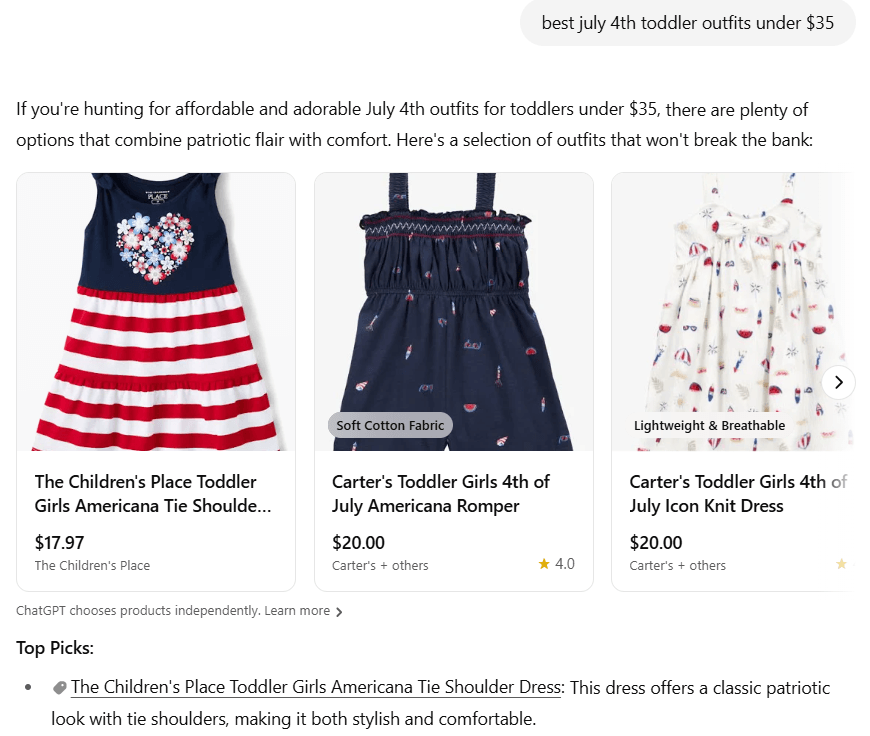
ChatGPT Shopping is OpenAI’s response to one of the most common use cases for the platform: Researching and buying products. With shopping results on ChatGPT, users see a visual carousel with relevant products and links to their product pages.
ChatGPT’s shopping carousels are not ads, though ChatGPT ads are available. Instead, listings appear based on relevance, structured data, and user intent.
How does ChatGPT Shopping work?
There are several components (or ranking factors) to ChatGPT’s shopping results, including:
| Factor | Function |
| User intent | Understand what the user wants and whether shopping results are relevant. |
| Personalization | Use memories and custom instructions to understand the user’s intent further. |
| AI model | ChatGPT uses its training data and then search data (such as from Google’s Shopping Graph) to generate its response. |
| Safety standards | Like other conversations, ChatGPT ensures the request aligns with its safety standards. |
| Structured metadata | Gets product information from structured data, like price, description, and reviews. |
| Labels | Categorizes products based on the model and third-party data, like “Budget-friendly” or “Most popular” |
| Review summaries | Summarizes likes, dislikes, average rating, and rating count using data from across websites. |
It’s important to note that ChatGPT does not rank product results based on:
- Price
- Shipping costs and policies
- Return policies
However, these factors can determine whether a product gets recommended.
If a user’s search intent requests a product under a certain amount or a provider with XYZ shipping or return policies, then ChatGPT will search for products that meet those requirements. And that’s okay! You want qualified traffic vs. vanity visits to your site.
You can see how ChatGPT generates its shopping results in the example below:
| Search: “best July 4th toddler outfits under $35” | |
| FACTOR | DETAILS |
| User intent | The search specifies:
|
| Personalization | Based on memories, ChatGPT knows the user lives on the West Coast, where temperatures are higher during the given month. |
| AI model | N/A |
| Safety standards | The user’s search meets OpenAI’s safety standards. |
| Structured metadata | ChatGPT uses structured metadata to compile:
|
| Labels | The search generates labels like:
|
| Review summaries | ChatGPT does not generate a review summary in this example. |
Once the results generate, users can click on different listings to see:
- Additional product images
- Where they can purchase the item
- Why they might like the item
- What other people are saying about the item
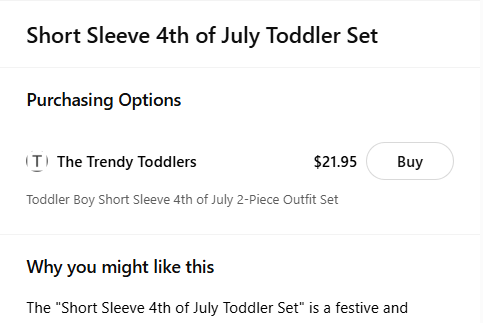
Users also have the option to select an item and ask ChatGPT for more details.
How does ChatGPT Shopping compare to Google and Bing?
So how do the product carousels compare for ChatGPT vs. Google? What about Bing? Compare all three below:
| Area | ChatGPT | Bing | |
| Price | Free | Paid | Paid |
| Product carousels | ✓ | ✓ | ✓ |
| Relevance | Customized to user intent and personalization | Requires filtering unless specified | Requires filtering unless specified |
| Structured metadata | ✓ | ✓ | ✓ |
| Labels | Customized to user intent and personalization | Limited to promotions, like “Sale” or “Free shipping” | Limited to discounts, like “25% off” |
| Review summaries | ✓ | Common phrases, like “Fits well” | None |
For a visual comparison, check out these examples for “best July 4th toddler outfits under $35”:
ChatGPT
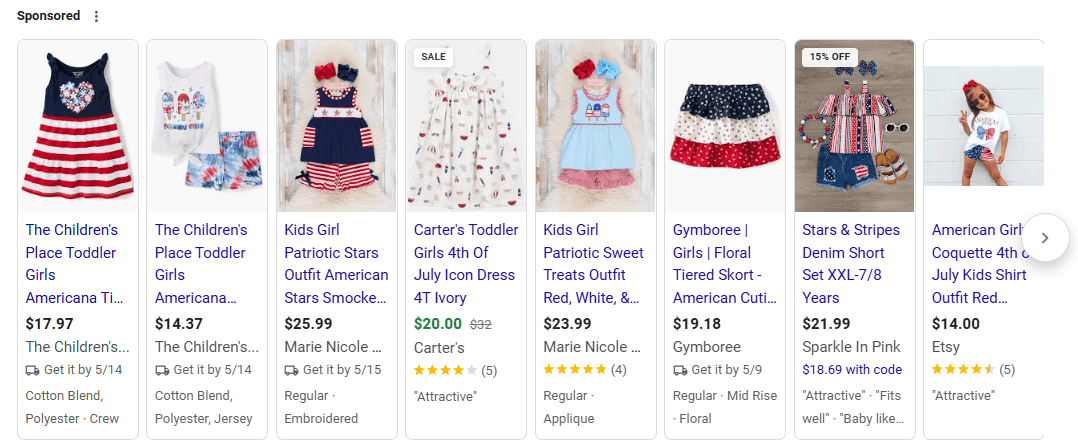
Bing
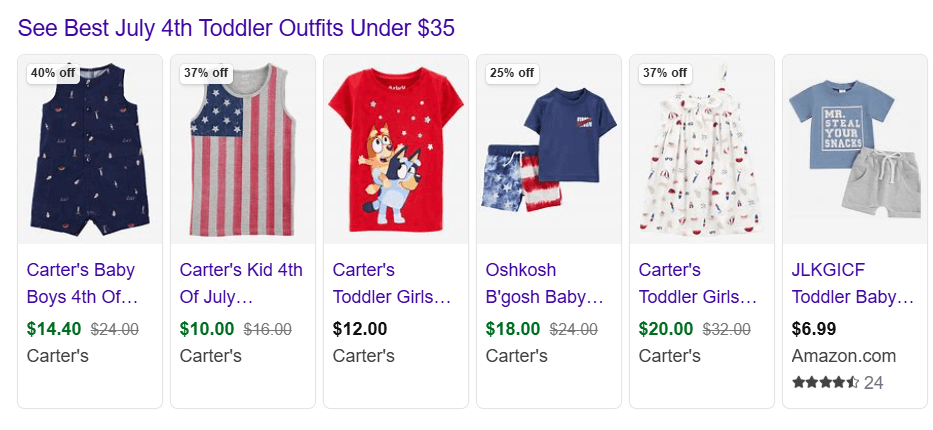
There are a few observations from these examples:
- One of the ChatGPT product listings also appears in Bing’s results
- Two of the ChatGPT product listings also appear in Google’s results
- The ChatGPT and Google product listings are all for girls, suggesting personalization
It’s no secret that ChatGPT’s third-party data providers include Bing and that its crawler, OAI-SearchBot, is indexing content from across the web, which explains some of these initial similarities.
Not to mention, ChatGPT uses fan-out queries to search the broader web (including Google’s search index) for products relevant to the user’s initial search.
Why does ChatGPT Shopping matter?

There are a few reasons ChatGPT Shopping matters to marketers and business owners:
- Cost: ChatGPT’s product carousels are not You don’t have to pay to get discovered.
- Reach: As the #1 AI chatbot, ChatGPT reaches more than 800 million people each week.
- Overlap: ChatGPT Shopping overlaps with ecommerce search engine optimization (SEO).
- Targeting: ChatGPT’s personalization makes it easier than ever to reach your market.
With ChatGPT Instant Checkout, that experience goes a step further, enabling users to purchase products directly through the Agentic Commerce Protocol (ACP).
Plus, optimizing for ChatGPT Shopping now (versus later) gives ecommerce stores like yours a first-mover advantage. These optimizations will also improve your visibility in other search and answer engines, like Google, Perplexity AI, and more.
How to appear in ChatGPT Shopping results
Now, let’s unwrap how to appear in ChatGPT Shopping results:
- Allow ChatGPT’s crawlers: First, make it possible for ChatGPT’s crawler (OAI-SearchBot) to crawl your site. This optimization usually requires no action unless your robots.txt file has disallowed OAI-SearchBot. If that’s the case, update your robots.txt file.
- Practice ecommerce SEO: Rank higher in search engine results and increase your chances of appearing in ChatGPT responses with ecommerce SEO optimizations, which include SEO copy for product pages, schema markup, site architecture, and more.
- Use Product schema markup: Structured metadata, which includes Product markup, is one of ChatGPT’s selection factors for its shopping results. Use the markup to provide ChatGPT with essential information, like pricing, product name, average rating, and more.
- Upload products to Google Merchant Center: Give ChatGPT even more data for its shopping results with Google Merchant Center, which also supports Google’s AI-powered features, like AI Overviews.
- Enhance product visuals: You have little time to capture a user’s attention in search results, whether on ChatGPT or Google. Make it count with high-quality visuals that show your product vs. hiding it in lifestyle shots.
- Improve review generation: Invest in review generation, like through automated email drip campaigns, to build the number (and quality) of reviews for your products, which can serve as a powerful trust signal for users shopping on answer engines like ChatGPT.
- Document product details in-depth: People use ChatGPT to get personalized recommendations, which means ChatGPT thrives on in-depth product descriptions and use cases, such as whether a product is best for runners with flat feet. On your product pages, document the features and use cases of your offerings.
Bonus tips for optimizing for ChatGPT
Learn more about getting discovered in ChatGPT conversations, from product listings to citations:
- Create a generative AI channel in GA4: Track traffic from ChatGPT and other AI platforms, like Gemini, Microsoft Copilot, and Perplexity AI, with a custom channel group in Google Analytics 4. You can even use ChatGPT to generate the necessary regex!
- Improve brand positioning: Get discovered by your target market by helping ChatGPT better understand your brand’s purpose and audience. Building reviews, product documentation, and online communities can give ChatGPT valuable context that changes when — and who — it recommends your company.
- Consider ChatGPT advertising: Take advantage of the opportunity and maximize your real estate on the platform by allocating some ad spend for experimenting with ChatGPT ads.
FAQs about ChatGPT Shopping
What is ChatGPT Shopping?
ChatGPT Shopping is displays product carousels in ChatGPT conversations when users search for products. Each listing in the product carousel includes product images, pricing, ratings, descriptions, review summaries, and a link to purchase the product.
Is ChatGPT Shopping free?
Yes, ChatGPT Shopping is free. Products appear based on their relevance to the user’s intent, along with ChatGPT’s understanding of the product listing through structured data, such as pricing.
How does ChatGPT decide which products to show?
ChatGPT uses user intent, personalization (memories and custom instructions), structured metadata (Product schema), review data, and real-time search results to generate shopping carousels.
Can users buy products directly in ChatGPT?
Users can purchase products in ChatGPT through the Agentic Commerce Protocol (ACP), which routes users through the selling brand’s payment ecosystem.
How do I get my products to appear in ChatGPT Shopping?
Appear in ChatGPT Shopping carousels by:
- Allowing ChatGPT’s crawler site access through your robots.txt file
- Uploading products to Google’s Merchant Center
- Enhancing product documentation with use cases and traits
- Practicing ecommerce search engine optimization
- Attracting reviews online
Get discovered across ChatGPT conversations
From conversational mentions to product carousels, there are multiple options for ecommerce stores looking to grow their visibility and revenue from ChatGPT — and hundreds of experts at WebFX who can help.
Ready to get listed? Contact us online or call 888-601-5359 to speak with a strategist today about our ChatGPT optimization services and ChatGPT advertising plans.
-
 Sarah Berry is a Lead SEO Consultant at one of the largest digital marketing agencies in the USA — WebFX. With more than 10,000 hours of experience, she offers practical insights and strategies to grow your digital revenue. Her work has been cited by Michigan State University, Business Insider, and Ars Technica. When she isn’t polishing her Time Magazine Person of the Year Award, she’s spending time with her flock of ducks. View full profile
 -

WebFX is a full-service digital marketing agency delivering revenue-driving strategies across online advertising, SEO and AI search optimization, and digital marketing. Backed by 1,100+ client reviews, a 4.9-star rating on Clutch, and proprietary revenue-tracking technology, our team helps businesses grow visibility and revenue across platforms, from Google to ChatGPT to LinkedIn. Discover how our expert team and revenue-accelerating tech can drive results for you. Learn more
Try our free Marketing Calculator
Craft a tailored online marketing strategy! Utilize our free Internet marketing calculator for a custom plan based on your location, reach, timeframe, and budget.
Plan Your Marketing Budget
Share this article


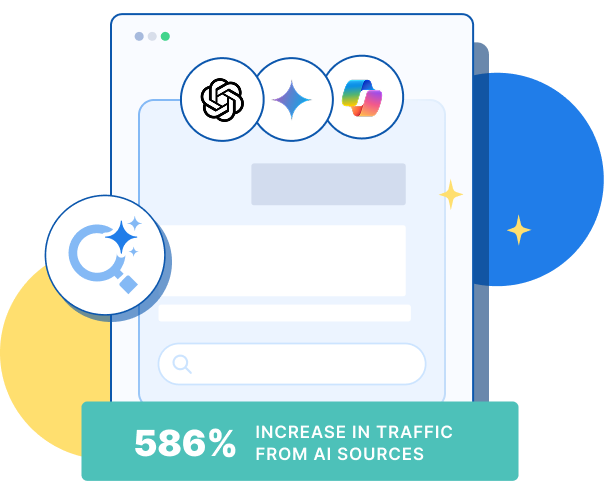
See AI Marketing in Action
Explore how WebFX helped a regional brand get discovered in AI search experiences — proving what’s possible with today’s AI-driven marketing!
Try our free Marketing Calculator
Craft a tailored online marketing strategy! Utilize our free Internet marketing calculator for a custom plan based on your location, reach, timeframe, and budget.
Plan Your Marketing Budget
What to read next