What you need to know about the DSA to AI Max migration
Google Ads has two AI Max deadlines: September 2026 for ACA and broad match, and February 2027 for DSA.
AI Max mirrors your legacy settings automatically, so unresolved gaps like missing brand exclusions carry over untouched.
DSA campaign creation reopened through January 2027, giving you a real window to test AI Max first.
Prep the closer September 2026 deadline first, then apply those lessons to your DSA side-by-side test.
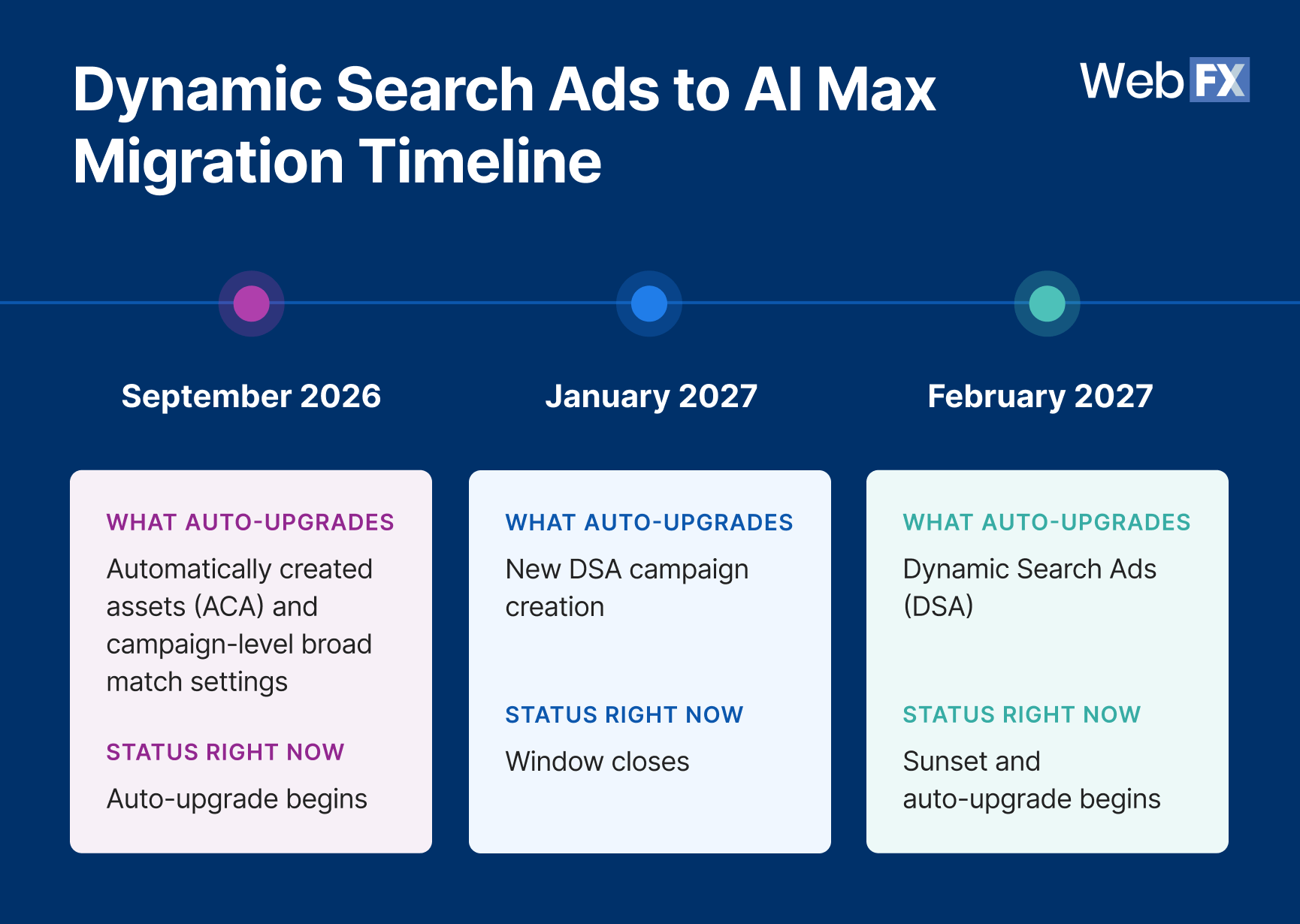
Google Ads has two separate deadlines for moving your account into AI Max. If you’re only tracking one, the other can still catch you off guard. Automatically created assets (ACA) and campaign-level broad match settings start auto-upgrading in September 2026. Dynamic Search Ads (DSA) has its own sunset, running through February 2027.
Each half of this Dynamic Search Ads to AI Max migration needs its own prep plan, since Google treats them as two distinct transitions with two distinct timelines. Here’s the good news: DSA campaign creation is open again right now, through January 2027. That gives you a real window to test AI Max on your own terms instead of getting auto-upgraded into it.
Below, you’ll find the Two-Path Migration Map: A separate, sequenced checklist for each deadline, plus what to do if your account runs into both at once.
Automatically created assets (ACA) and campaign-level broad match settings
Auto-upgrade begins
January 2027
New DSA campaign creation
Window closes
February 2027
Dynamic Search Ads (DSA)
Sunset and auto-upgrade begins
What does the DSA to AI Max migration include?
AI Max is Google’s AI-powered optimization layer, and it’s absorbing three legacy Search features on two different clocks. Automatically Created Assets (ACA) and campaign-level broad match settings move over first, in the September 2026 AI Max upgrade. Dynamic Search Ads follows with its own Google Ads DSA sunset in February 2027.
That gap wasn’t the original plan. Google initially set both dates for September 2026, then pushed the DSA sunset back to February 2027 after advertiser feedback, a reversal WebFX broke down as part of the broader Google Marketing Live AI Max announcements.The extra runway is useful, but it’s not a reason to wait until the deadline to think about it.
If you’re not sure which path applies to your account, start with the feature you’re actually running today.
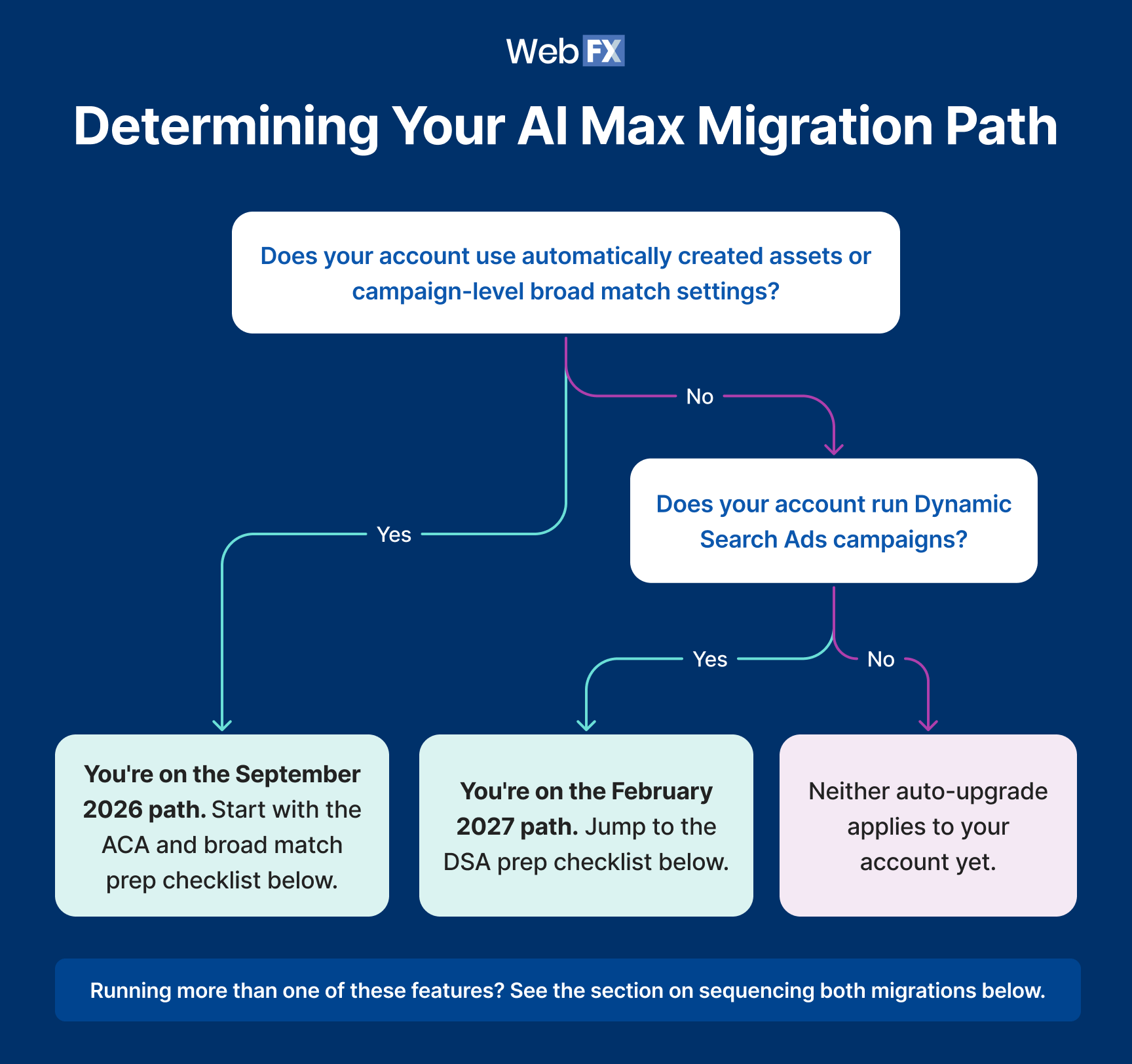
AI Max migration flowchart
Does your account use automatically created assets or campaign-level broad match settings?
Yes → You’re on the September 2026 path. Start with the ACA and broad match prep checklist below.
No → Continue to the next question.
Does your account run Dynamic Search Ads campaigns?
Yes → You’re on the February 2027 path. Jump to the DSA prep checklist below.
No → Neither auto-upgrade applies to your account yet.
Running more than one of these features? See the section on sequencing both migrations below.
Why waiting until the deadline is the wrong move for either migration
Google has been direct about what happens during the automatic transition. Its own documentation states that AI Max is “enabled with settings configured to mirror your legacy setup.” That’s Google preserving continuity, not auditing your account.
Here’s what that means in practice. If your account is missing a brand exclusion or has an untested Final URL expansion setting today, that gap carries forward into AI Max exactly as it is. Google isn’t flagging it for you, and the migration won’t fix it on your behalf.
Google also points to an average 7% conversion lift when advertisers use the full Google Ads AI Max feature suite compared to search term matching alone, based on the company’s own internal data for non-retail advertisers. Treat that as a directional data point tied to a specific advertiser segment, not a universal guarantee for every account.
Before either migration hits, know your own numbers. WebFX’s 2027 PPC Benchmarks report puts the average click-through rate for Google Search ads at roughly 6.66% across industries, with a median return on ad spend near 3.5:1. Pull your account’s current CTR and ROAS against those benchmarks now, so you have a clean baseline to compare against once AI Max takes over.
How to prepare for the ACA and broad match settings migration
This is the closer deadline, and it comes with no extra runway once the AI Max auto-upgrade hits in September 2026. Work through these five steps before then, in this order.
Brand exclusions: Set these first, so AI Max doesn’t start competing for branded traffic that would have converted through your existing campaigns anyway.
Negative keyword lists: Enforce these before AI Max broadens your reach, since a gap here gets amplified once the AI starts expanding your targeting.
Final URL expansion: Make a deliberate decision, on or off, for each campaign. Turning it on means Google can override your Final URLs, and any assets you’ve pinned to specific pages get ignored.
Text guidelines: Set guardrails on what the AI can say in your ads, especially if you operate in a regulated or brand-sensitive category where wording matters.
Incrementality test: Run a controlled test on one campaign with performance history, using Google’s one-click experiments, before letting AI Max manage your account at scale.
How to prepare for the Dynamic Search Ads migration
You have more runway here, but February 2027 isn’t indefinite. Knowing how to prepare for the AI Max upgrade on this path means running your DSA and AI Max test side by side now, not just a mental note to deal with it later.
Pull a 90-day performance baseline: Export your search term reports, landing page reports, and conversion data now, while it’s simple to do. Google hasn’t confirmed whether historical DSA reporting will be harder to access once your campaigns move to AI Max, but pulling this baseline now costs you nothing and protects you either way.
Audit your conversion tracking accuracy: AI Max leans heavily on Smart Bidding and conversion signals, so any gaps in your tracking will distort your test results before you even start comparing performance.
Check your landing page quality and coverage: AI Max pulls from your site content for targeting and creative the same way DSA does, so outdated or thin pages reduce relevance and waste spend during your test.
Run a genuine side-by-side test: DSA campaign creation is reopened now through January 2027. Migrate a small, controlled percentage of spend to AI Max and run it alongside your existing DSA campaigns rather than switching everything at once.
Trusting the results of that test means defining your test window and your 90-day baseline before you start, not judging performance from a gut check partway through.
Expert insights from
Kayla J.PPC Specialist
“Before testing AI Max, definitely audit your conversion tracking setup. If you’re not using the lowest-funnel conversion possible while still meeting Google’s minimum data requirements, you’ll have a hard time seeing positive results from AI Max. To ensure you’re receiving qualified leads, not just any form fill, whenever you open your campaigns up to more automated strategies, you want to ensure the algorithms are learning from the right types of leads.”
What to do if you’re running both AI Max migrations at once
Some accounts will need to hit both deadlines. If that’s you, prepare the September 2026 path first, since it’s closer and gives you less room to react.
Carry what you learn forward. The guardrails that mattered, the settings that caused issues, and the gaps you caught during the ACA and broad match prep all become useful input for your DSA side-by-side test ahead of February 2027.
Expert insights from
Kayla J.PPC Specialist
“If you’re pressed for time before the migration deadline, definitely start by auditing your conversion tracking & bid strategy. Together, those two things are will have the highest impact on performance. For lead-gen advertisers: check whether you’re tracking the right kinds of leads, ensure the data imports accurately and consistently, and consider switching to value-based bidding if possible.
Value-based bidding allows you to set dynamic values based on lead quality and/or lead stage, which tells Google exactly which types of leads are most valuable to your business. At the very least, use a conversion-focused bid strategy: maximize conversions or maximize conversion value (with or without target CPA/target ROAS).”
Next 30 day checklist for the DSA to AI Max migration
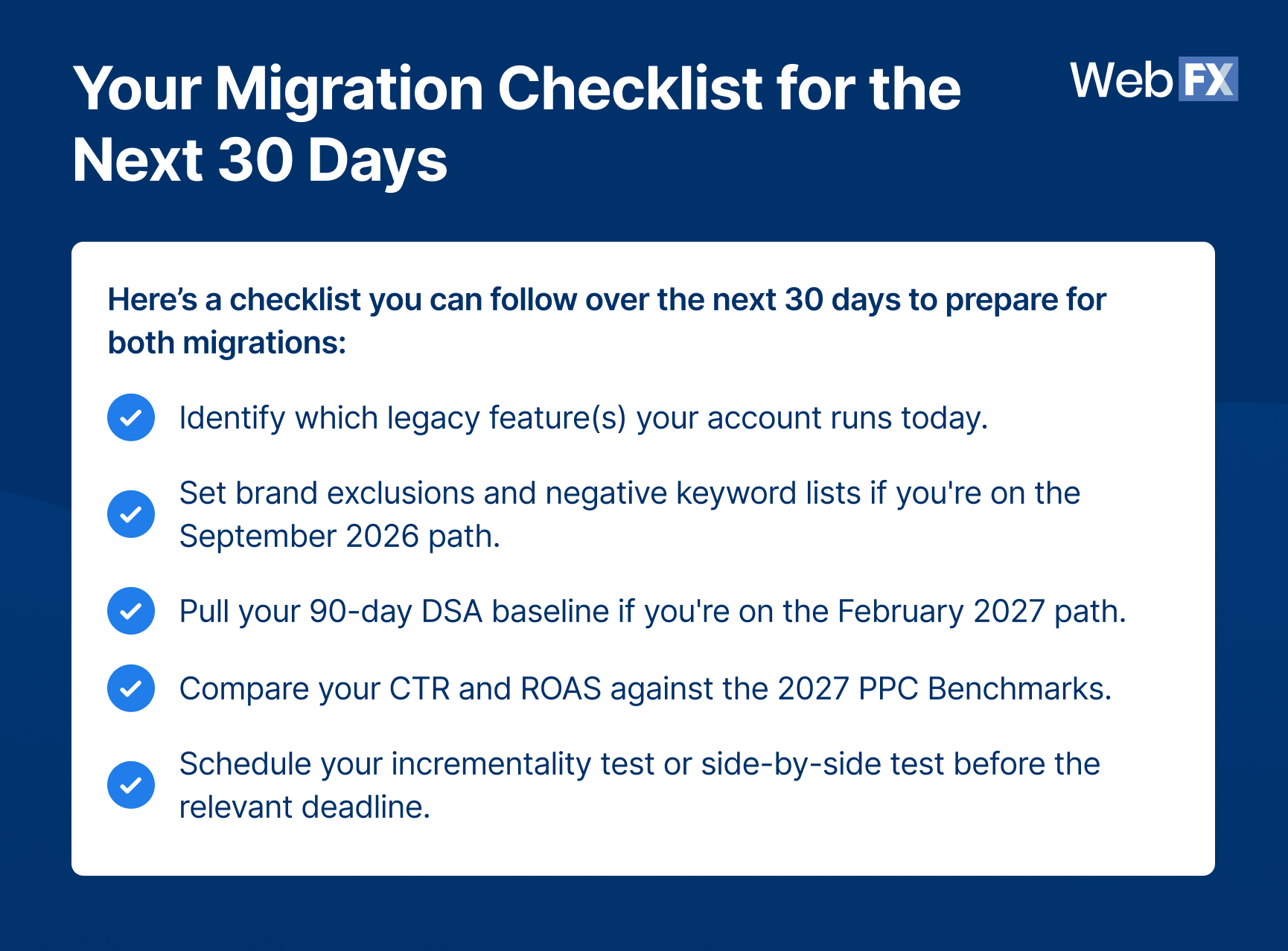
Here’s a checklist you can follow over the next 30 days to prepare for both migrations:
Identify which legacy feature(s) your account runs today.
Set brand exclusions and negative keyword lists if you’re on the September 2026 path.
Pull your 90-day DSA baseline if you’re on the February 2027 path.
Compare your CTR and ROAS against the 2027 PPC Benchmarks.
Schedule your incrementality test or side-by-side test before the relevant deadline.
$10B
Revenue Generated for Clients in the Last 5 Years
Turn Your Marketing Into a Revenue Engine
See how WebFX connects every click, lead, and sale into one measurable system built to grow your bottom line.
No. Your deadline is February 2027, not September 2026. The September upgrade only affects automatically created assets and campaign-level broad match settings, not stand-alone DSA campaigns.
That said, check your account before assuming you’re fully in the clear. Many accounts run DSA alongside broad match keywords in other campaigns, so the September deadline could still apply to part of your account even if your DSA campaigns aren’t due until February.
Yes. Google restored DSA campaign creation after previously phasing it out, and it stays open through January 2027. Use this window deliberately: Build a new DSA campaign that mirrors an existing AI Max test, with matching targeting and landing pages, so you get a true side-by-side comparison instead of relying on historical data alone.
Once January 2027 passes, you can manage existing DSA campaigns but can’t create new ones before the February auto-upgrade.
No. Google Ads Liaison Ginny Marvin has confirmed that AI Max extends broad match–style behavior to phrase and exact match keywords, adds keywordless matching, and layers in new advertiser controls that let you guide what the AI does and doesn’t do. These are capabilities no single legacy feature offered on its own.
Yes. Google confirms negative keywords are still respected after AI Max takes over, which matters more than it might sound like.
AI Max’s keywordless matching and broad match expansion can pull in a wider range of search terms than your current campaigns see. This means your negative keyword list becomes your main lever for excluding irrelevant queries. An outdated or thin list is a bigger liability under AI Max than it was under your legacy settings.
Google hasn’t said directly what happens to historical DSA reporting after migration, and we haven’t seen it confirmed elsewhere either. It’s possible that reporting could be harder to access once your DSA campaigns fold into AI Max, simply because it’s a different campaign type, but that’s not a confirmed change.
Because of that uncertainty, the safer move is to export your search term reports, landing page reports, and conversion data before the February 2027 deadline, not after. Pulling this baseline now costs you nothing if access doesn’t change, and it protects you if it does.
Learn how we decreased PPC cost per lead by 90%, and increased organic sessions year-over-year by 11% for a client.
A Dynamic Search Ads to AI Max migration doesn’t have to mean losing control of your account settings to an automatic upgrade. With a clear prep checklist for whichever deadline applies to you, you can walk into AI Max with your brand exclusions, negative keywords, and tracking already in place instead of hoping Google’s defaults match what your account actually needs.
WebFX’s PPC management services build this kind of migration prep directly into ongoing account management, backed by RevenueCloudFX’s closed-loop reporting so you can see exactly how your AI Max transition performs against your pre-migration baseline.







 Thaakirah Abrahams is a Lead Editor at WebFX, where she leverages her 5+ years of experience to craft compelling website content. With a background in Journalism and Media studies and certifications in inbound marketing, she holds a keen eye for detail and a talent for breaking down complex topics for numerous sectors, including the legal and finance industries. When she’s not writing or optimizing content, Thaakirah enjoys the simple pleasures of reading in her garden and spending quality time with her family during game nights. View full profile