


Contents
- What the new AI Overview click data actually shows
- Why this matters for how you measure marketing performance
- How to prepare your pages for high-intent AI Overview traffic: 3 moves for this week
- 1. Find out which of your pages are already being cited
- 2. Audit those pages for depth beyond the Overview summary
- 3. Track AI citation as a distinct channel
- A quick self-audit: Is your page ready for high-intent AI Overview traffic?
- FAQs about AI Overview traffic quality
- Start tracking the traffic that’s actually converting
-
What does new research reveal about AI Overview user behavior?
GWI research shows daily AI Overview users click through to sources 50% of the time, weekly/monthly users click 28% of the time, and occasional users click just 14% of the time—revealing a 3.5x engagement gap that most marketers miss when looking at average statistics. -
Why does lower click volume from AI Overviews not necessarily hurt business performance?
WebFX analysis of 2.3 billion sessions found that visitors arriving through AI-assisted channels convert approximately 1.2x higher than organic search traffic because they’ve already researched options and are actively evaluating rather than just exploring. -
How can marketers identify which pages are being cited in AI Overviews?
Check Google Search Console for pages with high impression volume but unusually low CTR (0.5% or lower in positions 1-5), as this indicates the AI Overview is likely answering queries before users click, and 75% of AI Overview links come from the top 12 organic rankings. -
What makes content valuable enough for high-intent AI Overview visitors to click through?
Pages need to provide depth beyond the Overview summary through proprietary data, named case studies, original expert perspectives, step-by-step processes, or concrete examples that AI can’t replicate—giving users a clear reason to seek more information. -
How should marketers track AI Overview traffic to demonstrate its business value?
Set up a custom GA4 segment filtering for referral sources like chatgpt.com, perplexity.ai, gemini.google.com, and bing.com/chat, then compare conversion rates against organic baselines to show leadership that AI-referred visitors convert at higher rates despite lower volume.

What you need to know about AI Overview traffic quality:
- Daily AI Overview users click cited sources 50% of the time. Occasional users click just 14% of the time.
- The visitors who click through citations are further along in their decision and more likely to convert.
- Audit your top GSC pages for low CTR. Those are your best candidates for a citation depth upgrade.
If you’ve spent the last 18 months watching your search traffic reports with growing unease as tracking dips and zero-click searches increase, new data published June 12 offers a more useful frame for what’s actually happening.
Research from GWI, a consumer survey firm whose data represents 3 billion individuals globally, reveals a striking fact about Google AI Overview users. According to the research, the gap between the most and least engaged users is wider than most marketers expect. That distinction changes the core question from “are AI Overviews killing my clicks?” to “who is still clicking, and what are they worth?”
This article breaks down the true value of AI Overview traffic quality, why it changes how you should report content ROI to your leadership team, and three specific moves you can make this week to act on it.
- What the new AI Overview click data actually shows
- Why this matters for how you measure marketing performance
- How to prepare your pages for high-intent AI Overview traffic: 3 moves for this week
- A quick self-audit: Is your page ready for high-intent AI Overview traffic?
- FAQs about AI Overview traffic quality
What the new AI Overview click data actually shows
Before drawing strategy conclusions from this data, it helps to understand exactly what GWI measured and why the gap between user types tells a more useful story than any single average.
GWI’s latest research, covered by Search Engine Journal, segments AI Overview users by engagement frequency rather than treating them as a single audience. The results reveal a striking three-tier breakdown in click-through behavior:
- Daily users click through to cited sources 50% of the time
- Weekly or monthly users click through 28% of the time
- Occasional users click through just 14% of the time
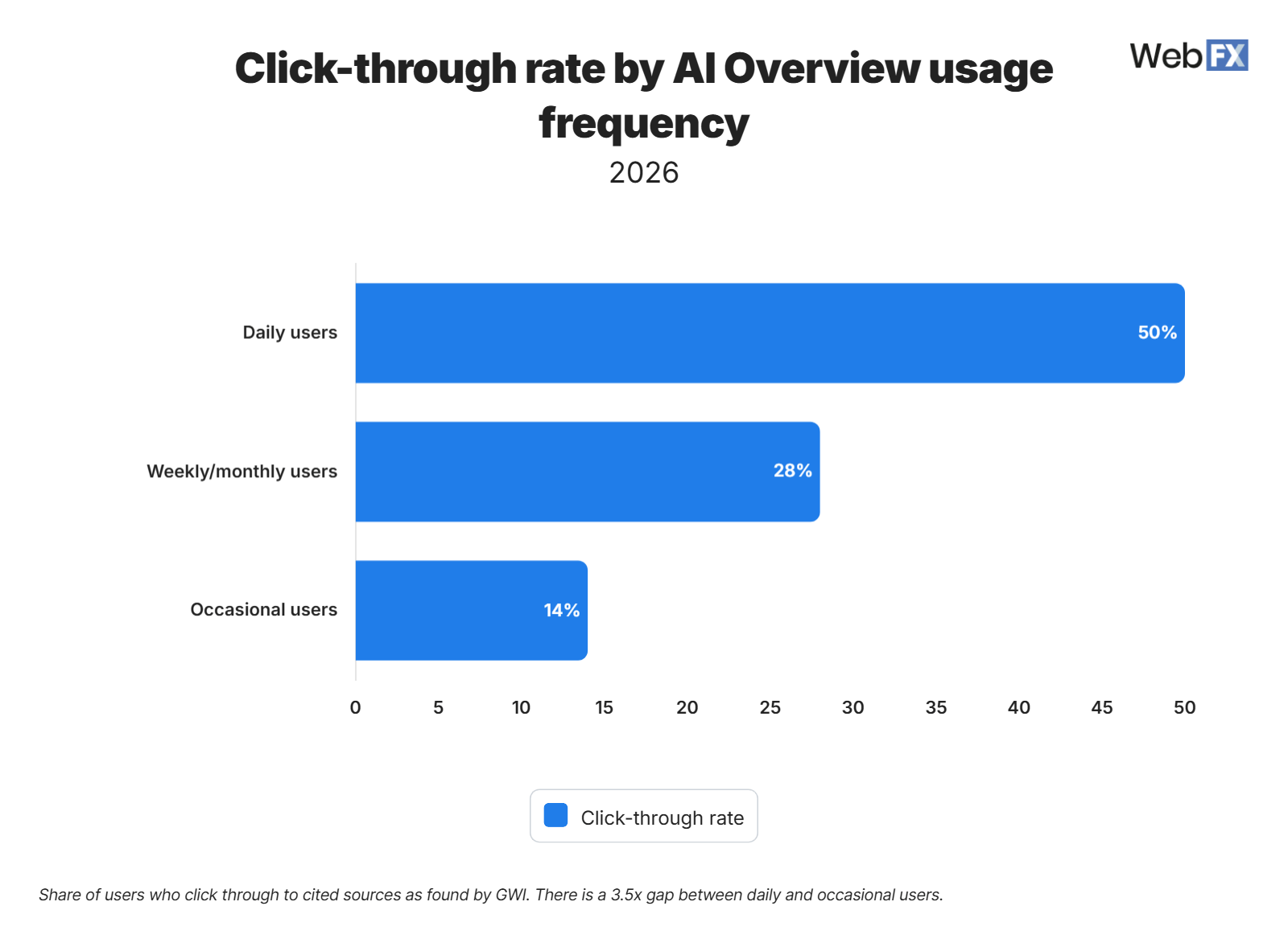
That’s a 3.5x gap between the most and least engaged users, and it’s the detail that most AI Overview coverage glosses over. When you see a stat like “AI Overviews reduce organic CTR by 18% on average,” that average combines these three audiences. A daily user who clicks half the time and an occasional user who clicks 14% of the time are having fundamentally different experiences of the same search result.
GWI Senior Data Analyst Chris Beer offers a useful explanation for why:
“Younger users are more likely to say AI Overviews have increased their trust of search results, but also more likely to say it’s decreased their trust as well. The key takeaway is that younger users seem to be more actively evaluating AI’s role in search, whether positively or negatively, while older users are more likely to remain neutral or unaffected.”
Expert insights from
Essentially, daily users use the Overview as a starting point, actively evaluating what it surfaces and comparing sources before deciding where to go next. That’s meaningfully different from a user who encounters an AI Overview once a month and accepts the summary at face value.
All this points to the fact that the AI Overview audience is not one audience. A content strategy built around avoiding AI Overviews entirely misses the daily users who are actively looking for sources to click.
For marketers, AI Overviews can be seen as a filter. The users who make it through that filter are more engaged than average.
Why this matters for how you measure marketing performance
The click gap isn’t just an interesting data point. It directly affects how you interpret traffic reports and make the case for content ROI to leadership.
WebFX analyzed 2.3 billion site sessions across multiple industries and found that generative AI-referred visitors converted approximately 1.2x higher than organic search, outperforming every other free channel in conversion activity.
That finding aligns with what the GWI data describes: visitors arriving through AI-assisted channels have often already researched their options. By the time they click through to your site, they’re evaluating, not exploring.
Here’s the measurement problem this creates. If your reporting tracks click volume as the primary indicator of search performance, a decline in AI Overview-affected queries reads as a loss. But the reality is that the visitors who do click through convert at higher rates.
Think of it this way: Consider two visitors arriving at the same product page. The first found it through a traditional organic result and clicked because it looked relevant. The second read an AI Overview summary of your topic, decided they wanted more depth than the summary provided, and then chose to click through.
The second visitor has already self-qualified. A visitor who self-qualified before clicking is already closer to a decision, and that changes what a single session is actually worth.
The takeaway is that AI Overviews do reduce organic click-through rates (CTR) by an average of 18%, according to research on zero-click search behavior. That’s a real impact, not something to dismiss.
But a CTR decline paired with higher conversion rates on the clicks that remain tells a different story than a CTR decline alone. AI search traffic quality is the variable your current dashboard is likely missing. AI Overview reporting that tracks only volume will miss this distinction entirely.
How to prepare your pages for high-intent AI Overview traffic: 3 moves for this week
Now that you understand the AI Overview click quality, you need to consider whether your content strategy is optimized for high-intent traffic. Here’s how to measure AI Overview traffic in a way that reflects its actual business value and three concrete moves you can make this week.
1. Find out which of your pages are already being cited
The first best practice is identifying your starting point. Open Google Search Console (GSC) and navigate to the Performance report. Filter by search type and look at your top pages by impressions over the last 90 days.
Sort by impressions and then look at CTR. Pages with high impression volume but unusually low CTR, for example, a CTR of 0.5% or lower on a page ranking in positions one through five, are strong candidates for AI Overview summarization. The Overview is likely answering the query before the user clicks, which explains the impression-to-click gap.
One limitation to keep in mind is that AI Mode click data is currently blended with traditional search data in GSC. Google has begun including AI Mode impressions and clicks in performance reports, but you can’t cleanly segment them yet.
So ultimately, you’re reading signals, not exact counts. Pull your top 20 pages by impressions, flag those with CTR anomalies, and treat those as your priority list for the next two steps.
2. Audit those pages for depth beyond the Overview summary
Once you have your priority list, search for each page’s primary keyword in Google and read the AI Overview that appears. Then ask one question: Does my page deliver something the Overview didn’t already say?
If the answer is no, that page needs one layer of original value that AI can’t replicate. For example, a page that defines a marketing concept sits at the shallow end. The Overview can summarize a definition without the user needing to click.
A page that defines the same concept and then provides a proprietary data point, a named case study from a real client, or a step-by-step process that goes past the conceptual level gives users a concrete reason to go deeper.
This is consistent with the specificity and completeness patterns we identified across page types that attract AI traffic — the highest-performing pages backed claims with named entities, statistics, and real examples, not generic summaries.
According to a recent study, 75% of AI Overview links come from the top 12 organic rankings, which means citation isn’t a separate game from SEO, it’s an extension of it. Make sure your most-cited pages have both the ranking signals and the depth that earns the click after the citation.
3. Track AI citation as a distinct channel
Most Google Analytics 4 (GA4) setups currently lump AI referral traffic into “Organic” or “Direct,” which makes it functionally invisible in performance reports. If you can’t see it, you can’t make the case for it, and you can’t optimize toward it.
Set up a custom segment in GA4 to isolate this traffic. Navigate to Explore, create a new segment, select Session segment, and filter by Traffic source. Add the following referral sources: Chatgpt.com, perplexity.ai, gemini.google.com, and bing.com/chat. Once the segment is live, compare its conversion rate against your organic baseline over a 60-day window.
This is worth delegating to your analyst today, not next quarter. AI citation tracking doesn’t require a new tool. It just requires a segment your current setup probably hasn’t built yet.
The business case for doing it is straightforward: If you can show leadership that AI-referred visitors convert at higher rates than organic traffic, that’s a concrete argument for protecting and growing your citation presence.
A quick self-audit: Is your page ready for high-intent AI Overview traffic?
Once you know which pages are being cited, the next question is whether those pages are actually built to convert the high-intent visitors who click through.
Daily AI Overview users are actively evaluating sources before deciding where to go. A page that looks thin, generic, or structured only for a first-time visitor is less likely to hold that audience. They arrived expecting depth, and a shallow page won’t deliver it.
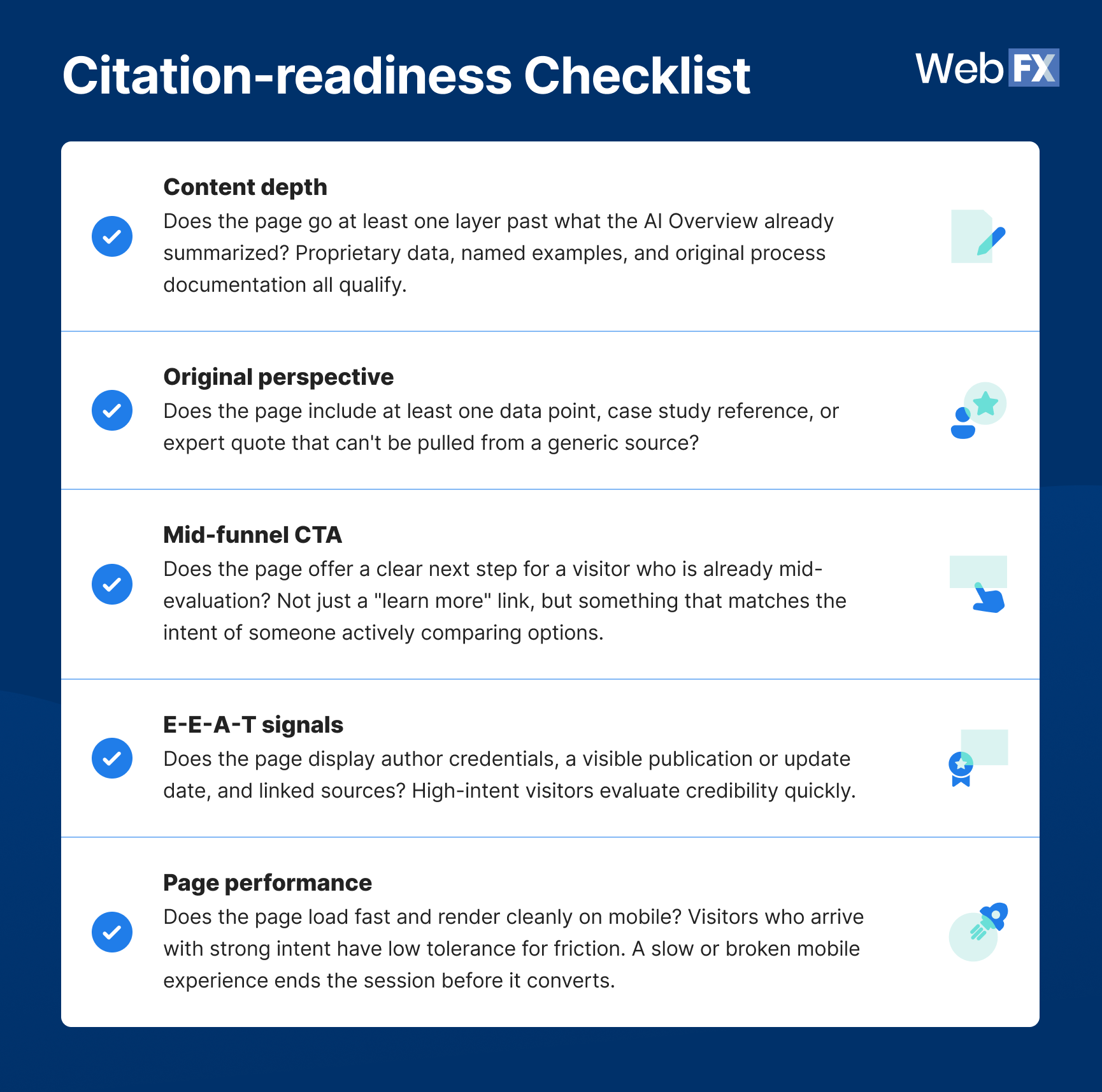
Run through this five-point checklist for each of your priority cited pages:
- Content depth: Does the page go at least one layer past what the AI Overview already summarized? Proprietary data, named examples, and original process documentation all qualify.
- Original perspective: Does the page include at least one data point, case study reference, or expert quote that can’t be pulled from a generic source?
- Mid-funnel CTA: Does the page offer a clear next step for a visitor who is already mid-evaluation? Not just a “learn more” link, but something that matches the intent of someone actively comparing options.
- E-E-A-T signals: Does the page display author credentials, a visible publication or update date, and linked sources? High-intent visitors evaluate credibility quickly.
- Page performance: Does the page load fast and render cleanly on mobile? Visitors who arrive with strong intent have low tolerance for friction. A slow or broken mobile experience ends the session before it converts.
If a page passes all five, it’s well-positioned for the audience the GWI data describes. If it fails two or more, that’s your highest-leverage content investment right now. Update that page to create deeper value and earn AI visibility.
Show up in AI Overviews
Strategic and expert-written content can help your business win AI overviews (and beyond). See how WebFX can help.
Yes, AI Overview clicks convert, often at stronger rates than average organic traffic. WebFX’s analysis of 2.3 billion sessions found that generative AI-referred visitors converted approximately 1.2x higher than organic search, outperforming every other free channel. Visitors who click through an AI Overview citation have already read a summary of your topic and decided they want more. By the time they land on your page, they’re evaluating, not browsing. Click-through rates vary significantly depending on how often users engage with AI Overviews. GWI’s research shows that daily users click cited sources 50% of the time, while occasional users click just 14% of the time. Occasional users are more likely to accept the Overview summary as a final answer, while daily users treat it as a starting point and actively look for sources to go deeper. Open Google Search Console (GSC) and pull your Performance report. Filter by your top pages over the last 90 days and sort by impressions. Pages with high impression volume but unusually low click-through rates are strong candidates for AI Overview summarization. Keep in mind that AI Mode data is currently blended with traditional search data in GSC, so you’re reading signals rather than exact counts. According to recent studies, 75% of AI Overview links come from the top 12 organic rankings, which means strong SEO fundamentals are the foundation. Beyond rankings, pages that go one layer deeper than the Overview summary itself, with original data, named case studies, or step-by-step processes, give Google’s AI a reason to cite them as a source worth clicking. You can optimize for AI Overview citations by making sure your pages rank well organically. From there, focus on adding one layer of original value that the Overview itself can’t replicate, such as a proprietary data point, a named case study, or a step-by-step process that goes past the conceptual level. Make sure your pages also carry clear E-E-A-T signals like author credentials, a visible publication date, and linked sources, since high-intent users and Google’s AI both evaluate credibility quickly. Finally, structure your content to answer a specific question directly, then go deeper, so the Overview has a clean answer to surface, and your page has a clear reason to earn the click.FAQs about AI Overview traffic quality
Do AI Overview clicks convert?
Why are AI Overview click-through rates lower for some users?
How do I know if my pages are appearing in AI Overviews?
What makes a page more likely to be cited in an AI Overview?
How can I optimize for AI Overview citations?
Start tracking the traffic that’s actually converting
Recent data on AI Overview traffic quality shows that the visitors who click through AI Overview citations are demonstrating stronger intent than the average organic visitor. Measuring volume alone undercounts the value of your AI-visible content.
If you need help tracking your AI citation rates and measuring the quality of that traffic, we recommend partnering with WebFX. WebFX offers high-quality AI SEO services to help you build a strong content strategy that earns frequent AI citations.
To top it off, we also offer our OmniSEO® technology that helps you track AI Overview performance metrics and their impact on your bottom line. Contact our team today to learn more about how we can improve your strategy.
-
 Thaakirah Abrahams is a Lead Editor at WebFX, where she leverages her 5+ years of experience to craft compelling website content. With a background in Journalism and Media studies and certifications in inbound marketing, she holds a keen eye for detail and a talent for breaking down complex topics for numerous sectors, including the legal and finance industries. When she’s not writing or optimizing content, Thaakirah enjoys the simple pleasures of reading in her garden and spending quality time with her family during game nights. View full profile
 -

WebFX is a full-service digital marketing agency delivering revenue-driving strategies across online advertising, SEO and AI search optimization, and digital marketing. Backed by 1,100+ client reviews, a 4.9-star rating on Clutch, and proprietary revenue-tracking technology, our team helps businesses grow visibility and revenue across platforms, from Google to ChatGPT to LinkedIn. Discover how our expert team and revenue-accelerating tech can drive results for you. Learn more

Try our free Marketing Calculator
Craft a tailored online marketing strategy! Utilize our free Internet marketing calculator for a custom plan based on your location, reach, timeframe, and budget.
Contents
- What the new AI Overview click data actually shows
- Why this matters for how you measure marketing performance
- How to prepare your pages for high-intent AI Overview traffic: 3 moves for this week
- 1. Find out which of your pages are already being cited
- 2. Audit those pages for depth beyond the Overview summary
- 3. Track AI citation as a distinct channel
- A quick self-audit: Is your page ready for high-intent AI Overview traffic?
- FAQs about AI Overview traffic quality
- Start tracking the traffic that’s actually converting
Share this article


See AI Marketing in Action
Explore how WebFX helped a regional brand get discovered in AI search experiences — proving what’s possible with today’s AI-driven marketing!
Try our free Marketing Calculator
Craft a tailored online marketing strategy! Utilize our free Internet marketing calculator for a custom plan based on your location, reach, timeframe, and budget.
What to read next