


How AI models see your brand
- AI models build an understanding of your brand using signals from your website, reviews, citations, social media, and third-party mentions.
- AI connects your brand to topics, services, and audience needs to determine what your business is known for.
- Consistent branding and strong topical associations can improve AI mentions and AI brand visibility.
AI models evaluate your brand using the topics, signals, and associations they find across the web. Platforms like ChatGPT, Google AI Overviews, Gemini, and Perplexity use reviews, citations, content, and entity relationships to determine how your business should be understood and when it should appear in AI-generated answers.
Below, we’ll walk through the following:
- Why does it matter how AI models view you?
- How AI models process information
- How AI models see your brand
- How to construct your brand to optimize for AI mentions
To figure out how to get your brand recommended in more AI responses, just keep reading!
Why does it matter how AI models view you?
Knowing how AI models see your brand is important because it’s a direct contributor to earning AI mentions.
As AI has shaken up the search market in the last few years, much of the conversation has centered around how to optimize specific pieces of content for AI citations. And for good reason — it’s vital for staying visible in search results. However, as important as it is to optimize for AI page visibility, it’s equally important to optimize for AI brand visibility.
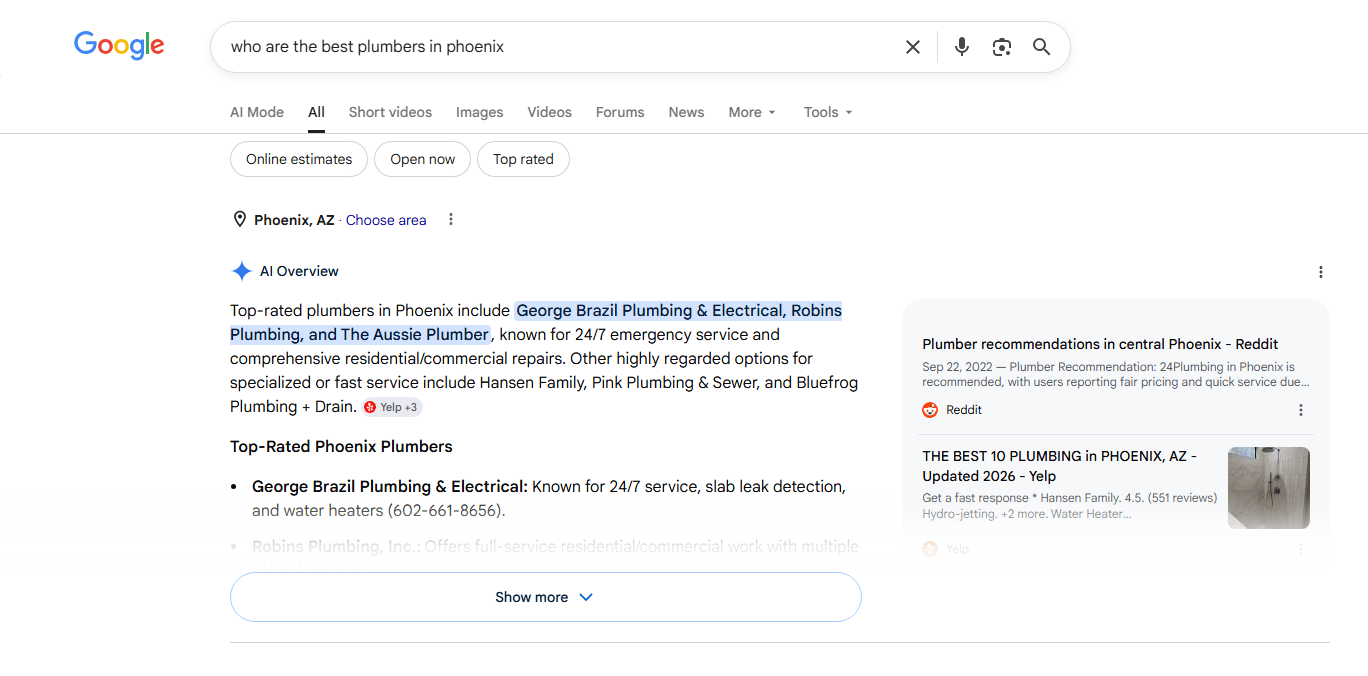
Basically, you want AI to recommend your brand to people who are looking for information about businesses in your industry. For example, if you run a plumbing company in Phoenix and someone looks up “who are the best plumbers in Phoenix,” you want the AI results to mention you.
But the trouble is that many businesses aren’t sure how to optimize for AI mentions. What can you do to make your brand more mentionable by AI tools through Generative Engine Optimization (GEO)? To answer that question, you have to first understand how AI models view you. That’s what the rest of this page will help you do.
How AI processes information
The first and most important thing to understand about AI is that no matter how convincingly it simulates human thought patterns, it doesn’t actually follow them. Its outputs might sound humanlike, but in fact, the way AI processes information is vastly different from how humans do it.
Humans are able to read a sentence or a paragraph and see beyond the letters on the screen, deriving an abstract meaning from what those letters spell out. To AI, though, all those words are just data. As you might expect, then, the way it absorbs information is by processing it as datapoints.
Years ago, I ran across an online tool that mapped out all the articles on Wikipedia in a 3D space. Each article was a small, colored point of light, and it had colored lines stretching out to connect it to all the other Wikipedia articles it linked to. In that way, you could see all the connection points between all the articles across the whole website.
That’s not entirely different from the way AI synthesizes information. Instead of each datapoint being a specific article, though, imagine each one as a different topic. AI views all of those topics in terms of how they relate to each other, noting all the connection points between different topics.
It does exactly the same thing with your brand.
How AI models see your brand
If you want to know how AI models view you, the most effective way is to identify which topics they see your brand as being adjacent to.
Essentially, AI looks at all the associations that it makes between your brand and other topics. It then looks for the central point or throughline of all those associations — the mathematical average of all of them — and that’s the space it identifies your brand as occupying. It’s not unlike finding the line of best fit on a scatterplot.
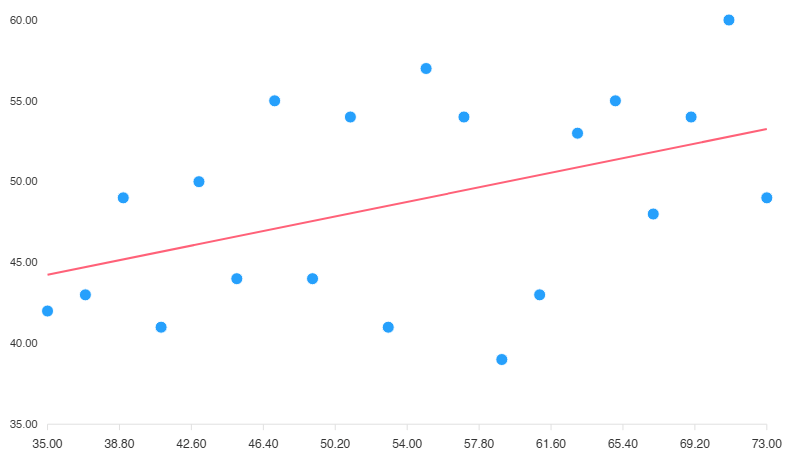
How does the AI form those associations with your brand to begin with, though? It basically goes throughout the Internet and looks for the topics your brand is mentioned in connection with. It pulls data from places like:
- Your website
- Online reviews
- Third-party directories
- News websites
By looking at those sources, as well as anywhere else your brand might be mentioned, the AI creates a picture of all the topics that are the most strongly associated with your brand.
The more consistent those associations are, the better the AI is able to pinpoint your brand’s location in its virtual “3D scatterplot” of data. That means repetitive, explicit associations create a clearer identity for your brand than vague, inconsistent ones.
How to construct your brand to optimize for AI mentions
To optimize for the way AI models process your brand, there are a few tips you should follow, including:
- Ensure your NAP info is consistent
- Engage in reputation management
- Be intentional about how you position your brand
Let’s discuss each of those in a bit more detail.
1. Ensure your NAP info is consistent
One simple but effective technique that can help you solidify your AI brand visibility is using consistent NAP (name, address, and phone number) information across the Internet. Your brand name is the key factor here.
If your company is called Jack Earl Brewery, use that name consistently — don’t use it interchangeably with “Jack Earl Brewers” or “J.E. Brewery.” Having all mentions of your brand use the same name makes it way easier for AI models to identify all of those mentions with your business.
2. Engage in reputation management
You won’t always have direct control over your brand associations. Many of them will be pulled from online reviews, which means the way people describe you in those reviews will have a big impact on the way AI views your brand. To optimize for that, it’s imperative to conduct reputation management.
That means you need to monitor for online reviews across multiple channels, whether that’s Google, Amazon, or an industry-specific directory site. Keep an eye on what people are saying, and when you encounter negative reviews, work to resolve whatever issues the reviewers are experiencing in the hopes that they’ll change the review to be more positive.
3. Be intentional about how you position your brand
The final tip — and the most crucial one — is to be highly intentional about the way you frame your own brand. Since AI views you through the lens of the connections it sees between your brand and other topics, it’s up to you to establish what those topics will be.
This is where your website content comes in. By consistently writing about specific subjects, you’ll eventually build up a strong association between your brand and each of those topics. On the other hand, creating content built around less relevant topics will make it harder for AI to identify your branding, or will potentially even cause you to be associated with topics you’d rather not be.
For that reason, you have to be thoughtful when choosing the topics you want to address in your content. Start by thinking about how you want AI to perceive your brand, and then ask yourself: Which topical associations will help you achieve that? Whatever your answer is, those are the topics to focus on in your content.
FAQs about how AI models see your brand
Here are the answers to some common questions about how AI models see your brand.
How does AI view my brand?
AI views your brand by pulling information about you from across the Internet and looking for the topics you’re most commonly associated with. It then identifies the positioning of your brand based on those topics. If you were to view each of those topics as a point in 3D space, together forming a cluster, your brand would be the point in the exact mathematical center of that cluster.
How can I optimize for AI mentions?
To optimize for AI mentions, you can use tactics like:
- Using a consistent brand name across all online sources
- Building a strong reputation management strategy
- Intentionally positioning your brand in relation to key topics
You can also opt to partner with an agency for AI brand positioning services to improve your brand mentions and ensure AI talks about your brand in a way that drives engagement, trust, and revenue.
Each of these helps AI models create a stronger picture of exactly what your brand represents, and ensures that that picture is more in line with what you want it to be.
Is optimizing for AI mentions different from optimizing for AI citations?
Yes. Optimizing for AI citations more often involves optimizing individual pages, with the goal being for AI responses to cite those pages as sources. AI citation optimization uses tactics like:
- Providing direct answers to questions
- Featuring FAQs on pages
- Using plenty of hard data
This is different from optimizing for AI mentions, which is more about the way AI represents your brand. In short, AI citations are where you’re cited as a source on other topics, while AI mentions are where you are the topic.
Increase your AI brand visibility with WebFX
Whether you’re looking to earn more citations or mentions, WebFX can help you do it. We bring 30 years of marketing experience to the table when we craft a custom AI brand visibility strategy for your business, and we know how to put you on top of the AI search game and help you drive revenue.
Interested in partnering with us for our AI optimization services? Just give us a call at 888-601-5359 or contact us online today!
-
 Matthew Gibbons is a Senior Data & Tech Writer at WebFX, where he strives to help businesses understand niche and complex marketing topics related to SEO, martech, and more. With a B.A. in Professional and Public Writing from Auburn University, he’s written over 1,000 marketing guides and video scripts since joining the company in 2020. In addition to the WebFX blog, you can find his work on SEO.com, Nutshell, TeamAI, and the WebFX YouTube channel. When he’s not pumping out fresh blog posts and articles, he’s usually fueling his Tolkien obsession or working on his latest creative project. View full profile
 -

WebFX is a full-service digital marketing agency delivering revenue-driving strategies across online advertising, SEO and AI search optimization, and digital marketing. Backed by 1,100+ client reviews, a 4.9-star rating on Clutch, and proprietary revenue-tracking technology, our team helps businesses grow visibility and revenue across platforms, from Google to ChatGPT to LinkedIn. Discover how our expert team and revenue-accelerating tech can drive results for you. Learn more

Try our free Marketing Calculator
Craft a tailored online marketing strategy! Utilize our free Internet marketing calculator for a custom plan based on your location, reach, timeframe, and budget.

Share this article


See AI Marketing in Action
Explore how WebFX helped a regional brand get discovered in AI search experiences — proving what’s possible with today’s AI-driven marketing!
Try our free Marketing Calculator
Craft a tailored online marketing strategy! Utilize our free Internet marketing calculator for a custom plan based on your location, reach, timeframe, and budget.