What did Google say about optimizing for AI search? Google’s official guide confirms that AI Overviews and AI Mode run on the same Search index and ranking systems as traditional results. It prioritizes helpful, non-commodity content, demonstrated expertise, and a technically sound site rather than special AI-specific tactics.
What actually works for AI search optimization? Focus on the fundamentals Google names: publishing non-commodity content with unique insights or firsthand experience, demonstrating real expertise through original data and credible authorship, keeping your site technically sound and crawlable, and earning genuine third-party coverage.
What tactics can you stop paying for? Google addressed five tactics that don’t provide a special advantage in its AI features: llms.txt files, content chunking, AI-specific rewrites, chasing inauthentic mentions, and overfocusing on structured data. Structured data still helps your broader SEO, but there’s no AI-specific schema to add.
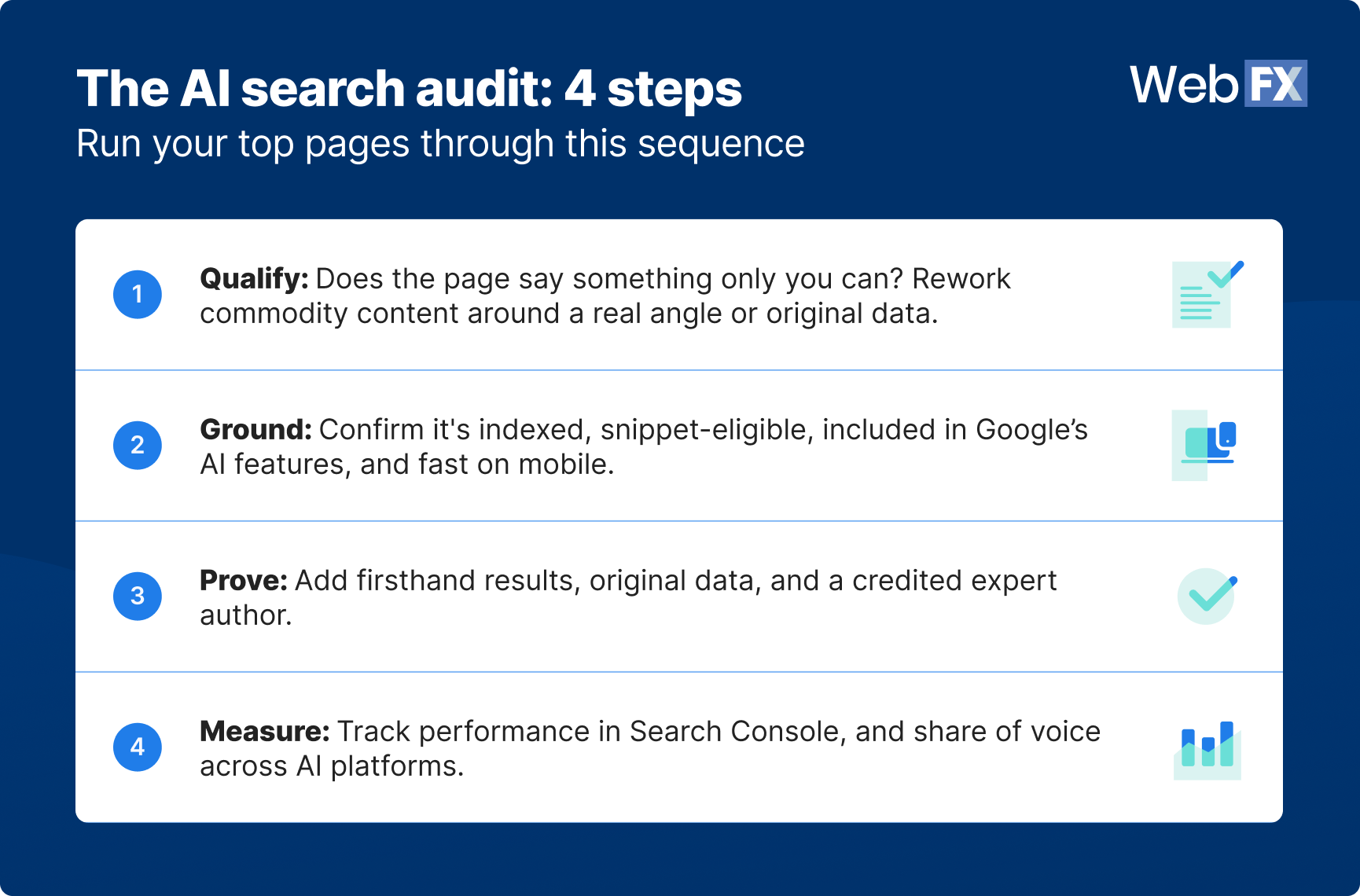
How do you audit a page for AI search? Run a four-step sequence: qualify the page for non-commodity value, ground it technically through indexing and mobile performance, prove expertise with a credited author and firsthand data, and measure results in Search Console’s Generative AI report or a tracker like OmniSEO®.
Why does non-commodity content matter most? AI systems cite sources that offer insights they can’t generate on their own, rather than absorbing generic summaries. With AI Overviews appearing in 65.9% of informational queries of seven or more words, commodity pages have to work harder to earn a citation or a click.
TL;DR: How to optimize for AI search according to Google
What changed: Google published official AI search optimization guidance in May 2026 (updated July 10, 2026), covering AI Overviews and AI Mode.
What works: Non-commodity content, demonstrated expertise, and technical fundamentals. Google’s AI features run on the same Search index and ranking systems, so strong SEO still applies.
What you can skip: llms.txt files, content chunking, AI-specific rewrites, and special “AI schema.” Google’s guide says these don’t give you a special advantage in AI Overviews or AI Mode.
What to do now: Audit your top pages for non-commodity value, confirm they’re technically eligible, add first-party expertise, and track results in Search Console.
To optimize for AI search, focus on what Google’s own guidance says its systems use: Non-commodity content, genuine expertise, and a solid technical foundation. In May 2026, Google published its first official guide to optimizing for AI Overviews and AI Mode, and it settled a year of speculation. The same guide also addresses five popular “AEO/GEO” tactics that don’t provide a special advantage in Google AI Overviews or AI Mode, including llms.txt files, content chunking, AI-specific rewrites, and special “AI schema.”
That gap matters for your budget. Marketers are being sold a menu of AI optimization add-ons, and Google just clarified which tactics do not provide a special advantage in its AI features. Below, you’ll see what Google confirmed works, what you can stop paying for, and how to put the fundamentals to work on your own pages.
This is Google’s guidance for Google’s own surfaces, AI Overviews and AI Mode, but the same fundamentals (non-commodity content, real expertise, technical health) carry over to ChatGPT, Perplexity, Gemini, and Claude. Each platform pulls and cites sources differently, so treat this as your Google-grounded foundation rather than a one-size-fits-all playbook.
Join 200K smart marketers for the hottest marketing news and insights in your inbox.
Inline Subscription Form
“*” indicates required fields
What did Google say about optimizing for AI search?
Google says the best way to optimize for AI search is to focus on the fundamentals it already rewards in regular search: Helpful, non-commodity content, demonstrated expertise, and a technically sound site.
Its official guide to optimizing for generative AI features, published in May 2026 and updated as recently as July 10, 2026, confirms that these features run on the same Search index and ranking systems as traditional results. Strong organic visibility gives your pages the technical and quality foundation needed to appear in Google AI Overviews and AI Mode, though inclusion is never guaranteed.
The guide also does something more useful. In a section Google labels “mythbusting,” it addresses popular tactics that don’t provide a special advantage in Google AI Overviews or AI Mode, including llms.txt files, content chunking, AI-specific rewrites, and special “AI schema.”
That impacts how you spend. A whole category of answer engine optimization (AEO) and generative engine optimization (GEO) services has grown up around those exact tactics, and Google just said they do not provide a special visibility advantage in its AI features. Before you pay for an llms.txt file or a round of “AI-optimized” content rewrites, it’s worth understanding how AI models see your brand and what Google’s own guidance actually asks for.
The rest of this piece splits Google AI search guidelines into two lists: What actually works, and what you can stop doing. You can apply both to your own pages this week.
What actually works for AI search optimization?
For Google, AI Overviews optimization starts with the priorities named in its guide: Non-commodity content, demonstrated expertise, technical accessibility, and strong reputation signals. None of them is an AI-specific trick. They’re the same signals that earn traditional rankings, which is why Google’s advice keeps circling back to doing the fundamentals well.
Here’s what each one looks like in practice:
Publish non-commodity content
Non-commodity content is material that offers something a reader can’t find on other pages ranking for the same query. Google’s guide draws the line clearly: A generic summary of common knowledge is commodity content, while a piece built on real experience, original data, or a genuine point of view is not. Its own example contrasts a stock “first-time homebuyer tips” article with a firsthand account of why someone waived an inspection and what it cost them.
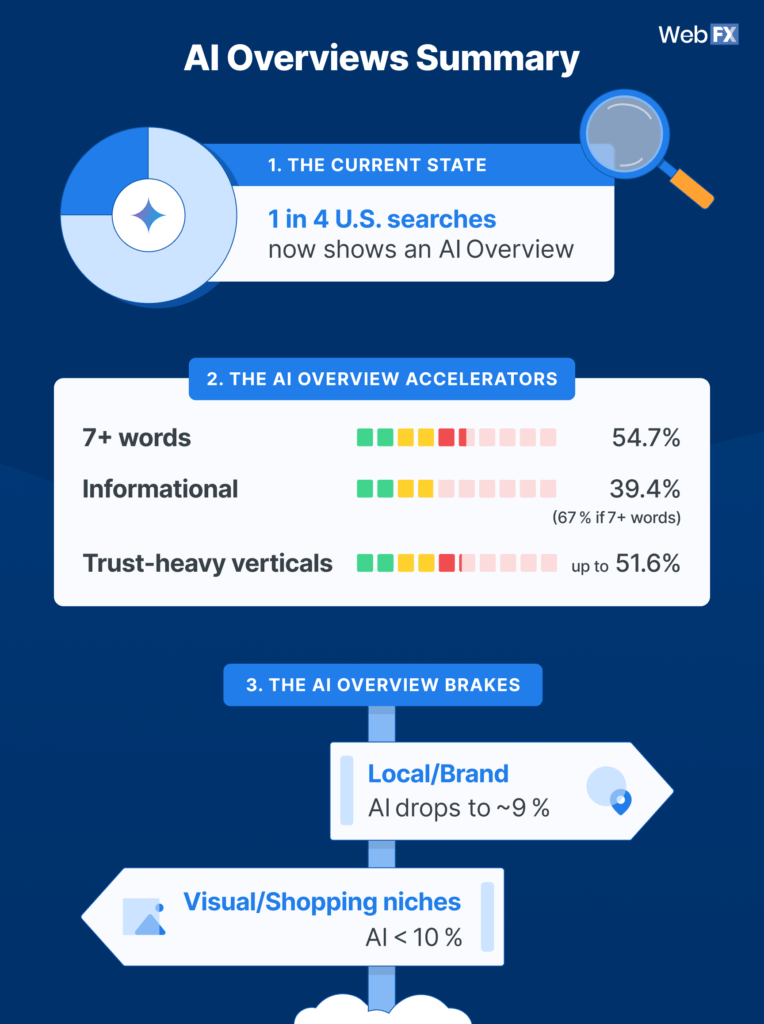
That distinction decides whether AI cites you or absorbs you, and the stakes are highest exactly where informational content used to win. Our study of 2.37 million keywords found AI Overviews appear in 25.8% of U.S. searches overall, but that jumps to 65.9% for informational queries of seven words or more. That puts commodity pages in a results format, where they need a stronger reason to earn a citation or a click.
Non-commodity content is how you earn the citation instead of feeding the summary. Give the model an insight it can’t generate on its own, and you become a source it names rather than one it absorbs. For a deeper walk-through, see our guide on how to improve your AI visibility.
Show real expertise and experience
AI systems favor content that demonstrates genuine expertise, so the fastest way to stand out is to add what only you know. That means firsthand results, original data, named examples, and author credentials that show real-world experience behind the advice.
Expert insights from
Abby F.SEO Consultant at WebFX
“One of the biggest things that actually helps improve AI visibility is ensuring your page matches the user’s search intent. Take a look at the AI Overviews and AI search result answers for your topic or target keyword to get an idea of what users want to know, and then make sure your page covers those same questions and topics, especially in the first paragraph of your page. While things like inserting schema markup can definitely help, the actual content on your page plays the biggest part in your visibility.”
Build a technically sound site
AI features can only cite pages they can crawl, render, and index, so technical health is the price of entry. Google’s guide points to the same fundamentals that govern traditional search: Crawlability, fast page performance, mobile usability, logical site structure, and clean internal linking.
None of this is new work. If your site already meets Google’s core technical standards for Search, it meets them for AI features too, because they draw from the same index.
Strengthen your reputation across the web
Google’s guide notes that its AI features surface authentic third-party coverage, including blogs, videos, and forum discussions, and that manufactured mentions don’t help. Beyond Google’s stated guidance, the practical takeaway is to keep your business information accurate and earn genuine coverage from credible sources. That gives buyers and AI systems clearer, verifiable context about your brand.
To picture where those mentions matter most, think in terms of the surfaces buyers actually check: Review sites, industry roundups, directories, and publisher coverage in your space.
What can you stop paying for?
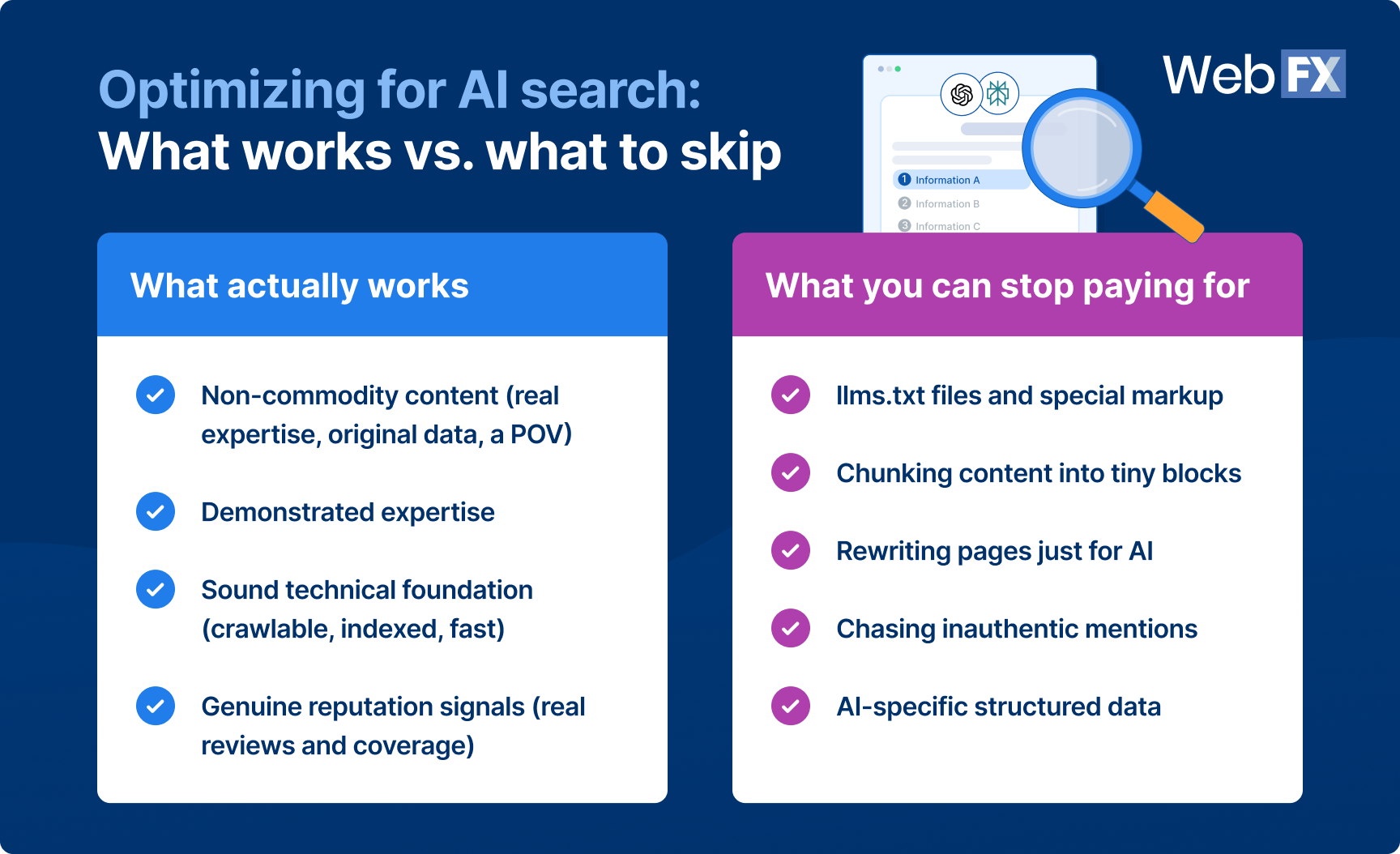
Google AI search guidelines address five tactics that don’t move the needle in Google AI Overviews or AI Mode, so the “AEO” and “GEO” services built primarily around them are unlikely to improve your visibility on those surfaces. Before you approve another line item, check it against what Google actually said. Here’s what the guide puts in its mythbusting section:
Optimizing for AI search: What works vs. what to skip
(Based on Google’s official generative AI search guidance)
What actually works
What you can stop paying for
Non-commodity content (real expertise, original data, a POV)
Demonstrated expertise
Sound technical foundation (crawlable, indexed, fast)
Genuine reputation signals (real reviews and coverage)
llms.txt files and special markup
Chunking content into tiny blocks
Rewriting pages just for AI
Chasing inauthentic mentions
AI-specific structured data
You don’t need an llms.txt file for AI search. Google confirms its systems don’t use llms.txt or other “special” markup to find or rank your content, and the data backs it up. An Ahrefs study of 137,000 sites found that 97% of published llms.txt files received no requests in May 2026. Among the files that received requests, AI retrieval bots such as OAI-SearchBot and PerplexityBot accounted for just 1.1% of the total.
You don’t need to chunk your content. Google’s systems understand the nuances of multiple topics on a page and can show the relevant piece on its own, so breaking your content into tiny blocks isn’t necessary. There’s no ideal page length, so write complete pages for your audience and let the topic set the length.
You don’t need AI-specific rewrites. Google understands synonyms and general meaning, so rewriting solid pages to capture every keyword variation is a waste of effort. If a page already answers the question well, rephrasing it to sound machine-friendly won’t lift it in AI answers.
You don’t need to chase inauthentic mentions. Google’s AI features do surface what’s said about you across blogs, videos, and forums, but seeking inauthentic mentions isn’t as helpful as it seems. Its core ranking systems focus on high-quality content while its spam systems filter the rest, and AI features rely on both.
You don’t need AI-specific structured data. There’s no special “AI schema” to add. Keep using relevant structured data as part of your broader SEO strategy because it helps Google understand your content and keeps pages eligible for supported rich results. The mistake is selling schema as a dedicated shortcut into AI Overviews or AI Mode.
Each of these tactics becomes a shortcut when it is sold as an AI-specific ranking advantage. Google AI search guidelines make clear that the budget is better spent on non-commodity content and technical fundamentals. If you’re weighing a specific AI optimization service, our AI optimization FAQ breaks down what’s worth it and what isn’t.
How to optimize for AI search: A 4-step audit
Now that you know what Google rewards and what it ignores, here’s how to put it to work. AI Overviews optimization comes down to a repeatable process, so run your top pages through a simple sequence: Qualify, ground, prove, and measure. Each step maps to one of Google’s confirmed levers, so you’re spending effort only where it moves visibility.
Step 1: Qualify the page against the non-commodity test
Start by asking whether the page says anything a reader couldn’t get from the other results on the same query. If it only restates common knowledge, it’s commodity content, and AI will summarize it rather than cite it. Rework it around a real angle, firsthand experience, or data you own before you touch anything else, because no technical fix compensates for a page with nothing unique to say.
Step 2: Ground the page technically
Confirm the page is indexed and eligible for a snippet. If your property has access to the Search generative AI control, confirm the site remains included in Google’s AI features. The page should also load cleanly on mobile.
Step 3: Prove your expertise
Add the signals that show a real expert stands behind the page. That means firsthand results, original data, named examples, and a credited author with genuine credentials. These are the same signals Google’s guide calls non-commodity, and they’re what separate a page AI names as a source from one it quietly absorbs.
Step 4: Measure in Search Console
If your property has access, track how the page performs in Google’s Generative AI performance report in Search Console, which shows how people find your content through AI features. Google warns against third-party tools that claim access to its “internal” metrics, so treat Search Console as your source of truth for Google itself. To see how you show up across the wider AI landscape, including ChatGPT, Perplexity, Gemini, and Claude, a visibility tracker like OmniSEO® gives you share-of-voice data that Search Console doesn’t cover.
Yes. Google AI search guidelines confirm its generative AI features run on the same core Search index and ranking systems as traditional results, so strong SEO is the foundation of AI visibility. A page that ranks well and earns snippets is already eligible to appear in AI Overviews and AI Mode. AI search optimization builds on the same SEO fundamentals applied to a new search surface.
No. Google states directly that its systems don’t use llms.txt or other special files to find or rank your content. An Ahrefs study of 137,000 sites found 97% of published llms.txt files received no requests in May 2026. Among the files that received requests, AI retrieval bots accounted for 1.1% of the total requests.
No. There’s no AI-specific schema type needed to appear in AI search. Keep using the structured data you have, since it still helps Google understand your content and can earn rich results in traditional search, but there’s nothing new to add specifically for AI.
If your property has access, use the Generative AI performance report in Google Search Console to measure impressions from AI Overviews and AI Mode. Use OmniSEO® to track share of voice across ChatGPT, Perplexity, Gemini, Claude, and other AI platforms. Together, these tools support AI Overviews optimization and broader AI visibility measurement.
Google has not published a fixed timeline. Visibility depends on crawling, indexing, your site’s inclusion setting, and the same ranking and quality systems that power regular Search. Prioritize non-commodity content and technical health, then monitor Google AI visibility alongside your broader organic performance.
Learn how WebFX grew a client’s AI traffic by 188% and earned 95% visibility for tracked AI questions.
The pages that get cited in AI answers win on genuine expertise and a clean technical foundation, the fundamentals no llms.txt file can fake.
WebFX builds that foundation into every page we optimize. We’ve already driven 617,125 visits, 12,335 leads, and 93,969 mentions from AI sources for our clients, and we can do the same for your pages.
Craft a tailored online marketing strategy! Utilize our free Internet marketing calculator for a custom plan based on your location, reach, timeframe, and budget.
Craft a tailored online marketing strategy! Utilize our free Internet marketing calculator for a custom plan based on your location, reach, timeframe, and budget.








 Albert Dandy Velasquez blends SEO strategy with compelling storytelling to help businesses boost their visibility and revenue online. With a B.A. in English and certifications from HubSpot, Semrush, and Google Analytics, he has written and optimized hundreds of articles on organic SEO, content strategy, and user experience. He regularly contributes to the WebFX blog and SEO.com, creating content that helps readers turn marketing goals into measurable results. When he’s off the clock, he’s usually exploring new neighborhoods on two wheels, filming travel content, or chasing golden hour with a coffee in hand. View full profile