
Marketing Mix Modeling Services for Better Budgeting and ROI
A marketing mix modeling agency helps you look beyond partial attribution views and understand how your marketing activities contribute to revenue over time. With marketing mix modeling services, you can make better budget decisions with ROI in mind.
WebFX outpaces the industry average in lead growth through its client-exclusive platform, RevenueCloudFX

“WebFX has a platform and business process that drives our digital marketing and sales success”
















What marketing mix modeling services help you answer
A strong marketing mix model should not only explain past performance, but also help you make smarter decisions about budget, ROI, and future growth. Here are the questions that marketing mix modeling services can help you answer:
- Where should you allocate your budget?
- How much does each channel contribute?
- What could happen if you increase or cut spend?
- How do your channels work together?
Where should you allocate your budget?
Where should you allocate your budget?
One of the biggest benefits of marketing mix modeling services is clearer budget allocation. Instead of spreading your budget evenly, you can use modeled insights to see where additional dollars are more likely to pay off.
For example, a marketing mix model may show that paid social, video, or offline media plays a meaningful role earlier in the journey. That can change how you fund your channel mix.
This matters during annual planning, quarterly reallocation, and ongoing optimization. If your team needs to decide where the next $5,000 should go, MMM services can help you answer this question with evidence.
How much does each channel contribute?
How much does each channel contribute?
MMM consulting services can estimate how much each channel contributes to revenue over time. These services can also estimate channels’ contribution to qualified leads, sales, subscriptions, or other core KPIs.
This kind of analysis helps you move beyond surface-level performance metrics. You may have a channel that produces a low cost per acquisition (CPA) in-platform, but it may not always drive the most incremental value. You may have another channel that appears less efficient on paper but influences conversions through other touchpoints.
For example, a business might find that search closes demand efficiently, while display or video helps create that demand in the first place. With marketing mix modeling services, you see the value of upper-funnel efforts that often get overlooked in final-touch reporting.
What could happen if you increase or cut spend?
What could happen if you increase or cut spend?
One of marketing mix modeling’s most practical benefits is forecasting. A good MMM consulting agency should help you estimate what could happen before you increase, cut, or reallocate spend.
Scenario planning can help you compare options before you adjust your budget. You can estimate the likely effect of increasing spend in one channel, reducing spend in another, or reallocating budget across regions, product lines, or business units.
This gives your team a clearer way to compare trade-offs before making budget changes. Instead of debating options in theory, your team can evaluate likely outcomes using a structured framework.
The same approach applies after a deal closes. If you’ve acquired a company, a forecast of marketing growth after acquisition shows what each marketing dollar should return, so you can decide where to put new budget.
How do your channels work together?
How do your channels work together?
Most buyers don’t convert after a single interaction with your brand. They may see an ad, read a blog post, sign up for email, revisit through search, and convert later through a direct visit or after speaking with your sales team.
MMM consulting helps you understand how those efforts support one another instead of treating each interaction as a separate event. If you credit only the final interaction of your customer, you may undervalue the earlier marketing efforts that helped generate demand and move the buyer toward conversion.
This is one reason many teams turn to an MMM agency. They need a measurement approach that accounts for how marketing efforts work together across the buying journey.
Transparent Pricing for Marketing Mix Modeling Solutions
Navigate marketing mix modeling with WebFX, a Google Meridian Partner that integrates marketing mix modeling into its award-winning platform, RevenueCloudFX. Discover what’s possible by requesting a proposal now!

Marketing Mix Modeling Software Starting At
via RevenueCloudFX
How WebFX approaches marketing mix modeling
WebFX approaches marketing mix modeling as a strategic planning process backed by purpose-built technology. As a Google Meridian Marketing Mix Modeling Certified Partner, we combine MMM expertise, business context, and RevenueCloudFX to help you evaluate performance, compare spending scenarios, and make smarter budget decisions.
This approach connects analysis to planning. We evaluate how your marketing efforts influence revenue, and RevenueCloudFX helps turn those insights into tools your team can use to review recommendations and plan your next steps.
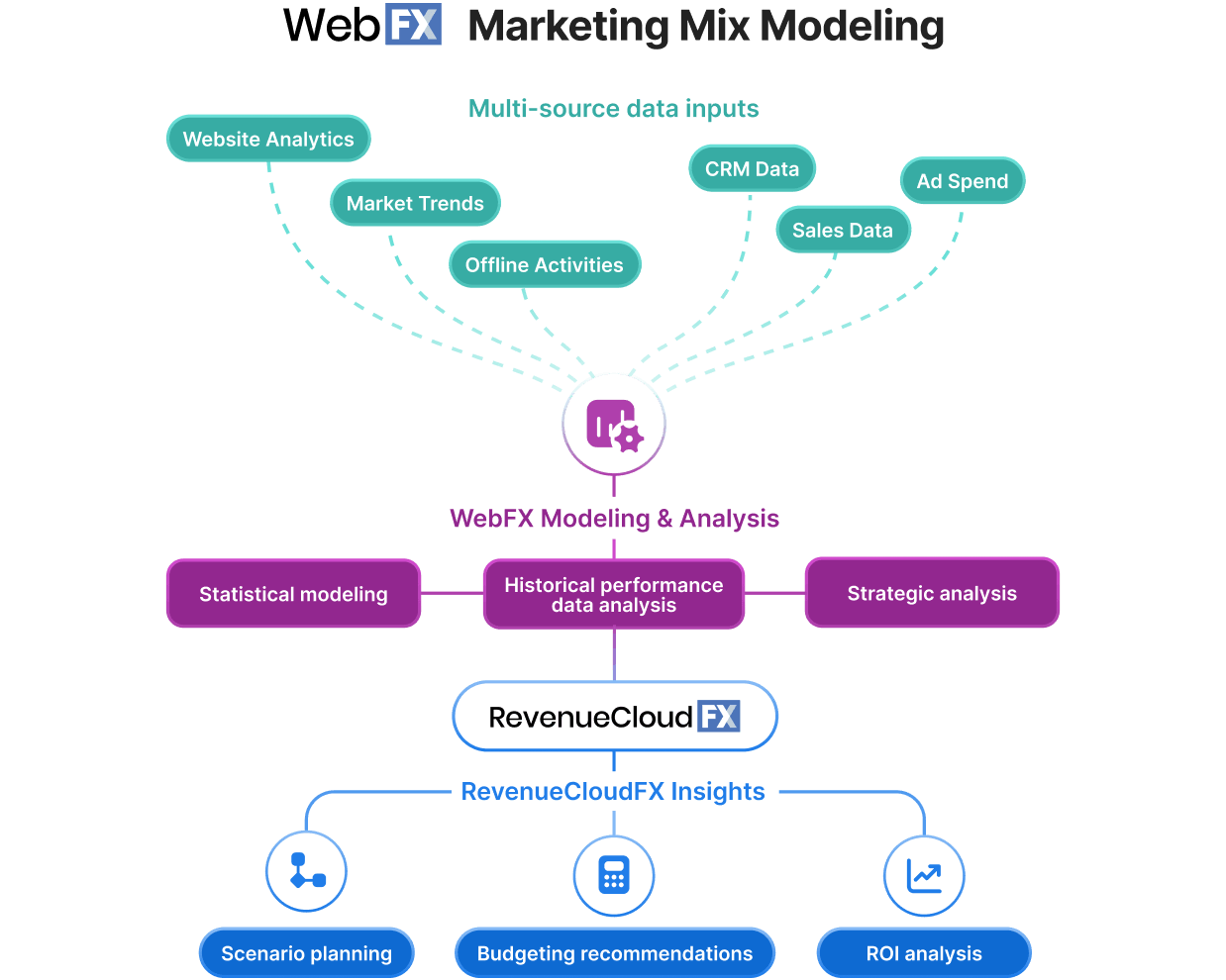
Bringing your marketing data together with RevenueCloudFX
RevenueCloudFX gives your team a clearer way to use marketing mix modeling insights in day-to-day planning. Instead of treating marketing mix modeling as a one-time analysis that sits in a slide deck, WebFX connects the outputs to a platform where you can review performance, compare recommendations, and evaluate next steps more easily.
RevenueCloudFX can help surface insights such as:
- Current versus recommended channel spend
- Projected revenue impact
- ROI by channel
- What-if planning scenarios
That makes it easier to review recommendations, compare options, and act on the findings.
It also helps marketing leaders explain performance to stakeholders. When reporting, recommendations, and modeled insights live in a more unified environment, it becomes easier to connect marketing decisions to revenue conversations.

Tailoring the analysis to your business
A useful marketing mix model depends on the quality and breadth of its inputs. Most businesses store marketing data across multiple systems, creating blind spots before modeling even begins.
WebFX helps bring together the data that matters most to your analysis. That may include:
- Ad platform data
- Website analytics
- Historical performance trends
- Campaign spend
- Lead and customer data
- Other online or offline signals relevant to your business
By building from a broader set of inputs, WebFX can create a model that reflects a more complete picture of performance.

Turning insights into planning tools
A strong marketing mix model should reflect how your business actually grows. We build a custom approach for each client based on the factors that shape their operations and marketing decisions, such as:
- Seasonality
- Promotional timing
- Sales cycles
- Geography
- Product mix
- Channel saturation
For example, we’d approach a B2B company with a long buying cycle differently from an outdoor recreation company with multiple locations and with faster purchase behavior. A manufacturer with several business units may need scenario planning across product lines or regions. In contrast, a regional service provider may need recommendations based on a smaller channel mix and a more concentrated market.
This business context helps WebFX produce analysis that is more useful for planning. It also helps your team apply the findings to real budgeting decisions rather than treating the model like a static report.

Comparing scenarios and planning next steps
WebFX also uses marketing mix modeling to help you evaluate your next move.
Using marketing mix modeling insights, WebFX helps you compare budget scenarios, assess projected revenue impact, estimate ROI by channel, and identify when additional spending may produce diminishing returns. That gives your team a more practical way to compare your current mix with stronger allocation opportunities.
This is where WebFX’s process and RevenueCloudFX support one another. WebFX provides the strategic interpretation behind the model, and RevenueCloudFX helps make those recommendations easier to review, communicate, and revisit over time.

What you get from WebFX’s marketing mix modeling services
WebFX’s marketing mix modeling services are designed to give you practical outputs your team can use for planning, budgeting, and performance discussions.
- Revenue acceleration technology
- Channel-level ROI insights
- Scenario planning
- Budget recommendations
- Executive-ready insights
Revenue acceleration technology
Revenue acceleration technology
In addition to our team’s expertise, you get access to our RevenueCloudFX platform, which features RevMixAI. RevMixAI is a tool that shows you how to reallocate your marketing budget for stronger revenue impact.
With WebFX’s expertise as a Google Meridian Certified Partner and RevMixAI-powered views in RevenueCloudFX, you can turn modeled insights into budget guidance, scenario planning, and ROI insights you can apply to future decisions.
Channel-level ROI insights
Channel-level ROI insights
WebFX helps you see how different marketing efforts contribute to revenue and ROI over time. That gives your team a stronger basis for evaluating performance and deciding where your budget can drive the most impact.
Scenario planning
Scenario planning
Scenario planning lets you test future budget decisions before you make them. This can include questions such as:
- What happens if you move 15% of paid social spend into paid search?
- What happens if you increase investment in one region while holding others flat?
- What happens if you reduce upper-funnel spend during a slower quarter?
This helps your team compare trade-offs before making budget changes. Instead of debating options in theory, you can evaluate likely outcomes and choose a direction with stronger evidence behind it.
Budget recommendations
Budget recommendations
WebFX gives you budget guidance for your team. That may include recommendations for channel mix, reallocation priorities, areas of overspend, or channels worth further investment.
We can also help you compare your current mix with recommended allocation opportunities, including where additional spend may improve returns and where diminishing returns may start to appear. This makes marketing mix modeling especially valuable for lean internal teams that need direction.
Executive-ready insights
Executive-ready insights
Marketing leaders often need to explain budget decisions to executives who don’t have time to dig through analytics reports. Our marketing mix modeling services make those recommendations easier to understand at a glance.
That may include:
- Summary views
- High-level interpretation
- Reporting that shows how modeled insights connect to performance goals
Our marketing mix modeling services help your team communicate the “why” behind your budget recommendations more quickly and clearly.
Explore WebFX Pricing for Marketing Mix Modeling
Ready to get started? Contact us online today!
Combines disjointed customer data into unified customer journeys enriched with additional purchased data fields for real-time audience segmentation Benchmark lift: 20% For audiences which sync to revenue driving marketing automation tools Bulk upload CRM closed lead data for reporting and deduplicate existing clients from new lead reporting Options such as MQL, SQL, Won/Lost to refine lead generation machines and audience segmentation Marketing + Sales CRM with Integrated Marketing Channel Attribution for Closed-Loop ROI Our proprietary CRM software that powers over $600 million in annual sales for clients Connect with your CRM contacts with 1-to-1 via text messages. Included # of outbound SMS/month for each Nutshell seat Onboarding with a Nutshell CRM Subject Matter Expert (SME) from the Nutshell team will provide demos, build CRM workflow/pipeline stages. The set up, ongoing monitoring, & debugging of data pipelines to send offline conversions to Google, YouTube Ads, Bing, and/or Microsoft Ads to improve their machine learning algorithm for your campaigns, saving you ad spend budget and accelerating new customer acquisition. (Minimum of 25-30 conversions per month needed) The set up, ongoing monitoring, & debugging of data pipelines to send contacts to Google, YouTube Ads, Bing, and/or Microsoft Ads to create lookalike and/or custom audiences. (Minimums differ per platform, but typically 1,000 active contacts are needed to use an audience) Bidirectional CRM connection to append marketing data [4 fields total: source, medium, utm_parameters, and notes (to include: entry page, link to full lead journey/call transcript)] to CRM leads, and query back lead status and revenue for Customer360FX Contacts and Automated Audiences Bidirectional CRM connection to create New leads in CRM tracked by RevenueCloudFX, and query back lead status + revenue for Customer360FX and Automated Audiences Additional data connectors such as supported LiveChat, Paid Advertising, & Ecommerce platforms that sync data into RevenueCloudFX Additional data connectors such as supported LiveChat, Paid Advertising, & Ecommerce platforms that sync data between RevenueCloudFX and the original Martech tool. Additional data connectors for supported ERPs + Accounting systems such as NetSuite, Sage, Quickbooks, FreshBooks, Clover, etc. Data pipeline consultant and engineering time spent building new pipelines or customizing existing IntegrationsFX data pipelines for custom client requirements. Identity resolution for B2B visitors with basic data enrichment to support sales teams and smarter marketing automation campaigns Benchmark lift: 20% 3rd party data purchased from leading providers to enrich missing or incomplete firmographic data points such as Location, Industry, Number of Employees, Domain and Annual Sales. Access professional profiles, including job title, work experience, education, LinkedIn profile, etc. Includes The ability to export resolved professional contacts. Contact info for ICPs working at the companies that visit your website. Average match rate of ~35% of resolved from anonymously resolved companies visiting your website, who have buying intent ProspectorFX allows you to search and filter for prospective new customers from a database of over 400 million profiles based on your ideal customer persona. Use credits to reveal the phone, email, and social touchpoints of your most desired matches. Omnichannel lead journey tracking and scoring for form submissions, live chats, and microconversions. Automatically filters leads from blacklisted IP addresses Close more leads in less time with lead scoring customized to your business Automated call tracking + recording for ROI measurement Channel-specific call tracking numbers Caller location for Automated Audience Creation Enhanced firmographic + demographic data for Automated Audience Creation such as age, employer, occupation, home value, social media profiles, etc. Caller and agent sentiment analysis and intent powered by Google AI Enhanced firmographic and demographic data to enrich incoming leads (including list uploads) for sales support and marketing segmentation. LeadScorerFX Pro utilizes data Enrichment fields for Enhanced lead scoring calculations and measurements. ROI + CPL Dashboarding with automated ad spend tracking for cost per lead analysis per MROI Channel Multi-device programmatic advertising based on CRM and visitor data Benchmark lift: 8% increase in closed sales Competitor website changes tracking and strategy monitoring Location data accuracy reports for increasing maps visibility Benchmark lift: 12% increase in local leads On-demand email sending with real-time audience syncing from Customer360FX Benchmark lift: 16% increase in leads Drag n drop page builder to rapidly deploy high converting landing pages Benchmark lift: 11% increase in leads Real-time insights to which content types provide the highest value for your website. IBM Watson-powered, SEO content creation and evaluation tool to outrank competitors Benchmark lift: 10% increase in organic traffic User intent for content marketing search engine ranking analysis powered by IBM Watson Benchmark lift: 8% increase in organic traffic Customize demographic & firmographic audience journeys Benchmark lift: 11% increase in conversions Boost your online credibility and local leads, and gain visibility to customer experiences through this review collection software.
Features Foundation Data Professional Innovator Innovator VIP
Customer Data Platform
Customer360FX Unified Customer Journeys + Automated Segmentation ✓ ✓ ✓ ✓
First-Party Data Profiles Up to 20,000 contacts / 160,000 emails/mo Up to 50,000 contacts / 400,000 emails/mo Up to 100,000 contacts / 800,000 emails/mo Up to 250,000 contacts / 2,000,000 emails/mo
CSV Upload ✓ ✓ ✓ ✓
Lead Statuses ✓ ✓ ✓ ✓

Nutshell Pro 10 Pro Nutshell seats 20 Enterprise Nutshell seats 40 Enterprise Nutshell seats 80 Enterprise Nutshell seats
150 outbound SMS per user, for a shared pool of up to 1,500 per month for your 10 users 150 outbound SMS per user, for a shared pool of up to 3,000 per month for your 20 users 150 outbound SMS per user, for a shared pool of up to 6,000 per month for your 40 users 150 outbound SMS per user, for a shared pool of up to 12,000 per month for your 80 users
Nutshell Onboarding
Up to 4 hours of CRM Onboarding Support & Consulting Up to 4 hours of CRM Onboarding Support & Consulting Up to 6 hours of CRM Onboarding Support & Consulting Up to 12 hours of CRM Onboarding Support & Consulting
SchedulerFX automated calendar booking system Up to 10 Calendars Up to 20 Calendars Up to 40 Calendars Up to 80 Calendars
– IntegrationsFX Conversion Based Smart Bidding Available to WebFX Paid Search Clients Available to WebFX Paid Search Clients Available to WebFX Paid Search Clients Available to WebFX Paid Search Clients
– IntegrationsFXLookalike + Custom Audiences Continually Updated Available to WebFX Paid Search Clients – Up to a total of 15 audiences Available to WebFX Paid Social Clients – Up to a total of 30 audiences Available to WebFX Paid Social Clients – Up to a total of 50 audiences Available to WebFX Paid Social Clients – Up to a total of 100 audiences
– IntegrationsFX CRM: Attribution, Closed-Loop Reporting, and Audience Segmentation ✓ ✓ ✓ ✓
– IntegrationsFX CRM: New Contact Creation ✓ ✓ ✓
IntegrationsFX: Additional Unidirectional Data Pipelines
Up to a total of 2 Unidirection IntegrationsFX Data Pipelines
Up to a total of 4 Unidirection or Bidirectional IntegrationsFX Data Pipelines
Up to a total of 7 Unidirection or Bidirectional IntegrationsFX Data Pipelines
Up to a total of 15 Unidirection or Bidirectional IntegrationsFX Data Pipelines
IntegrationsFX: Additional Bidirectional Data Pipelines Yes – Up to a total of 4 Unidirection or Bidirectional IntegrationsFX Data Pipelines Yes – Up to a total of 7 Unidirection or Bidirectional IntegrationsFX Data Pipelines Yes – Up to a total of 15 Unidirection or Bidirectional IntegrationsFX Data Pipelines
– IntegrationsFX ERP Closed-Loop Reporting + Audience Segmentation Yes – Up to a total of 4 Unidirection or Bidirectional IntegrationsFX Data Pipelines [Excludes Enterprise ERP Integrations] Yes – Up to a total of 7 Unidirection or Bidirectional IntegrationsFX Data Pipelines [Excludes Enterprise ERP Integrations] Yes – Up to a total of 15 Unidirection or Bidirectional IntegrationsFX Data Pipelines including Enterprise ERPs such as Oracle E-Business Suite, SAP, ADP Wisely, and Microsoft Dynamics Business Central
– IntegrationsFX | Data Warehouse Synchronization Integration: AWS Redshift, Snowflake, BigQuery, etc By Quote
Pipeline Consulting & Engineering Time Up to 25 hours / year Up to 50 hours / year
Measurement, Insights + ROI
CompanyTrackerFX ✓ ✓ ✓ ✓
– Standard Company Enrichment ✓ ✓ ✓ ✓
New Contact & Prospect Lookup (Monthly Credits) Total of 10 credits per month
(5 for ProspectorFX & 5 for CompanyTrackerFX Pro) Total of 300 credits per month
(Flexible allocation between ProspectorFX & CompanyTrackerFX Pro) Total of 800 credits per month
(Flexible allocation between ProspectorFX & CompanyTrackerFX Pro) Total of 2,000 credits per month
(Flexible allocation between ProspectorFX & CompanyTrackerFX Pro)
– CompanyTrackerFX Pro: Employee Resolution ✓ ✓ ✓ ✓
– ProspectorFX: Contact & Company Search ✓ ✓ ✓ ✓
LeadManagerFX ✓ ✓ ✓ ✓
Advanced Spam Filtering ✓ ✓ ✓ ✓
LeadScorerFX Standard ✓ ✓ ✓ ✓
CallTrackerFX: Tracked Monthly Calls 1,250 calls tracked / mo 2,500 calls tracked / mo 5,000 calls tracked / mo 10,000 calls tracked / mo
CallTrackerFX: Unique Call Tracking Numbers 25 unique numbers 50 unique numbers 75 unique numbers 150 unique numbers
Standard Call Enrichment ✓ ✓ ✓ ✓
Enterprise Call Enrichment ✓ ✓ ✓
AIConversationsFX 
✓ ✓ ✓ ✓
DataEnrichmentFX: Enriched Contacts & Leads ✓ ✓ ✓ ✓
– Contact & Lead Enrichment: Web Leads, Callers, Contacts, & Email Lists (Monthly Enrichments) Up to 2,000 enrichments / mo Up to 5,000 enrichments / mo Up to 15,000 / mo Up to 40,000 / mo
– B2B-to-B2C Secondary Email Resolution & B2C-to-B2B Secondary Email Resolution ✓ ✓ ✓ ✓
– B2C CallTrackerFX Leads: Reverse Phone # Lookup ✓ ✓ ✓ ✓
LeadScorerFX Pro ✓ ✓ ✓
MROIDashboardFX ✓ ✓ ✓ ✓
Revenue Acceleration & Forecasting
AdTechFX Yes – Available for WebFX Paid Search and Paid Social Clients Yes – Available for WebFX Paid Search and Paid Social Clients Yes – Available for WebFX Paid Search and Paid Social Clients Yes – Available for WebFX Paid Search and Paid Social Clients
PlaybookFX
Big data insights & PredictionGeniusFX forecasts identify the most effective path for revenue growth✓ ✓ ✓ ✓
CompetitorSpyFX: Up to 5 Competitors Tracked ✓ ✓ ✓ ✓
LocalFX ✓ ✓ ✓ ✓
EmailMarketingFX Sending to up to 20,000 Contacts, with unlimited emails sent to each Contact, included in plan Sending to up to 50,000 Contacts, with unlimited emails sent to each Contact, included in plan Sending to up to 100,000 Contacts, with unlimited emails sent to each Contact, included in plan Sending to up to 250,000 Contacts, with unlimited emails sent to each Contact, included in plan
FunnelsFX ✓ ✓ ✓ ✓
ML, Smarter Content & Buyer Journey
ContentAnalyticsFX ✓ ✓ ✓ ✓
ContentGeniusFX ✓ ✓ ✓ ✓
DeepLearningFX 5 reports / mo 10 reports / mo 25 reports / mo Unlimited reports
PersonalizeFX Up to 15 demographic, firmographic, or audience segments can be personalized Up to 30 demographic, firmographic, or audience segments can be personalized Up to 60 demographic, firmographic, or audience segments can be personalized Unlimited demographic, firmographic, or audience segments can be personalized
ReviewAccelerationFX Up to 3 locations Up to 5 locations Up to 10 locations Up to 25 locations
Personalized Onboarding & Martech Strategy
Contacts imported from legacy software systems ✓ ✓ ✓ ✓
Onboarding + performance implementation w/ Strategic Martech Specialist 3 calls during first year onboarding
and up to 10 hours of consulting, auditing, implementation and setup 3 calls during first year onboarding
and up to 15 hours of consulting, auditing, implementation and setup 4 calls during first year onboarding
and up to 20 hours of consulting, auditing, implementation and setup 4 calls during first year onboarding
and up to 30 hours of consulting, auditing, implementation and setup
Annual Martech Specialist Consultations 1 / year 2 / year 4 / year 4 / year
On-going Data Architect Support Queue Access Up to 4 hours / year Up to 6 hours / year Up to 12 hours / year Up to 20 hours / year
Dedicated Martech Expert ✓ ✓ ✓ ✓
Execution of Martech FuelFX Assets 3 per quarter / 12 per year
Standard Monthly Licensing Cost $675 $1,175 $2,500 $4,975
Existing Monthly Customer Cost $600 $975 $2,250 $4,475
WebFX has thousands of reviews praising our transparency, communication, and results.
WebFX Agency Rating

4.9/5
based on over 550 third-party reviews

FAQs
What do marketing mix modeling services include?
MMM services typically include data collection, channel analysis, model development, result interpretation, and recommendations for budget allocation or forecasting.
Some providers also include scenario planning, executive reporting, and support for ongoing model refreshes.
How much do marketing mix modeling services cost?
Pricing depends on the scope of data, number of channels, level of customization, reporting needs, and whether the engagement includes ongoing support. If you are comparing pricing among MMM providers, ask about the deliverables included and how the analysis will support actual budget decisions.
How do I choose the best marketing mix modeling agency or provider?
Look for a provider that understands your channel mix, can work across your data sources, explains results clearly, and turns analysis into actionable planning guidance.
You should also evaluate how well the provider supports reporting, scenario planning, and business-specific context.
How long does it take to see results from marketing mix modeling?
You may start seeing value as soon as the model helps your team make clearer planning decisions. The timeline depends on:
- Data readiness
- Model scope
- How quickly your team acts on the insights
What is marketing mix modeling?
Marketing mix modeling (or MMM) measures how your marketing activities influence revenue, leads, or sales over time. It helps you identify which efforts contribute to business results so you can allocate budget more strategically.
Using historical performance data and statistical analysis, it can estimate how factors such as spend, impressions, promotions, seasonality, and geography affect outcomes. Because marketing mix modeling can evaluate both online and offline efforts, it gives you a broader view of performance than user-level attribution alone.
Why is marketing mix modeling important?
Marketing mix modeling is essential for understanding which efforts drive revenue and where to improve ROI.
In many organizations, marketing is viewed more as a cost center than a profit-generating department because attributing revenue to marketing activity has become more difficult.
Third-party cookie restrictions and app-tracking limits give businesses a limited view of how prospects discover and interact with brands online. Long buying cycles also make it harder to connect marketing activity to revenue.
People research products and deliberate for weeks before buying. When it’s time to make a purchase, they’ve interacted with various campaigns both online and offline.
Then there’s AI. It has made measuring marketing efforts more complex by making it easier to launch more campaign variations, messages, and personalized experiences. That gives marketers more to test and optimize, but it also makes it harder to measure which efforts actually improve ROI.
While platform attribution offers useful insights, these insights are typically siloed and don’t provide a complete picture of how online and offline marketing efforts translate into revenue.
For example, social ads may create demand that branded search can later capture. Organic search may help move leads closer to conversion, while email marketing gets the final credit. Offline efforts, such as trade shows or sales outreach, may influence your prospects to buy even when they don’t appear in last-click reporting.
This is where marketing mix modeling matters. It helps you evaluate how your marketing activities influence revenue using historical performance data, business outcomes, and statistical analysis. That broader view helps you answer questions such as:
- Which marketing activities contribute most to revenue?
- Which investments drive stronger incremental ROI?
- How do your efforts work together across the customer journey?
- Where should you adjust spending to improve returns?
How do marketing mix models differ from attribution reports?
Attribution reports typically assign credit to specific touchpoints within tracked user journeys. Meanwhile, marketing mix models take a broader view and estimate how channels influence outcomes over time using historical data and statistical analysis.
The broader view can help when attribution data feels incomplete, siloed, or too narrow for larger budgeting decisions.
Can marketing mix modeling measure offline and online channels together?
Yes. One of marketing mix modeling’s main advantages is its capability to measure both offline and online channels. It can help evaluate both channels, provided the underlying data is available and structured well enough for analysis.
How often should a marketing mix model be updated?
The update frequency of a marketing mix model depends on your channel mix, budget, seasonality, and planning cycle. Some businesses revisit models quarterly, while others update them on a different cadence tied to business planning or major market changes.
Is marketing mix modeling right for midsized B2B companies?
It can be, especially if your business invests across multiple channels, has a longer sales cycle, and needs a better way to allocate spend. The more complex your buying journey and budget decisions become, the more useful a broader measurement framework can be.
Can marketing mix modeling help allocate budget across regions, products, or business units?
Yes. If you need to compare spend decisions across multiple planning groups, a model can help structure those trade-offs.