


Contents
- Marketing mix modeling: Best for ROI analysis, and budget and channel decisions
- What marketing mix modeling can help you do
- The limitations of marketing mix modeling
- Attribution: Best for faster campaign optimization
- What attribution can help you do
- The limitations of multitouch attribution
- When should you use marketing mix modeling, attribution, or both?
- Use marketing mix modeling for budget allocation and ROI analysis
- Use attribution when you need faster digital optimization
- Use both when you need strategic and tactical decisions
- Pro tip: Do not jump to MMM just because it sounds more advanced
- FAQs
- MMM vs. MTA? Use the right measurement approach you need
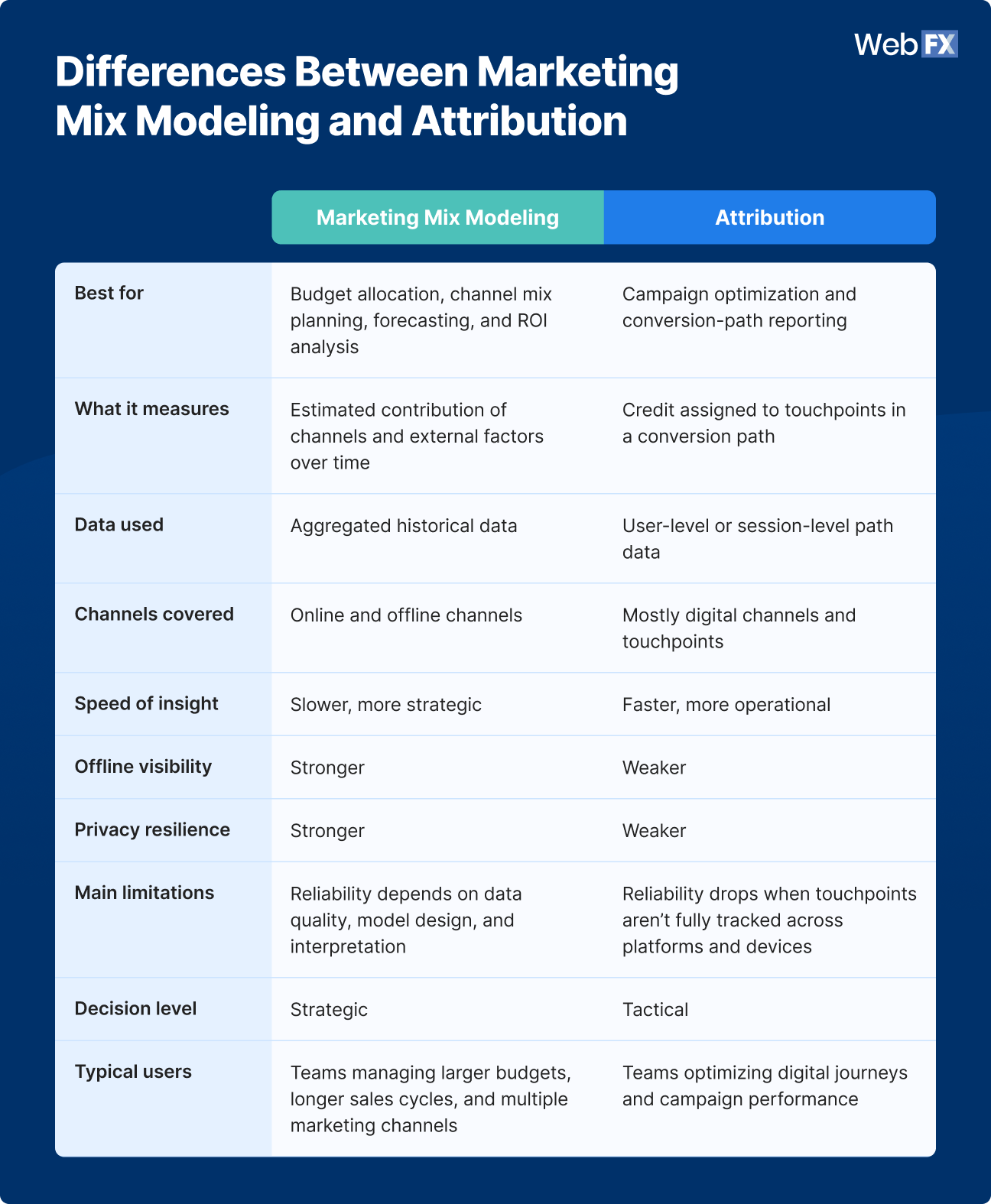
Table View 🔽
| Marketing mix modeling | Attribution | |
| Best for | Budget allocation, channel mix planning, forecasting, and ROI analysis | Campaign optimization and conversion-path reporting |
| What it measures | Estimated contribution of channels and external factors over time | Credit assigned to touchpoints in a conversion path |
| Data used | Aggregated historical data | User-level or session-level path data |
| Channels covered | Online and offline channels | Mostly digital channels and touchpoints |
| Speed of insight | Slower, more strategic | Faster, more operational |
| Offline visibility | Stronger | Weaker |
| Privacy resilience | Stronger | Weaker |
| Main limitations | Reliability depends on data quality, model design, and interpretation | Reliability drops when touchpoints aren’t fully tracked across platforms and devices |
| Decision level | Strategic | Tactical |
| Typical users | Teams managing larger budgets, longer sales cycles, and multiple marketing channels | Teams optimizing digital journeys and campaign performance |
This blog post can help you understand both measurement approaches and decide which one fits your business.
The main difference between marketing mix modeling and attribution lies in scope. Marketing mix modeling (MMM) focuses on broader channel impact over time, while multitouch attribution (MTA) tracks the touchpoints in a customer journey:
- Marketing mix modeling helps you estimate how channels affect revenue over time at a broader level, while MTA helps you track and understand which touchpoints influenced a conversion path.
- MMM works best for budget planning, channel mix decisions, and situations where user-level tracking leaves gaps, while MTA works best for faster optimization of your digital marketing efforts.
- Some businesses benefit from both MMM and MTA. However, not every business has the data, complexity, or planning needs to justify marketing mix modeling.
In short, MMM helps you make bigger budget decisions, while MTA helps you optimize day-to-day execution.
For example, if you want to know whether paid search drove more conversions this week after a landing page update, attribution can help. If you want to know whether your overall mix of paid search, organic search, and direct mail actually improved revenue efficiency over the last two quarters, marketing mix modeling gives you better insights.
Marketing mix modeling: Best for ROI analysis, and budget and channel decisions
MMM enables you to understand how your overall marketing mix affects revenue. Instead of assigning credit to individual paths, MMM uses aggregated historical data to estimate how different channels and external factors influence revenue and ROI over time.
Let’s go through what MMM can help your business with and its limitations:
If you’re newer to MMM itself, our introduction to marketing mix models covers how they work, what factors they consider, and the four steps to building one — helpful context before diving into the comparison below.
What marketing mix modeling can help you do
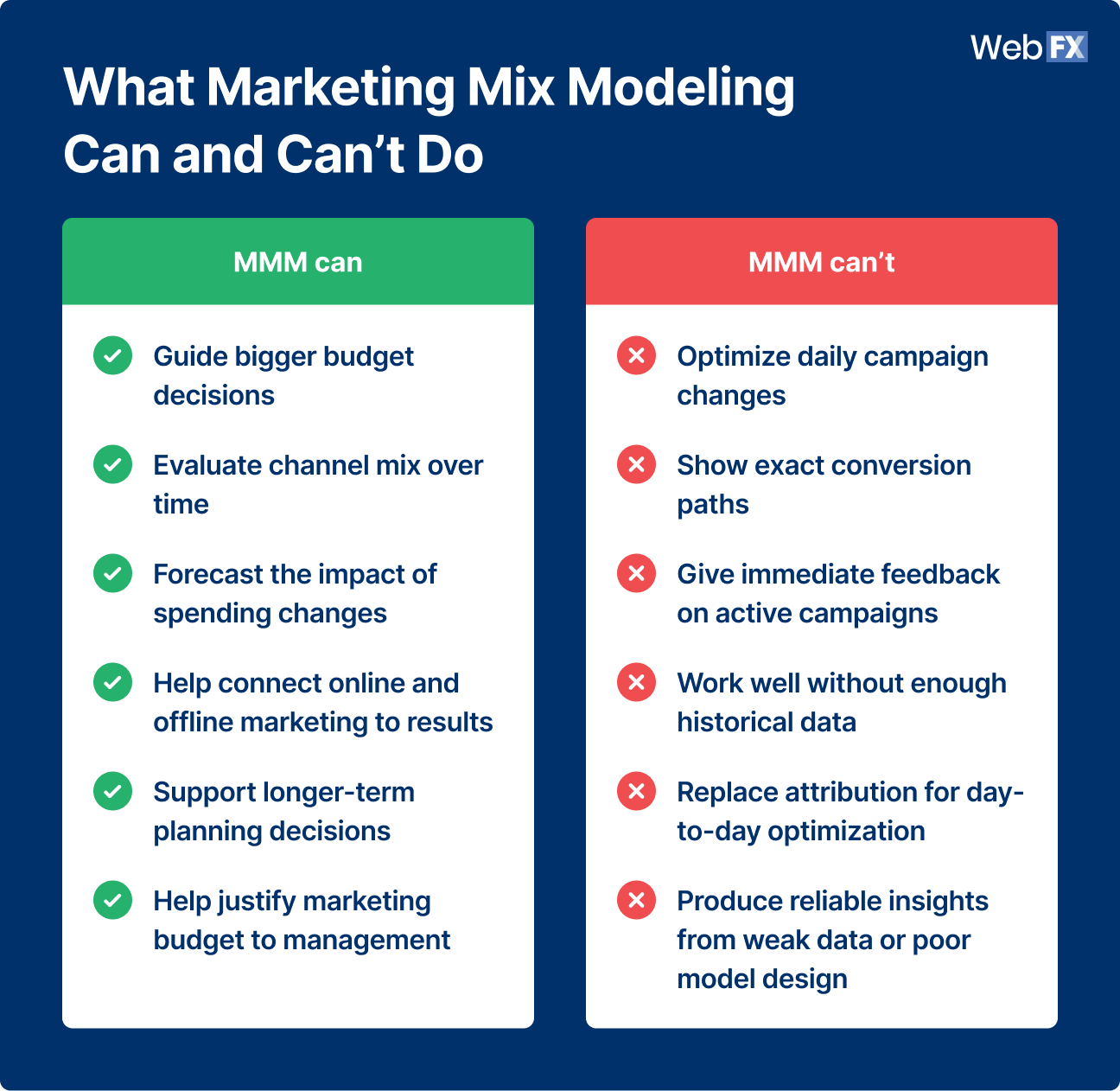
Marketing mix modeling works best when your team needs to answer bigger planning questions, not campaign-level questions. It can help you:
- Evaluate your marketing channel mix
- Forecast the impact of spending changes
- Understand how online and offline efforts work together to generate revenue over time
For example, a heavy equipment company might invest in paid search, dealer support, and events. Marketing mix modeling helps the business evaluate how those efforts contribute to more inquiries, sales, and revenue.
MMM also helps marketing leaders with crucial planning decisions and justifying budgets to management. With marketing mix modeling, marketers can:
- Explain performance trends
- Plan marketing activities for the next quarter or year
- Defend budgets
The limitations of marketing mix modeling
Marketing mix modeling can help you improve your budgeting, forecasting, and channel decisions, but it also comes with real requirements and limitations.
Before you choose MMM, make sure you understand where it can fall short and what it requires from your business.
It needs enough historical data and clean inputs
Marketing mix modeling is not a plug-and-play fix. It needs enough:
- Historical data
- Variation in spend and outcomes
- Consistent data inputs
Without those inputs, MMM has less information to work with and more room for error. If your business is not investing in multiple marketing channels, has inconsistent tracking data, or has a thin data history, you may not get much value from MMM.
In other words, if your inputs are weak, the model’s output will be weak, too. If that sounds like your current situation, marketing mix modeling consulting can help you identify and address those data gaps before they compromise your results.
It takes more expertise to build and interpret
Attribution reports are typically available in your existing analytics tools. MMM usually takes more work to set up, validate, and interpret in a way that reflects your business accurately.
That’s because MMM is more than just a dashboard. It’s a model built on assumptions about timing, channel interaction, seasonality, and outside influences on demand. If those assumptions are inaccurate, the output can point you in the wrong direction.
To address that risk, businesses using MMM must have the right analytical support, clear business context, and a process for validating results against what’s happening in the market.
It is not ideal for day-to-day campaign tweaks
Marketing mix modeling is strategic, not day-to-day. It will not replace the faster feedback you need for daily optimization.
MMM looks for patterns across aggregated data over time, which makes it better for planning decisions than for quick campaign adjustments. If your paid search cost per lead (CPL) jumps this week because an ad group drifted off target, attribution and platform reporting will help you respond faster.
That is why many teams interested in stronger measurement use both attribution and MMM. The two are not direct replacements for each other. They serve different roles, and some businesses benefit from using both.
It can produce misleading recommendations if the model or data is weak
Marketing mix modeling can look scientific and still point you in the wrong direction if the assumptions, controls, or inputs are weak.
That’s why clean historical data and sound model design matter for reliable output. A model may suggest that one channel deserves more credit when the underlying assumptions or controls distorted the result. If you act on that, you might end up moving your budget in the wrong direction.
Pro tip: Treat MMM as a strategic decision tool that needs validation, context, and careful interpretation.
Attribution: Best for faster campaign optimization
Multitouch attribution (MTA) is most useful when your buyer journey is mostly online and can be measured through tools like Google Analytics or other analytics platforms. It is best used for campaign optimization and conversion-path reporting, but it’s the weaker option for bigger budget and channel-mix decisions.
What attribution can help you do
Attribution works well when a large share of your buyer journey happens online, where your tools can capture touchpoint activity. It is especially useful when you need to improve performance inside active digital campaigns.
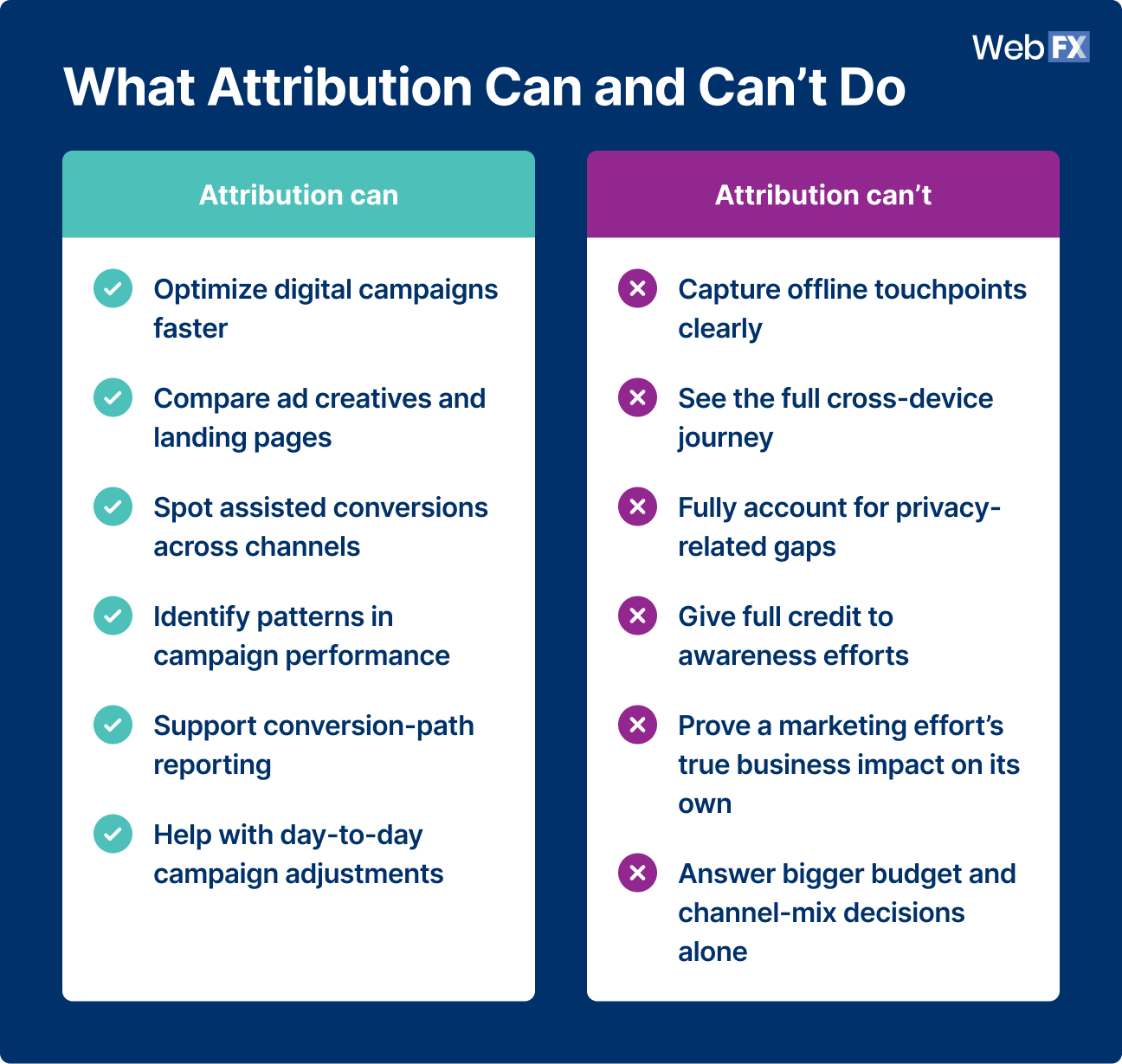
With attribution, you can:
- Compare which ad creative drove more demo requests
- See which landing pages drove more quote submissions
- Spot patterns in assisted conversions across paid and organic channels
- Adjust bids, audiences, and messaging faster
You don’t have to wait months to spot patterns in campaign performance. So if your paid social campaigns drive a spike in assisted conversions after a new product launch, or branded search drives more inquiries, MTA can surface those patterns quickly.
That speed matters when you need to adjust bids or audiences, update your ad copy, or pause weak ads.
The limitations of multitouch attribution
Multitouch attribution becomes less reliable when your customer journey includes touchpoints your tools can’t track, such as offline touchpoints, cross-device behavior, or privacy-related gaps.
Understand the limitations of MTA so you use it appropriately and effectively.
It can miss important touchpoints outside your reports
Attribution can only report on what it sees. That sounds obvious, but your analytics tools may miss key touchpoints, leading to inaccuracies in your MTA report.
Imagine this scenario: A prospect may hear about your B2B company at a trade show, ask a colleague for a recommendation, search your brand later, then convert after clicking a remarketing ad.
Attribution may give most of the credit to the last visible touchpoint, the remarketing ad, even though the offline touchpoint contributed to the conversion.
That can distort budget decisions. Channels like events, podcasts, field sales support, direct mail, referrals, and word of mouth often contribute to revenue without showing up cleanly in path-level reports.
It has limited visibility in privacy-constrained customer journeys
Attribution is not as easy today as privacy changes roll out. Users can decline tracking, and third-party cookies are being phased out.
When a buyer researches your solution on a work laptop, resumes their research on their personal phone, and inquires through their mobile, your attribution model may only capture part of the journey.
It can underestimate channels that create awareness early
Some marketing efforts are not meant to drive lead form submissions or purchases. Branding, for one, introduces your business to your prospects and helps your brand get noticed.
An attribution model may not give your brand-building efforts (and other awareness campaigns) enough credit for their contribution to your revenue. As a result, when businesses need to reduce spending, awareness campaigns are typically among the first to have their budgets cut.
For example, a manufacturing business might sponsor an industry newsletter that makes buyers remember its name. Later, those same buyers search the brand, click a paid search ad, and convert. Attribution may reward the paid search click while giving little to no credit to the sponsored newsletter.
Because the sponsored newsletter didn’t appear to help close a sale, teams might never invest in it again or allocate their budget to search ads instead.
It can give credit without proving real impact
Attribution reports can tell you the touchpoints that your customer interacted with. However, they don’t automatically prove which touchpoints led to an inquiry or purchase.
That distinction matters. When you can’t accurately identify touchpoints that contributed to revenue, you might overinvest in the wrong channels and underinvest in the right ones.
When should you use marketing mix modeling, attribution, or both?
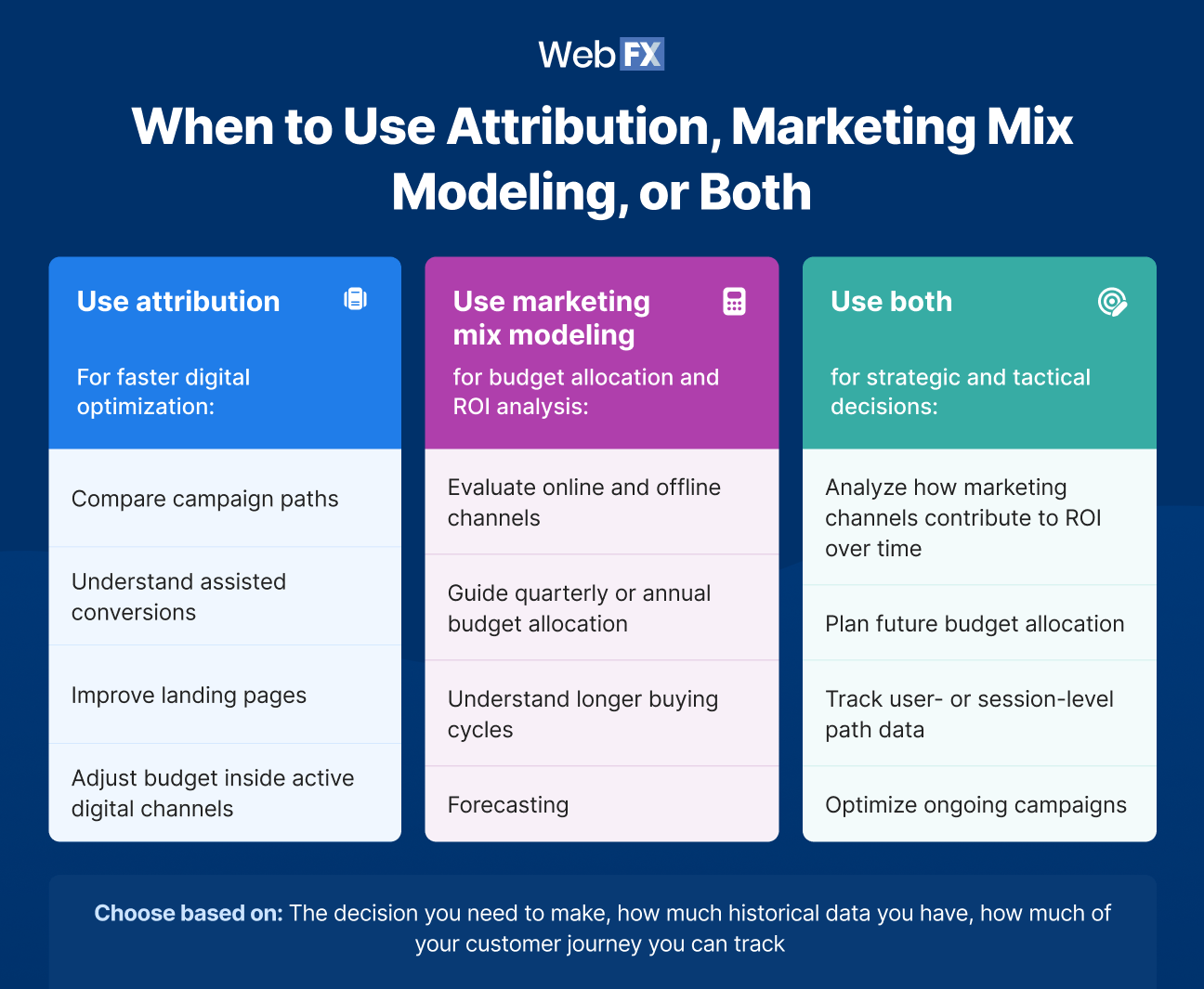
By now, it’s clear that MMM and MTA are two distinct measurement approaches. The right measurement approach for your business depends on three things:
- The decision you need to make
- How much reliable historical data you have
- How much of your customer journey you can track
Use marketing mix modeling for budget allocation and ROI analysis
Marketing mix modeling makes more sense when your main question is “Which parts of our marketing are most likely improving our ROI over time?”
You can use MMM solutions like Google Meridian when you need to:
- Evaluate online and offline channels together
- Guide quarterly or annual budget allocation
- Understand longer buying cycles
- Support executive planning conversations
This often fits businesses with higher-value sales, more than a few meaningful channels, and more pressure to prove the bottom-line impact of budget decisions.
Use attribution when you need faster digital optimization
Attribution makes sense when you need fast answers about digital performance you can track. Use it when you want to:
- Compare campaign paths
- Understand assisted conversions
- Improve landing pages
- Adjust budget inside active digital channels
Use both when you need strategic and tactical decisions
Some teams need both MMM and MTA. Marketing mix modeling helps with bigger investment decisions (strategic), while multitouch attribution helps with daily execution (tactical).
For example, a heavy equipment marketing team may use attribution to refine paid search and landing-page performance. The same team can also use MMM to understand how broader channel mix, seasonality, and brand investment affect inquiries over time.
MMM and MTA are not direct replacements for each other. They answer different questions, and some businesses benefit from using both.
Pro tip: Do not jump to MMM just because it sounds more advanced
Not every business needs marketing mix modeling today.
If your team runs campaigns on only a few channels, has a short sales cycle and mostly digital customer journey, or lacks strong historical data, you may get better returns from strengthening your attribution setup.
Instead of jumping into MMM, integrate your CRM with your other analytics tools and improve your reporting hygiene first.
FAQs
What is marketing mix modeling (MMM)?
Marketing mix modeling is a measurement approach that lets you better understand how your overall marketing mix and external factors (like seasonality) affect your revenue over time. Using aggregated historical data, MMM helps marketing leaders with important planning decisions and justifying budgets to management.
What is multitouch attribution (MTA)?
Multitouch attribution is a measurement approach that enables you to track touchpoints in your consumer’s journey and analyze how each one contributed to a conversion. MTA enables you to spot patterns in assisted conversions across organic and paid channels, and optimize your campaigns.
What’s the difference between MMM and MTA?
MMM and MTA are distinct marketing measurement approaches. MMM is best used for evaluating your budget allocation and how your channel mix contributes to ROI over time, while MTA is best used for analyzing your customer’s conversion path and optimizing your campaigns.
Is marketing mix modeling better than attribution?
Neither marketing mix modeling nor attribution is better than the other.
Marketing mix modeling is better for strategic budget decisions and broader channel analysis. Attribution is better when you need faster visibility into digital journeys and campaign performance.
Can marketing mix modeling and attribution work together?
Yes. In many cases, they should.
Attribution can help your team optimize what is happening now, while marketing mix modeling can help you decide where your budget should go in the next quarter or next year.
Does privacy loss make attribution less reliable?
Yes, it can. With privacy changes, attribution doesn’t “see” the full customer journey.
That doesn’t mean you shouldn’t use attribution at all, though. Instead, you should be careful about treating it as complete.
Is marketing mix modeling only useful for large enterprises?
Not necessarily. MMM fits businesses that have enough historical data, channel complexity, and a strategic need to justify it. Some midsize businesses meet these requirements.
Which model can track offline marketing better?
Marketing mix modeling usually handles offline marketing better because it can evaluate broader channel effects over time, rather than relying solely on digital paths.
MMM vs. MTA? Use the right measurement approach you need
MMM and MTA are measurement approaches that can’t be used interchangeably.
Whether you need marketing mix modeling, attribution, or both, the partner you can trust and reach out to remains the same: WebFX.
Our award-winning team has been helping clients grow their revenue for 30+ years in 200+ industries. When you team up with WebFX, you get access to our proprietary platform RevenueCloudFX, which can help you with MMM and MTA so you can make data-backed decisions. We’re also a certified Google Meridian Partner trained to implement Google’s open-source MMM solution.
Contact us online or call 888-601-5359 to speak with a strategist about our marketing mix modeling services!
-
 Maria is a Lead Content Specialist at WebFX. With nearly two decades of experience in B2B and B2C publishing, marketing, and PR, she has authored hundreds of articles on digital marketing, AI, and SEO to help SMB marketers make informed strategic decisions. Maria has a degree in B.S. Development Communication major in Science Communication, and certifications in inbound marketing, content marketing, Google Analytics, and PR. When she’s not writing, you’ll find her playing with her dogs, running, swimming, or trying to love burpee broad jumps. View full profile
 -

WebFX is a full-service digital marketing agency delivering revenue-driving strategies across online advertising, SEO and AI search optimization, and digital marketing. Backed by 1,100+ client reviews, a 4.9-star rating on Clutch, and proprietary revenue-tracking technology, our team helps businesses grow visibility and revenue across platforms, from Google to ChatGPT to LinkedIn. Discover how our expert team and revenue-accelerating tech can drive results for you. Learn more

Try our free Marketing Calculator
Craft a tailored online marketing strategy! Utilize our free Internet marketing calculator for a custom plan based on your location, reach, timeframe, and budget.

Contents
- Marketing mix modeling: Best for ROI analysis, and budget and channel decisions
- What marketing mix modeling can help you do
- The limitations of marketing mix modeling
- Attribution: Best for faster campaign optimization
- What attribution can help you do
- The limitations of multitouch attribution
- When should you use marketing mix modeling, attribution, or both?
- Use marketing mix modeling for budget allocation and ROI analysis
- Use attribution when you need faster digital optimization
- Use both when you need strategic and tactical decisions
- Pro tip: Do not jump to MMM just because it sounds more advanced
- FAQs
- MMM vs. MTA? Use the right measurement approach you need
Share this article


Proven Marketing Strategies
Try our free Marketing Calculator
Craft a tailored online marketing strategy! Utilize our free Internet marketing calculator for a custom plan based on your location, reach, timeframe, and budget.