


Contents
- What is Google Meridian?
- The businesses that will benefit the most from Meridian marketing mix modeling
- Questions Google Meridian helps marketers answer
- How Google Meridian works for marketing mix modeling
- What marketers get out of the model
- Why setup and interpretation matter so much
- The benefits of Google Meridian for marketers
- Data-driven budget optimization for smarter spending decisions
- Actionable insights for forecasting
- Transparency for easier evaluation
- Flexibility to adapt the model to your business
- Geographic details for precise planning
- How Meridian differs from traditional MMM
- Google Meridian vs. attribution modeling
- Does Google Meridian MMM fit your business?
- How WebFX helps businesses implement and operationalize Meridian
- FAQs
- Improve your budgeting and ROI with MMM experts

TL;DR: What is Google Meridian marketing mix modeling?
- Google Meridian is Google’s open-source marketing mix modeling (MMM) framework that helps businesses measure how marketing channels contribute to revenue, leads, and ROI.
- Meridian MMM uses aggregated data and statistical modeling to support media planning, forecasting, and privacy-focused measurement.
- Unlike attribution modeling, Google Meridian evaluates broader channel impact over time instead of focusing only on tracked conversion paths.
- WebFX is a certified Google Meridian partner that helps businesses implement, interpret, and optimize Meridian MMM.
Google Meridian marketing mix modeling (MMM) helps marketers understand how advertising channels influence business performance so they can make smarter budgeting and forecasting decisions. Businesses use Meridian MMM to evaluate channel contribution, improve media planning, and measure marketing impact across channels over time.
- What is Google Meridian?
- How Google Meridian works for marketing mix modeling
- The benefits of Google Meridian for marketers
- How Meridian differs from traditional MMM
- Google Meridian vs. attribution modeling
- Where Google Meridian fits best
- How WebFX helps businesses implement and operationalize Meridian
- FAQs
What is Google Meridian?
Google Meridian is a marketing mix model that helps marketers estimate how much each channel contributes to leads, sales, or revenue over time.
Instead of relying solely on platform reports or tracked conversion paths, Meridian MMM helps you understand how your marketing investments contribute to results, so you can make better budget decisions and improve ROI.
Google built Meridian as an open-source marketing mix modeling solution based on Bayesian modeling. In practical terms, Meridian gives marketers a more transparent and flexible way to measure channel impact. It uses aggregated performance data over time and accounts for external factors that can affect results, and helps with budget planning.
The aggregated approach, which groups performance data such as channel spend, impressions, leads, and revenue over time, makes Meridian privacy-safe and independent of cookies and user-level information.
The businesses that will benefit the most from Meridian marketing mix modeling
Meridian can be especially useful for businesses that:
- Invest in multiple channels
- Manage longer buying cycles
- Need a clearer way to connect marketing spend to revenue over time
Many teams still face the same problem: They can access plenty of channel data, but they still can’t clearly explain which investments actually drove revenue and where next quarter’s budget should go to improve ROI.
Questions Google Meridian helps marketers answer
Meridian helps marketers answer practical questions such as:
- Which channels contributed to revenue or another key performance indicator (KPI)?
- What are the returns that those channels generate?
- How should I allocate my budget in the future for maximum ROI?
Google’s documentation frames those questions as Meridian’s core business use cases, alongside response curves that show how impact changes as marketing spend rises or falls.
For example, a manufacturer may see paid search increase the number of leads filling out forms, while trade shows influence bigger deals later in the pipeline.
Both channels contribute to revenue, but they don’t always appear together in one clean report. Meridian can help this manufacturing business estimate how each channel contributed over time, giving the team better insights for future budget decisions.
How Google Meridian works for marketing mix modeling
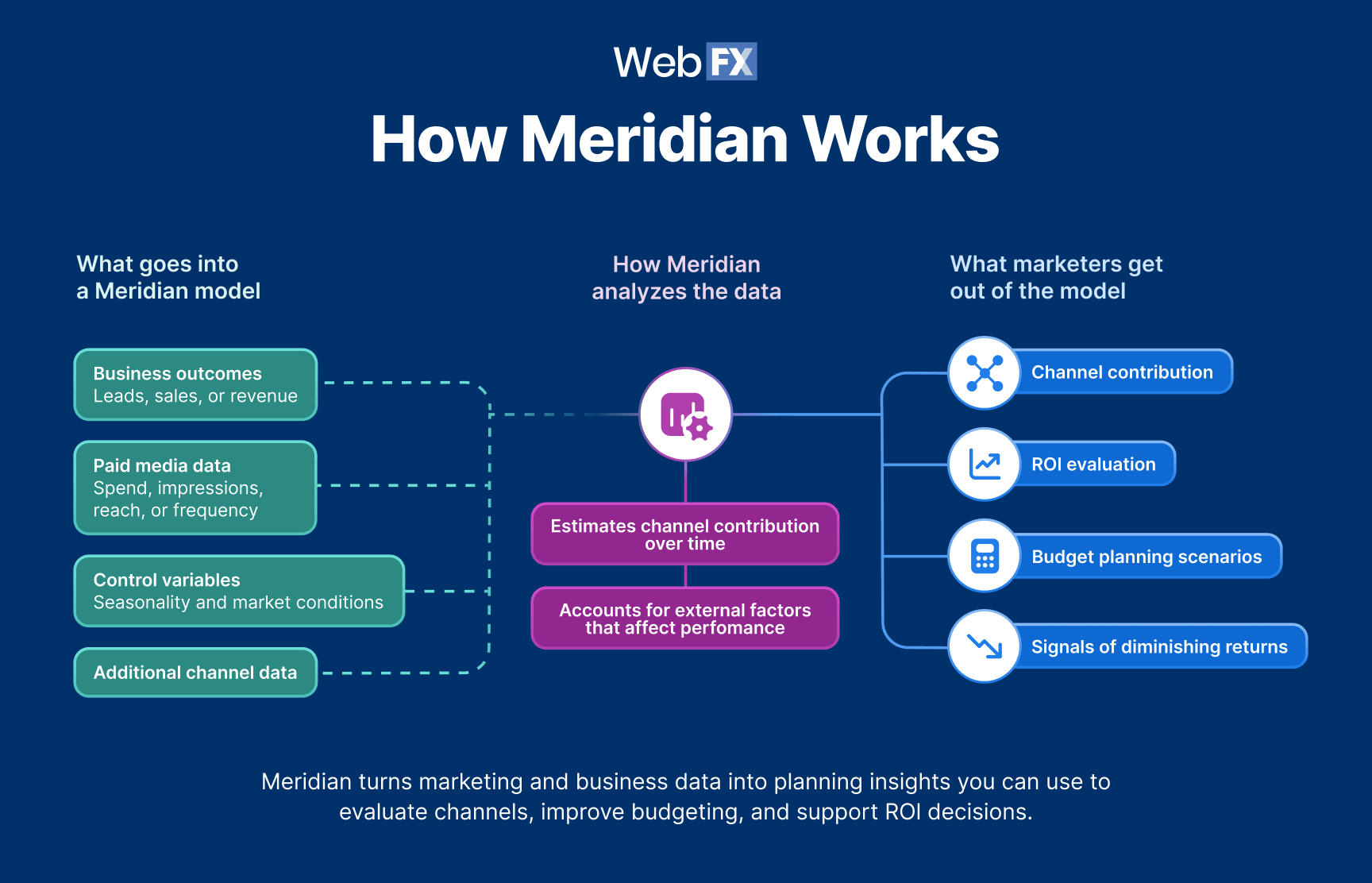
A Meridian model starts with organized, reliable data. At a minimum, that includes your business outcome data and paid media data.
Depending on what your business tracks, you can also include organic media, non-media treatments, reach and frequency data, and control variables that may affect performance. Those inputs can include:
- Business outcomes (such as leads, sales, or revenue)
- Paid media inputs (such as spend, impressions, reach, or frequency)
- Control variables (such as seasonality and market conditions)
- Optional online and offline marketing data
Meridian needs both your marketing inputs and the business context around them.
Remember: Garbage in, garbage out. If your data is incomplete or inconsistent across channels, the model becomes less reliable.
What marketers get out of the model
Once the model is set up well, Meridian can help marketers:
- Estimate channel contribution
- Compare returns across channels
- Evaluate how future budget changes may affect performance
- Identify where additional spend may generate diminishing returns
That gives marketers planning insights to decide where to allocate their budget, which channels may be under- or overfunded, and how different investments may influence ROI over time.
Why setup and interpretation matter so much
This is where some teams underestimate the work. Meridian is built on a sophisticated modeling approach, which means the quality of the output depends on the quality of the data, definitions, and assumptions behind it.
Channel definitions must be clear, and outcome data must be reliable. The model also needs assumptions that reflect how the business actually works.
For example, a business can run a model with messy channel definitions or weak outcome data and still get outputs. That does not mean those outputs are strong enough to support budget allocation, channel prioritization, or forecasting decisions.
The benefits of Google Meridian for marketers
For marketers under pressure to justify their budgets and improve ROI, Google Meridian offers several practical benefits:
- Data-driven budget optimization for smarter spending decisions
- Actionable insights for forecasting
- Transparency for easier evaluation
- Flexibility to adapt the model to your business
- Geographic details for precise planning
Data-driven budget optimization for smarter spending decisions
One of Meridian’s biggest benefits is helping marketers make more informed budget decisions. It can help you:
- Analyze channel contribution
- Compare returns across channels
- Assess how future budget allocation may affect revenue
That gives you a stronger basis for identifying which channels may be under- or overfunded and deciding where to invest more and where to pull back.
Actionable insights for forecasting
Google Meridian gives you more than a full picture of past performance. It can help you ask forecasting questions, such as:
- How much should I invest per channel?
- At what point may returns start to diminish?
- How will my media mix influence my ROI over time?
The answers to these questions matter when you need to defend next quarter’s budget.
Transparency for easier evaluation
Meridian gives teams more visibility into how the model works, what assumptions shape the output, and how results were produced. That can be especially useful for marketers who want more clarity than a closed measurement tool provides.
For example, if you work with an analytics partner or need to explain findings to leadership, that added visibility can make the model easier to evaluate, trust, and communicate.
Flexibility to adapt the model to your business
Meridian marketing mix modeling is open-source, making it flexible enough to reflect how different businesses operate.
That matters because marketing performance does not look the same across industries, buying cycles, or channel mixes. A business with offline influences, longer sales cycles, multiple locations, or unique seasonalities may need a custom model that fits its operations.
Geographic details for precise planning
Google Meridian can also support more detailed analysis by geography, which is useful for businesses that market across multiple regions or locations. That added granularity can help teams compare performance across markets and make more precise budget decisions.
For example, a multilocation business may find that the same channel mix does not perform equally well across markets. Meridian can spot those differences so budget decisions reflect local performance rather than national averages.
How Meridian differs from traditional MMM
Traditional marketing mix modeling has often been associated with expensive consulting engagements and unclear methodologies. Meridian gives marketers a more transparent and flexible alternative.
Unlike older MMM approaches that often felt closed and consultant-dependent, Meridian gives marketing teams more visibility into how the model works and more flexibility in how they apply it. That can make Meridian feel more modern and flexible than the older, black-box version of MMM that many marketers still picture.
However, modern does not mean effortless.
Google Meridian can support advanced measurement, but it still requires the fundamentals: reliable data, thoughtful model setup, and people who can interpret outputs in business terms. The tool can sharpen decision-making, but teams must still make the call.
Google Meridian vs. attribution modeling
The main difference between Google Meridian and attribution modeling is this: Attribution helps you understand tracked touchpoints in a conversion path, while Meridian helps you evaluate broader channel impact and make budget decisions over time.
A simple way to think about it is this: Attribution helps you examine the individual trees in the forest, while Meridian aids you with evaluating the forest as a whole.
Attribution is useful for understanding what happened within measurable user journeys. Meridian is handy for when you need a wider view of how channels contribute to results, especially when factoring in offline influence, delayed effects, or cross-channel impact.
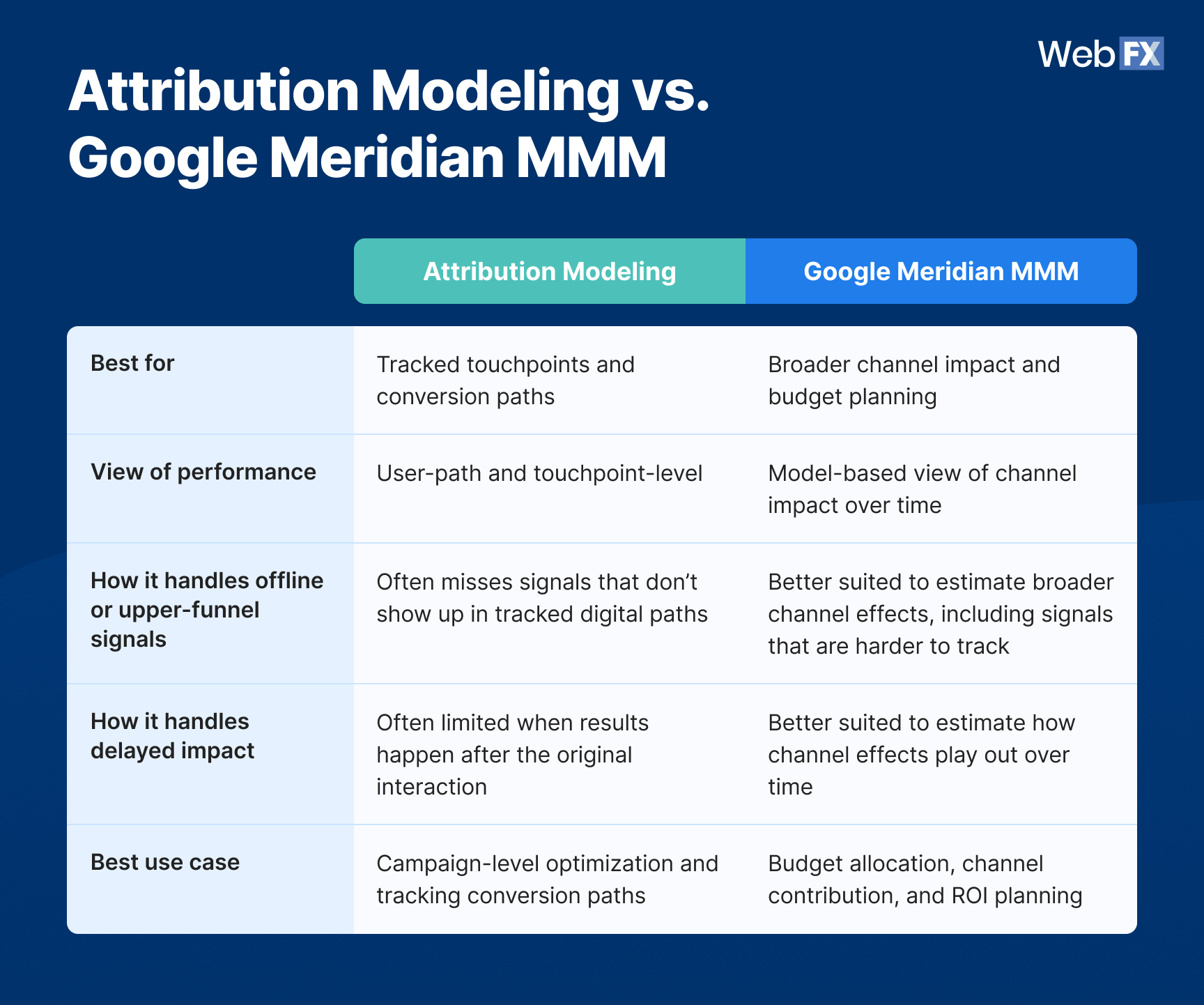
Table view 🔽
Attribution modeling vs. Google Meridian MMM
| Category | Attribution Modeling | Google Meridian MMM |
| Best for | Tracked touchpoints and conversion paths | Broader channel impact and budget planning |
| View of performance | User-path and touchpoint-level | Model-based view of channel impact over time |
| How it handles offline or upper-funnel signals | Often misses signals that don’t show up in tracked digital paths | Better suited to estimate broader channel effects, including signals that are harder to track |
| How it handles delayed impact | Often limited when results happen after the original interaction | Better suited to estimate how channel effects play out over time |
| Best use case | Campaign-level optimization and tracking conversion paths | Budget allocation, channel contribution, and ROI planning |
Many businesses benefit from both marketing mix modeling and attribution. Attribution can help with channel management and tracking conversion paths. Meridian MMM can help with bigger planning decisions, such as where to shift budget and how channels contribute to ROI overall.
Meridian can guide broader budget and channel decisions, but marketers still need campaign-level insights to understand why specific channels may be underdelivering.
For Performance Max campaigns, Performance Max channel diagnostics can surface asset and eligibility issues that may be limiting delivery on specific channels. This gives you a more actionable view of campaign performance.
Does Google Meridian MMM fit your business?
Meridian makes the most sense for businesses with enough data, channel complexity, and budget pressure to justify deeper measurement. That often includes companies with:
- Multiple paid and organic channels
- Longer buying cycles
- Online and offline influences on revenue
- Executive pressure to justify spending
- Enough historical data to support modeling
These traits are typically found in manufacturing, heavy equipment, healthcare, professional services, larger enterprises, and other high-stakes markets.
Meridian may not be the best fit for small teams with limited data or teams investing in a few marketing channels. In those cases, the modeling lift may outweigh the planning value.
How WebFX helps businesses implement and operationalize Meridian
Google Meridian has made MMM more accessible, but setup, integration, interpretation, and optimization take work. Google Meridian certified partners like WebFX can help you operationalize Meridian through:
- Setup support: A Meridian model is only as useful as its setup. Our team helps businesses define the right inputs, outcomes, and business questions in the pre-modeling stage.
- Data integration: We help businesses connect the right data sources so the model reflects a fuller view of your channels’ performance.
- Model interpretation: Once your data is integrated, we help you translate model outputs into decisions on budget allocation, channel weighting, and optimization priorities.
- Ongoing optimization: MMM is an ongoing measurement process. Our team can help your model evolve as your business goals change and media mix patterns shift.
- Practical activation through RevenueCloudFX and RevMixAI: Our proprietary growth platform RevenueCloudFX features RevMixAI, which uses Meridian and Gemini to help you with reallocating your marketing budget, scenario planning, and improving your ROI over time.
As a Meridian beta tester, WebFX brings implementation experience that can help businesses move from “we have a model” to “we know what to do next.”
FAQs
What data do I need to run a Meridian marketing mix model?
To run a Google Meridian marketing mix model, you typically need:
- Historical channel data
- Business outcome data
- Context variables such as seasonality
Complete and consistent data support stronger analysis.
Can Meridian measure both my online and offline marketing channels?
Yes, Meridian can support online and offline marketing channels, provided you have usable aggregated data for those channels and outcomes. That broader view is one reason MMM is useful for complex businesses.
Is Google Meridian suitable for enterprise or mid-market businesses?
Google Meridian suits both midsize and large enterprise businesses.
Larger enterprises are a good fit for Meridian because they typically invest in more marketing channels and have a presence in multiple markets, but that doesn’t mean Meridian is only suited to these companies.
Midsize businesses can use Google Meridian if they:
- Have enough historical data
- Invest in multiple marketing channels
- Need to make budget-allocation decisions
Should my business use Meridian, attribution modeling, or both?
Many businesses benefit from using both because they answer different measurement questions. However, smaller businesses with limited data, shorter sales cycles, and fewer marketing channel investments may not benefit from using MMM.
How much is Google Meridian MMM?
Google Meridian is free to use because it is open-source. However, your investment cost will depend on implementation, modeling expertise, internal resources, and any partner agency support.
WebFX has a track record of success in driving measurable results for businesses like yours.
See how we do it

$10 billion
Revenue Driven For Clients

200+
Industries of Expertise

93%
Client Satisfaction Rating

9:1
Dedicated FXers Per Client
Improve your budgeting and ROI with a certified Google Meridian partner
Gone are the days of blindly spreading your budget evenly across channels. Google Meridian MMM can improve your budgeting, measurement, and ROI.
If your team needs support with setting up, integrating data, and maintaining Google Meridian MMM, you know who to call. WebFX is a Google Meridian beta tester and certified partner that can do the heavy lifting for you.
When you partner with WebFX, you’ll get a team of marketing mix modeling experts dedicated to helping you improve your budgeting and forecasting. You’ll also have access to our proprietary growth platform, RevenueCloudFX, which lets you evaluate and enhance your campaigns’ performance.
Let’s work together toward improved ROI. Contact us online or call us at 888-601-5359 to learn more about our marketing mix modeling services!
-
 Maria is a Lead Content Specialist at WebFX. With nearly two decades of experience in B2B and B2C publishing, marketing, and PR, she has authored hundreds of articles on digital marketing, AI, and SEO to help SMB marketers make informed strategic decisions. Maria has a degree in B.S. Development Communication major in Science Communication, and certifications in inbound marketing, content marketing, Google Analytics, and PR. When she’s not writing, you’ll find her playing with her dogs, running, swimming, or trying to love burpee broad jumps. View full profile
 -

WebFX is a full-service digital marketing agency delivering revenue-driving strategies across online advertising, SEO and AI search optimization, and digital marketing. Backed by 1,100+ client reviews, a 4.9-star rating on Clutch, and proprietary revenue-tracking technology, our team helps businesses grow visibility and revenue across platforms, from Google to ChatGPT to LinkedIn. Discover how our expert team and revenue-accelerating tech can drive results for you. Learn more

Try our free Marketing Calculator
Craft a tailored online marketing strategy! Utilize our free Internet marketing calculator for a custom plan based on your location, reach, timeframe, and budget.
Contents
- What is Google Meridian?
- The businesses that will benefit the most from Meridian marketing mix modeling
- Questions Google Meridian helps marketers answer
- How Google Meridian works for marketing mix modeling
- What marketers get out of the model
- Why setup and interpretation matter so much
- The benefits of Google Meridian for marketers
- Data-driven budget optimization for smarter spending decisions
- Actionable insights for forecasting
- Transparency for easier evaluation
- Flexibility to adapt the model to your business
- Geographic details for precise planning
- How Meridian differs from traditional MMM
- Google Meridian vs. attribution modeling
- Does Google Meridian MMM fit your business?
- How WebFX helps businesses implement and operationalize Meridian
- FAQs
- Improve your budgeting and ROI with MMM experts
Share this article


Proven Marketing Strategies
Try our free Marketing Calculator
Craft a tailored online marketing strategy! Utilize our free Internet marketing calculator for a custom plan based on your location, reach, timeframe, and budget.
What to read next