


Contents
- What is B2B agentic commerce?
- How could agentic commerce help B2B buyers?
- Why is agentic commerce getting attention now?
- What could agentic commerce change for B2B marketers?
- What B2B marketers should not assume about agentic commerce
- How B2B businesses can get ready for agentic commerce
- 1. Make your website easy to understand
- 2. Structure your product and service information
- 3. Strengthen trust signals
- 4. Review your conversion paths
- 5. Monitor AI visibility without overinvesting too early
- Should B2B marketers act on agentic commerce now?
- FAQs about agentic commerce for B2B
- Build a stronger foundation for AI visibility and agentic commerce

At a glance: What is B2B agentic commerce?
- B2B buyers may eventually use AI agents to compare vendors, check product or service details, request quotes, or complete repeat purchases.
- B2B marketers don’t need to overhaul their strategy yet. The better move is to have clear website content, structured product or service information, trust signals, and conversion paths.
- The right approach is preparation, not panic. Learn the agentic commerce space and monitor AI visibility.
B2B agentic commerce is getting more attention as major technology companies build the infrastructure behind AI-assisted buying experiences. Amazon, Meta, Microsoft, Salesforce, and Stripe recently joined the Universal Commerce Protocol (UCP) Tech Council, adding momentum to standards designed to help AI agents interact with commerce systems.
Learn how to start preparing your website, content, data, and trust signals for B2B agentic commerce with these topics:
- What is B2B agentic commerce?
- Why is agentic commerce getting attention now?
- What could agentic commerce change for B2B marketers?
- What B2B marketers should not assume about agentic commerce
- How B2B businesses can get ready for agentic commerce
- Should B2B marketers act on agentic commerce now?
- FAQs about agentic commerce for B2B
What is B2B agentic commerce?
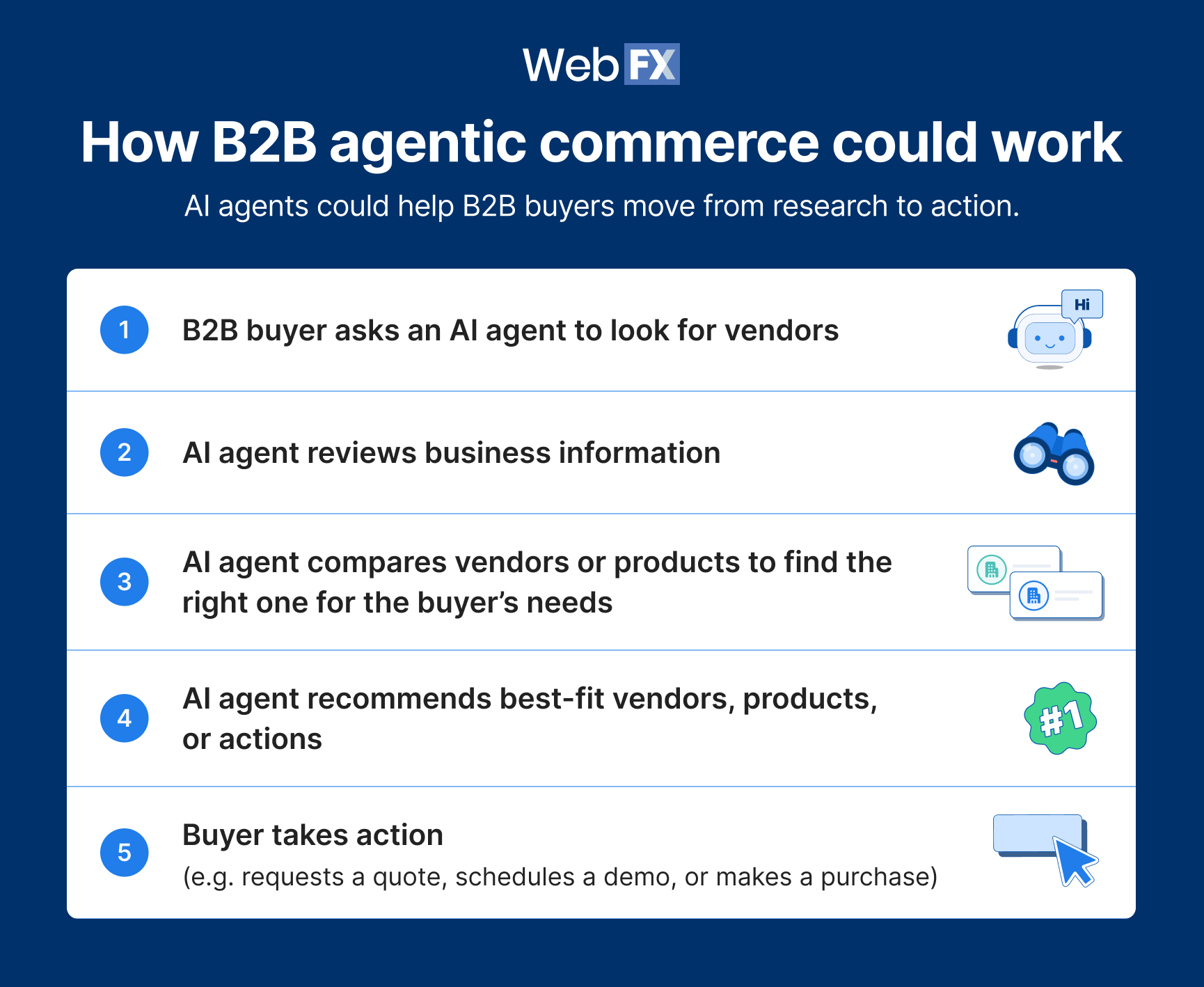
B2B agentic commerce is the use of AI agents to help buyers research, compare, shortlist, and eventually perform buying actions with vendors.
In consumer ecommerce, agentic commerce may look like an AI assistant finding a product in a specific color or size, adding it to cart, and completing checkout for a shopper.
In B2B, the path to purchase is more complex, and different industries have unique needs.
How could agentic commerce help B2B buyers?
Agentic commerce could eventually help B2B buyers do any of the following:
- Find vendors
- Compare solutions
- Check availability or pricing
- Schedule demos
- Request a quote
- Reorder supplies
- Manage repeat procurement
- Compare subscription tiers
- Manage renewals
- Check seat counts, usage limits, or upgrade options
These aren’t distant possibilities. B2B buyers are also turning to AI platforms to do their research today — using tools like Copilot and Gemini to compare vendors, summarize options, and prepare questions before ever speaking with sales.
A software buyer may not ask an agent to “buy a platform” without human review, but they may use an agent to compare plan tiers, summarize renewal terms, identify usage limits, or prepare questions before talking with sales.
B2B buyers are unlikely to hand complex vendor decisions to AI agents overnight. In many B2B purchases, AI agents may influence discovery and comparison long before they complete a transaction.
Why is agentic commerce getting attention now?
Agentic commerce is attracting attention because major technology companies are building infrastructure that enables AI agents to interact with commerce systems more easily.
Google’s Universal Commerce Protocol (UCP) is one such infrastructure. UCP is an open standard designed to help AI agents and commerce systems communicate about products, prices, carts, checkout, payments, and order status.
Instead of relying on custom integrations for each platform and system, businesses can use UCP as a universal bridge for commercial data.
The formation of the UCP Tech Council also matters because it shows that large technology and commerce companies are working together to standardize how AI agents interact with businesses. Amazon, Meta, Microsoft, Salesforce, and Stripe recently joined the council, alongside existing members Google, Shopify, Etsy, Target, and Wayfair.
For marketers, the important takeaway is that an agent-led B2B buying process is becoming more formalized.
That means B2B marketers should pay attention now before agentic commerce becomes crowded or confusing. If AI agents need structured, accurate, and trustworthy business information to recommend vendors, the B2B businesses with cleaner digital foundations may have fewer gaps to fix later.
What could agentic commerce change for B2B marketers?
Agentic commerce could change where and how B2B buyers evaluate solutions and vendors. Your website will still matter, but it may not always be the first place buyers visit to compare their options.
Many B2B buyers visit websites, read service pages, compare proof points, and contact sales when they’re ready. However, AI platforms are becoming a go-to research tool for a growing number of B2B buyers.
In our study of website visits from various industries from 2024 to 2025, Manufacturing, Professional Services, and SaaS B2B categories accounted for about 35% of generative AI traffic in 2025. That finding means AI-assisted research is already part of the B2B buying journey, especially when buyers compare vendors, review specifications, or narrow their options before contacting a company.
In an agentic commerce experience, AI-assisted research could become more action-oriented. A buyer may ask an agent to summarize vendors, compare service offerings, check product details, or recommend next steps before visiting your site.
This change can affect how buyers discover your B2B business, how you measure visibility, and how clearly your business information must be presented to AI agents.
What B2B marketers should not assume about agentic commerce
B2B marketers should take agentic commerce seriously, but they shouldn’t scramble to implement it like it’s the key to growing their bottom lines.
Agentic commerce has more obvious early applications in retail and ecommerce than in complex B2B services. A consumer may let an AI agent buy a pair of shoes in a specific color and size. A B2B buyer evaluating a six-figure software contract, commercial equipment purchase, or professional services engagement will likely need more human review.
B2B buying often involves multiple people, systems, and approval steps. A buyer may need to compare technical specifications, meet with sales, review contracts, involve procurement, check compliance requirements, and plan implementation. Those factors make B2B purchases harder for AI agents to complete from start to finish.
UCP and other commerce standards can make future agentic interactions easier, but you’ll still need proof that your particular B2B buyers are using those experiences before reallocating your budget and efforts to agentic commerce. The right response is education and preparation, not panic.
How B2B businesses can get ready for agentic commerce
B2B marketers don’t need to build an agentic commerce strategy from scratch yet. The better move is to strengthen the digital foundation AI systems may use to understand, compare, and recommend businesses later.
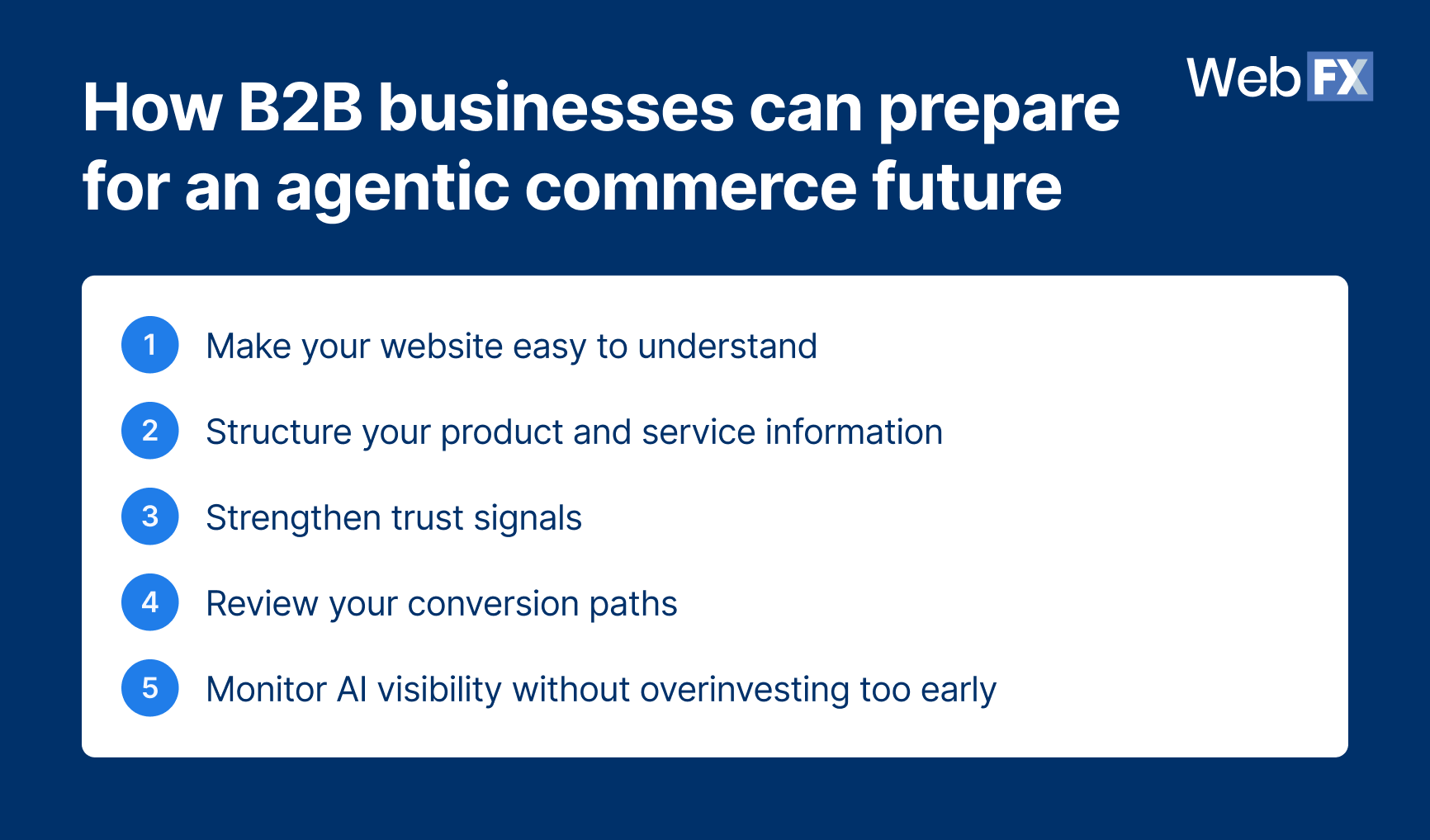
Start with the fundamentals that already support search engine optimization (SEO), generative engine optimization (GEO), buyer trust, and conversion:
- Make your website easy to understand
- Structure your product and service information
- Strengthen trust signals
- Review your conversion paths
- Monitor AI visibility without overinvesting too early
1. Make your website easy to understand
Your website should explain what you offer, who you serve, where you operate, and why buyers should trust you.
That sounds basic, but many B2B websites beat around the bush. Do your service pages use broad language? Are your product pages missing key specs? Do your case studies lack measurable results?
If you answer yes to any of these questions, your buyers and AI systems will find your content vague and may struggle to interpret what your business does. As a result, they might conclude that your business isn’t the right fit.
Review your website for:
- Clear service and product pages
- Plain-language descriptions
- Strong internal links between related pages
- FAQs that answer real buying questions
- Accurate company, location, and contact details
For example, if you market industrial equipment, your website should clearly explain product categories, use cases, service areas, financing options, and maintenance support.
2. Structure your product and service information
“The quickest win for businesses looking to prepare for agentic commerce is ensuring their product or service pages use to-the-point specs, list specific use cases, and provide accurate pricing (or pricing requirements, like needing to request a quote), along with marking up the page with structured data,” advises Sarah B., Lead SEO Consultant at WebFX.
That’s because AI agents need organized information to compare options. For B2B companies, this may include service details, product specs, use cases, integrations, pricing guidance, or quote requirements.
Depending on your business model, this could include:
- Schema where relevant
- Product feeds for catalog-driven businesses
- Service area information
- Pricing or quote guidance when appropriate
- Clear specs, use cases, compatibility details, and integrations
For catalog-driven businesses, structured product data may become especially important. Product names, categories, SKUs, specs, availability, shipping details, and compatibility information can help systems understand what you sell.
For service businesses, structured information may look different. You may need clearer:
- Service pages
- FAQ schema
- Organization schema
- Review schema where eligible
- Location details
- Content that explains your process and qualifications
Use technical markup to support information buyers already need. Your structured data should make your business easier to understand, compare, and verify.
3. Strengthen trust signals
B2B buyers want proof before they shortlist a vendor. If AI systems summarize or compare providers for those buyers, they may also need proof points that support your credibility.
Strengthen trust signals like:
- Case studies
- Reviews and testimonials
- Certifications and awards
- Industry-specific proof
- Original research or expert commentary
- Consistent brand mentions across trusted sources
Trust signals shouldn’t live only on one Testimonials page. Add relevant proof where buyers make decisions, such as on product, service, comparison, pricing, industry, and quote-request pages.
4. Review your conversion paths
If agentic commerce influences how buyers research and compare vendors, some visitors may arrive on your site with more context than a traditional first-time visitor. They may already know what they want, which vendors they’re comparing, or what questions they need answered.
Review the actions and page elements that help buyers move from interest to action:
- Demo forms
- Quote forms
- Meeting schedulers
- Contact options
- Shopping carts or reorder flows
- Sales handoff processes
- Product comparison pages
- Service pages
- Pricing or quote-request pages
For example, if a buyer lands on a comparison page or service page after using AI, can they quickly find the right next step? Can they request a quote without having to dig through multiple pages? Can they schedule a demo, ask a technical question, or contact sales with enough context?
This matters because agentic commerce may compress parts of the research process. A buyer who reaches your site after using AI may already have a shortlist. Your website should help them move forward, not restart their research from scratch.
5. Monitor AI visibility without overinvesting too early
Start by watching how AI systems describe your business and your competitors.
You can use tools like the OmniSEO® platform to monitor prompts your buyers might ask, such as:
- “Best [service] companies for [industry]”
- “Top [product category] suppliers near [location]”
- “Compare [your company] vs. [competitor]”
- “Best [software type] for [use case]”
- “Who provides [service] for [industry] companies?”
Track whether your brand appears, which competitors appear, what information AI systems use, and where answers seem incomplete or inaccurate. You can also use agentic readiness tools like Is It Agent-Ready? to check your website’s content accessibility and bot access control.
Use those findings to improve your website content, structured information, and trust signals.
“Optimize for AI visibility before you rely on agentic commerce,” Dan S., Senior Director at SEO.com, advises. “If your brand doesn’t show up in AI-assisted searches, it probably won’t trigger an agentic commerce session.”
The best approach right now is measured: Learn the space, monitor the shift, and prepare the fundamentals before making large investments.
Should B2B marketers act on agentic commerce now?
Yes, but with the right level of investment.
B2B marketers should learn the space, prepare the fundamentals, and monitor adoption. Most B2B businesses don’t need a full agentic commerce program yet.
Some B2B companies may need to watch the space more closely than others. Businesses with online catalogs, repeat purchasing, subscriptions, self-service ordering, or marketplace-style buying paths already have more structured product or account information. That may make them better positioned for early agentic commerce use cases.
That doesn’t mean these businesses should overhaul their strategy now, though. It means they may have more reason to clean up product data, conversion paths, subscription information, and reorder flows sooner.
For complex B2B services, custom contracts, or high-consideration solutions, the near-term impact will likely show up earlier in the research and comparison stages. In that case, focus on how AI systems describe your business, whether your proof points are easy to find, and whether buyers can take the next step once they reach your site.
A practical approach looks like this:
- Learn the basics of agentic commerce and UCP.
- Review your website for vague or outdated information.
- Make your product, service, and company details clearer and easier to compare.
- Add trust signals like case studies, reviews, certifications, and testimonials.
- Monitor AI visibility and competitor mentions through tools like OmniSEO platform.
- Hold off on major agentic commerce investments until data shows that your buyers are using it.
Prepare, but don’t panic.
FAQs about agentic commerce for B2B
What is agentic commerce?
Agentic commerce is the use of AI agents to help users discover, compare, and complete buying-related tasks. In B2B, agentic commerce may help buyers research vendors, compare solutions, request quotes, schedule demos, manage subscriptions, or complete repeat purchases.
Is agentic commerce the same as AI search?
No. AI search helps users find and summarize information. Agentic commerce goes a step further by allowing AI agents to help users take buying-related actions.
An AI search tool can summarize the top vendors for a specific service. An AI agent can also compare those vendors but do more, like check a buyer’s requirements, add products to a cart, schedule a demo, or start a quote request.
What is UCP?
Universal Commerce Protocol (UCP) is an open standard designed to help AI agents and commerce systems exchange information about products, pricing, carts, checkout, payments, and order status.
For marketers, UCP matters because it signals that major platforms are preparing for a future where AI agents interact more directly with commerce systems.
Will agentic commerce affect B2B companies?
Yes, but the timing and impact will vary by industry and business model.
Agentic commerce may affect catalog-driven, subscription-based, and repeat-purchase B2B companies sooner than complex service businesses. For high-consideration B2B purchases, AI agents may influence research, comparison, and vendor shortlisting before they affect final transactions.
Should B2B marketers optimize for AI agents now?
Yes, but start with fundamentals. B2B marketers should prioritize the following before investing heavily in agentic commerce-specific programs:
- Clear website content
- Structured data
- Trust signals
- Seamless conversion paths
Your goal is to make your business easier for both buyers and AI systems to understand, compare with similar providers, and trust.
What should B2B companies prepare first?
Start with the information AI systems and buyers both need:
- What you offer
- Who you serve
- What makes you credible
- How buyers can take the next step.
That means reviewing service pages, product information, FAQs, case studies, reviews, schema, contact paths, and quote or demo flows.
How is agentic commerce related to SEO and GEO?
Agentic commerce builds on SEO and GEO because AI agents need reliable information to discover, compare, and recommend businesses.
SEO helps your pages appear in traditional search. GEO helps your brand appear in AI-generated answers. Many SEO and GEO best practices, such as clear service pages, schema markup, FAQs, internal links, reviews, and expert content, also help prepare your website for agentic commerce.
Agentic commerce adds another layer. Instead of only helping buyers find information, AI agents may eventually help them take action, such as requesting a quote, comparing vendors, scheduling a demo, or completing a purchase.
How is agentic commerce different from ecommerce automation?
Ecommerce automation usually follows rules set by the business, such as abandoned-cart emails, reorder reminders, or product recommendations.
Agentic commerce centers on the buyer’s AI agent. Instead of only responding to preset business rules, the agent may search, compare, decide, or act based on the buyer’s goals and preferences.
Build a stronger foundation for AI visibility and agentic commerce
Agentic commerce may not reshape B2B buying tomorrow, but AI-assisted discovery is already changing how buyers research vendors. The safest move is to strengthen the same fundamentals that support SEO, AI visibility, and buyer trust with clear content, structured information, credible proof, and seamless conversion paths.
Looking for a partner that can help you with your SEO and GEO efforts? Consider teaming up with WebFX.
We’ve been helping our clients grow their revenue through SEO, GEO, and other digital marketing strategies. Our AI SEO services can help you strengthen the content, trust signals, and visibility foundations that support AI-assisted buying journeys today.
We’re pumped to help you build a stronger foundation for AI visibility and agentic commerce. Contact us online or call us at 888-601-5359 to speak with a strategist about our AI SEO services!
-
 Maria is a Lead Content Specialist at WebFX. With nearly two decades of experience in B2B and B2C publishing, marketing, and PR, she has authored hundreds of articles on digital marketing, AI, and SEO to help SMB marketers make informed strategic decisions. Maria has a degree in B.S. Development Communication major in Science Communication, and certifications in inbound marketing, content marketing, Google Analytics, and PR. When she’s not writing, you’ll find her playing with her dogs, running, swimming, or trying to love burpee broad jumps. View full profile
 -

WebFX is a full-service digital marketing agency delivering revenue-driving strategies across online advertising, SEO and AI search optimization, and digital marketing. Backed by 1,100+ client reviews, a 4.9-star rating on Clutch, and proprietary revenue-tracking technology, our team helps businesses grow visibility and revenue across platforms, from Google to ChatGPT to LinkedIn. Discover how our expert team and revenue-accelerating tech can drive results for you. Learn more

Try our free Marketing Calculator
Craft a tailored online marketing strategy! Utilize our free Internet marketing calculator for a custom plan based on your location, reach, timeframe, and budget.

Contents
- What is B2B agentic commerce?
- How could agentic commerce help B2B buyers?
- Why is agentic commerce getting attention now?
- What could agentic commerce change for B2B marketers?
- What B2B marketers should not assume about agentic commerce
- How B2B businesses can get ready for agentic commerce
- 1. Make your website easy to understand
- 2. Structure your product and service information
- 3. Strengthen trust signals
- 4. Review your conversion paths
- 5. Monitor AI visibility without overinvesting too early
- Should B2B marketers act on agentic commerce now?
- FAQs about agentic commerce for B2B
- Build a stronger foundation for AI visibility and agentic commerce
Share this article


See AI Marketing in Action
Explore how WebFX helped a regional brand get discovered in AI search experiences — proving what’s possible with today’s AI-driven marketing!
Try our free Marketing Calculator
Craft a tailored online marketing strategy! Utilize our free Internet marketing calculator for a custom plan based on your location, reach, timeframe, and budget.