What are ChatGPT ads? ChatGPT ads are paid placements that appear below relevant ChatGPT conversations for eligible users, offering advertisers a way to reach people during conversational AI experiences.
What is generative engine optimization (GEO)? GEO is the process of improving content, brand authority, and online presence so AI tools are more likely to mention, cite, or recommend your business in AI-generated answers, providing long-term compounding visibility.
When should you choose ChatGPT ads first? ChatGPT ads are better for short-term needs like product launches, seasonal promotions, events, or aggressive quarterly pipeline goals where you need immediate results and measurable campaign data for leadership reporting.
When should you prioritize GEO instead? GEO is the better first investment for businesses with long, complex sales cycles where buyers perform heavy research before converting.
How do you measure success for each strategy? ChatGPT ads use traditional paid media metrics like impressions, CPC, conversion rate, and pipeline generated, while GEO tracks AI citation rate, brand mention rate, query coverage, and AI-driven traffic through specialized tools like OmniSEO.
ChatGPT Ads have entered the chat and brought along a new budget question: Should you pay for visibility now through advertising, or invest in generative engine optimization (GEO)?
The answer depends on your goals and needs:
ChatGPT Ads are the better choice if you need urgent visibility for product launches or seasonal promotions. They are paid placements that appear below relevant ChatGPT conversations for eligible users.
GEO is the better first investment if you’re focused on long-term visibility and want your brand to appear in AI-generated answers over time.
Use a combination of both for a stronger strategy: ChatGPT ads for speed and GEO for staying power.
In this guide, we’ll compare ChatGPT ads and GEO, explain when each strategy makes sense and help you decide where to invest first. We’ll cover:
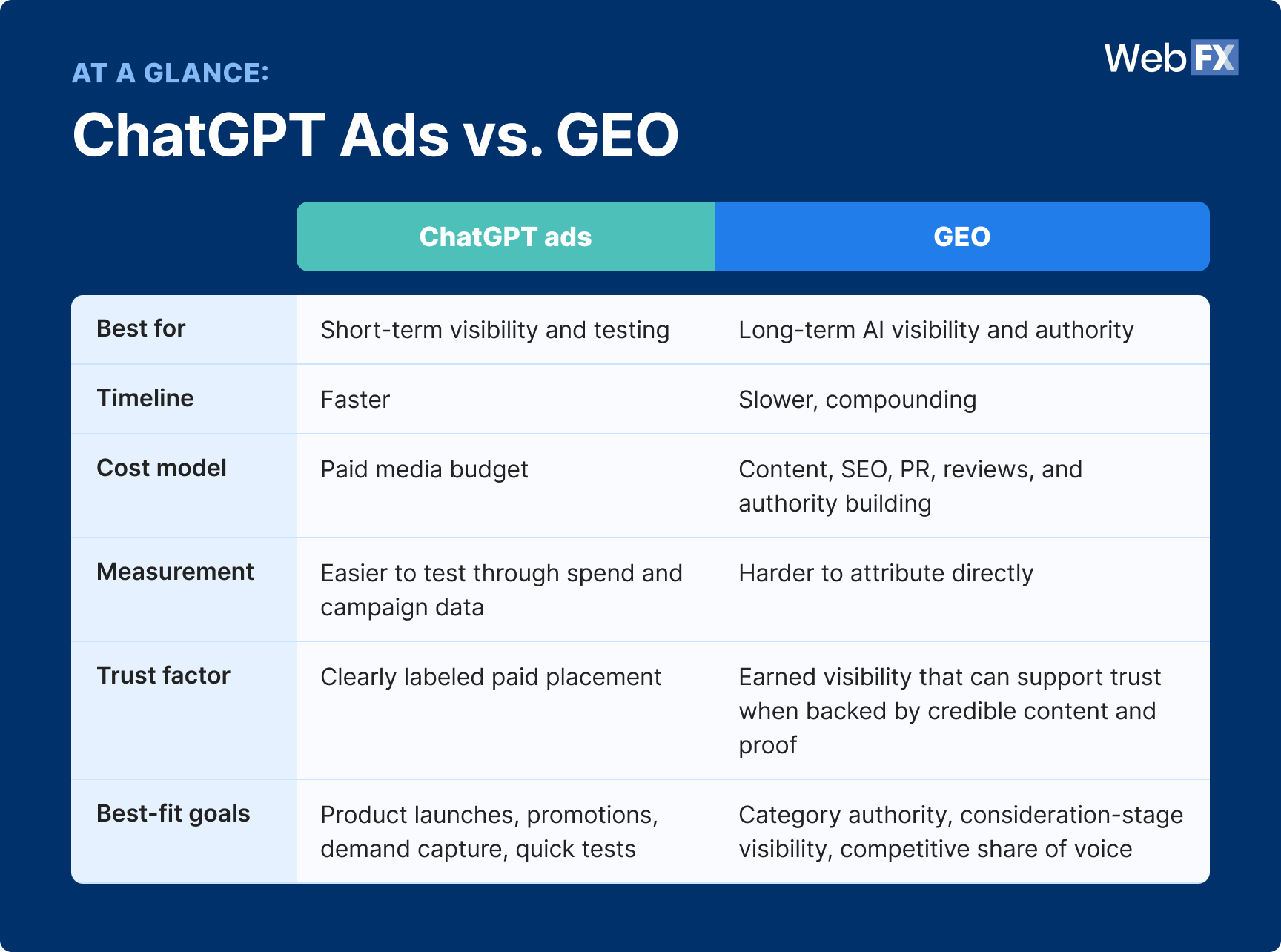
ChatGPT ads and GEO both help brands show up in AI-driven experiences, but they work in different ways. ChatGPT ads are paid placements, while GEO is an organic strategy focused on helping AI tools understand, cite, and recommend your brand.
Choose organic ChatGPT optimization first if you need to educate your prospects or gain their trust before they purchase. This option is typically the priority for businesses with longer sales cycles.
You can use ChatGPT ads to test short-term demand and organic ChatGPT optimization to improve your long-term visibility. By using both, you’re targeting both immediate and future growth opportunities for visibility.
What are ChatGPT ads?
ChatGPT ads are paid placements that can appear below relevant ChatGPT conversations for eligible Free users and Go subscribers. They give advertisers a way to reach people as they explore, compare, and make decisions in a conversational AI experience.
They are labeled paid placements that appear separately from the answer experience. That said, availability varies based on market, user eligibility, and advertiser access, so it’s important to check whether ChatGPT ads are available for your business.
How ChatGPT ads work
ChatGPT ads are different from traditional keyword-based search ads. Instead of matching only to a short search query, ChatGPT ads can use richer conversational context to understand what someone is trying to accomplish.
For example, a traditional search ad might target a phrase like “best CRMs for small businesses.” A ChatGPT ad experience can support a more nuanced conversation, such as a user comparing CRM options for a small sales team, asking about integrations, and seeking to understand pricing or implementation needs.
OpenAI’s guidance says creating ads for ChatGPT requires a different approach from that of keyword-based platforms, since ads are matched to conversational user intent rather than simple search terms. The ads system also uses inputs like context hints, landing pages, ad titles, and ad copy to help determine relevance.
That means the opportunity for your brand is to show up at a critical moment: when users are engaged in a decision-making conversation.
The biggest advantage of ChatGPT ads is speed. Once your campaign is available and approved, paid visibility can start much faster than organic citations or mentions.
ChatGPT ads can also give advertisers:
Faster visibility in AI-assisted search moments
More control over spend
A clearer way to test messaging and offers
Defined campaign goals and performance signals
A more direct path to short-term demand generation for demos, newsletter sign-ups, or quote requests.
That makes ChatGPT ads a stronger fit for:
Launches
Seasonal campaigns
Promotions
Campaigns targeting competitor comparisons
Short-term campaigns to generate leads
Campaigns that need clearer short-term reporting, such as quarterly pipeline pushes, product launches, or tests, where leadership needs early performance data
For marketing teams that need to show early signs of traction, ChatGPT ads may be easier to communicate to leadership because they have a defined budget, timeline, and campaign goal.
Cons of ChatGPT ads
The main downside of ChatGPT ads is that they rely on paid visibility. When the spending stops, the visibility stops, too.
Other limitations include:
Ads don’t automatically make your brand part of organic AI-generated answers.
Some users may not trust a labeled ad and prefer an organic AI-generated recommendation.
Reporting, benchmarks, and best practices are still evolving because ChatGPT ads are newer than established platforms like Google Ads.
Advertisers may need time to understand available formats, measurement, reporting, creative best practices, and campaign benchmarks.
ChatGPT ads require sustained spend to maintain paid visibility.
ChatGPT ads may be less ideal if you need long-term authority, not just visibility. They may also be a weaker fit if you do not have a clear offer to test, cannot sustain paid media spend, or want your brand to appear organically in AI-generated answers.
What is GEO?
GEO, or generative engine optimization, is the process of improving your content, brand authority, and online presence so AI tools are more likely to mention, cite, or recommend your business in AI-generated answers.
📽️ Watch: Intro to Generative Engine Optimization
In this blog post, GEO refers to the organic side of AI visibility, including organic ChatGPT optimization. In other words, GEO is how you improve your chances of being included in AI-generated answers without paying for a labeled ad placement.
How GEO works
GEO works by making your brand’s answers easier for AI tools to find, understand, and use. That means your content needs to:
Answer real buyer questions clearly
Include credible proof
Appear across sources that support your authority.
Strong GEO often depends on several signals working together:
Clear, answer-first content
Well-structured comparison pages
Helpful definitions and explanations
Case studies and first-party data
Reviews and third-party mentions
Expert quotes and author credibility
Consistent brand and service information across the web
GEO is not just “write more content, show you’re an expert, and implement technical SEO.” It is about making your best answers easier for AI tools to find, understand, and use.
“The ‘write for people, use schema markup, demonstrate expertise’ advice isn’t wrong — it’s just incomplete,” says Colton W., Senior Paid Ads Consultant at WebFX. “The tactic most brands are missing is deliberate answer engineering: structuring your content to directly answer the exact phrasing of questions people ask AI models, not just the keyword variations they search on Google.”
For example, a vague service page that says your company offers “innovative solutions for progressive teams” is not very useful for AI-generated answers. A stronger GEO-friendly page explains:
What you do
Who will likely benefit from your products or services
Long-term visibility is the biggest advantage you’ll get from GEO. It can help your brand appear in AI-generated answers, buyer comparisons, and recommendation-style responses over time.
GEO can also help you:
Show up earlier in the buyer’s research process
Build authority beyond traditional search results
Support trust when your brand appears with credible proof
Create visibility that can compound over time
Strengthen content, SEO, PR, reviews, and other authority-building efforts
That makes GEO a stronger fit for businesses with long sales cycles, complex products, or high-consideration services. It is also a good fit if your buyers research before contacting sales, your competitors already appear in AI-generated answers, or you want to build category authority over time.
Cons of GEO
Speed is the biggest issue with GEO. You can’t publish one page and expect immediate AI visibility, because it takes time.
Other limitations include:
Results are harder to control than paid placements.
Attribution is less direct than paid campaign reporting.
You may need to update content, strengthen proof, and build authority across multiple sources.
Competitive categories may take more time and effort.
Results can depend on how AI tools retrieve, interpret, and summarize information.
GEO may be less ideal if you need immediate results. If you lack the resources to maintain content or need short-term campaign reporting for leadership, GEO may not be the perfect fit.
It may also be harder to gain traction if your brand has limited authority, limited proof, or unclear buyer questions to target.
Should you invest in ChatGPT ads or GEO first?
The right first investment depends on your goals, timeline, budget, and buyer journey. Use this simple decision guide to decide where to start:
Choose ChatGPT ads first if you need results fast
Choose GEO first if your buyers perform heavy research before they buy
Use both if you need speed now and authority later
Choose ChatGPT ads first if you need results fast
ChatGPT ads are the better first move when speed matters most for your:
Brand or product launch
Event
Seasonal promotion
Limited-time offer
Aggressive quarterly pipeline goal
ChatGPT ads are also easier to explain when leadership wants near-term performance data. You can set a defined budget, test messaging, and learn whether AI-assisted conversations create qualified demand.
Expert insights from
Colton W.Senior Paid Ads Consultant at WebFX
“If you need measurable pipeline impact within the next quarter, the ChatGPT ad buy is the more defensible choice — it’s a channel with a defined spend, a defined audience, and at least some attribution path.”
If you’re entering a new market and your brand doesn’t appear organically in AI-generated answers yet, ChatGPT ads can help create initial visibility while your GEO efforts are brewing.
Choose GEO first if your buyers do heavy research before they buy
GEO is the better first investment when your buyers need time, education, and trust before they convert.
This is especially true for organizations with long, complex sales cycles, such as B2B companies and professional services firms. Industries like healthcare, which need to cultivate trust among their clients, can also start with GEO.
In these categories, buyers often ask AI tools for comparisons, shortlists, risks, pricing guidance, implementation advice, and vendor recommendations before they ever fill out a form.
“GEO is a compounding investment,” Colton explains. “It builds over months, not weeks.”
He adds: “If your product has a long sales cycle or you’re in a competitive category where buyers do significant research before entering a sales process, GEO is arguably more important than a ChatGPT ad buy.”
Expert insights from
Colton W.Senior Paid Ads Consultant at WebFX
“The brands losing the AI citation game in their category right now are handing upper-funnel mindshare to competitors who will close those buyers later. If your business lives or dies on consideration-stage visibility, that’s where the budget should go.”
If your brand is missing from AI-generated answers, you may lose the chance to even get shortlisted.
GEO also makes sense if you are already investing in SEO and content. Many of the same assets that support organic search visibility — useful pages, strong authority signals, clear expertise, and trustworthy proof — can also support AI visibility.
Use both if you need speed now and authority later
Many companies shouldn’t treat ChatGPT ads and GEO as an either-or decision.
Ads can help you test short-term demand, while GEO builds long-term visibility. GEO can help strengthen content, proof, and brand authority that support your broader AI visibility strategy. Together, they can help you cover both immediate and future opportunities.
A combined strategy can work especially well if:
You are entering a competitive category
You need to fill your sales pipeline in the short term while earning long-term authority
Your competitors already appear in AI-generated answers
You want to test which topics or prompts produce qualified demand
You are already investing in content, SEO, review management, or digital PR
The key is to avoid treating paid visibility as a substitute for organic AI visibility. ChatGPT ads can help you show up faster, but GEO helps you build visibility that can last beyond a single campaign.
Get Help Showing Up in ChatGPT
A strategist will review your goals, timeline, and buyer journey, then shows you where to invest first.
Measurement is one of the biggest differences between ChatGPT ads and GEO.
ChatGPT ads are easier to evaluate like a paid media channel. GEO is better measured as a visibility, authority, and market-position channel.
How to measure ChatGPT ads performance
ChatGPT ads should be measured against specific campaign goals.
Before launching your campaign, decide what success looks like: Are you trying to promote a product, generate leads, increase awareness, or test a new offer?
Potential ChatGPT ads metrics include:
Impressions
Clicks
Cost per click (CPC)
Conversion rate
Cost per lead (CPL)
Assisted conversions
Pipeline generated
Campaign-level lift
Because ChatGPT ads are newer than many paid channels, marketers shouldn’t compare their ChatGPT ads performance with pay-per-click (PPC) benchmarks.
That’s because the context and user behavior are different. Based on our recent study of generative AI traffic, users referred by generative AI consistently converted at higher rates than those from organic search throughout 2025 across industries. The SaaS and Retail industries had AI referrals convert at more than 50%, while organic search conversions were at 20–30%.
The best first step is to run a focused test tied to your clear goal, then compare performance against your other paid channels and your internal expectations.
How to measure GEO
GEO measurement is less about one campaign dashboard and more about tracking whether your brand is gaining visibility in AI-generated answers.
Tools like OmniSEO® can also make GEO measurement more practical by helping you track AI visibility, brand mentions, and query coverage across AI search experiences.
Why GEO results are harder to attribute but still worth tracking
Paid ads tell you what happened after someone clicked. GEO helps you see whether your brand made it into the conversation at all.
That is why GEO attribution can feel less clean than paid media attribution. A buyer may see your brand in an AI-generated answer, search for you later, visit your website directly, read reviews, and then convert through another channel. If you only look at last-click attribution, GEO may not get the credit it deserves.
Instead of measuring GEO with one metric, look at a group of indicators:
Is AI-referred traffic increasing?
Is your brand appearing for more high-value prompts?
Are AI tools citing your content more often?
Are competitors showing up more or less often than you?
Are AI-assisted visitors converting?
Are branded searches increasing after AI visibility improves?
GEO is not always a clean direct-response channel. It is often a visibility and trust channel that supports the buyer journey before the final conversion.
How to test ChatGPT ads before scaling spend
You don’t need to start with a huge ChatGPT ads budget. A focused test can help you learn whether the channel deserves more investment.
Start with one clear campaign goal, such as:
Demo requests
Product launch traffic
Competitive comparison traffic
High-margin service inquiries
Event registrations
Then compare performance against prompts or topics where your brand has weak organic AI visibility. If your brand doesn’t appear organically for high-value AI conversations, ChatGPT ads may help you test whether those conversations have commercial value.
Use the test to answer practical questions:
Which conversational intents seem most valuable?
Which offers get the strongest response?
Do AI-assisted users convert?
How does lead quality compare with other paid channels?
Should you scale spend, adjust messaging, or invest more in GEO?
This approach keeps paid testing disciplined and helps you avoid spending before you know what works.
What to do after you choose ChatGPT ads, GEO, or both
Once you decide where to invest first, the next step is focus. Don’t try to do everything at once.
Choose the path that fits your most urgent business goal, then build from there.
If you choose ChatGPT ads first
Start with one high-intent offer or audience segment. Avoid launching too many campaigns at once before you understand how people respond in an AI-assisted environment.
Define your success metrics. Track the metrics relevant to your goal. Look at CPL and CPC if your goal is conversion-related.
Use campaign insights to support your organic strategy. If certain topics, questions, or offers perform well in paid campaigns, they may also be worth supporting with GEO-focused content.
Don’t treat paid visibility as a replacement for organic AI visibility. Ads can help you show up, but they don’t automatically make your brand part of AI-generated recommendations.
If you choose GEO first
Identify the questions buyers ask before they search for your brand directly. These are often comparison, cost, problem, and recommendation questions.
Audit your existing content. Does it answer user questions clearly? Does it provide enough proof? Does it include specific examples? Would an AI tool be able to extract a complete, helpful answer from the page?
Strengthen the signals that support your credibility. Use expert quotes and first-party data to boost your authority in your niche. Publish case studies and customer reviews for social proof.
If you choose both
Define a different job for each channel. Use ChatGPT ads to test short-term demand. Use GEO to build long-term visibility and authority.
Compare paid performance with organic AI visibility. If ads perform well for a topic where your brand doesn’t appear organically, that may signal a GEO opportunity. If your brand already appears organically for certain prompts, you may decide to spend paid budget elsewhere.
Use paid and organic insights to make each channel smarter.
ChatGPT ads are better when you need faster paid visibility, clearer short-term testing, and more defined campaign measurement. GEO is better when you want to build long-term visibility, authority, and presence in AI-generated recommendations.
The best option depends on your goal. If you need results quickly, start with ads. If you need long-term research-stage visibility, start with GEO. If you need both, use both.
No. ChatGPT paid ads do not affect organic AI-generated answers and should be treated as separate. ChatGPT ads can create paid visibility, but they don’t influence organic recommendations.
This is important for accuracy and trust. Buying ads may help your brand appear as a labeled paid placement, but it doesn’t mean your brand will automatically appear in ChatGPT’s organic answers.
Not exactly. GEO and SEO overlap, but they are not identical.
SEO focuses on improving visibility in traditional search results. GEO focuses on improving visibility in AI-generated answers across tools like ChatGPT and other generative search experiences.
GEO emphasizes clear, extractable answers, entity authority, third-party proof, and content that AI tools can summarize or cite. Strong SEO can support GEO, but GEO requires thinking beyond rankings and clicks.
ChatGPT ads and GEO shouldn’t compete for the same job. ChatGPT ads help you buy visibility, while GEO helps you earn visibility in AI-generated recommendations.
If you’re not sure about which strategy to prioritize, let WebFX help you evaluate your AI visibility and identify ChatGPT ad opportunities.
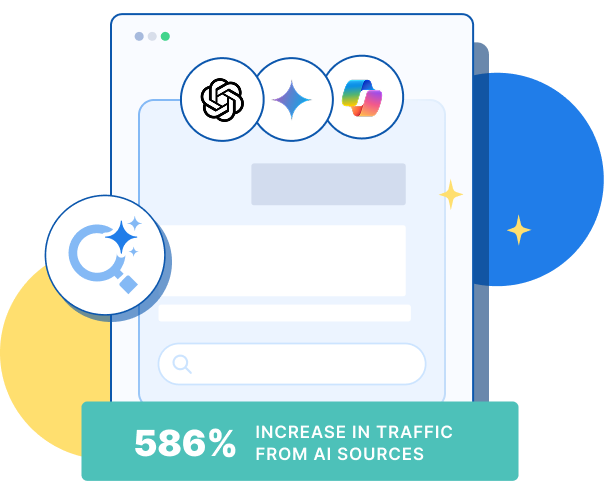
We have over 30 years of experience helping clients grow their revenue through digital marketing. Recently, we’ve helped clients generate over 12,335 leads through AI-driven traffic sources!
Buy Visibility Today. Earn It for Tomorrow.
Get a plan that pairs ChatGPT ads for quick wins with GEO for visibility that compounds.
Craft a tailored online marketing strategy! Utilize our free Internet marketing calculator for a custom plan based on your location, reach, timeframe, and budget.
Craft a tailored online marketing strategy! Utilize our free Internet marketing calculator for a custom plan based on your location, reach, timeframe, and budget.
Maria is a Lead Content Specialist at WebFX. With nearly two decades of…
More
Maria is a Lead Content Specialist at WebFX. With nearly two decades of experience in B2B and B2C publishing, marketing, and PR, she has authored hundreds of articles on digital marketing, AI, and SEO to help SMB marketers make informed strategic decisions. Maria has a degree in B.S. Development Communication major in Science Communication, and certifications in inbound marketing, content marketing, Google Analytics, and PR. When she's not writing, you'll find her playing with her dogs, running, swimming, or trying to love burpee broad jumps. Hide








 Maria is a Lead Content Specialist at WebFX. With nearly two decades of experience in B2B and B2C publishing, marketing, and PR, she has authored hundreds of articles on digital marketing, AI, and SEO to help SMB marketers make informed strategic decisions. Maria has a degree in B.S. Development Communication major in Science Communication, and certifications in inbound marketing, content marketing, Google Analytics, and PR. When she’s not writing, you’ll find her playing with her dogs, running, swimming, or trying to love burpee broad jumps. View full profile