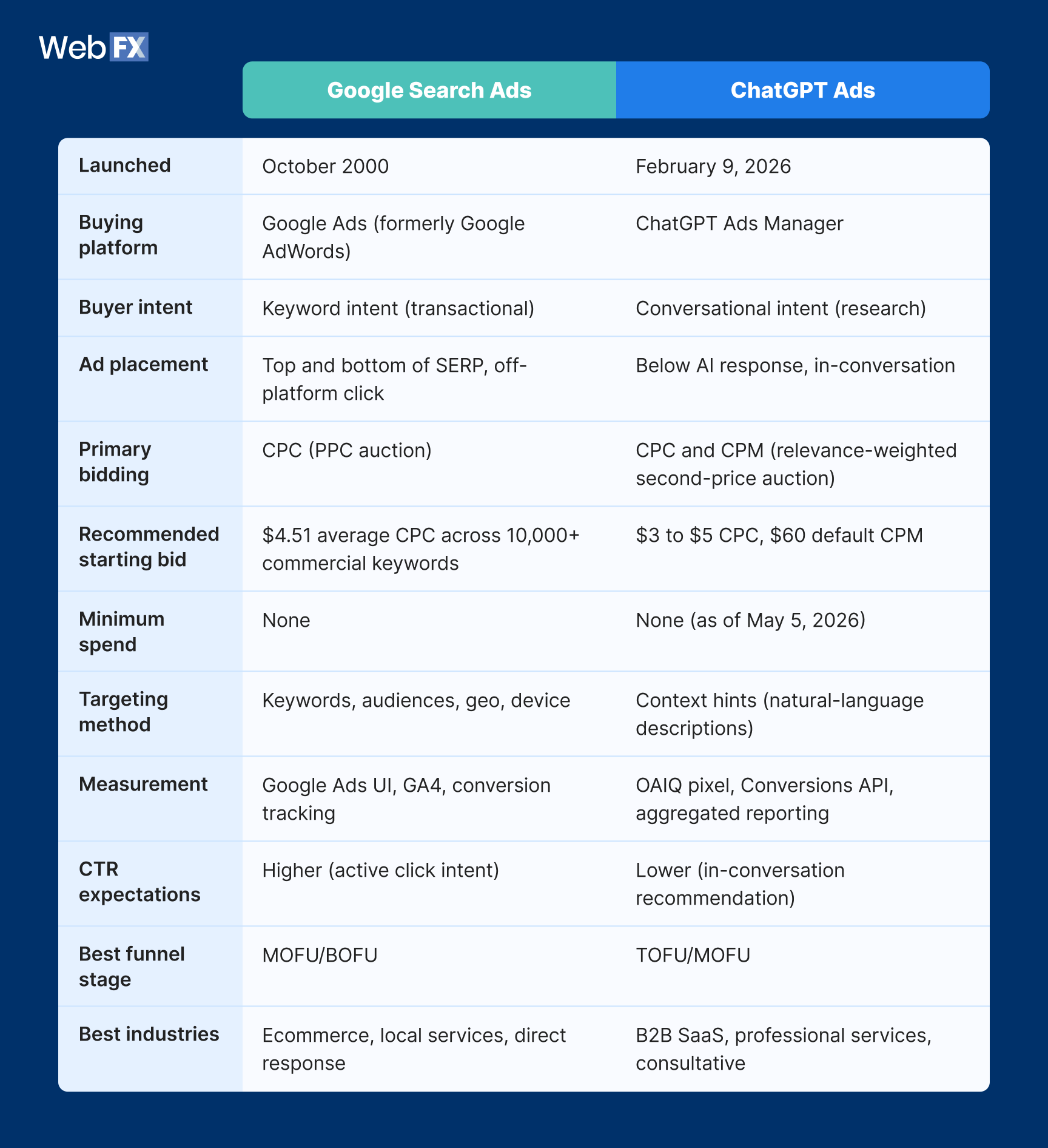
The 7 key differences between ChatGPT ads and Google search ads include:
1. Buyer intent (Google targets keyword-based searches for specific products/services, while ChatGPT targets conversational research questions)
2. Ad formats and placement (Google shows text links above/below organic results that send users off-platform, while ChatGPT shows sponsored cards below AI responses that keep users in-conversation)
3. Cost and bidding models (Both now support CPC bidding, with Google having no minimum spend and ChatGPT starting at $3-5 per click with the $50,000 pilot minimum removed as of May 2026)
4. Targeting capabilities (Google uses keyword targeting with granular controls like match types and demographics, while ChatGPT uses context hints with no keyword targeting or demographic data)
5. Measurement and ROI (Google offers mature reporting through Google Ads UI and GA4 with 4-6% average CTR, while ChatGPT now has pixel-based measurement with 0.68% average CTR)
6. Industry fit (ChatGPT benefits B2B SaaS, professional services, and high-consideration purchases, while Google benefits ecommerce, local services, and emergency services)
7. Strategic timing (Google captures existing demand from ready-to-buy customers, while ChatGPT influences buyers during early research and comparison phases)
Google search ads target buyers through keyword-based searches, often around a specific product, service, or problem. ChatGPT ads appear within conversational, back-and-forth research experiences where users ask broader or more detailed questions.
For example, someone on Google might search ‘CRM software pricing,’ while someone in ChatGPT might ask, ‘What’s the best CRM for a 20-person sales team that integrates with Salesforce?’
Many brands are starting to invest in both. Google search ads help capture traditional search intent, while ChatGPT ads create visibility inside AI-driven research and recommendation journeys.
This guide compares the two platforms across buyer intent, ad formats, cost, targeting, measurement and ROI, funnel stage, and where each one fits inside your marketing strategy.
Google search ads and ChatGPT ads differ across seven core dimensions: intent, formats, cost, targeting, measurement and ROI, funnel stage, and best fit. The table below covers those alongside platform basics like launch date, recommended starting bid, and minimum spend, with each platform’s position as of May 2026.
How buyer intent differs between ChatGPT ads and Google ads
Google search ads target keyword intent. ChatGPT ads target conversational intent. The distinction matters because the two intent types map to different stages of the same buyer journey.
Google search ads capture users who have already narrowed their decision and are typing transactional, bottom-funnel queries: “buy CRM software,” “plumber near me,” “Salesforce pricing.” The user knows what they want and is one click from converting.
ChatGPT ads, by contrast, appear inside research and comparison conversations: “what’s the best CRM for a 20-person sales team,” “how do I choose between Salesforce and HubSpot,” “is Salesforce worth it for B2B.”
The research-to-action gap
There’s a structural gap between where buyers research and where they convert, and most advertisers are only covering one side of it. Call it the research-to-action gap: AI platforms like ChatGPT dominate exploratory discovery, while search engines like Google dominate execution intent.
A buyer asks ChatGPT for the best options, then opens a new tab and Googles the brand by name to convert. Brands that only run Google search ads catch the second click but never enter the consideration set in the first place. Brands that only run ChatGPT ads get into the consideration set but lose the conversion to whoever owns the branded SERP.
The full-funnel play is to show up on both sides of the gap.
How each platform places and formats ads
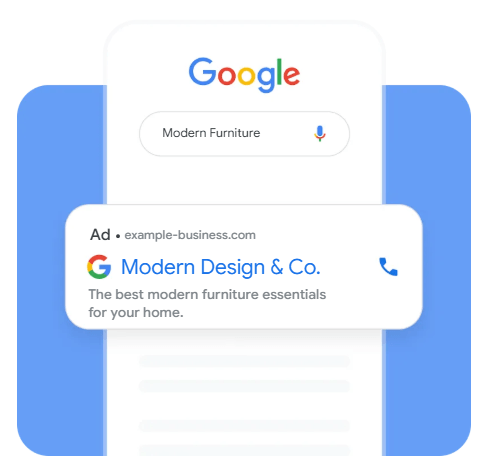
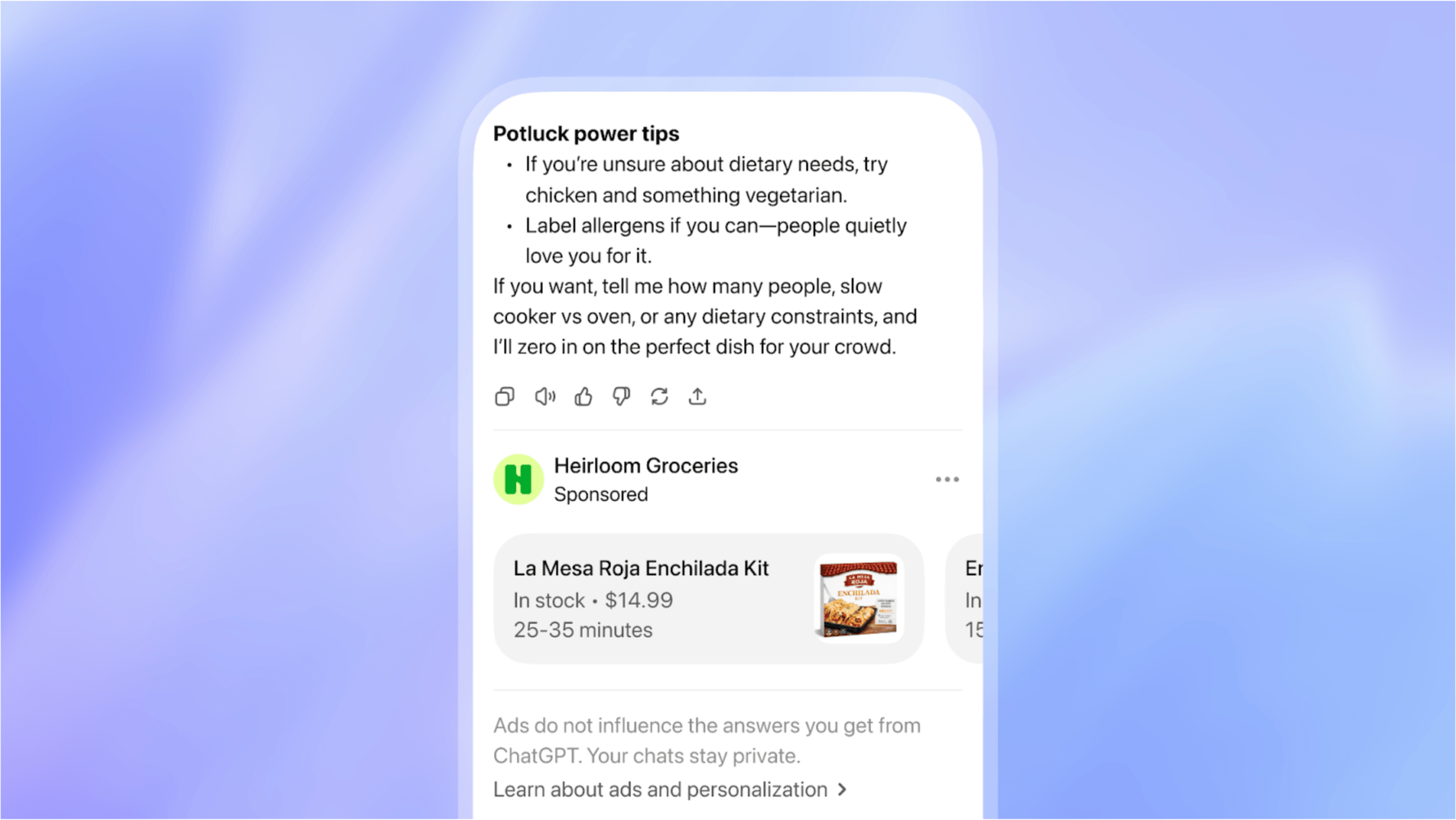
Google search ads appear as text links above and below organic results and send users off-platform. ChatGPT ads appear as clearly labeled sponsored cards below the AI’s response and keep users in-conversation.
Google’s placement library is mature. Text ads, shopping ads, sitelinks, callouts, structured snippets, and image extensions all give advertisers multiple surfaces to compete for visibility on a single SERP. The user clicks, lands on your site, and converts (or doesn’t) in the same session.
A Google search ad appears at the top of the search results page, marked “Ad” and sending the user off-platform when clicked. Source: Google.
ChatGPT’s placement is simpler by design. A single sponsored card appears below the AI’s organic answer, with the advertiser’s name, favicon, ad title, copy, image, and a landing page link. OpenAI calls this “answer independence”: the ad system runs on infrastructure that is physically separate from the model generating ChatGPT’s responses, so advertising dollars cannot influence what ChatGPT actually says.
A ChatGPT ad appears as a clearly labeled sponsored card below the AI’s organic answer. Source: OpenAI.
The trade-off for that independence is reach. Ads only appear for logged-in adult users on the Free and Go subscription tiers in the U.S., Canada, Australia, and New Zealand. Pro, Business, Enterprise, and Education tiers see no ads at all, which removes a large slice of high-value B2B buyers from the addressable audience.
ChatGPT ads vs. Google ads cost and bidding models
Both platforms now support cost-per-click (CPC) bidding. Google Ads runs on a CPC auction with quality score weighting and no minimum spend. ChatGPT Ads use a relevance-weighted second-price auction with two bidding options: CPC starting at a recommended $3 to $5 per click, or CPM with a $60 default (observed closer to $25 in early pilots).
Here’s what changed in 2026 that most comparison articles haven’t caught up to:
CPC bidding for ChatGPT ads went live April 21, 2026, then rolled out broadly with the self-serve Ads Manager on May 5.
The $50,000 pilot minimum is gone. Any approved advertiser can set a budget that fits their test.
Measurement Pixel and Conversions API are now live, closing most of the measurement gap that defined the early pilot.
That combination matters because the dominant “ChatGPT is premium-only, Google is flexible” framing was true in February 2026 and false by May. SMBs, startups, and in-house teams can now buy ChatGPT ads at the same budget level they’d test a new Google ad campaign.
The strategic implication is the first-mover window. ChatGPT CPCs are currently soft at $3 to $5 because almost no advertisers in any given vertical have hands-on optimization data yet. Twelve months from now, those CPCs will look very different.
ChatGPT ads vs. Google ads targeting
Google Ads uses keyword targeting with granular control layers. ChatGPT Ads use context hints, which are natural-language descriptions of the conversations where your product is relevant, with no keyword targeting and no demographic profile data.
Google’s targeting stack is the most developed in digital advertising. Advertisers control match types (broad, phrase, exact), negative keywords, geo radius, device, day-parting, audience segments, and remarketing pools. The platform optimizes against historical click and conversion data per keyword combination.
ChatGPT’s targeting works differently. Instead of selecting keywords, advertisers write descriptions of the questions, needs, or situations users bring to ChatGPT, and the platform’s inference engine matches ads to conversations.
Advertisers receive only aggregated performance data. Chats, names, email addresses, IP addresses, and precise locations stay inside ChatGPT and never reach the advertiser. That privacy posture is non-negotiable in OpenAI’s product design, and it’s the trade-off for ChatGPT’s contextual relevance.
The creative implication is straightforward. ChatGPT rewards specific, intent-matched offers far more than generic brand messaging, because the matching happens at the conversation level rather than the keyword level. Google rewards tight ad groups built around keyword-aligned headlines.
Get an Ads Strategy Built for How Buyers Ask and Search
Click-through rate (CTR) shows where the two platforms still diverge most clearly. The average CTR for Google Ads sits at 4-6% with top-position ads averaging closer to 7.94%. Similarweb data shows ChatGPT ads currently average a 0.68% CTR overall, with top-quartile advertisers reaching 1.0% and best-in-class brands hitting 1.57%. That gap is what you’d expect from in-conversation recommendation placements where the goal is recall, not immediate click.
The bigger ROI question is what you’re measuring. Three things worth tracking differently:
Assisted conversions. ChatGPT ads often influence a decision before the user converts through a different channel. Last-click attribution undercounts that influence by default.
Brand search lift. A successful ChatGPT campaign should show up as a measurable bump in branded Google searches for your name within two to four weeks.
AI citation and visibility. Whether your brand gets mentioned organically inside ChatGPT, Google AI Overviews, and other AI search experiences is now part of the same discovery layer as paid placement.
That third metric is where most advertisers have no visibility at all, which is the problem OmniSEO® was built to solve. OmniSEO® tracks where your brand shows up across AI search experiences, monitors citation rates, and gives you the same kind of dashboard for AI visibility that you’ve had for SEO and PPC for years. Pairing it with the Measurement Pixel and your Google Ads conversion data closes the attribution loop across both platforms.
Which industries benefit most from each platform
Industry fit shifts the math on which platform deserves the larger budget share. Some verticals convert almost entirely through high-intent search; others spend weeks in research before any direct query happens.
Industries that benefit most from Google search ads:
Ecommerce and direct-response retail
Local services (HVAC, plumbing, roofing, electricians)
Emergency services
Legal services
Home services
Travel and hospitality with date-specific intent
The pattern is consistent. ChatGPT wins where the buyer’s first question is “which option should I consider,” and Google wins where the buyer’s first question is “who can I hire right now.” Brands selling into both moments need budget on both platforms.
When to choose ChatGPT ads vs. Google search ads (or both)
Choose Google search ads when you need to capture existing demand from buyers ready to act. Choose ChatGPT ads when you need to influence buyers earlier, during research and comparison. Run both when your sales cycle includes both moments, which is true for most B2B and high-consideration brands.
Run Google search ads if you:
Sell products with clear keyword demand
Run direct-response or ecommerce campaigns
Need granular geo, device, or audience targeting
Want immediate, measurable conversions on a same-session basis
Operate in a local service category
Run ChatGPT ads if you:
Sell B2B SaaS, professional services, or consultative offerings
Target buyers who research before they purchase
Want to capture share of voice in “best of” and comparison conversations
Can wait for brand-lift and assisted conversion data
Want to lock in early-mover CPCs before competition arrives
Brands that wait until 2027 to test ChatGPT ads will be benchmarking against competitors with 12 months of context-hint optimization data, lower CPCs locked in by relevance scoring, and a track record of citations in commercial conversations. That gap will be expensive to close.
Expert insights from
Colton W.Sr. PPC Consultant at WebFX
“The biggest mistake is treating them as if they operate in a silo and are not influencing one another. Google is built primarily to capture existing, high-intent demand, while ChatGPT offers a unique opportunity to shape a buyer’s journey and perception of your brand during the formative research stage. If you’re only focused on the bottom of the funnel, you’re missing the chance to influence the decision process that leads to them searching a particular keyword and seeing/clicking your Google ad.”
Neither is universally better. ChatGPT ads perform better for research-stage conversations and B2B consideration. Google search ads perform better for direct-response purchases and high-intent transactional queries. Most full-funnel brands run both.
The cost of ChatGPT ads starts at a recommended $3 to $5 CPC starting bid or a default $60 CPM, with no minimum spend since May 5, 2026. Google search ad CPCs average $4.51 across industries based on WebFX’s analysis of 10,000+ commercial keywords, with legal services and insurance topping $67 per click.
No. ChatGPT ads use context hints, which are natural-language descriptions of the conversations where your product is relevant, rather than exact-match keywords. The platform’s inference engine matches ads to conversations based on those descriptions.
No. OpenAI’s “answer independence” principle keeps ad delivery on infrastructure that is physically separate from the model generating ChatGPT’s responses. Advertisers cannot pay for placement inside an answer, only inside a clearly labeled sponsored card below the answer.
Most SMBs should start with Google search ads to capture existing demand, then layer in ChatGPT ads once their offer and landing pages are converting reliably. The exception is B2B SaaS and consultative services, where ChatGPT’s first-mover window may be worth a parallel test from day one.
Get a ChatGPT Ads and Google Ads strategy that drives revenue
ChatGPT ads compared to Google search ads is no longer a question of which channel wins. It’s a question of which moment in the buyer journey you can afford to lose.
Google still owns the last click. ChatGPT now owns the consideration phase that decides which last click happens. The brands that show up on both sides of the research-to-action gap close more revenue, faster, with less wasted spend on either side. That’s the strategy WebFX builds for clients.
Own the Research Moment and the Search That Follows
One coordinated ad strategy puts your brand in ChatGPT comparisons and at the top of branded Google results.
With more than $10 billion in client revenue generated, 30+ years of digital marketing experience, and a 91% client retention rate, the WebFX team of 750+ experts manages full-funnel paid campaigns across Google Ads, ChatGPT Ads, and emerging advertising channels.
Craft a tailored online marketing strategy! Utilize our free Internet marketing calculator for a custom plan based on your location, reach, timeframe, and budget.
Craft a tailored online marketing strategy! Utilize our free Internet marketing calculator for a custom plan based on your location, reach, timeframe, and budget.

![Compare ChatGPT ads vs. Google search ads on intent, cost, targeting, CTR, and ROI. See which platform fits your goals in [stat current-year] and where to invest first.](https://www.webfx.com/wp-content/uploads/2026/05/052606_chatgpt_ads_vs_google_search_ads-1-scaled.png)





 Albert Dandy Velasquez blends SEO strategy with compelling storytelling to help businesses boost their visibility and revenue online. With a B.A. in English and certifications from HubSpot, Semrush, and Google Analytics, he has written and optimized hundreds of articles on organic SEO, content strategy, and user experience. He regularly contributes to the WebFX blog and SEO.com, creating content that helps readers turn marketing goals into measurable results. When he’s off the clock, he’s usually exploring new neighborhoods on two wheels, filming travel content, or chasing golden hour with a coffee in hand. View full profile