


Table of Contents
- Where Claude fits in a modern marketing stack
- How to use Claude AI for marketing
- 1. Deep market and customer research
- 2. Brand-safe content strategy and briefing
- 3. SEO content clustering and intent mapping
- 4. Campaign planning and message development
- 5. Data analysis and synthesis
- Claude prompt and workflow kit [with free downloadable guide]
- Prompting best practices for on-brand marketing results
- Claude vs. ChatGPT: Which one is better for marketing?
- 4 common mistakes marketers make when using Claude (plus what to do instead)
- 1. Using Claude like a search engine
- 2. Publishing first drafts
- 3. Skipping brand context
- 4. Using it to define strategy
- FAQs
- Get the most value from Claude
- Claude AI works best when marketers use it within defined workflows, not one-off prompts.
- Claude excels at research, synthesis, and planning, not final decision-making.
- The fastest teams move from AI experiments to repeatable AI operations.
Claude AI helps marketing teams research audiences, organize ideas, build content briefs, map SEO topics, and synthesize large sets of data faster. The best way to use Claude for marketing is within clear workflows, with trusted source material, brand context, and human review.
In this guide, you’ll learn practical Claude use cases for marketing and business, plus prompt tips that help your team work faster without losing quality or brand consistency.
- Where Claude fits in a modern marketing stack
- How to use Claude AI for marketing
- Prompting best practices for on-brand marketing results
- Claude prompt and workflow kit [with free downloadable guide]
- Claude vs. ChatGPT: When is it best to use one over the other?
- 4 common mistakes marketers make when using Claude
- FAQs
Where Claude fits in a modern marketing stack
Claude AI is particularly strong at tasks that require reasoning, synthesis, and long-context understanding. That makes it a valuable support tool for marketers working with any of the following:
- Large volumes of information (such as years of campaign notes and feedback)
- Complex inputs (like multiple audience segments and channels in one campaign)
- Nuanced brand considerations (such as tone, compliance, and positioning)
In practice, Claude fits best as a research and planning assistant. It works alongside your human experts and existing tools, not as a replacement for them.
For example, a dermatology practice could use Claude to summarize customer reviews from various platforms to identify language patterns and recurring complaints. It should not replace your team members or analytics platform when reporting campaign performance.
Understanding this distinction early helps teams avoid misuse and disappointment. That said, Claude is not suited for these tasks:
- Replacing human judgment
- Real-time data reporting
- Defining your business strategy
How to use Claude AI for marketing
The most effective teams use Claude at specific moments, when they need to:
- Analyze information
- Organize ideas, or
- Prepare structured inputs for human decision-making
Let’s walk through those moments that show how marketers can use Claude within defined workflows that support quality, efficiency, and brand safety.

5 marketing workflows where Claude AI adds value
Let’s go through each one:
1. Deep market and customer research
Claude excels at making sense of large qualitative datasets, especially when those datasets come from operational systems that marketers don’t always have time to analyze deeply.
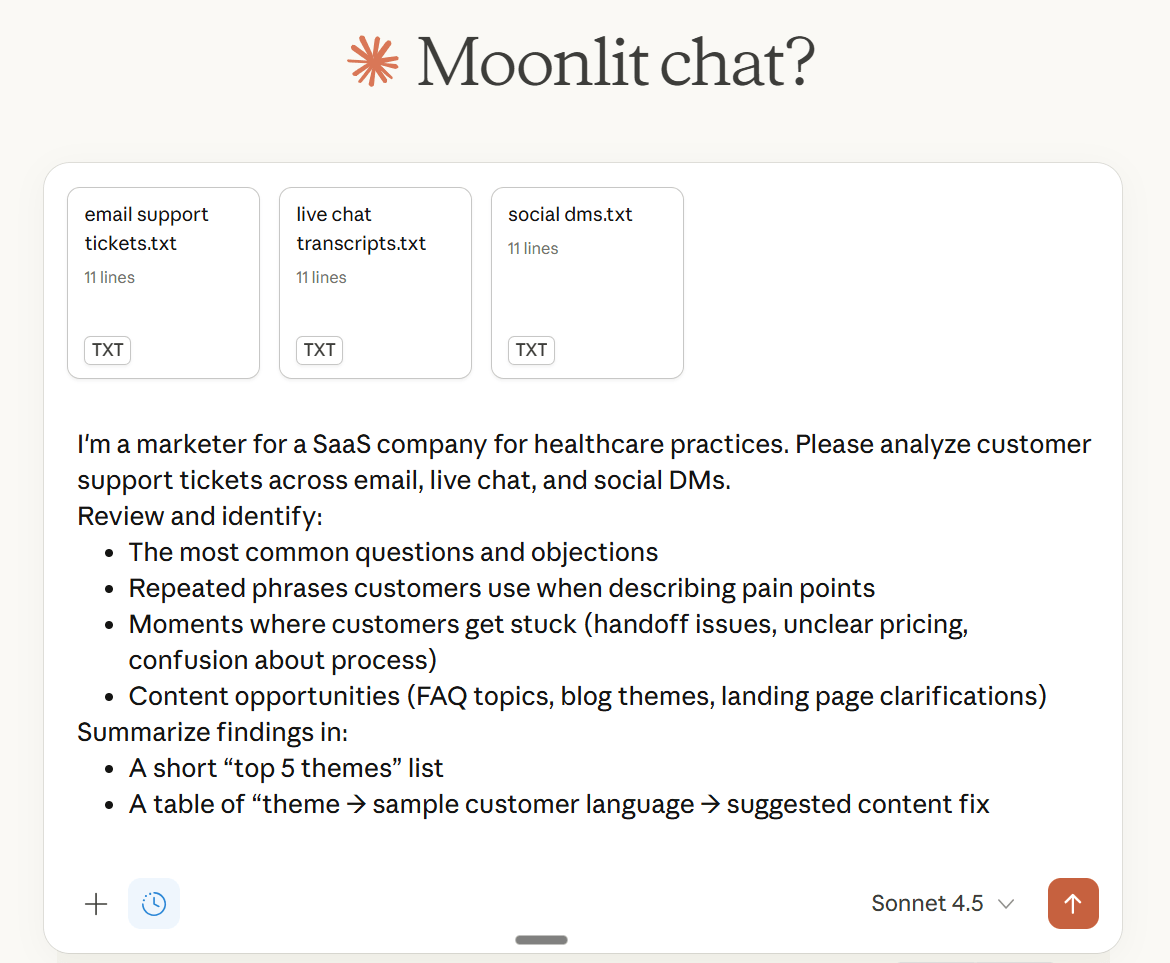
For example, a SaaS company for healthcare practices could use it to analyze hundreds of support tickets related to onboarding, integrations, and feature requests. Claude can help identify recurring pain points, commonly used phrases, and patterns that indicate why prospects hesitate or churn.
That synthesis gives your team a clearer starting point for refining positioning, content themes, and FAQs.
2. Brand-safe content strategy and briefing
Claude and other AI tools work best for content writing, drafting, outlining, and structuring content.
However, it’s essential to ensure you take the time to learn how to use AI content creation effectively and train your AI tool on your brand style and guidelines, your personas, search ranking factors, content standards, and more.
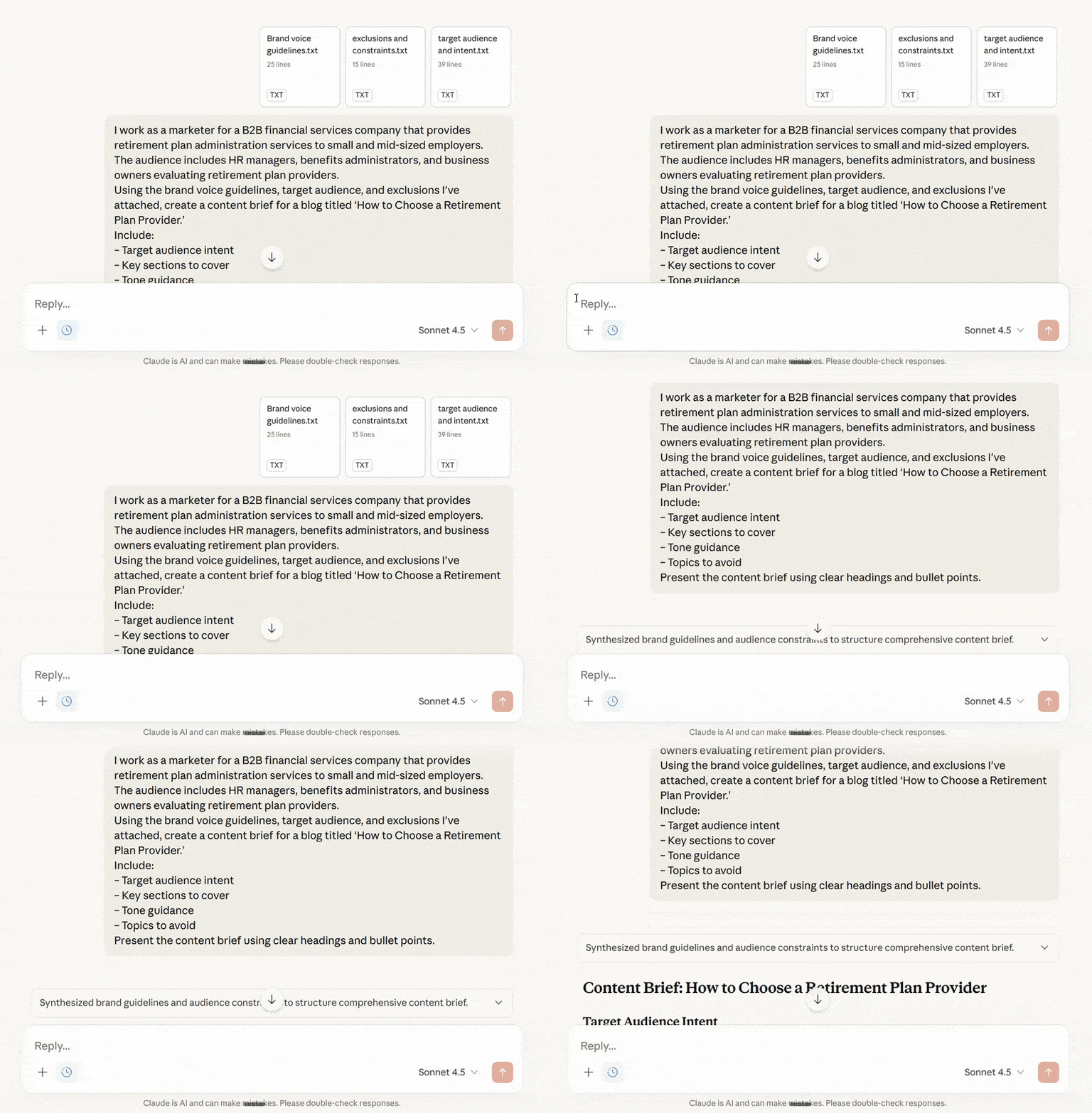
In this workflow, provide brand voice guidelines, positioning statements, exclusions, and examples to Claude. The AI tool then helps generate content briefs, messaging frameworks, or structured outlines that your writers and strategists can refine.
For example, a financial services company might use Claude to draft a blog brief for “How to Choose a Retirement Plan Provider.” It can outline audience intent, compliance considerations, and tone, while keeping final writing and approval human-led.
3. SEO content clustering and intent mapping
Claude doesn’t replace keyword tools or SERP analysis. Instead, use this AI tool to complement them.
Once you have a list of related keywords and SERP insights, organize and interpret SEO inputs with the help of Claude.
For example, a marketer of an HVAC company could provide a list of keywords related to HVAC maintenance and ask Claude to group them by intent and funnel stage. That output supports SEO briefs and content planning.
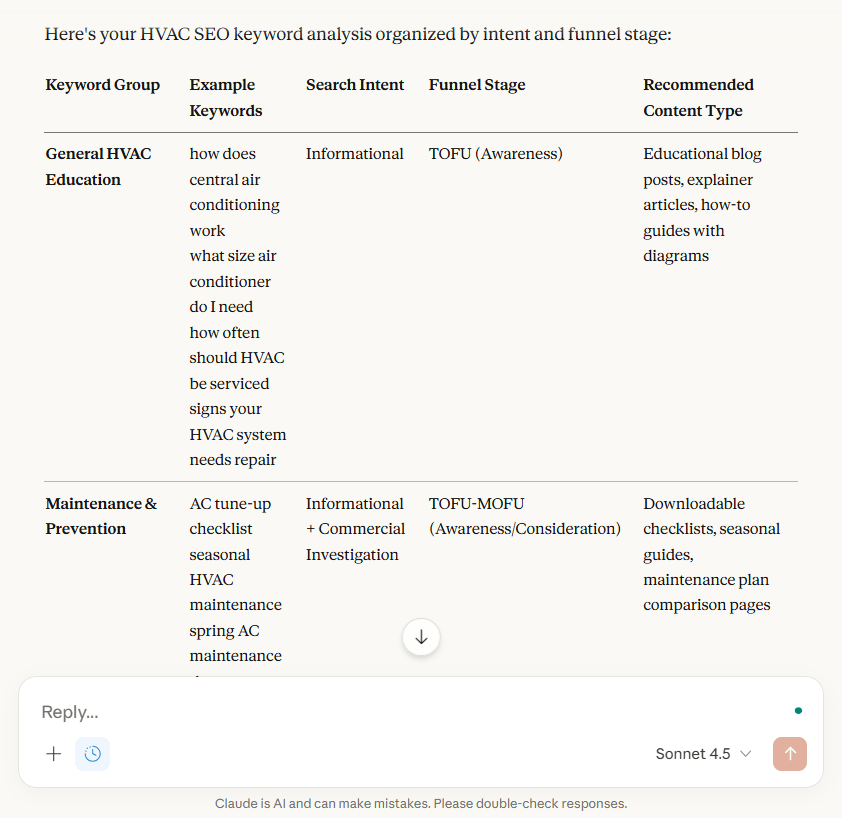
In this example, we asked Claude to to provide its output in a table with these columns:
- Keyword group
- Example keywords
- Search intent
- Funnel stage
- Recommended content type
The prompt also shared additional context that the goal is to plan SEO content to support buyer education, service selection, and emergency repair needs.
4. Campaign planning and message development
Claude can act as a strategic thinking partner during campaign planning, especially when teams need to pressure-test ideas before execution.
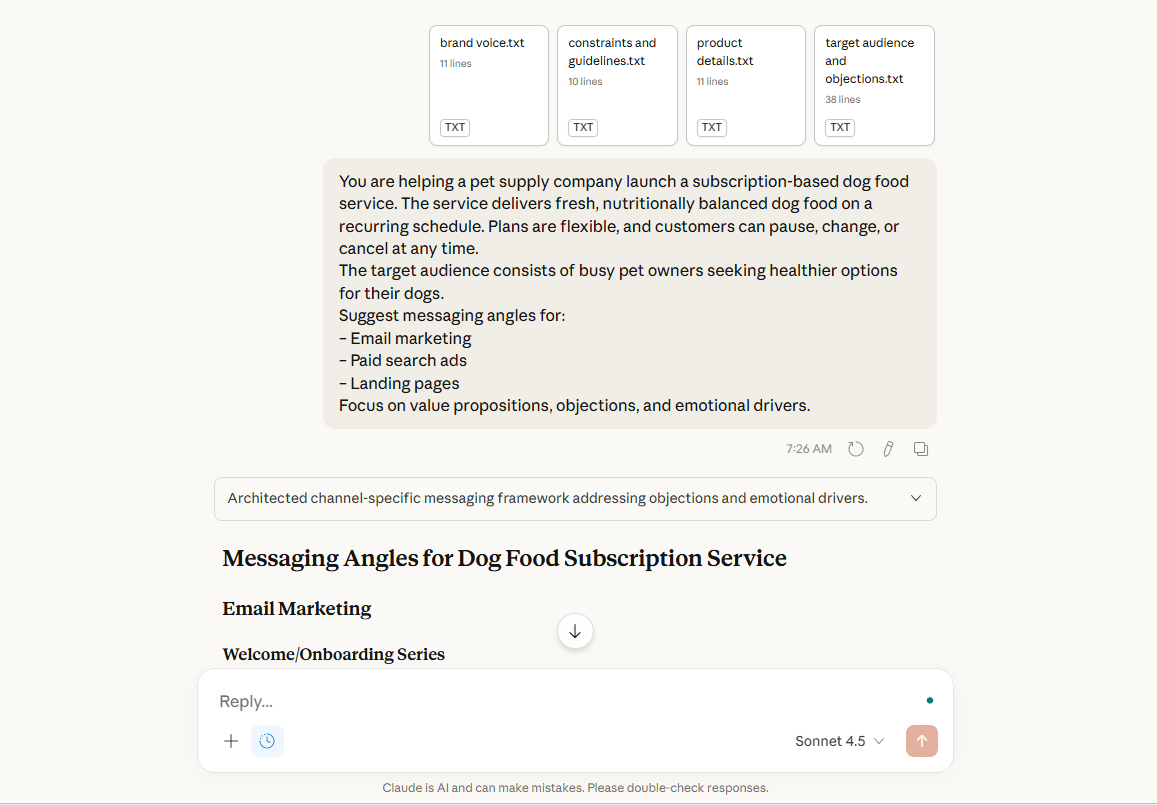
For example, a pet supply store launching a subscription-based dog food service could ask Claude to explore messaging angles across channels and customer segments.
5. Data analysis and synthesis
Claude’s long-context strength becomes especially valuable with complex data analysis and synthesis.
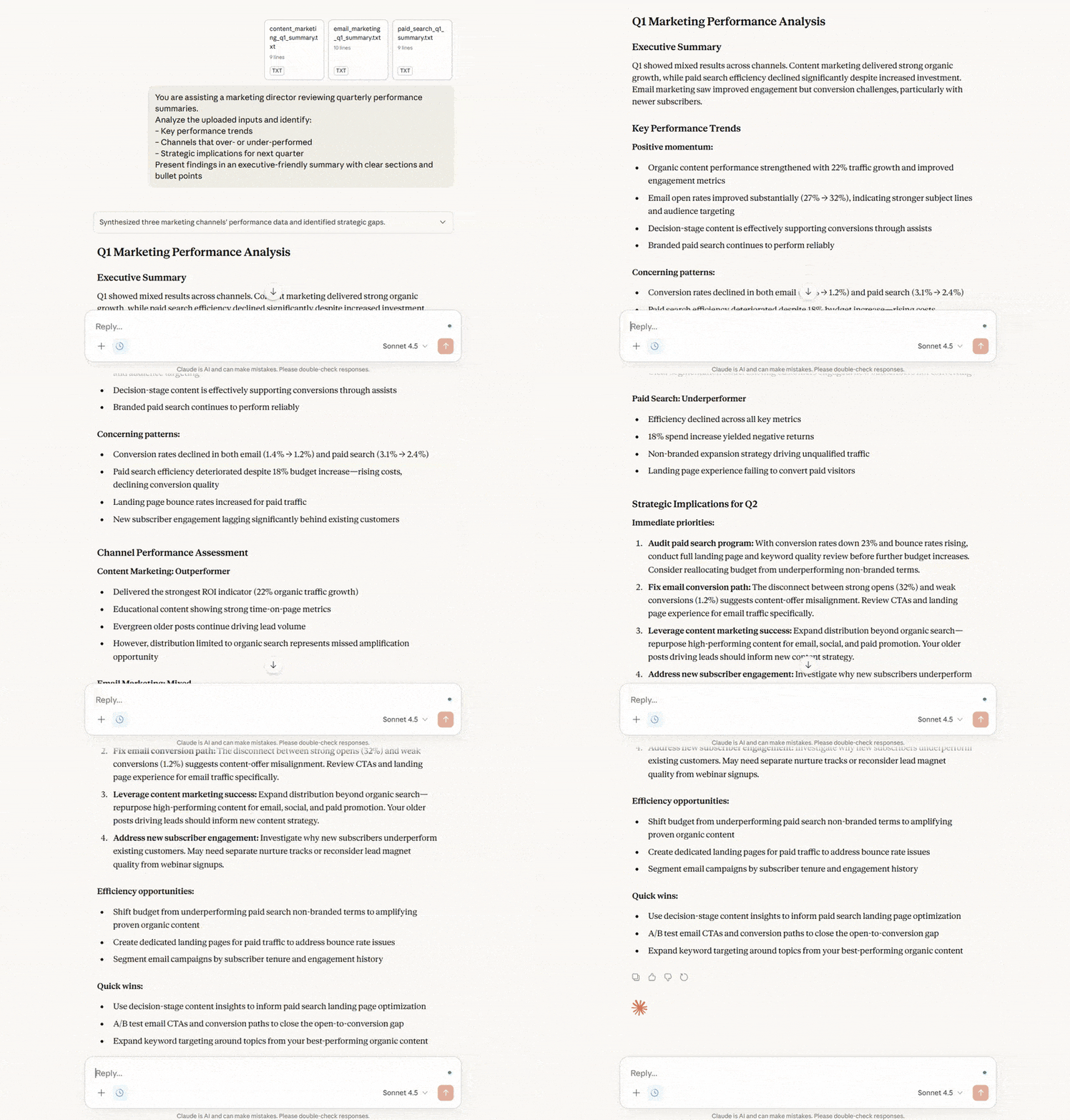
When marketers review multiple campaign reports, survey summaries, or performance snapshots, insights often get lost in the volume. Claude helps by synthesizing information into patterns and takeaways that humans can act on.
For example, a marketer wants to analyze a campaign’s overall performance on various channels like pay-per-click advertising (PPC), email marketing, and social media marketing. They can upload performance data to Claude and get a synthesized view of the campaign performance.
Claude prompt and workflow kit [with free downloadable guide]
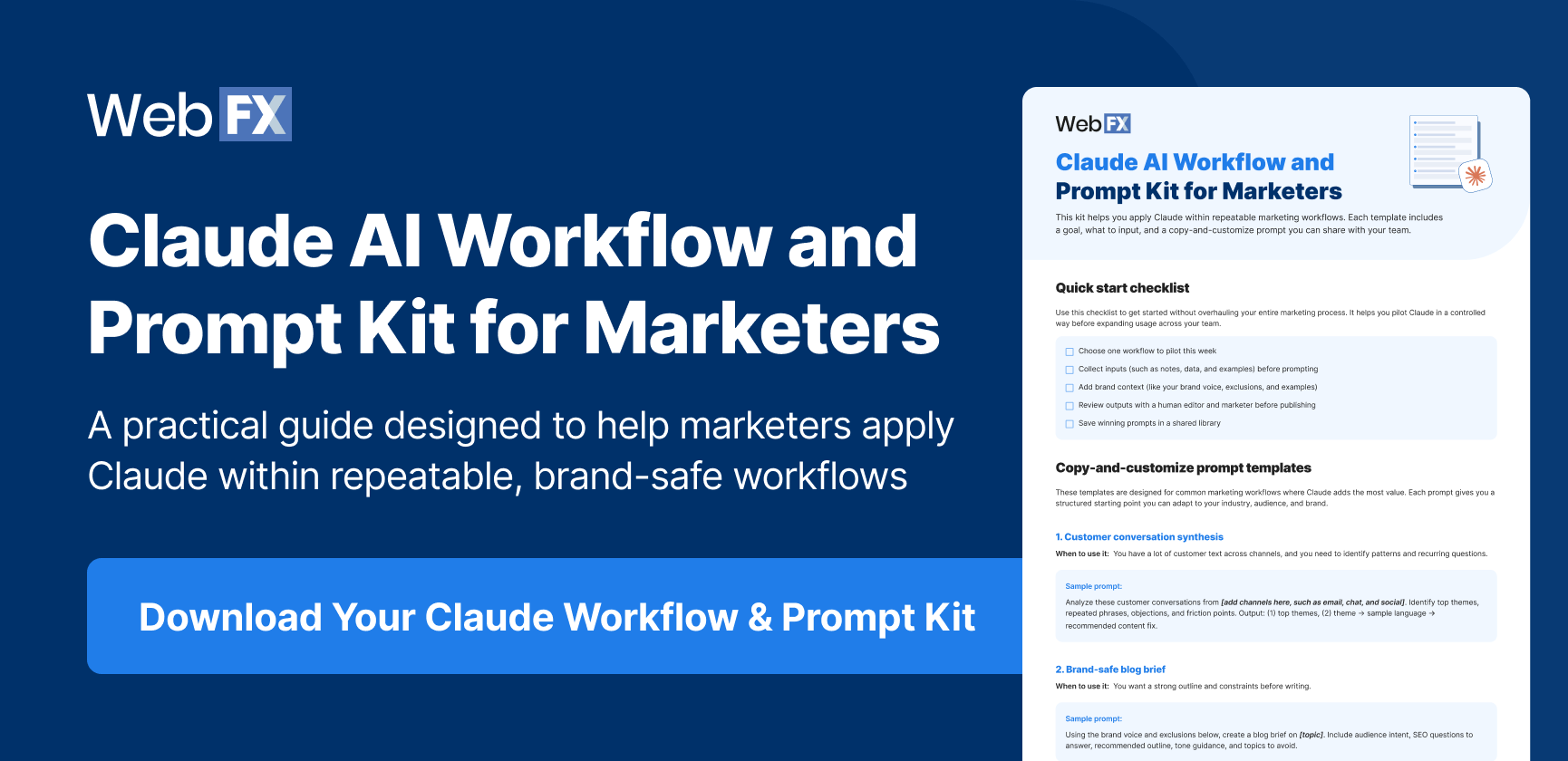
To make these workflows easier to implement, we created a brand-safe Claude prompt and workflow kit for you.
Think of it as your checklist for:
- Copying and customizing your brand’s prompts for each workflow
- Standardizing how your team uses Claude
- Adding guardrails to protect your brand voice
Prompting best practices for on-brand marketing results
If you’ve been using AI tools like Claude and ChatGPT for a while now, you’ve probably noticed that you get better responses when you provide detailed input and background information. The best results are often achieved with follow-up prompts, too.
After spending time using and experimenting with various AI platforms like Claude, our team developed a 4C Framework for effective prompting. Based on this framework, the four elements of an effective prompt exhibit the following:
- Creativity: A unique idea of what the output should be. Define your idea well.
- Context: Give Claude relevant background information. Provide details like your business’s nature and ideal customer profile (ICP).
- Constraints: Give your tool clear boundaries. Provide detailed requirements, such as the length of SEO briefs or how long you want your campaigns to run.
- Clarity: Provide specific instructions on how you want Claude to format or structure its response. If you’re asking Claude for help with content mapping, include in your prompt how you want it to present its response.
Claude vs. ChatGPT: Which one is better for marketing?
Claude and ChatGPT each have their own strengths, so we can’t say one tool is generally better than the other. What we can say, though, is that one AI tool could be a better fit for a particular task than the other.
Claude often performs better when tasks require long documents and structured reasoning because it’s designed to handle extended context more comfortably. Meanwhile, ChatGPT may feel faster for rapid ideation or short-form drafting.
We created the table below for your quick reference:
| Marketing task | Claude | ChatGPT |
| Long-form analysis and synthesis | Strong fit | Moderate fit |
| Campaign planning | Strong fit | Moderate fit |
| Rapid ideation | Moderate fit | Strong fit |
| Short-form drafts | Moderate fit | Strong fit |
4 common mistakes marketers make when using Claude (plus what to do instead)
Because Claude can perform various tasks, it’s tempting to use it for a variety of things. However, like most tools, Claude isn’t an all-powerful, all-around tool you can use for everything.
Make the most of it by using it for its strengths and avoid these common mistakes marketers make when using Claude:
- Using it like a search engine
- Publishing first drafts
- Skipping brand context
- Using it to define strategy
Let’s go through each one:
1. Using Claude like a search engine
Claude isn’t designed to retrieve or verify the most recent information online unlike search engines like Google. If you use Claude to fetch your competitors’ pricing packages and offers, it may process outdated information.
What you should do instead: When accuracy or recency matters, use search engines or primary sources first. Then, use Claude to analyze, organize, or explain information you already trust.
Provide the inputs yourself (like documents, notes, reports, or confirmed data), and ask Claude to synthesize patterns, summarize takeaways, or pressure-test interpretations.
2. Publishing first drafts
A generative AI tool’s first draft typically sounds generic that it could read like it’s from Google’s AI Overview and not from your brand. If you want your audience to feel a connection with your business, use your brand voice. And you can only do that when your published content has a human’s input.
What you should do instead: Treat Claude’s outputs as drafts. Add your point of view, specificity, and proof points. Add a review step into your process before anything goes live.
3. Skipping brand context
When you don’t provide Claude your brand context, it fills in the gaps with patterns learned from generic online content. It won’t automatically generate incorrect answers, but the output will likely be flat, bland, and forgettable.
The result? Your messaging won’t help you stand out. That’s why it’s important to provide important nuances in your brand tone, voice, positioning, and ICP.
What to do instead: Before using Claude for any marketing work, give it background information about your brand and business. This doesn’t need to be a long document. A one-page reference is often enough.
At a minimum, include:
- How your brand should sound (tone, level of formality, personality traits)
- Who you’re speaking to and who you’re not
- Claims or language you avoid
- A few examples of on-brand and off-brand messaging
Once you have this documented, reuse it consistently. Paste it into prompts, store it in a shared prompt library, or reference it in your workflow templates. That consistency is what turns Claude from a generic writing assistant into a tool your team can rely on.
4. Using it to define strategy
When marketers are stretched thin or unfamiliar with certain strategies, it’s tempting to turn to a tool like Claude to get started with the “best next campaign” or outline a full marketing plan from scratch.
The problem with this approach is that it relies on an AI tool that doesn’t have the full context of your business. Without having full understanding of your priorities, constraints, performance history, and risk tolerance, AI tools like Claude can’t craft a solid marketing strategy that bring results.
What you should do instead: Use Claude like a strategic support tool. Create your strategy, and then run it by Claude to:
- Pressure-test a campaign idea
- Generate alternative angles or messaging directions
- Identify gaps in your existing plan
- Summarize input from different stakeholders
FAQs
Is Claude safe for client-facing marketing work?
Yes, but when used with guardrails. Marketers should provide clear brand context, avoid publishing raw outputs, and apply human review before anything goes live. Claude supports the process, but your team stays accountable.
Teams working in regulated industries should also involve legal or compliance reviewers when needed.
Can Claude replace marketers?
No. Claude supports research, planning, and analysis. However, strategy, creativity, and judgment remain human responsibilities. The strongest teams use AI to extend their capabilities.
How do I get started with Claude for marketing?
Start by identifying where your team struggles. Is your team short on time for a particular task such as research or fine-tuning messaging?
Choose one workflow that addresses the bottleneck and define guardrails before expanding. As you get more confident with using the tool, your team can layer Claude into additional workflows without overwhelm.
Get the most value from Claude
Claude can be a powerful addition to your marketing team’s toolkit when it’s used with intention.
Teams that get the most value from Claude use it in specific, high-leverage moments: to synthesize large volumes of of information, structure ideas, and support decisions that still belong to humans. That’s what turns AI from an experiment into something operational and genuinely helpful.
If you’re just getting started, resist the urge to use Claude everywhere at once. Pick one workflow. Add context and guardrails. Review the output. Then refine how your team uses it over time. That approach builds confidence, consistency, and trust.
Our Claude AI workflow and prompt kit is designed to help you do exactly that. It gives you structured prompts, examples, and brand-safety checks you can adapt to your own marketing process.
If you’re exploring ways to build a more efficient marketing stack, you can also review our free proprietary marketing tools!
-
 Abby is a Sr. SEO Consultant at WebFX, where she implements, optimizes, and tracks SEO and digital marketing strategies that are powered by data for WebFX. With certifications in SEO, Local SEO, and Google Analytics, Abby has implemented hundreds of optimizations and led strategies and initiatives that have helped WebFX improve online visibility, traffic, and leads. Before her time as a Digital Marketing Analyst, Abby was an innovative content writer who created content for WebFX clients in various industries and for WebFX’s own blog and website. When she’s not implementing strategies and optimizations that drive leads and revenue, you’ll find her walking her dog, travelling around Europe, or watching her favorite reality TV show. View full profile
 -
 Trevin serves as the Senior Vice President of Sales at WebFX. He has worked on over 450 marketing campaigns and has been building websites for over 25 years. His work has been featured by Search Engine Land, USA Today, Fast Company and Inc. Read his review of working with WebFX for the last 15 years. View full profile
 -

WebFX is a full-service digital marketing agency delivering revenue-driving strategies across online advertising, SEO and AI search optimization, and digital marketing. Backed by 1,100+ client reviews, a 4.9-star rating on Clutch, and proprietary revenue-tracking technology, our team helps businesses grow visibility and revenue across platforms, from Google to ChatGPT to LinkedIn. Discover how our expert team and revenue-accelerating tech can drive results for you. Learn more
Try our free Marketing Calculator
Craft a tailored online marketing strategy! Utilize our free Internet marketing calculator for a custom plan based on your location, reach, timeframe, and budget.
Plan Your Marketing Budget
Table of Contents
- Where Claude fits in a modern marketing stack
- How to use Claude AI for marketing
- 1. Deep market and customer research
- 2. Brand-safe content strategy and briefing
- 3. SEO content clustering and intent mapping
- 4. Campaign planning and message development
- 5. Data analysis and synthesis
- Claude prompt and workflow kit [with free downloadable guide]
- Prompting best practices for on-brand marketing results
- Claude vs. ChatGPT: Which one is better for marketing?
- 4 common mistakes marketers make when using Claude (plus what to do instead)
- 1. Using Claude like a search engine
- 2. Publishing first drafts
- 3. Skipping brand context
- 4. Using it to define strategy
- FAQs
- Get the most value from Claude
Share this article


See AI Marketing in Action
Explore how WebFX helped a regional brand get discovered in AI search experiences — proving what’s possible with today’s AI-driven marketing!
Try our free Marketing Calculator
Craft a tailored online marketing strategy! Utilize our free Internet marketing calculator for a custom plan based on your location, reach, timeframe, and budget.
Plan Your Marketing Budget
 Sr. SEO Consultant
Senior Vice President of Sales
Sr. SEO Consultant
Senior Vice President of Sales
What to read next