What is ARD? An open standard for helping AI agents discover tools, APIs, agents, Skills, MCP servers, and other callable capabilities.
What changed? Lighthouse 13.5 added an ARD audit and grouped it with llms.txt under agent discovery.
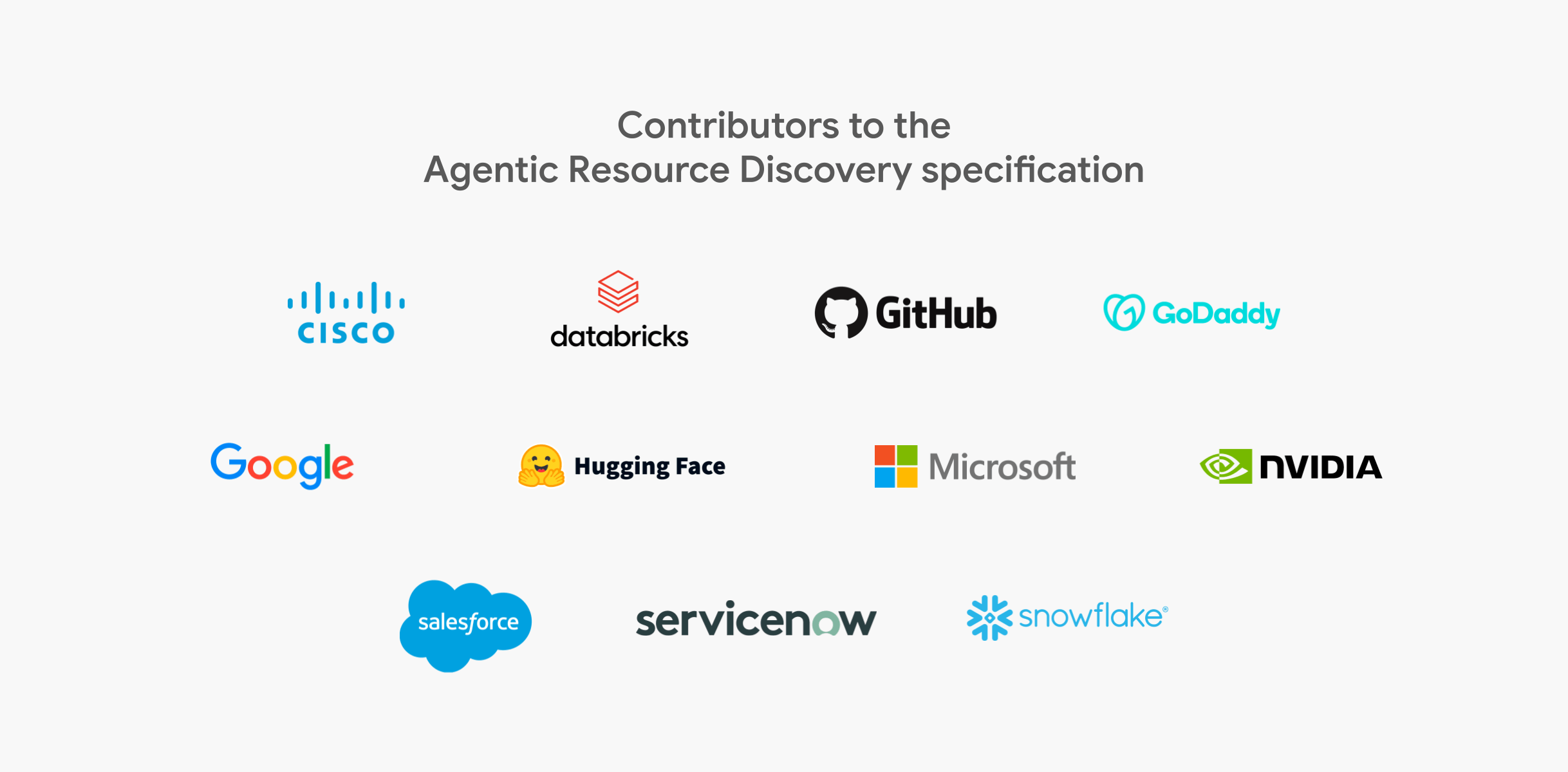
Who is behind it? Contributors include Google, Microsoft, GitHub, NVIDIA, Cisco, Salesforce, ServiceNow, Snowflake, Databricks, Hugging Face, and GoDaddy.
Does it affect Google rankings? Google has not identified ARD as a Search ranking signal.
What should marketers do? Understand the use case, identify agent-facing capabilities, assign ownership, and evaluate implementation based on real business value.
Agentic Resource Discovery (ARD) is an open specification for helping AI agents find external tools and services on the web, and Google’s Lighthouse just added an audit for it. That audit landed in Lighthouse 13.5 on September 18, 2026, which quietly moved a young agent protocol into a tool your SEO and development teams already run.
This does not make ARD a Google ranking factor, and the specification is still an early proposal. What it does mean is that you can now test whether your ARD setup is valid. For marketers, the bigger takeaway is that agent readiness is becoming something your SEO and development teams can actually inspect, even if most businesses do not need to implement ARD yet.
Let’s break down what ARD is, how it works, what the Lighthouse audit actually changes, and how much you should do about it today:
Tell us about your business, and we’ll create a custom plan to grow your traffic, leads, and predictable revenue.
What is Agentic Resource Discovery?
Agentic Resource Discovery is an open specification that gives AI clients a standard way to discover external capabilities they can use to finish a task. Think of an agentic resource as any callable thing an AI agent can reach for: An API, an MCP server, a Skill, a workflow, or another agent.
ARD handles discovery only. It sits before invocation, helps the agent find the right resource, and then steps aside so the agent connects through that resource’s own native protocol. The specification is explicit that ARD does not replace MCP, A2A, APIs, or Skills. It points agents toward them.
A quick way to picture it is that traditional search helps a person find a webpage. ARD helps an AI agent find a capability. One returns something to read, the other returns something to use.
Google announced the specification in June 2026, developed with a broad group of partners across the agent ecosystem. That backing is part of why the standard is worth watching this early.
For example, today someone might ask ChatGPT, “Who can repair my AC near me?” and get a list. An agentic version of that request is closer to, “Find an HVAC company near me with availability tomorrow and book an appointment.” ARD could help the agent discover which businesses expose a booking capability that it can actually use. That is the practical shift to watch: AI discovery is moving from helping customers find information toward helping them complete actions.
The Agentic Resource Discovery specification launched with backing from Google, Microsoft, GitHub, NVIDIA, Cisco, Salesforce, ServiceNow, Snowflake, Databricks, Hugging Face, and GoDaddy. (Image: Google)
How does Agentic Resource Discovery work?
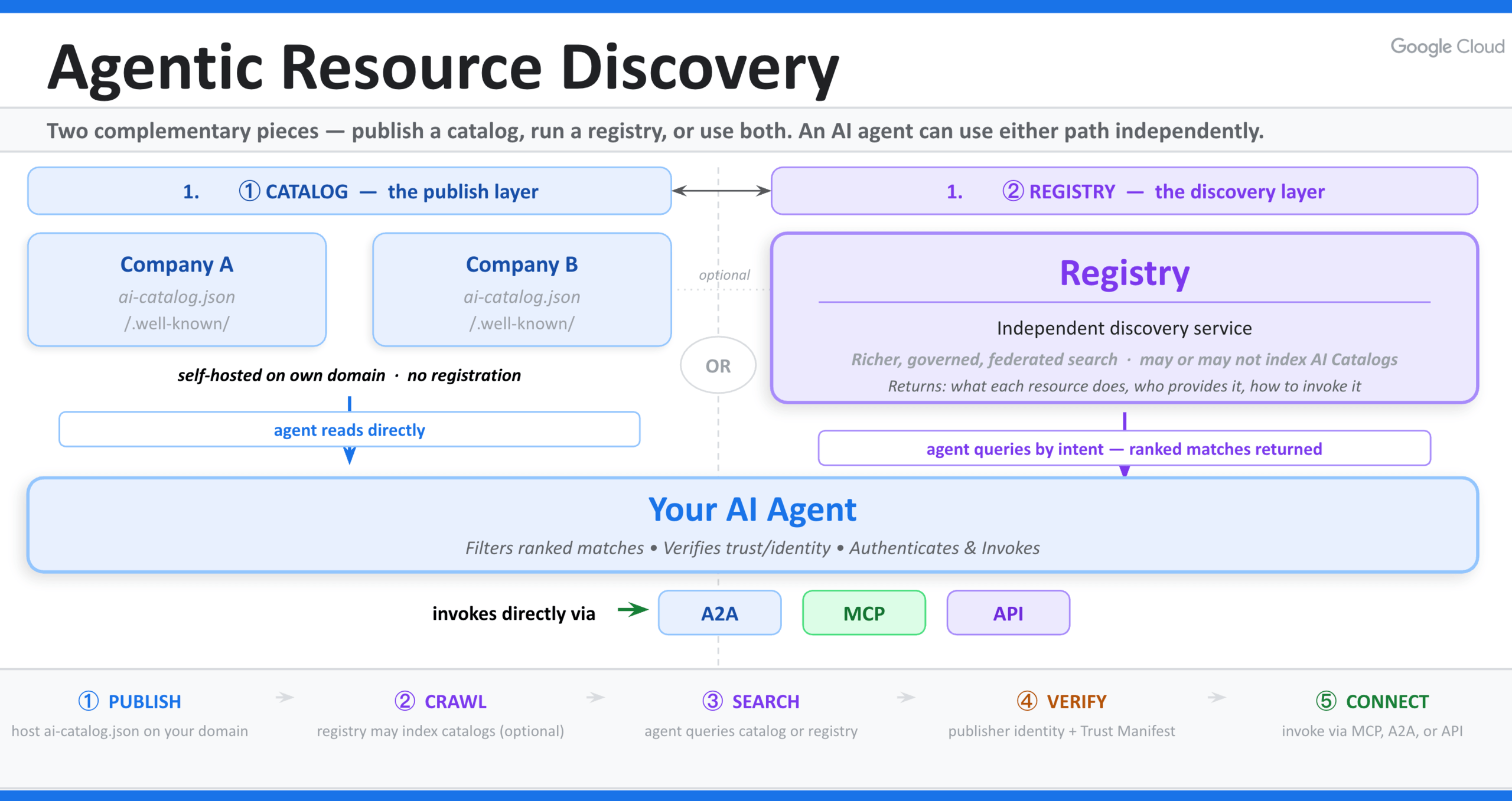
ARD runs on two pieces: Catalogs and registries. A business publishes entries describing its callable capabilities, registries index those entries, and agents search them to find and verify what they need. The flow breaks into four steps:
A business publishes its capabilities. It hosts a manifest of ARD entries on its own domain, at /.well-known/ard.json, describing what each resource is and what it can do.
Registries index those entries. Acting like search engines for agentic capabilities, they crawl the published entries and make them searchable, along with the data needed to verify who published each one.
An agent searches for what it needs. When it faces a task, it queries a registry in plain language and gets back ranked matches.
The agent connects through the native protocol. Execution happens over the resource’s own protocol, whether that is MCP, A2A, or a standard API. ARD points the way, then steps out of the execution path.
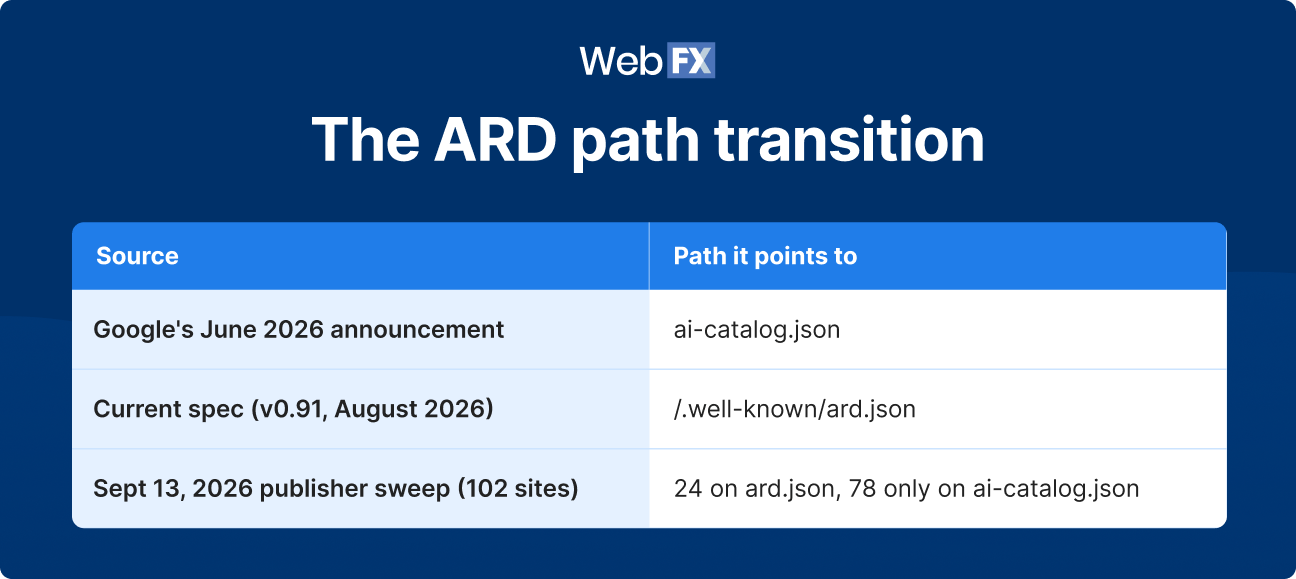
Google’s June announcement graphic still labels the catalog file ai-catalog.json, the predecessor to today’s ard.json.
What changed when Lighthouse added an ARD audit?
Lighthouse 13.5 added an ARD audit and grouped it with llms.txt under “agent discovery”, which puts agent readiness inside a web-quality tool that SEO and development teams already use daily. Google expects the release to reach Chrome 156 DevTools and PageSpeed Insights within two weeks, so this will surface in the environments your team checks without anyone opting in. You can see the audit listed in the Lighthouse 13.5 release notes.
This is a progression, as Lighthouse 13.3 shipped a broader Agentic Browsing category back in May 2026, so agent readiness has been creeping into the tool for months. The 13.5 audit is the newest step.
What it does not do is turn ARD into a ranking signal. Google has not tied ARD, or agent readiness generally, to Search position. The audit lets you inspect an ARD implementation. That is a different thing from a ranking factor, and the distinction is the whole reason to stay measured about what you do next.
Why are ard.json and ai-catalog.json both showing up?
Both filenames are live right now because the standard is mid-transition, and this is the clearest sign that ARD is young enough to reward patience. Google’s June 2026 announcement told publishers to host an ai-catalog.json file. The current specification, version 0.91 and still marked “Proposal” as of August 26, 2026, moves that to /.well-known/ard.json and calls ai-catalog.json the predecessor path.
That ecosystem scan on September 13, 2026 found most profiled publishers still reachable only at the older path. Even Lighthouse itself reflects the transition: The 13.5 release that added the ARD audit still ships an ai-catalog test fixture.
The takeaway for your team is straightforward. ARD is established enough that Google now audits it, and unsettled enough that the basic file conventions are still moving. That is a strong argument for understanding it now and holding off on a rushed implementation that a spec revision could outdate.
Why does AI agent readiness matter to marketers?
Agent readiness matters because AI-driven discovery already sends real, high-intent traffic, and agents are the next layer of that shift. Traffic from generative AI grew 796% between January 2024 and December 2025 across an analysis of 2.3 billion sessions, and those AI-referred visitors converted about 1.2x higher than organic search. AI sends visitors who are closer to a decision.
That pattern shows up in where AI traffic lands, too. Across roughly 590,000 AI sessions spanning 2,500 URLs and more than 15 industries, over 90% of AI referrals landed on consideration- or decision-stage content over top-of-funnel pages.
A fair caveat: Neither study measures ARD adoption, and neither proves that publishing an ARD catalog will lift your traffic. What they show is that AI-mediated discovery already intersects the high-intent parts of the buyer’s journey.
Today, AI often helps a buyer research and compare, and companies are now building agentic systems that take the next step and actually complete tasks. ARD is the infrastructure meant to help those agents find the capabilities available to them. That is why it belongs on your radar before it belongs in your backlog.
Does your website need Agentic Resource Discovery right now?
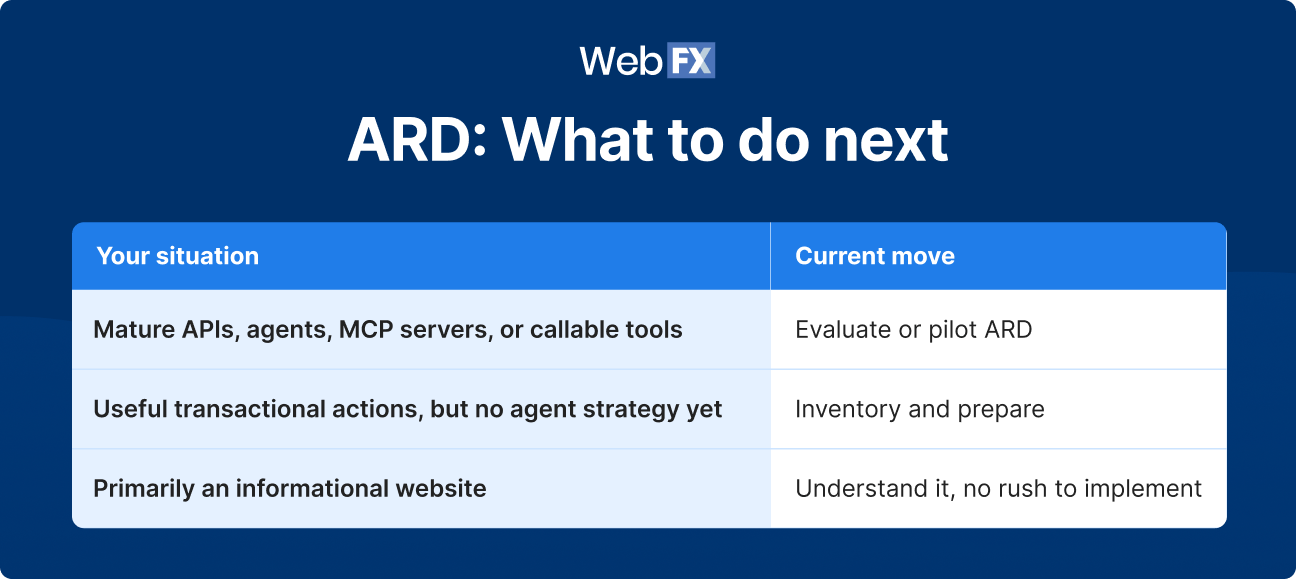
Most businesses should evaluate ARD before implementing it, and the answer depends on whether you have a real capability that an agent could use. Run through these three questions before you touch a catalog file:
What could an agent actually do for your customer? List the real actions: Search inventory, check availability, request pricing, book an appointment, retrieve product information, trigger a workflow, or query an API. If nothing on that list fits your business, ARD is a monitor-for-now item.
Is that capability already machine-callable? Look at whether you already have APIs, MCP resources, agents, or structured services that an agent could reach. A use case that exists only because ARD exists probably is not ready.
Can you govern access safely? Weigh authentication, authorization, data exposure, internal ownership, and compliance before you expose anything to autonomous clients.
Mature APIs, agents, MCP servers, or callable tools
Evaluate or pilot ARD
Useful transactional actions, but no agent strategy yet
Inventory and prepare
Primarily an informational website
Understand it, no rush to implement
Expert insights from
Abby F.SEO Consultant at WebFX
“For most teams, I’d suggest keeping an eye on ARD developments for now rather than making it a top priority because it’s still developing and there’s uncertainty on how it affects rankings.”
How should marketers prepare their sites for AI agents?
Start by understanding the standard and your own capabilities. You do not need to optimize your site for AI agents overnight, but these five steps can keep you ready without overcommitting to a proposal that is still changing:
Inventory agent-facing capabilities: Ask your product and development teams what a machine can already call. That list is the real foundation, and most marketing teams have never written it down.
Assign ownership: ARD crosses SEO, product, engineering, and security, so name who owns the decision before it falls through the cracks between them.
Run a Lighthouse baseline: Once 13.5 reaches your team’s environments, document what the audit reports instead of optimizing for a green checkmark you do not yet understand.
Follow the current spec if you pilot: If you do experiment, use ard.json, include representative queries, name the resource type and capabilities, and run the official conformance tooling.
Monitor before making ARD a KPI: Watch spec revisions, Lighthouse behavior, the Chrome and PageSpeed Insights rollout, registry adoption, and whether real agent traffic actually arrives.
Tracking how you show up across AI search is exactly what AI SEO services and OmniSEO® are built for, and that same visibility work is where you’ll watch agent discovery as it matures. Getting visibility measurement in place now means you will already know your baseline when agent traffic becomes something worth reporting to leadership.
How does ARD relate to MCP, llms.txt, SEO, and GEO?
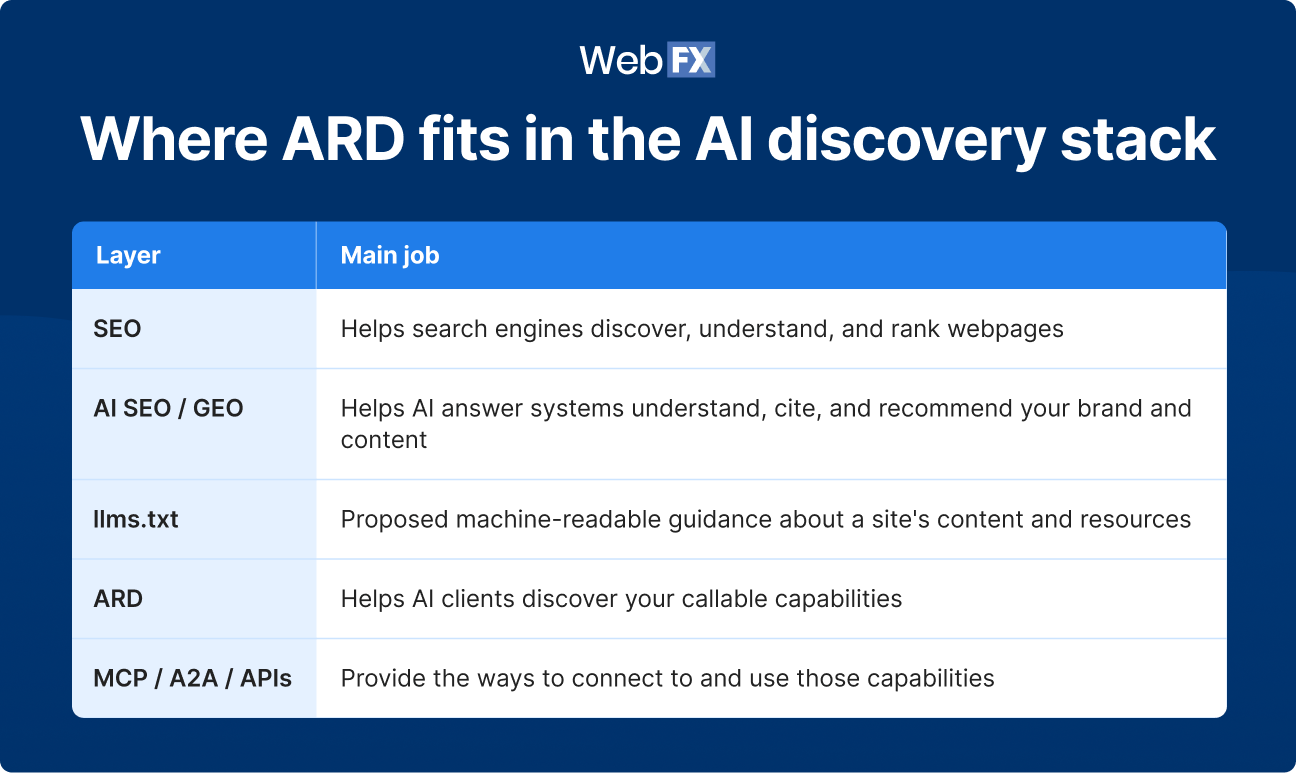
ARD is a discovery layer for agents, and it sits alongside the layers you already manage rather than replacing any of them. Here is how the pieces divide the work:
Helps search engines discover, understand, and rank webpages
AI SEO / GEO
Helps AI answer systems understand, cite, and recommend your brand and content
llms.txt
Proposed machine-readable guidance about a site’s content and resources
ARD
Helps AI clients discover your callable capabilities
MCP / A2A / APIs
Provide the ways to connect to and use those capabilities
None of this unseats the technical SEO foundation you already need. ARD adds a discovery path for a different kind of machine interaction, one aimed at agents that act over answer engines that cite. Think of agent-ready SEO as a new layer on your existing work, not a replacement for it, and the stronger your current SEO and AI visibility work, the better positioned you are for whatever agent discovery turns into.
Agentic Resource Discovery (ARD) is an open specification that helps AI agents find and verify external capabilities, such as APIs, MCP servers, Skills, and other agents, so they can complete tasks. It handles discovery only, then hands off to the resource’s native protocol for execution.
Businesses publish a catalog of their capabilities at a standard path on their domain, registries index those catalogs, and AI agents search the index using plain-language intent. Once an agent finds a match, it connects directly through the resource’s own protocol.
ARD is a discovery layer that helps an agent find a capability, while MCP (Model Context Protocol) is one of the execution protocols an agent uses to actually connect to and use that capability. ARD points the way; MCP is one of the roads.
Google has not identified ARD as a Search ranking signal. The Lighthouse audit lets you inspect an ARD implementation, but there’s no evidence that it affects your position in Google’s organic results.
The current specification (v0.91) uses /.well-known/ard.json and treats ai-catalog.json as the predecessor path. If you publish a catalog now, follow the current ard.json convention, and know that many sites still sit on the older path while the standard settles.
WebFX has thousands of reviews praising our transparency, communication, and results.
Lighthouse adding an ARD audit makes agent readiness worth evaluating now. It does not make it worth implementing everywhere.
The businesses with real, machine-callable capabilities have a genuine reason to start testing. Everyone else can use this moment to identify what an agent could eventually do with their site, decide who would own that experience, and map the safeguards they would need before exposing anything.
Know your own agent use case cold, so that when the standard settles and agent traffic becomes measurable, you are ready to act instead of scrambling to catch up.
Want help tracking your visibility across AI search today, so you’re ready as agent discovery matures? With 7+ years of AI experience, WebFX has already generated 93,969 mentions and 12,335 qualified leads from AI sources for our clients, and OmniSEO® gives you the tracking to see where that visibility comes from. Get your free proposal or call 888-601-5359 to talk through our AI SEO services today.
Try our free Marketing Calculator
Craft a tailored online marketing strategy! Utilize our free Internet marketing calculator for a custom plan based on your location, reach, timeframe, and budget.
Craft a tailored online marketing strategy! Utilize our free Internet marketing calculator for a custom plan based on your location, reach, timeframe, and budget.








 Albert Dandy Velasquez blends SEO strategy with compelling storytelling to help businesses boost their visibility and revenue online. With a B.A. in English and certifications from HubSpot, Semrush, and Google Analytics, he has written and optimized hundreds of articles on organic SEO, content strategy, and user experience. He regularly contributes to the WebFX blog and SEO.com, creating content that helps readers turn marketing goals into measurable results. When he’s off the clock, he’s usually exploring new neighborhoods on two wheels, filming travel content, or chasing golden hour with a coffee in hand. View full profile