Marketing moves fast. Add WebFX as a preferred source on Google and get our latest insights when you search.
Thaakirah Abrahams is a Lead Editor at WebFX, where she leverages her 5+ years of experience to craft compelling website content. With a background in Journalism and Media studies and certifications in inbound marketing, she holds a keen eye for detail and a talent for breaking down complex topics for numerous sectors, including the legal and finance industries. When she’s not writing or optimizing content, Thaakirah enjoys the simple pleasures of reading in her garden and spending quality time with her family during game nights. View full profile
AI is not ending marketing as a career path, but it is changing which marketing skills matter most.
Routine, repetitive tasks like basic reporting and simple ad optimization are the most automated. Strategy, brand voice, and client relationships still depend on people.
The marketers who thrive treat AI as a skill to build, not a threat to avoid.
AI is unlikely to replace marketing jobs across the board. Instead, AI is reshaping marketing roles by automating routine tasks while increasing the value of human skills like strategy, creativity, brand judgment, and relationship building.
This guide breaks down which marketing tasks AI handles well, which roles still depend on human judgment, and how to future-proof your marketing career. You’ll also hear from WebFX marketers about how AI is changing their work today.
No, AI won’t replace marketing jobs across the board. But the answer changes depending on which marketing role you’re asking about, so here’s how it plays out by discipline.
Will AI replace SEO jobs?
No. The SEO job itself looks different from what it did a few years ago. AI has added generative engine optimization (GEO) and AI Overview visibility to the SEO skill set, in addition to traditional keyword and technical work.
SEO specialists who understand how to structure content for both search engines and AI-driven answers are in a stronger position than ever, because that dual skill set is still rare.
Will AI replace copywriters?
AI can draft copy quickly, but it can’t replicate a brand’s voice, understand a client’s audience the way a human writer does, or make a strategic call about what a campaign should say and why. Copywriting roles are shifting toward editing, strategy, and brand voice ownership, with AI handling more of the first-draft grunt work.
Will AI replace marketing managers?
Marketing managers who used to spend hours building reports now spend that time interpreting them and making decisions faster. AI removes friction from reporting and data aggregation, but it doesn’t own the strategy, budget calls, or team leadership that define the role.
Will AI replace marketing analysts?
Analysts are seeing the most task-level automation of any marketing specialty, since AI is genuinely good at pulling and structuring data. Analysts who move into interpretation, forecasting, and cross-channel strategy are the ones becoming more valuable as the manual pulling work disappears.
Why marketing careers still need people
AI is transforming how marketers work, but it’s not replacing the reasons companies hire marketers in the first place. AI tools are excellent at processing data, drafting first versions, and running repetitive tasks around the clock. They’re far less capable at reading a client’s brand voice, building trust with a customer, or making a judgment call when a campaign needs to pivot fast.
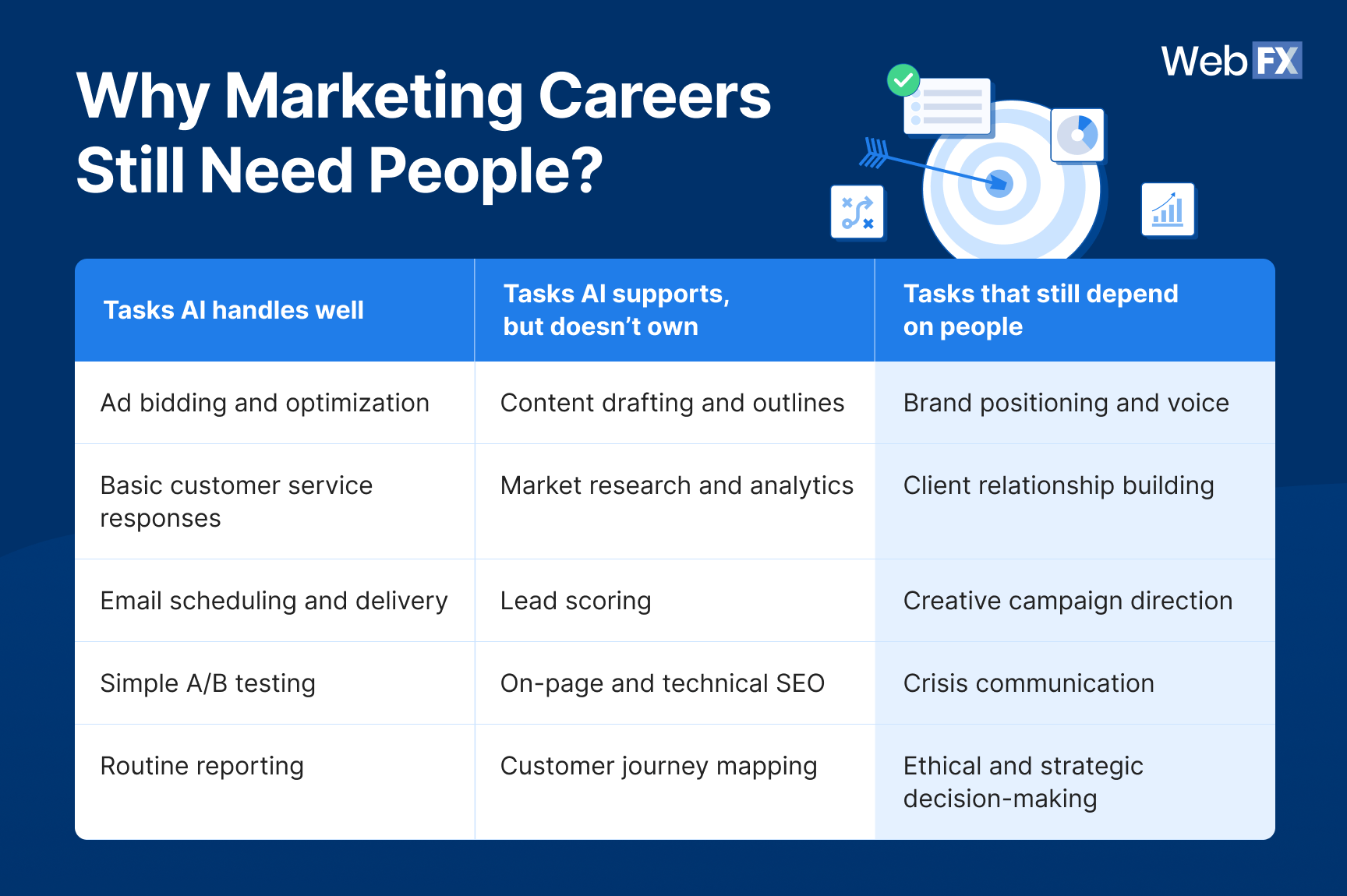
That gap is exactly where marketing careers are headed. So the question you should be asking is “which marketing skills is AI making more valuable, and which ones is it making less valuable?” Here’s a quick breakdown:
Marketers who lean into the middle and right columns of that table are the ones building careers that grow, not shrink, as AI adoption increases. That directly relates to a study showing that 52% of U.S. marketers using AI in their work cite improved speed and workflow efficiency as a top benefit, not as a reason they needed fewer people on the team.
Expert insights from
Trevin S.Vice President of Business Development at WebFX
“AI is another item in your toolbox. You don’t want to be afraid of it, but rather open to learning about it and using it where appropriate. AI still requires plenty of human guidance, even if your marketing organization wants to use it aggressively.”
Is AI taking marketing jobs right now?
While some marketing jobs have been lost to AI in the past, that’s not the reality for all marketing careers today. If you’re wondering whether AI will replace marketing jobs, it’s probably because you’ve heard about some muddy layoff stories.
The layoffs that get blamed on AI
A few large companies have cut marketing-adjacent roles and pointed to AI as part of the reason.For instance, Salesforce reduced its marketing and data analytics teams as part of a broader AI-driven restructuring, and Snap’s CEO cited AI’s ability to handle repetitive work when announcing workforce cuts.
Look closer at these cases, though, and a pattern shows up. Most of the roles affected were high-volume, repetitive positions like customer support and campaign coordination at companies with enormous cost structures. The strategists, managers, and client-facing marketers making judgment calls weren’t the ones losing their jobs.
But here’s the real kicker: Nearly a third of companies that made AI-related cuts have already rehired for those same positions, since AI ended up covering only part of the job. That gap between the AI layoff headlines and what’s actually sustainable is a real signal worth trusting.
So, is a marketing career still safe in the age of AI?
Marketing jobs are changing in two different ways, and it’s worth separating them:
Some tasks within marketing roles are getting automated.
But entire marketing careers disappearing because of AI is uncommon, no matter what the layoff headlines imply.
Tasks that are the most automated tend to be the ones marketers themselves describe as tedious: pulling reports, tagging campaigns, drafting a first-pass outline, or answering the same customer question for the hundredth time. Those are real time savings, not a sign that the role itself is obsolete.
What’s much harder to automate is the judgment layer above those tasks. That includes deciding what the data means, what a brand should say in a sensitive moment, or how to build a relationship with a client over the years. That’s the part of marketing that keeps evolving into new titles and new specialties rather than vanishing.
Expert insights from
Erika H.Revenue Marketing Consultant
“Because of AI, I’ve had to sharpen my ability to ask the right strategic questions upfront before diving into execution. With AI handling so much of the tactical work (like generating ad copy variations or pulling performance data), I realized I was getting outputs faster but not always the right outputs.
So I developed a discipline of stepping back first and asking: What’s the actual business problem we’re solving? What metric truly matters here? This has made me more effective with clients, especially on strategic calls. Instead of presenting a mountain of data, I can zero in on the 2-3 insights that actually impact their revenue goals. AI gives me speed, but sharpening my strategic questioning gives me precision, and that’s what clients really value.”
If you’re looking for a marketing job you can trust to last, WebFX takes a different approach to AI in marketing on purpose. We use AI to give our team more time for strategy, client relationships, and creative work, not to justify cutting the people who do that work. The FXers you’ll hear from below are proof of that in practice.
How AI is changing marketing careers, not ending them
Talk to marketers who use AI daily, and you’ll hear a consistent theme: It’s freed them up to focus on the work that actually requires a person.
Expert insights from
Grayson H.Internet Marketing Specialist at WebFX
“One task that AI now handles for me is negative keyword optimization for my PPC clients. Instead of having to manually check every single search term in my account, I am able to have AI analyze the search terms and provide a spreadsheet and recommendations in minutes, and now I typically use that time to communicate updates to clients, or even be able to get more search term reviews done in a shorter amount of time.”
Expert insights from
Erika H.Revenue Marketing Consultant
“I used to spend so much time writing ad copy for my clients. AI now assists with the initial drafting of ad copy variations and performance report summaries that used to take me hours. I redirect that time into deeper strategic work like analyzing cross-channel performance patterns for clients or preparing more comprehensive strategy recommendations.
Instead of being in the weeds writing copy, I’m spending more time connecting the dots between what’s working across campaigns and translating that into actionable next steps for clients.”
AI clears out the manual, repetitive work, and people redirect that time toward client conversations, strategy, and the kind of hands-on craft that made them want to work in marketing in the first place.
If you’re sizing up a marketing career right now, reliable companies that lean into AI aren’t cutting the humans out of the process. They’re changing what those humans spend their day doing. That’s what actually shapes your career.
How to future-proof your marketing career in the age of AI
Future-proofing your marketing career isn’t about racing to learn every new AI tool the day it launches. Learning how to use AI in marketing careers comes down to a small set of durable skills that stay valuable no matter which specific tools your next employer uses. Here’s where to focus:
Use AI daily, not occasionally. Marketers who use AI for drafting, research, and reporting build real speed and fluency, and that fluency shows up in interviews, not just on the job.
Get specific about your AI experience. Employers notice candidates who can describe exactly how they’ve used AI, not just candidates who mention it in passing.
Build the skills AI struggles with. Strategic thinking, client communication, and creative judgment are what separate marketers who direct AI output from marketers who just consume it.
Have a real example ready. A specific strategic decision you made carries more weight in an interview than a task you completed with AI’s help.
Audit your own role. List which of your tasks AI already handles well, which ones it supports, and which ones still need your judgment. That list becomes your roadmap for what to learn next.
Treat upskilling as ongoing. The marketing skills that matter shift fast, and staying current is a skill in itself. At WebFX, that’s part of why we invest in ongoing internal training instead of expecting new hires to already know everything about AI marketing on day one.
Expert insights from
Grayson H.Internet Marketing Specialist at WebFX
“One skill that I have been able to sharpen and hone a lot with AI has been communication as a whole. When working with AI as a tool, you have to be specific with small details and nuances, and these small things make a major impact on the output you get from AI tools. This has been a great skill to build, because not only do I have better ideas on how to give better context to the AI, but that also allows me to communicate that context to clients as well.”
Why a marketing career is still a smart move in the age of AI
If you’re evaluating whether to pursue or stay in a marketing career, the key takeaway is that AI is reshaping marketing roles rather than replacing the field. Companies still need people who can build client relationships, direct strategy, and make the judgment calls AI can’t make on its own. That need isn’t going away as AI adoption grows.
The marketers who struggle are usually the ones who avoid AI entirely, not the ones who use it. Building AI fluency now, on top of the strategic and creative skills that have always mattered in marketing, is the strongest move you can make for your career. If you’re still skeptical, learn more from our marketers who’ve built long term careers at WebFX.
AI will change how marketers work, but it won’t replace them completely. Routine tasks like basic reporting and ad optimization are the most automated, while strategy, human creativity, brand voice, and client relationships still depend on people.
AI is most likely to automate the routine parts of marketing roles, like data pulling, basic customer service replies, and simple A/B testing. It’s far less likely to replace the strategic and relationship-driven parts of any marketing job.
Creative and strategic roles, such as brand management, content strategy, and client relations, are less at risk. These areas depend on human insight, empathy, and original thinking.
Stay ahead by learning how to use AI tools, building creative and strategic skills, and keeping up with tech trends. Treat upskilling for marketing jobs as ongoing rather than a one-time effort. Focusing on what makes your work uniquely human will help your career grow alongside AI.
Strategic thinking, brand voice, client relationship management, and the ability to direct and edit AI-generated work all matter more as AI takes over routine tasks. Comfort using AI tools daily is quickly becoming a baseline expectation, too.
AI is automating some tasks that used to define entry-level roles, like basic reporting and campaign tagging. Entry-level marketers who use that shift to build strategic and analytical skills earlier are positioning themselves well, since companies still need to grow junior talent into future strategists and managers.
New marketing job titles emerging because of AI include roles like:
AI marketing specialist
Marketing automation manager
GEO/AEO specialist (generative and answer engine optimization)
Marketing strategist
AI workflow designer
These titles barely existed a few years ago, and they’re among the fastest-growing in the field. These titles tend to sit at the intersection of traditional marketing skills and AI fluency, which is exactly the kind of hybrid experience that makes a candidate harder to replace.
Build your AI-empowered marketing career at WebFX
AI is changing what marketing work looks like day-to-day, but it hasn’t changed why companies need skilled marketers. If anything, it’s made strategic thinking, creativity, and client relationships more valuable, not less.
WebFX is a full-service digital marketing agency with 750+ team members who use AI to work smarter, not to replace the expertise our people bring to clients. We’ve been named a best place to work in Pennsylvania, and we invest heavily in training so our team can grow alongside the tools they use.
If you’re looking for a marketing career built for the AI era, explore our open positions and see what it’s like to build your career at WebFX.
Try our free Marketing Calculator
Craft a tailored online marketing strategy! Utilize our free Internet marketing calculator for a custom plan based on your location, reach, timeframe, and budget.
Craft a tailored online marketing strategy! Utilize our free Internet marketing calculator for a custom plan based on your location, reach, timeframe, and budget.








 Thaakirah Abrahams is a Lead Editor at WebFX, where she leverages her 5+ years of experience to craft compelling website content. With a background in Journalism and Media studies and certifications in inbound marketing, she holds a keen eye for detail and a talent for breaking down complex topics for numerous sectors, including the legal and finance industries. When she’s not writing or optimizing content, Thaakirah enjoys the simple pleasures of reading in her garden and spending quality time with her family during game nights. View full profile