What are AI search ads? AI search ads are paid placements that appear inside AI-generated answers on platforms like Google AI Mode and ChatGPT, where machine learning systems automatically handle targeting, bidding, and creative assembly based on product feeds, audience signals, and conversion data rather than fixed keyword lists.
What major changes happened in May 2026? OpenAI announced conversion-optimized campaigns for ChatGPT ads starting June 5, 2026, while Google introduced Gemini-built ad formats at Google Marketing Live that answer user questions directly inside AI Mode, marking a shift where ads become integrated into AI-generated answers rather than appearing separately.
How do these ads appear on each platform? Google’s AI Mode ads include Conversational Discovery ads and Highlighted Answers that generate creative for specific queries and appear in recommendation lists, while ChatGPT ads appear below relevant conversations with relevance-weighted bidding at $3-$5 CPC or $60 CPM.
Why should marketers care about AI search ads now? ChatGPT accounts for 82.6% of generative AI traffic and 94% of B2B buyers use LLMs during research, with OpenAI projecting $2.5 billion in ad revenue this year rising to $100 billion by 2030, creating an early-mover advantage before competition intensifies.
How can advertisers prepare for AI search ads? Set up conversion tracking (OpenAI Pixel or Conversions API for ChatGPT, Google conversion tracking), clean product feeds and structured data, build intent-matched landing pages, supply multiple creative variants with brand guardrails, and configure view-through and assisted-conversion windows for accurate attribution.
AI search ads snapshot:
What’s happening: In two weeks, OpenAI and Google both began placing ads inside AI-generated answers.
What AI search ads are: Paid placements where AI handles targeting, bidding, and creative, building the ad to fit a query instead of a keyword list.
On ChatGPT: Conversion-optimized campaigns reach early access on June 5, 2026, for advertisers who set up the Pixel or Conversions API by June 1.
On Google: New Gemini-built formats (Conversational Discovery ads and Highlighted Answers) appear inside AI Mode, announced at Google Marketing Live on May 20, 2026.
What to do now: Get answer-ready by fixing conversion tracking, product feeds, and landing pages before you scale spend.
AI search ads are paid placements that appear inside AI-generated answers, where a model runs the targeting, bidding, and creative instead of matching a fixed keyword list. Within two weeks, both OpenAI and Google moved these ads inside the answer itself, turning a quiet experiment into the next performance channel. Most advertisers are not set up to compete in it yet.
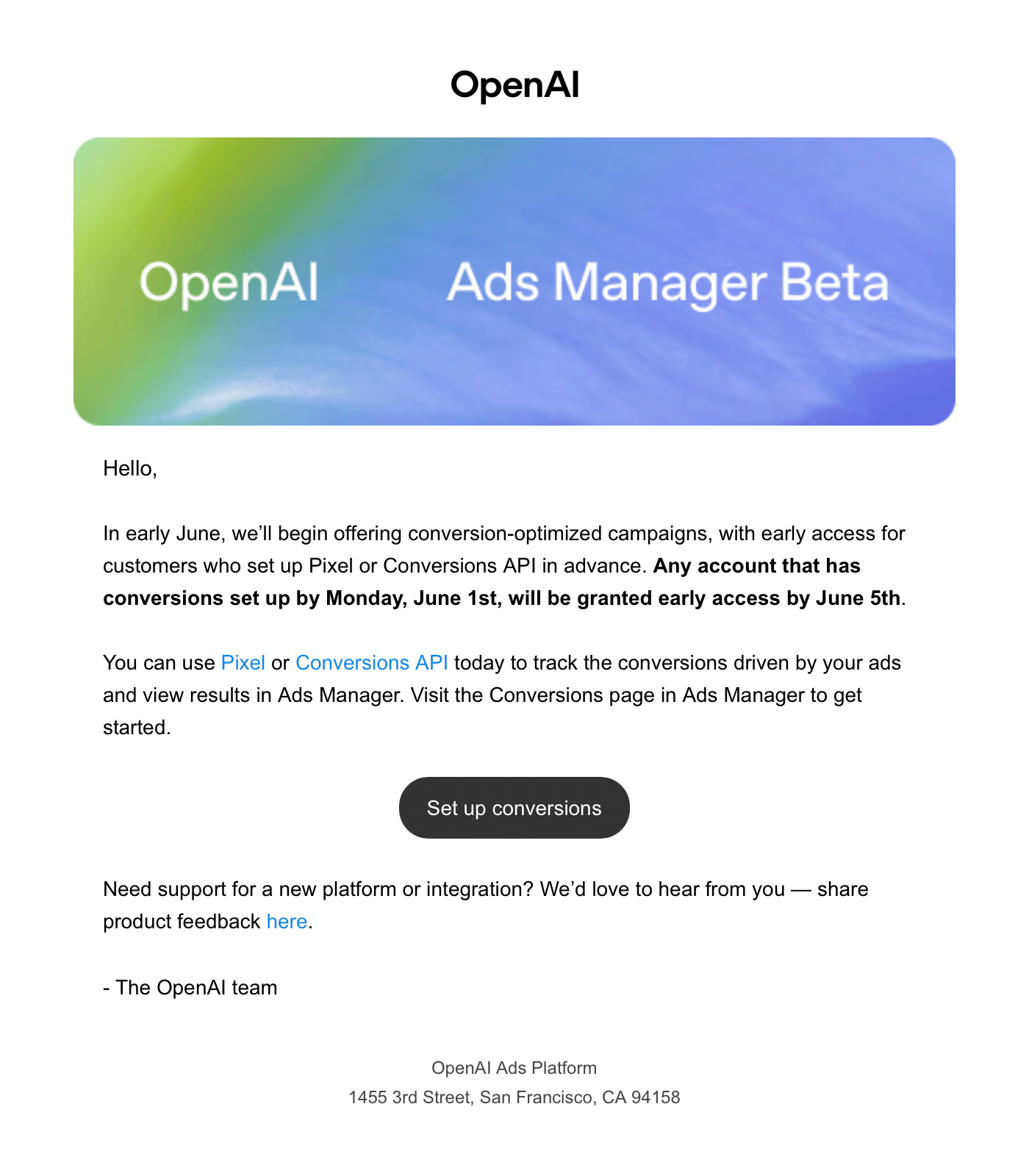
OpenAI confirmed conversion-optimized ChatGPT campaigns, with early access starting June 5, 2026. Days earlier at Google Marketing Live, Google introduced Gemini-built formats that answer a user’s question directly inside AI Mode. Two launches, two weeks, one direction.
Let’s walk you through what AI search ads are, how they show up on ChatGPT and Google, and the steps that make your campaigns answer-ready.
AI search ads are advertisements that machine learning systems target, bid on, and build automatically, assembling the creative to fit a specific query rather than a keyword list you choose by hand. They appear inside AI-driven search surfaces, including Google AI Overviews, AI Mode, and ChatGPT, woven into the answer instead of stacked above the organic links.
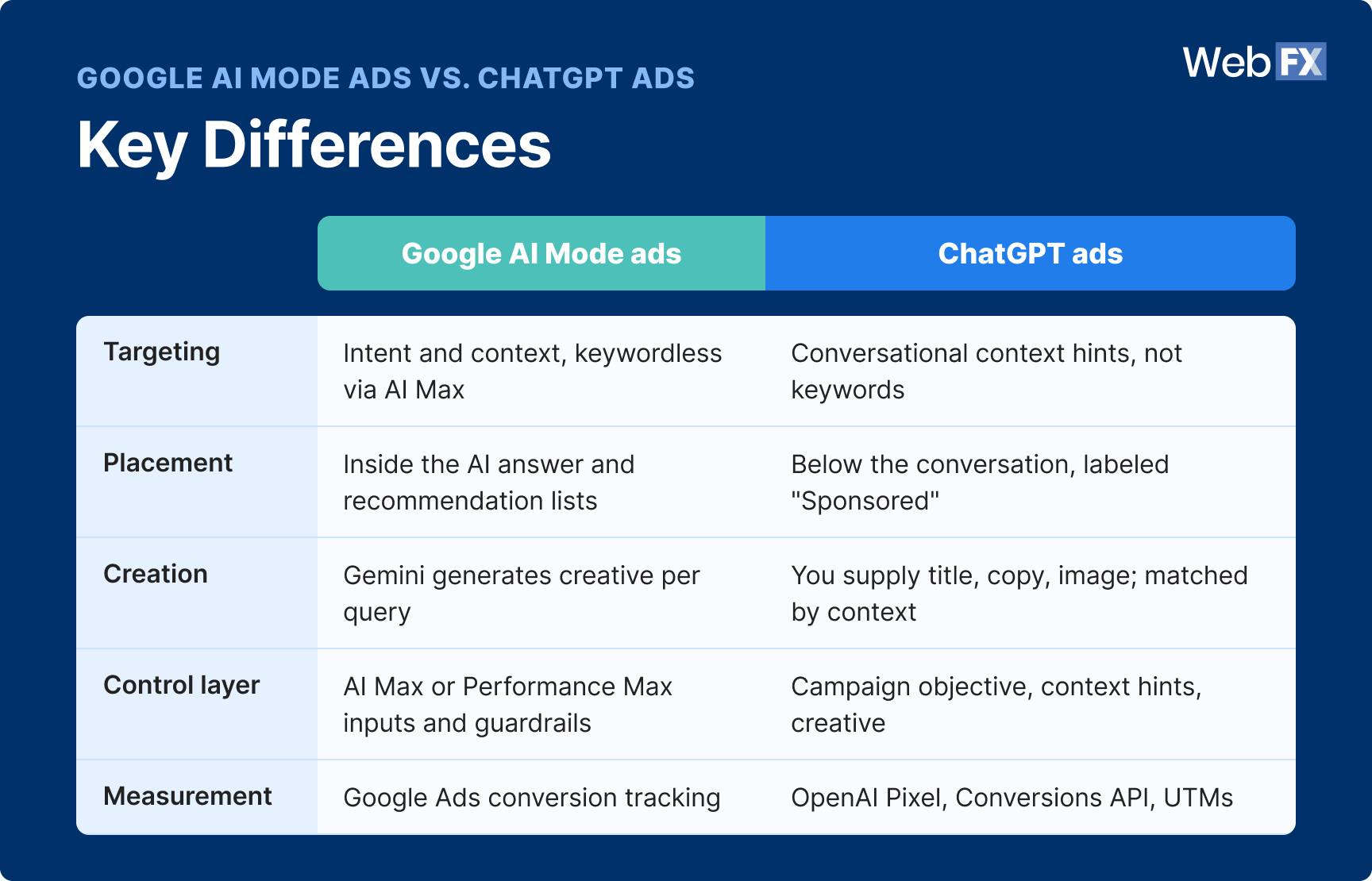
The control layer is what changed. You no longer pick the exact words that trigger an ad, you give the system inputs it uses to assemble one: your product feeds, audience signals, conversion data, and landing page content. Keywords still exist, but they share the wheel.
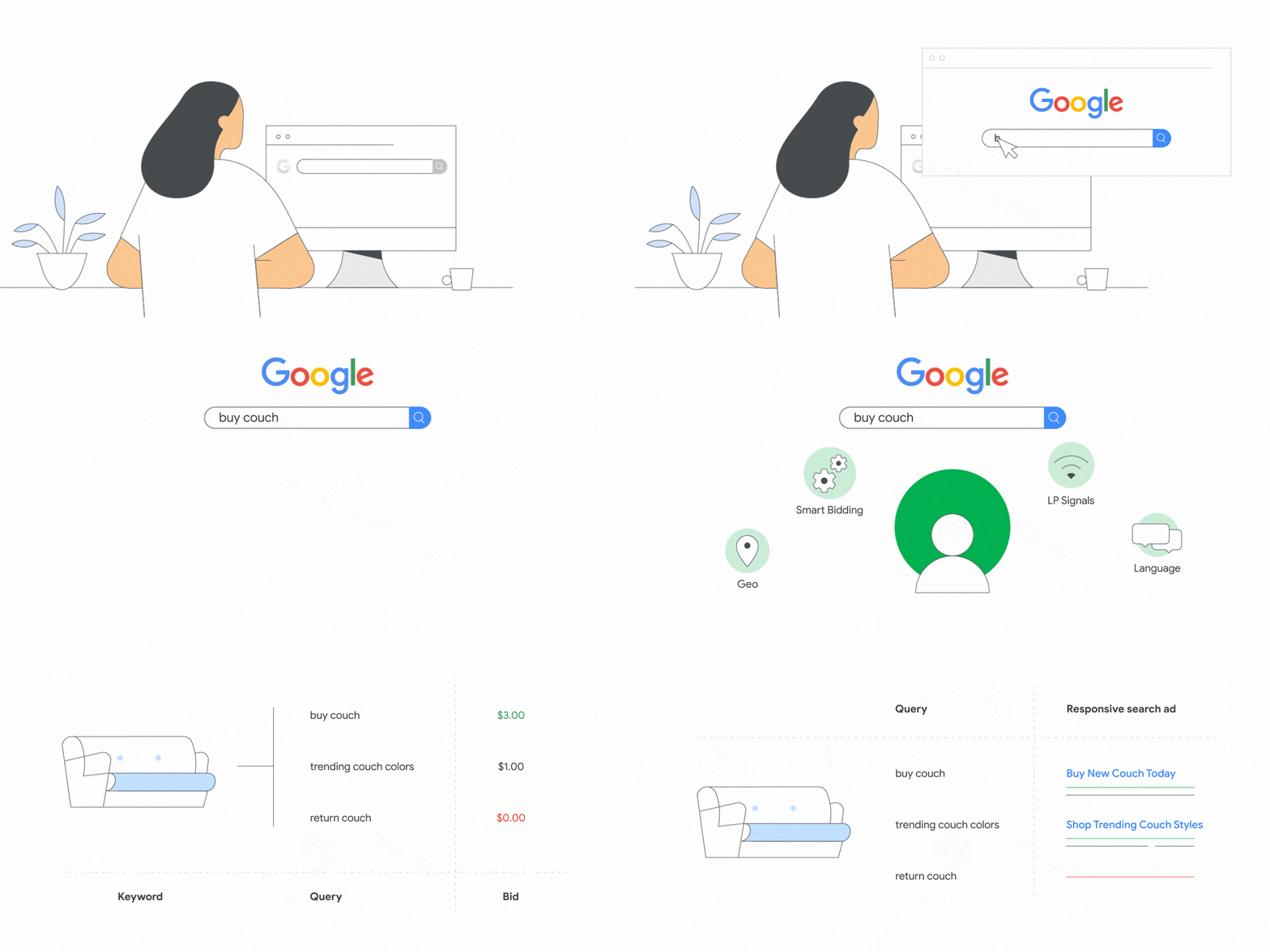
On Google, AI search ads run on its AI-powered Search ads stack. AI Max uses keywordless broad match to reach queries you never listed, dynamic creative writes headlines from your assets and pages, and final URL expansion routes each click to the page that best fits intent. Google reports that 75% of people make faster, more confident decisions using AI Mode in Search, which is exactly why advertisers are following them onto these surfaces.
Google’s AI-powered Search ads use AI to match ads to relevant searches, optimize bids, and create more relevant ad experiences. Source: Google Ads Help
What just changed for AI search ads in the last two weeks?
Two launches landed in the same two-week window, and both put the ad inside the answer. OpenAI moved on the performance side, and Google moved on the AI Mode side, so the shift is happening across both major surfaces at once.
A new Conversions objective joins Reach and Clicks, the Pixel tracks site activity after an ad click, and the Conversions API sends first-party data back to OpenAI. That setup lets OpenAI optimize toward sales and sign-ups instead of engagement, which Search Engine Land called the clearest signal yet that the company is building a performance advertising ecosystem around ChatGPT.
You run these campaigns through the ChatGPT Ads Manager, OpenAI’s self-serve platform that opened in beta on May 5, 2026.
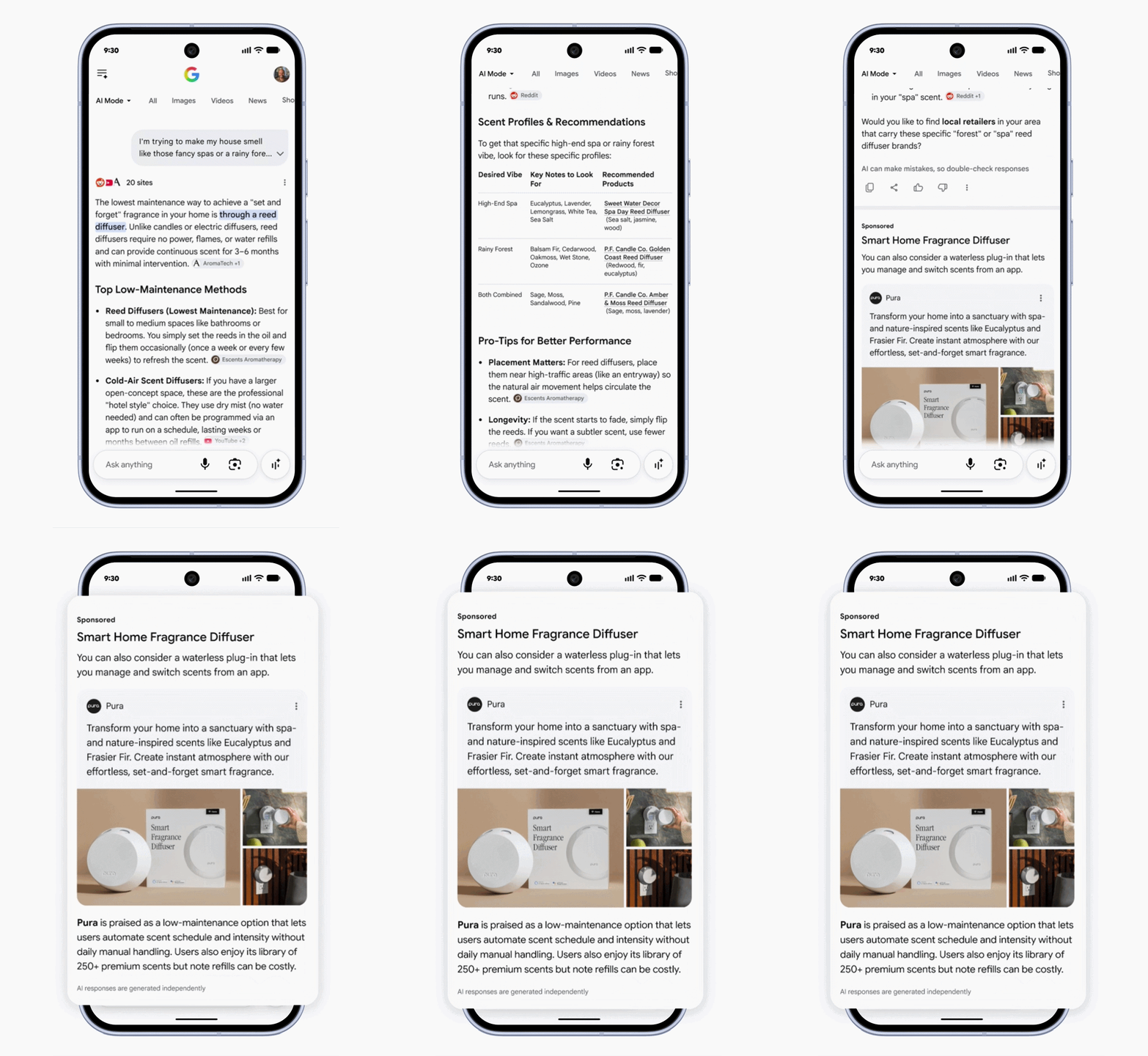
On Google’s side, Google Marketing Live introduced Gemini-built ad formats that answer a user’s question directly inside AI Mode. Conversational Discovery ads generate creative tailored to the specific query, and Highlighted Answers let relevant ads appear inside AI Mode’s recommendation lists.
Both formats include an independent AI explainer that synthesizes product information alongside your creative, and both stay clearly labeled “Sponsored.” These formats are currently in testing in the U.S. They aren’t in every account yet, but Google has confirmed they’re coming, which makes now the right time to wire up your inputs.
A Conversational Discovery ad answering a home-fragrance query in Google AI Mode, shown by Google at Google Marketing Live 2026.
Both announcements share one premise. The ad gets generated to fit the answer, per query, in real time, and that is the real story.
Coverage has treated these as two separate product launches, but they point in the same direction. Ads are becoming part of the answer experience on both ChatGPT and Google.
How do AI Mode ads and ChatGPT ads actually appear?
AI Mode ads appear inside Google’s generated answer, and ChatGPT ads appear directly below the conversation, both matched to context rather than exact keywords. The mechanics differ, but the principle is the same: the system reads intent, then places or builds an ad to fit it.
On Google, the AI Mode formats run on Gemini. Conversational Discovery ads generate creative for the specific question a person asks, Highlighted Answers slot relevant ads into AI Mode’s recommendation lists, AI-powered Shopping ads write custom explainers for high-consideration buys like appliances, and Business Agent for Leads puts a chat agent trained on your site inside the ad. To appear in any of them, you build on AI Max for Search, AI Max for Shopping, or Performance Max.
On ChatGPT, ads appear below a relevant conversation, clearly labeled and separated from the answer, and the system matches them using context hints, landing page content, and ad copy rather than exact-match keywords. Buying runs on a relevance-weighted second-price auction, with a recommended max bid of $3 to $5 per click for the Clicks objective and a $60 default for CPM campaigns. For a full pricing breakdown, see our comprehensive guide on how much ChatGPT ads cost.
Why do AI search ads matter for marketers right now?
AI search ads matter now because both the audience and the ad budget are moving into AI answers faster than most advertisers can adapt. The platforms are building performance infrastructure, and the early-mover window is open, with competition still thin.
Here is the part most coverage misses. Answer-ready assets decide who wins these placements. Clear product positioning, high-quality landing pages, clean conversion data, and creatives that an AI model can adapt safely now matter more than a bigger bid.
Those assets are exactly what strong search engine optimization (SEO) already builds, so your SEO investment feeds your AI search ads instead of competing with them. Pairing the two keeps you visible across both traditional search and AI answers.
Expert insights from
Colton W.Sr. PPC Consultant at WebFX
“Strategists should prioritize visibility within high-intent, long-tail queries that AI models are likely to answer conversationally. Instead of focusing solely on traditional metrics, they need to treat AI response presence as a new form of organic-adjacent brand positioning within a zero-click marketing strategy. Strategists who are (justifiably) put off by the lack of control have some options at their disposal now (especially within Google) to set up guardrails for what is generated about your brand. Leverage these guardrails to expand visibility while staying on-message.”
How to make your AI search ads answer-ready
Start with measurement. AI ad systems optimize toward the conversion data you feed them, so the inputs you wire up before launch decide how well the model performs. Use this checklist:
Clean your product feeds and structured data, so the model assembles ads from accurate inputs.
Build landing pages that match per-query intent, not a generic homepage.
Supply rich creative inputs and clear brand guardrails that an AI model can adapt without going off-message. That means multiple headline and description variants, approved imagery, and tone guidelines.
The tracking and visibility layer is where this gets hard for in-house teams, and it is where OmniSEO® and AI search optimization services do the heavy lifting, pairing your paid placements with the organic AI citations that compound over time.
Looking to test ChatGPT Ads but don’t know where to start?
WebFX takes a methodical approach to testing this new channel to give your business the best shot at success.
AI search ads are paid placements that appear inside AI-generated search answers, where machine learning handles targeting, bidding, and creative instead of a manual keyword list. They run across Google AI Overviews, AI Mode, and ChatGPT.
ChatGPT ads appear directly below a relevant ChatGPT conversation, clearly labeled “Sponsored” and separated from the AI’s answer. The system matches them to the conversation’s context rather than exact keywords.
Conversational Discovery ads are Google ad units that use Gemini to build creative answering a user’s specific question inside AI Mode. Each one includes an independent AI explainer alongside the advertiser’s message.
No. OpenAI’s Answer Independence principle keeps ads from influencing ChatGPT’s responses, and Google separates its independent AI explainer from advertiser creative and labels the unit “Sponsored.”
Start by setting up conversion tracking, the OpenAI Pixel or Conversions API for ChatGPT and conversion tracking for Google, then clean your feeds and landing pages so the model has accurate inputs. Launch a small, measured test before you scale spend.
Ads are moving into answers. Your strategy needs to catch up.
Ads have moved inside the answer on both ChatGPT and Google, and the brands that adapt first will set the pace. Early advertisers on past platforms, from Google Ads to Meta to TikTok, captured lower costs and built optimization data before competition caught up, and the same window is open now. Move early and you get more time to test the formats, clean up your inputs, and learn what drives qualified conversions before adoption gets crowded.
Want a partner to map your AI search ads strategy? WebFX has 30+ years of experience helping businesses stay ahead of shifts like this, and our team of 750+ experts can build your testing plan across Google Ads management, ChatGPT advertising, and AI search optimization.
Craft a tailored online marketing strategy! Utilize our free Internet marketing calculator for a custom plan based on your location, reach, timeframe, and budget.
Craft a tailored online marketing strategy! Utilize our free Internet marketing calculator for a custom plan based on your location, reach, timeframe, and budget.






 Albert Dandy Velasquez blends SEO strategy with compelling storytelling to help businesses boost their visibility and revenue online. With a B.A. in English and certifications from HubSpot, Semrush, and Google Analytics, he has written and optimized hundreds of articles on organic SEO, content strategy, and user experience. He regularly contributes to the WebFX blog and SEO.com, creating content that helps readers turn marketing goals into measurable results. When he’s off the clock, he’s usually exploring new neighborhoods on two wheels, filming travel content, or chasing golden hour with a coffee in hand. View full profile