


Contents
- Can healthcare brands run ads inside ChatGPT?
- What ChatGPT’s healthcare ad restrictions mean for your practice
- How healthcare brands earn visibility inside ChatGPT today
- What healthcare marketers should do instead of waiting for ChatGPT ads
- Common mistakes healthcare marketers make with ChatGPT advertising
- FAQs about ChatGPT advertising for healthcare
- Earn patient visibility inside AI conversations with WebFX
-
Can healthcare brands run ads inside ChatGPT?
No, most healthcare brands cannot run paid ads inside ChatGPT because OpenAI explicitly excludes healthcare, prescription drugs, and clinical care providers from its current ad inventory during the test period, covering nearly every consumer-facing medical category from hospitals to telehealth services. -
What do ChatGPT’s healthcare ad restrictions mean for providers?
The restrictions level the playing field since competitors also cannot buy their way into AI conversations, making organic AI visibility the highest-leverage channel for patient acquisition as traditional paid acquisition strategies do not apply to most healthcare providers. -
How can healthcare brands earn visibility in ChatGPT today?
Healthcare brands earn visibility through AI search optimization by being recommended in organic AI answers, which involves optimizing for question-based queries, building E-E-A-T signals with visible credentials, earning citations from authoritative sources, creating condition-specific clinical pages, and maintaining strong local presence. -
What should healthcare marketers do instead of waiting for ChatGPT ads?
Healthcare marketers should audit their AI visibility, invest in AI search optimization, double down on local SEO and Google Business Profile, run Google Ads and Local Services Ads, build E-E-A-T-aligned content with clinical credentials, and track AI citations using tools like OmniSEO to monitor where their brand surfaces. -
What are common mistakes healthcare marketers make with ChatGPT advertising?
Common mistakes include waiting for restrictions to lift instead of building AI visibility now, publishing medical content without clear author credentials, ignoring local SEO during AI hype cycles, and feeding protected health information into consumer AI tools which creates HIPAA compliance exposure risks.
ChatGPT advertising for healthcare is restricted. OpenAI’s current ad policies disallow healthcare advertisers, medical services, prescription products, and health claims about prevention, diagnosis, or treatment from ChatGPT’s ad inventory during the test period, which means hospitals, private practices, telehealth brands, prescription services, and most consumer-facing health businesses cannot buy sponsored placements inside ChatGPT conversations.
Healthcare marketers still have legitimate paths to ChatGPT visibility: AI search optimization that earns organic citations, B2B clinical advertising on physician-verified networks, and enterprise integrations through OpenAI for Healthcare. This guide explains who is restricted from advertising in ChatGPT, what limited exceptions exist, and how healthcare brands can earn visibility in ChatGPT without buying ads.
- Can healthcare brands run ads inside ChatGPT?
- What ChatGPT’s healthcare ad restrictions mean for your practice
- How healthcare brands earn visibility inside ChatGPT today
- What healthcare marketers should do instead of waiting for ChatGPT ads
- Common mistakes healthcare marketers make with ChatGPT advertising
- FAQs about ChatGPT advertising for healthcare
Insights from 98,500+ hours of healthcare marketing experience

“*” indicates required fields
Can healthcare brands run ads inside ChatGPT?
No. Most healthcare brands cannot run paid ads inside ChatGPT because OpenAI explicitly excludes healthcare, prescription drugs, and clinical care providers from its current ad inventory during the test period. The restriction covers nearly every consumer-facing medical category, from hospitals and dental practices to telehealth and mental health services.
List view
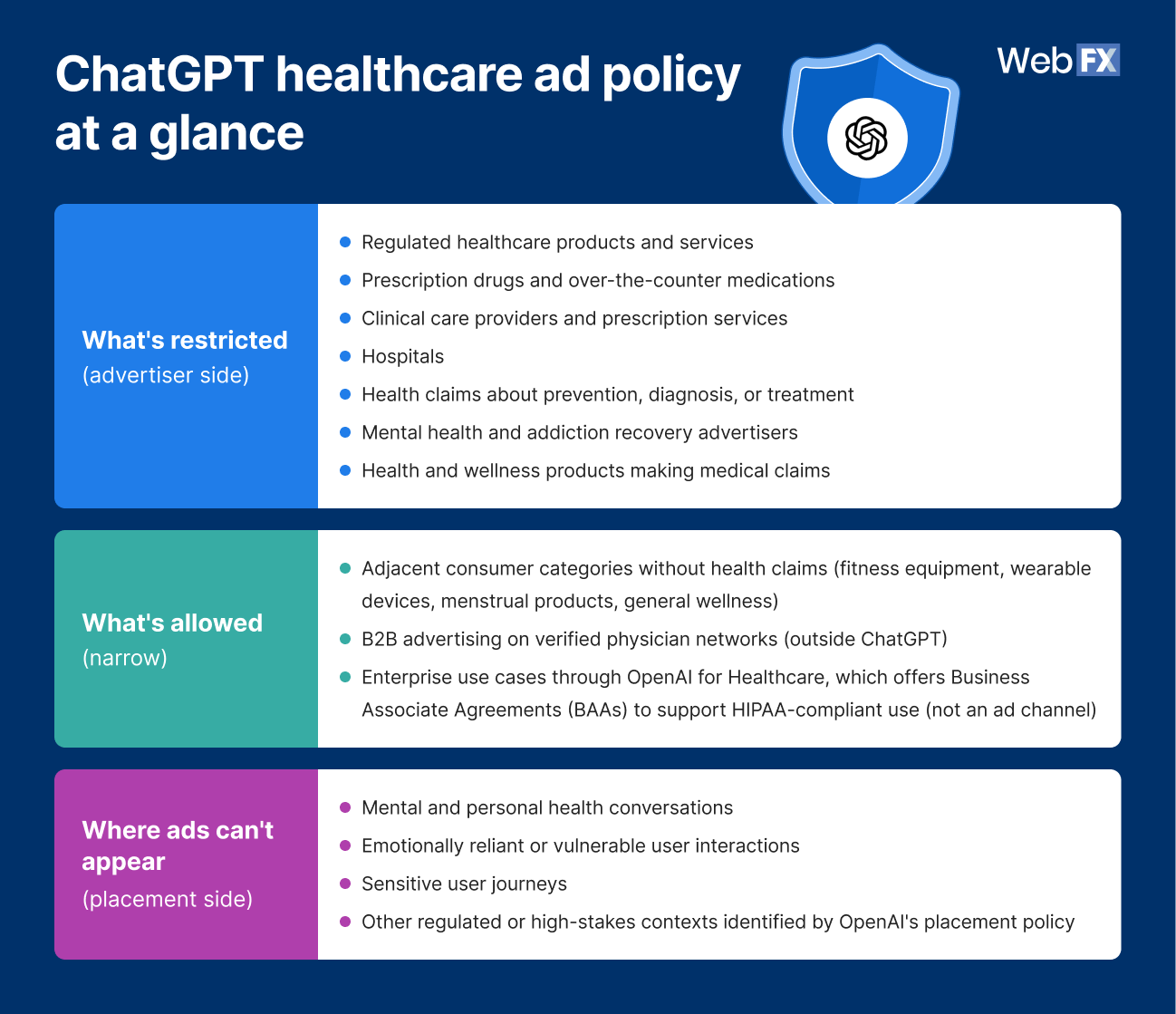
What’s restricted (advertiser side):
- Regulated healthcare products and services
- Prescription drugs and over-the-counter medications
- Clinical care providers and prescription services
- Hospitals
- Health claims about prevention, diagnosis, or treatment
- Mental health and addiction recovery advertisers
- Health and wellness products making medical claims
What’s allowed (narrow):
- Adjacent consumer categories without health claims (fitness equipment, wearable devices, menstrual products, general wellness)
- B2B advertising on verified physician networks (outside ChatGPT)
- Enterprise use cases through OpenAI for Healthcare, which offers Business Associate Agreements (BAAs) to support HIPAA-compliant use (not an ad channel)
Where ads can’t appear (placement side):
- Mental and personal health conversations
- Emotionally reliant or vulnerable user interactions
- Sensitive user journeys
- Other regulated or high-stakes contexts identified by OpenAI’s placement policy
One nuance worth noting: in April 2026, OpenAI refined its placement policy so that medical, legal, and financial advice contexts are no longer categorically blocked from showing ads from approved categories. Healthcare advertisers themselves remain ineligible, and sensitive user conversations, such as mental health discussions, remain fully ad-free, but the surrounding ad ecosystem has become slightly more permissive than earlier reporting suggested.
The restrictions cover the bulk of the healthcare market. For most providers, the practical answer is straightforward: paid ChatGPT placement is not a current option for patient acquisition, and waiting for it to open is not a viable strategy.
What ChatGPT’s healthcare ad restrictions mean for your practice
The restrictions on ChatGPT ads for healthcare mean traditional paid acquisition strategies do not apply to most providers, but they also mean your competitors cannot buy their way into AI conversations either. That levels the playing field around organic AI visibility, which becomes the highest-leverage channel for patient acquisition in the AI search era.
Here is what the restrictions mean sector by sector:
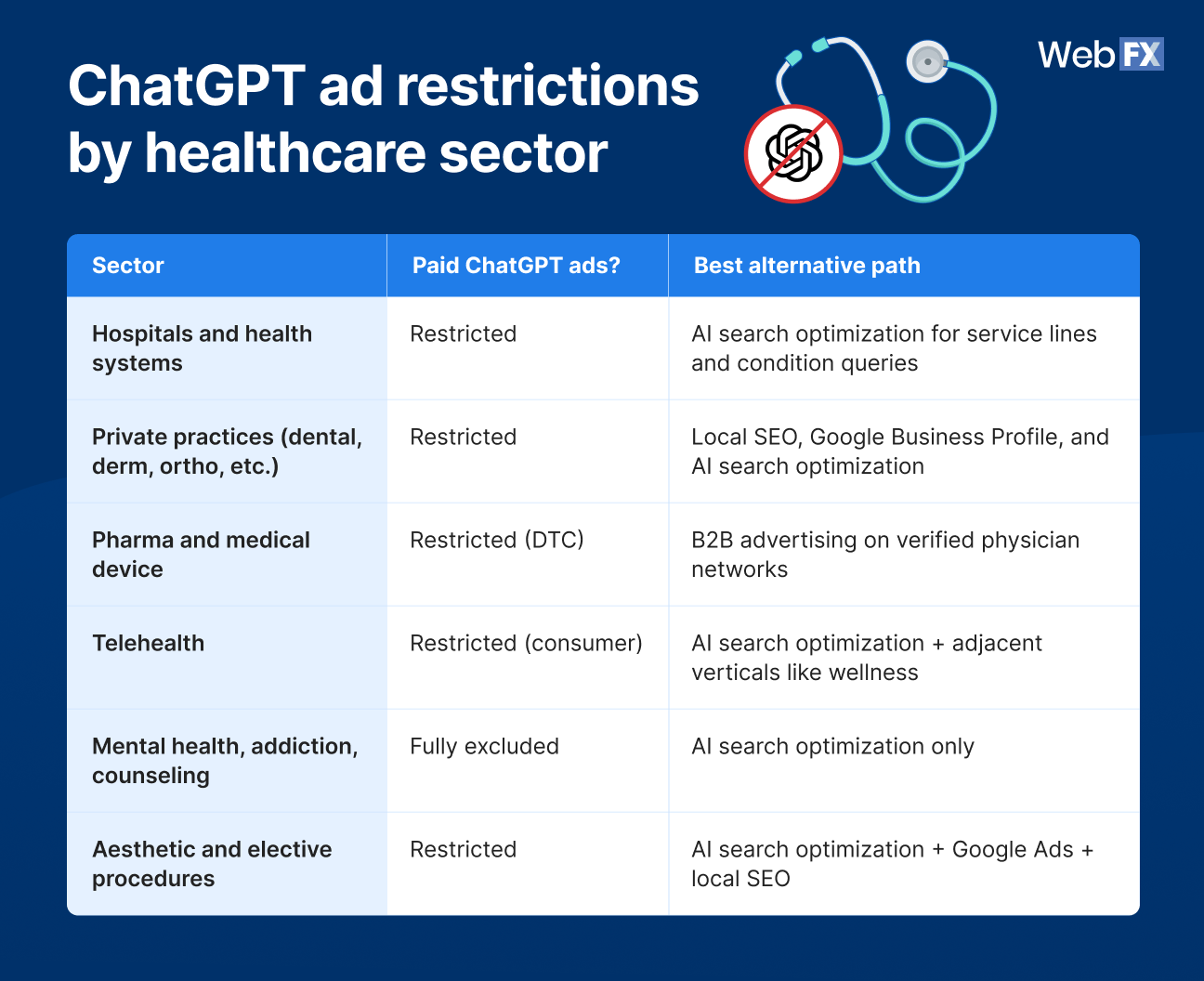
Table view
| Sector | Paid ChatGPT ads? | Best alternative path |
| Hospitals and health systems | Restricted | AI search optimization for service lines and condition queries |
| Private practices (dental, derm, ortho, etc.) | Restricted | Local SEO, Google Business Profile, and AI search optimization |
| Pharma and medical device | Restricted (DTC) | B2B advertising on verified physician networks |
| Telehealth | Restricted (consumer) | AI search optimization + adjacent verticals like wellness |
| Mental health, addiction, counseling | Fully excluded | AI search optimization only |
| Aesthetic and elective procedures | Restricted | AI search optimization + Google Ads + local SEO |
The pattern is consistent across sectors: healthcare advertising in ChatGPT is not an option for patient acquisition, so the question becomes how to earn visibility inside AI conversations through other means.
How healthcare brands earn visibility inside ChatGPT today
Healthcare brands earn visibility inside ChatGPT by being recommended in organic AI answers, not by buying placement. This is called AI search optimization, sometimes called AEO or GEO, and it works by structuring your content so ChatGPT’s models cite your practice when patients ask health questions.
Here are five tactics that move the needle for healthcare brands:
- Optimize for question-based queries. Patients ask ChatGPT, “best pediatric dentist near me,” “what’s the difference between PRP and stem cell therapy,” and “should I get a colonoscopy at 45 or 50.” Your content has to answer these the way a credentialed expert would, with structured headings, direct answers, and citation-ready phrasing.
- Build E-E-A-T signals. Show visible author credentials, board certifications, peer-reviewed citations, and clinical accuracy. Google and AI systems both lean heavily on Experience, Expertise, Authoritativeness, and Trust signals for medical content (Your Money or Your Life topics carry the highest scrutiny).
- Earn citations from authoritative sources. Focus on earning citations from medical journals, .gov health sites, recognized patient organizations, and partnerships with hospital systems. AI systems weigh cited content far more heavily than uncited claims.
- Create condition-specific clinical pages. Make these pages highly specific, accurate, and frequently updated. ChatGPT’s models prefer current, structured medical content over generic service pages.
- Maintain local presence. Maintain your Google Business Profile, NAP consistency, structured data markup, and patient reviews. AI systems pull local context from these signals when answering “near me” health queries.
Watch for shadow AI risks
Staff using consumer ChatGPT to draft patient communications, summarize charts, or handle clinical notes is a HIPAA exposure risk. Any protected health information (PHI) entered into a consumer-facing AI tool may fall outside HIPAA’s safeguards. Make sure your team uses enterprise tools that offer a Business Associate Agreement to support HIPAA-compliant use, not the free or Plus version of ChatGPT, for any task involving patient data.
What healthcare marketers should do instead of waiting for ChatGPT ads
Healthcare marketers should invest in AI search visibility, traditional paid channels with proven healthcare ROI, and content built to earn AI citations as the channel matures, rather than waiting for ChatGPT advertising restrictions to lift. The six action items below are what work today:
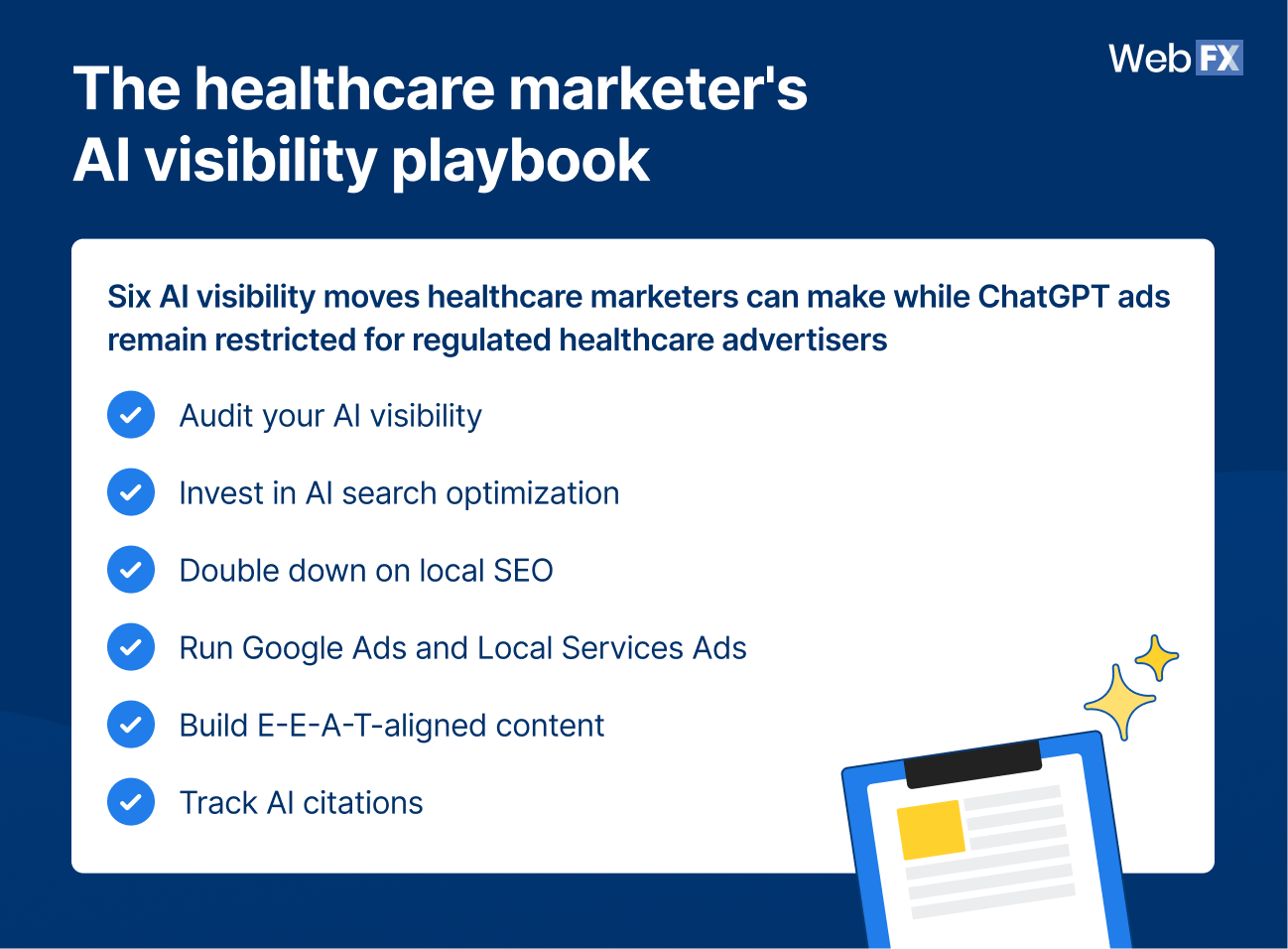
- Audit your AI visibility. Run brand queries and condition queries through ChatGPT, Google AI Overviews, and Perplexity. See where you appear, where you don’t, and which competitors are showing up in your place.
- Invest in AI search optimization. Pages built to be cited, not just to rank. WebFX’s AI search optimization services cover the technical, content, and authority work that earns AI citations.
- Double down on local SEO. Google Business Profile is still the highest-leverage channel for most practices. Optimize for service-area pages, patient reviews, and structured data.
- Run Google Ads and Local Services Ads. These are still among the largest patient acquisition channels by volume. Healthcare PPC works when paired with strong landing pages and compliance-aware tracking.
- Build E-E-A-T-aligned content. Author credentials, clinical accuracy, peer-reviewed sourcing, and content reviewed by licensed practitioners. This is what AI systems look for when deciding which healthcare sources to cite.
- Track AI citations. Tools like OmniSEO® track where your brand surfaces across AI search experiences, monitor AI citation rates, and give you the same kind of dashboard for AI visibility that you have had for SEO and PPC for years.
For most healthcare marketers, the limiting factor is not whether to invest in AI visibility, it is knowing which signals to prioritize first. Partnering with an experienced AI search optimization team that understands healthcare compliance saves months of trial and error.
Future-Proof Your SEO Strategy with OmniSEO®
Goodbye search engine optimization, hello search everywhere optimization.

Common mistakes healthcare marketers make with ChatGPT advertising
The most common mistakes healthcare marketers make with ChatGPT advertising include waiting for restrictions to lift, publishing medical content without clear credentials, ignoring local SEO during AI hype cycles, and feeding protected health information into consumer AI tools.
- Waiting for healthcare ads to open instead of building AI visibility. OpenAI has given no timeline for opening healthcare verticals. Marketers who wait risk falling behind competitors that are already building citation-worthy content organically.
- Publishing medical content without clear author credentials. AI systems weigh E-E-A-T signals heavily for healthcare topics. Content without visible clinical authorship, citations, and review dates has a harder time earning trust from patients and AI systems.
- Ignoring local SEO because of AI hype. Google Business Profile, local landing pages, patient reviews, and structured data still shape how patients and AI systems evaluate providers.
- Feeding PHI into consumer AI tools. Staff using free or consumer-facing AI tools to summarize patient notes or draft clinical communication can create compliance exposure. Teams should use enterprise tools with appropriate privacy, security, and compliance controls for any workflow involving protected health information.
FAQs about ChatGPT advertising for healthcare
Can healthcare brands run ads inside ChatGPT?
No. Most healthcare brands cannot run ads inside ChatGPT. OpenAI’s current ad policies exclude healthcare, prescription drugs, clinical care providers, hospitals, mental health services, and health claims from paid ad inventory during the test period. Healthcare marketers should focus on AI search optimization to earn organic visibility inside ChatGPT answers instead.
What healthcare categories are excluded from ChatGPT ads?
Excluded healthcare advertiser categories include hospitals, clinical care providers, prescription drugs, over-the-counter medications, prescription services, ads making health claims about prevention or diagnosis or treatment, mental health and addiction recovery services, and any product framing itself with medical benefits. On the placement side, ads also cannot appear in mental and personal health conversations or other sensitive user contexts, regardless of the advertiser’s category. Adjacent consumer wellness categories may be allowed when they avoid health claims.
What can healthcare brands do instead of ChatGPT ads?
Healthcare brands can earn visibility inside ChatGPT through AI search optimization, which structures content so ChatGPT’s models cite your practice in organic answers. Other proven channels include Google Ads, Local Services Ads, local SEO, Google Business Profile optimization, and E-E-A-T-aligned content built to meet medical-content quality standards.
What is ChatGPT Health, and is it different from ChatGPT for Healthcare?
Yes, they are different OpenAI products. ChatGPT Health is a consumer-facing health experience launched January 7, 2026, with additional privacy protections designed for sensitive health information, including purpose-built encryption and conversation isolation. It lets individuals connect medical records and ask personal health questions, but it is not designed as an advertising platform.
OpenAI for Healthcare is a separate enterprise suite that includes ChatGPT for Healthcare, designed for healthcare organizations and offering Business Associate Agreements (BAAs) to support HIPAA-compliant use cases. Neither product is an advertising channel.
How can hospitals and private practices appear in ChatGPT answers?
Hospitals and private practices appear in ChatGPT answers by building strong E-E-A-T signals, earning citations from authoritative medical sources, maintaining accurate condition-specific clinical pages, optimizing Google Business Profile and local SEO, and structuring content to answer the question-based queries patients actually bring to ChatGPT. AI search optimization is the discipline that ties these tactics together.
Will ChatGPT eventually allow healthcare ads?
OpenAI has stated that eligible ad categories may expand over time as safeguards, review systems, and compliance infrastructure mature, but the company has given no timeline for opening healthcare. Given the regulatory complexity of healthcare advertising in the U.S. (HIPAA, FTC, FDA), most marketers should plan around continued restrictions rather than wait for the channel to open.
Turn Your Data into a Competitive Advantage
Reach your target audience like never before with WebFX’s advanced marketing technology. Target new leads that mirror your ideal customer or re-engage prospects to provide support to your sales team.
Earn patient visibility inside AI conversations with WebFX
Every month your competitors invest in AI search visibility is a month they earn citations you do not. Hospitals, private practices, and healthcare brands that show up inside ChatGPT answers today will be the ones patients trust when AI becomes their first stop for medical questions.
WebFX has 98,500+ hours of healthcare marketing expertise, a team of 750+ digital experts, and AI search strategies that have helped clients earn over 94K AI mentions and generate 12,335 leads from AI sources. Our team understands the compliance, content, and authority signals that get healthcare brands cited inside AI search experiences.
Stay visible where patients are already asking questions. Request your free proposal or call 888-601-5359 to speak with a strategist today about our AI search optimization services for healthcare.
-
 Albert Dandy Velasquez blends SEO strategy with compelling storytelling to help businesses boost their visibility and revenue online. With a B.A. in English and certifications from HubSpot, Semrush, and Google Analytics, he has written and optimized hundreds of articles on organic SEO, content strategy, and user experience. He regularly contributes to the WebFX blog and SEO.com, creating content that helps readers turn marketing goals into measurable results. When he’s off the clock, he’s usually exploring new neighborhoods on two wheels, filming travel content, or chasing golden hour with a coffee in hand. View full profile
 -

WebFX is a full-service digital marketing agency delivering revenue-driving strategies across online advertising, SEO and AI search optimization, and digital marketing. Backed by 1,100+ client reviews, a 4.9-star rating on Clutch, and proprietary revenue-tracking technology, our team helps businesses grow visibility and revenue across platforms, from Google to ChatGPT to LinkedIn. Discover how our expert team and revenue-accelerating tech can drive results for you. Learn more

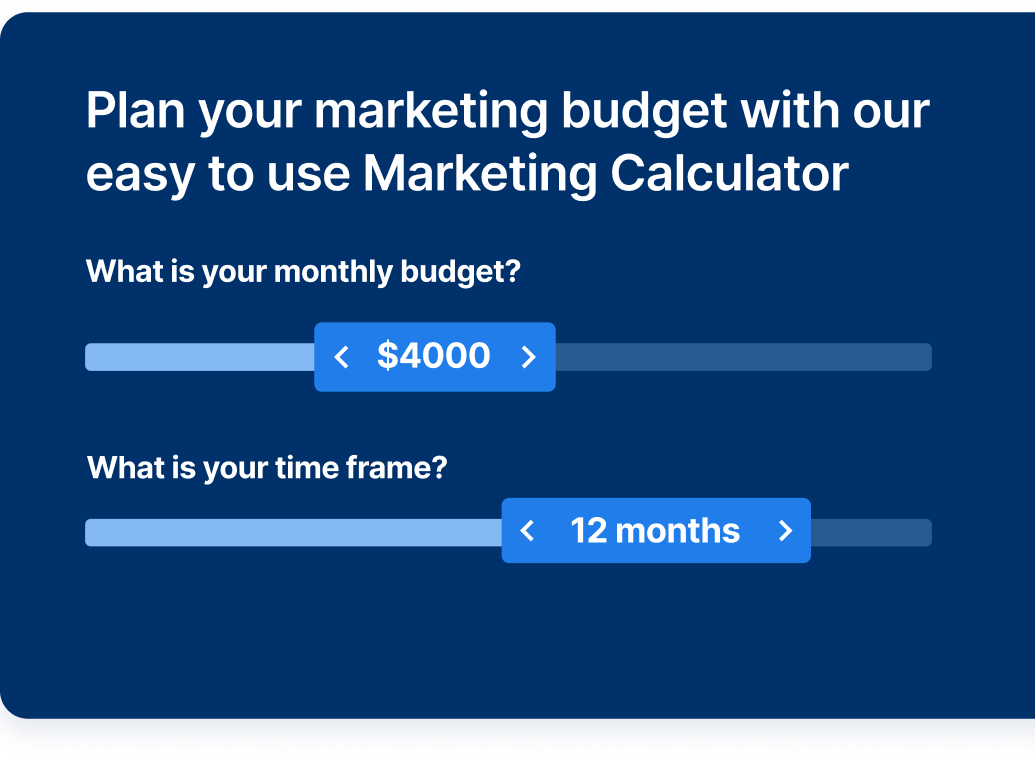
Try our free Marketing Calculator
Craft a tailored online marketing strategy! Utilize our free Internet marketing calculator for a custom plan based on your location, reach, timeframe, and budget.
Contents
- Can healthcare brands run ads inside ChatGPT?
- What ChatGPT’s healthcare ad restrictions mean for your practice
- How healthcare brands earn visibility inside ChatGPT today
- What healthcare marketers should do instead of waiting for ChatGPT ads
- Common mistakes healthcare marketers make with ChatGPT advertising
- FAQs about ChatGPT advertising for healthcare
- Earn patient visibility inside AI conversations with WebFX
Share this article


Help More Patients Find Your Practice
See how healthcare providers like Hurst Pediatric Dentistry increased local leads 5× with data-driven SEO from WebFX.
Try our free Marketing Calculator
Craft a tailored online marketing strategy! Utilize our free Internet marketing calculator for a custom plan based on your location, reach, timeframe, and budget.
What to read next