As AI-powered search becomes more personalized, email may be taking on another role beyond nurturing leads, driving repeat purchases, and staying top of mind.
The findings point to a bigger trend marketers shouldn’t ignore: AI-powered discovery is becoming increasingly personalized, making visibility a broader marketing challenge than rankings alone.
Why email matters for AI visibility
The Gmail study raises an interesting question: How much do previous brand interactions influence future recommendations?
As AI-powered search becomes more personalized, building familiarity with your audience may become an increasingly important part of visibility. That’s where email stands out.
Every newsletter, nurture sequence, industry update, and educational email creates another opportunity to reinforce your expertise, stay top of mind, and strengthen your association with the topics you want to be known for.
If brands users engage with are more likely to appear in personalized AI experiences, email may help strengthen visibility. It can also influence what happens after a recommendation appears by increasing recognition and trust when customers encounter your brand.
Expert insights from
Sarah B.Lead SEO Consultant, WebFX
“The study reinforces something we’ve been seeing across AI search. Visibility is becoming about more than rankings alone. The brands that consistently educate, engage, and stay connected with their audiences are often the same brands building the trust and familiarity that drive recommendations and action.”
Viewed through that lens, email becomes part of a broader visibility strategy, creating the familiarity that influences both recommendations and the decisions that follow.
4 ways to make email part of your AI visibility strategy
If personalization and brand familiarity become increasingly important in AI search, email has a larger role to play than many marketers realize.
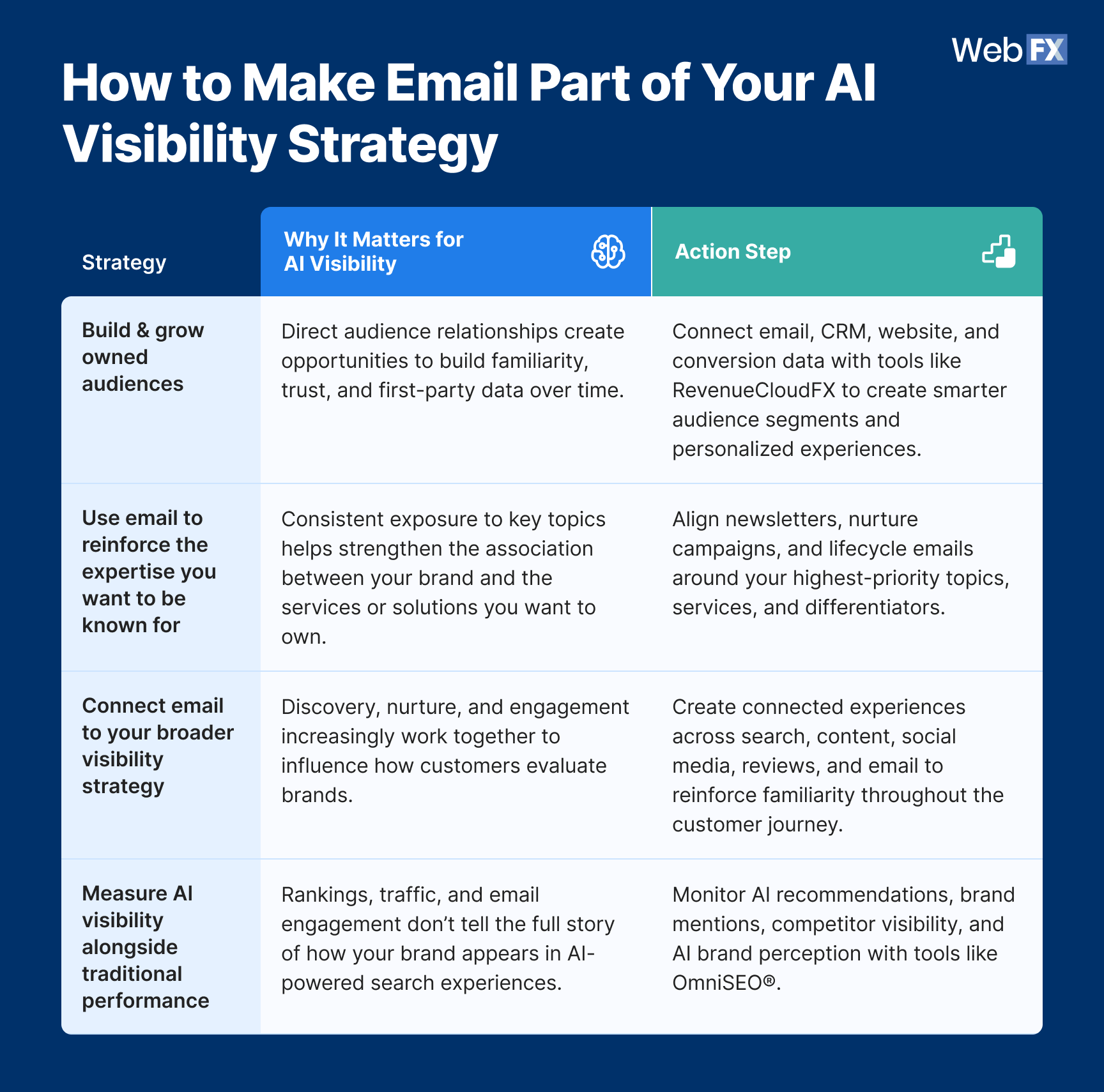
Here are four ways businesses can strengthen their visibility as AI-powered discovery continues to evolve:
Direct audience relationships create opportunities to build familiarity, trust, and first-party data over time.
Connect email, CRM, website, and conversion data with tools like RevenueCloudFX to create smarter audience segments and personalized experiences.
2. Use email to reinforce the expertise you want to be known for
Consistent exposure to key topics helps strengthen the association between your brand and the services or solutions you want to own.
Align newsletters, nurture campaigns, and lifecycle emails around your highest-priority topics, services, and differentiators.
3. Connect email to your broader visibility strategy
Discovery, nurture, and engagement increasingly work together to influence how customers evaluate brands.
Create connected experiences across search, content, social media, reviews, and email to reinforce familiarity throughout the customer journey.
4. Measure AI visibility alongside traditional performance
Rankings, traffic, and email engagement don’t tell the full story of how your brand appears in AI-powered search experiences.
Monitor AI recommendations, brand mentions, competitor visibility, and AI brand perception with tools like OmniSEO®.
1. Build and grow owned audiences
Unlike search rankings, ad platforms, or social media algorithms, your email audience is something you own, giving you an ongoing opportunity to build familiarity, trust, and engagement over time.
As AI-powered search becomes more personalized, direct relationships with your audience become increasingly valuable.
The real advantage comes from the first-party data those relationships generate. Understanding which content subscribers engage with, which services they research, which tools they use, and where they are in the buying journey can help marketers create more relevant experiences and reinforce the topics most important to their audience.
How to do it:
Start by connecting your email program to the rest of your marketing ecosystem. Use website behavior, content engagement, CRM insights, and conversion data to create audience segments based on actual interests and intent. Platforms like RevenueCloudFX can help unify those customer insights, giving marketers a more complete view of how audiences engage across channels and throughout the buying journey.
The goal is building a smarter audience strategy that creates meaningful, repeated interactions with your brand. As the study suggests, those interactions can help build the familiarity that influences which brands people recognize, trust, and ultimately choose when recommendations appear in AI-powered search experiences.
2. Use email to reinforce the expertise you want to be known for
As AI-powered discovery becomes more personalized, every email is an opportunity to reinforce your expertise and strengthen your association with the topics most important to your business.
Industry insights, original research, educational content, customer success stories, and expert commentary can all help build familiarity around the services and solutions you want to be known for.
How to do it:
Identify the core topics, services, and solutions you want your brand to own, then align your newsletters, nurture campaigns, and lifecycle emails around those themes.
For example, an HVAC company looking to build visibility around AC replacement could regularly share seasonal maintenance tips, energy-efficiency advice, signs it’s time to replace a system, financing guidance, and customer success stories.
Use email to amplify your strongest content, reinforce key differentiators, and continue conversations that began through search, AI discovery, social media, or other channels.
3. Connect email to your broader visibility strategy
Many businesses treat visibility and nurture as separate marketing functions. Search, content, reviews, social media, and advertising drive discovery, while email takes over once someone enters the funnel.
As AI-powered search becomes more personalized, those lines become less clear. The same interactions that help someone discover your brand can also influence how familiar they are with it later.
How to do it:
Think beyond individual channels and consider how prospects move through your visibility ecosystem. For example, someone might discover a healthcare provider through AI search, subscribe to a newsletter for health tips, receive educational content about treatment options, and later ask an AI platform for recommendations on specialists or providers. Each interaction is an opportunity to reinforce expertise, trust, and familiarity.
The goal is creating a connected experience across the customer journey. The brands most likely to earn recommendations are often the ones that consistently show up throughout the discovery, evaluation, and decision-making process.
4. Measure AI visibility alongside traditional performance
As AI-powered search becomes more personalized, marketers need a way to understand whether their visibility efforts are translating into recommendations.
Website traffic, rankings, email engagement, and conversions remain important, but they don’t answer questions like:
Is our brand appearing in AI-generated recommendations?
How are AI platforms describing our business?
Which competitors are being recommended alongside us?
Are we becoming more visible for the topics we want to own?
How to do it:
Track AI visibility alongside traditional marketing metrics. Solutions like OmniSEO® help businesses monitor AI recommendations, brand mentions, competitor visibility, and brand perception across platforms like ChatGPT, Perplexity, and Google AI Overviews.
The goal is understanding how your brand appears across AI-powered discovery experiences and whether your visibility efforts are strengthening your presence over time. As search evolves, recommendations are becoming an increasingly important part of the visibility equation.
While email isn’t a traditional ranking factor, emerging research suggests it may play a role in building the familiarity, trust, and engagement that influence personalized AI-powered search experiences. As AI platforms become more tailored to individual users, the relationships brands build through channels like email may become increasingly valuable.
The most effective emails focus on reinforcing the expertise and topics you want your brand to be known for. Industry insights, educational content, original research, customer success stories, product education, and expert commentary can all help strengthen the association between your brand and key topics over time.
Owned audiences provide a direct relationship with your prospects and customers. Unlike search engines, social media platforms, or advertising networks, your email audience is something you control. Those relationships also generate valuable first-party data that can help marketers better understand audience interests, intent, and engagement.
Email should be viewed as part of a broader visibility ecosystem. Businesses can connect email with content marketing, SEO, CRM data, reviews, social media, and AI visibility efforts to create a more consistent customer journey. The goal is reinforcing expertise and brand familiarity across every touchpoint, including the inbox.
Traditional email metrics like opens, clicks, and conversions won’t show how your brand appears across AI-powered search experiences. Businesses should also monitor AI visibility metrics such as brand mentions, recommendation share, competitor visibility, and AI brand perception using tools like OmniSEO®.
Start building visibility beyond search results
The findings of the study reinforce a broader shift already underway.
As AI-powered discovery becomes more personalized, visibility is increasingly shaped by the relationships brands build with their audiences over time. Familiarity, trust, and engagement all play a role in how customers evaluate recommendations.
The customer journey doesn’t end when someone leaves your website. Every interaction that follows, including the inbox, is another opportunity to reinforce expertise, build familiarity, and stay top of mind.
If you’re looking to strengthen your visibility across AI-powered search experiences, WebFX can help. From AI visibility tracking with OmniSEO® to content, AI SEO, and email strategies that build long-term brand familiarity, our team can help you create a stronger presence wherever customers discover your business.
Try our free Marketing Calculator
Craft a tailored online marketing strategy! Utilize our free Internet marketing calculator for a custom plan based on your location, reach, timeframe, and budget.
Craft a tailored online marketing strategy! Utilize our free Internet marketing calculator for a custom plan based on your location, reach, timeframe, and budget.






 Emily Carter is the Sr. Content Team Lead at WebFX, where she leads the creative team behind the company’s content. With an M.S. in Digital Marketing and 10+ years of experience, she’s written and reviewed hundreds of articles on marketing, SEO, and tech. These days, her focus is on content strategy and operations, with a special interest in the systems, processes, and people that help great content come to life. Her work appears across WebFX and its brands, including SEO.com, Nutshell, and TeamAI, and has been featured by Social Media Today, HuffPost, and more. Outside the office, she’s usually road-tripping, hiking, or planning her next national park adventure. View full profile@emcarter16