Contents
- Why websites need both AI and traditional search optimization
- Foundational on-page SEO strategies for AI search
- 1. Conduct keyword and prompt research
- 2. Create useful content
- 3. Add internal links
- 4. Optimize title tags, meta descriptions, and heading tags
- 5. Improve page speed and mobile responsiveness
- Advanced on-page SEO strategies for AI search
- 1. Strengthen topical relevance
- 2. Add structured data
- 3. Target conversational queries
- 4. Improve readability and accessibility
- FAQs about the top on-page SEO strategies for AI search
- Use on-page SEO to improve AI search visibility

What to know about on-page SEO for AI search
- Traditional SEO is still the foundation for AI search visibility.
- Helpful content and strong on-page SEO support both search and AI search.
- Internal links, metadata, and page structure help AI systems understand your content.
- Schema, topical relevance, and conversational queries strengthen AI search performance.
- Readability and accessibility make content easier to surface and use.
Over the last year and a half, the search landscape has shifted dramatically toward AI search results. Google’s AI Overviews appear for 25.8% of searches, according to WebFX’s latest study, while generative AI traffic grew by 796% from January 2024 to December 2025.
That said, search engines still command the majority of search traffic, indicating that traditional SEO is not dead and that digital marketers must continue to optimize for both search and AI search. The good news is that many of the same tactics that support strong organic visibility also support AI visibility.
The most important on-page SEO strategies for AI search still start with the fundamentals: helpful content, strong internal linking, optimized title tags and headings, clear site structure, and accessible page experiences. The difference is that now those elements also need to help AI systems understand, trust, and surface your content.
Why websites need both AI and traditional search optimization
A strong SEO foundation is a requirement for AI visibility. Without strong content, a quality backlink profile, and a solid technical base, all of which are needed for traditional SEO, it is unlikely that a site will succeed in AI search.
Traditional SEO still matters because search engines continue to drive the majority of search activity and many high-intent commercial queries. At the same time, AI search is reshaping how users discover information, evaluate brands, and ask more conversational questions.
Rather than treating them as separate channels, you should view them as overlapping visibility opportunities because the same core signals that support strong SEO also support stronger AI search presence.
Show up in AI Search and Beyond
See how WebFX can help your brand increase visibility everywhere your audience is searching- from ChatGPT to Google and beyond.
Foundational on-page SEO strategies for AI search
If you want to improve visibility in AI search, start with on-page SEO fundamentals. These strategies help search engines and AI systems understand your pages, connect related topics, and surface your content for relevant queries. Below are a few foundational on-page SEO strategies that support both traditional SEO and Generative Engine Optimization (GEO).
1. Conduct keyword and prompt research
The first step in any search strategy is identifying the keywords and prompts you want to target. When choosing them, focus on search volume, ranking difficulty, and, most importantly, intent.
For AI search, this means looking beyond traditional short-tail terms and identifying the conversational prompts your audience is actually using. Prioritize queries that align with the purpose of the page, whether that is educating top-of-funnel visitors or capturing higher-intent commercial traffic.
2. Create useful content
Content remains one of the strongest ways to target the terms you want a page to rank for. To make that content work harder for both traditional and AI search, align each page with a clear search intent and avoid trying to cover too many topics at once.
When mapping keywords to pages, make sure the content format matches the query. Informational terms often work best in blog content, while commercial and transactional terms are usually better suited for service, product, or industry pages. The stronger the match between query, page type, and user need, the stronger the page tends to perform.
3. Add internal links
Internal links are one of the strongest on-page SEO tools because they help readers discover related content and help search engines understand how your site is organized. They also reinforce relationships between pages, which is especially helpful when you are building out topic depth around a subject.
A strong internal linking strategy should point users and crawlers toward closely related pages in a natural way. Rather than linking just for the sake of linking, use internal links to connect supporting articles, service pages, and deeper resources that strengthen the main topic of a page.
4. Optimize title tags, meta descriptions, and heading tags
Title tags, meta descriptions, and heading tags shape how your content is understood and how it appears in search. Title tags still play an important role in relevance, while meta descriptions can improve click-through rate by giving users a clearer reason to visit your page.
Heading tags help structure the page for both readers and search engines. Clear, descriptive headings make it easier to scan content, understand the main takeaways, and surface the right sections for relevant queries. In practice, this means writing metadata and headings that are specific, useful, and aligned with the page’s core topic.
5. Improve page speed and mobile responsiveness
Page speed and mobile friendliness have become increasingly important ranking signals in both traditional SEO and GEO. This is because they directly affect how usable your site is. If a page is slow, difficult to navigate, or frustrating on mobile, it is less likely to perform well for users or search systems.
For AI search, strong page experience also supports content accessibility and crawlability. Marketers should make sure pages load quickly, display cleanly across devices, and remove avoidable friction that could prevent users or search engines from engaging with the content.
Advanced on-page SEO strategies for AI search
Once your fundamentals are in place, use these advanced tactics to make your content easier for AI systems to interpret, connect, and cite.
1. Strengthen topical relevance
Strengthening topical relevance means helping search engines clearly understand what a page is about and how it connects to related content across your site. This approach, often called semantic optimization, is especially important for AI search because AI systems rely on meaning, context, and entity relationships to interpret content.
In practice, each page should focus on one primary theme, and related pages should support that theme in a logical way. Content clustering is an effective framework here because it helps establish topical depth while also providing clearer opportunities for internal linking and a stronger site structure.
2. Add structured data
Structured data, often referred to as schema, is backend markup that helps search engines interpret page content more clearly. While it is not a substitute for strong content, it can strengthen how your pages are understood in both traditional and AI search.
Start with the schema types that best match the page. Service schema works well on service pages, product schema on product pages, LocalBusiness schema on location pages, and article schema on blog content. Beyond that, Organization, HowTo, FAQ, and Person schema can help clarify your brand, content type, and expertise signals when they are used appropriately.
3. Target conversational queries
To improve visibility in AI search, content should directly answer questions and reflect how people actually search in natural language. That means expanding beyond traditional keyword targeting and building content around more conversational, long-tail phrasing where it makes sense.
One practical way to do this is by reviewing Google Search Console query data to identify the questions and phrasing your audience already uses. Those insights can help you create supporting content, expand existing pages, and better align your copy with the way users search across both traditional and AI-driven platforms.
4. Improve readability and accessibility
Readability and accessibility make content easier for users to engage with and easier for search systems to interpret. Pages that are overly dense, vague, or difficult to navigate are less likely to perform well, especially when AI systems are trying to extract and surface clear answers. A few general tips for enhancing a page’s readability:
- Avoiding unnecessary fluff
- Utilizing headings and subheadings
- Using concise language and minimal jargon
- Including tables of contents or options for easily navigating a page
To improve accessibility, consider:
- Adding alt-text to images
- Using strong color contrasting
- Making sure the page experience accommodates users with certain disabilities
FAQs about the top on-page SEO strategies for AI search
Does traditional SEO still matter for AI search?
Yes, traditional SEO still matters for AI search. In many cases, a strong traditional SEO foundation is what enables AI visibility in the first place. Without quality content, a solid internal linking structure, and a technically sound website, it is much less likely that a site will perform well in AI-generated results.
What on-page SEO factors help AI search visibility most?
Some of the most important on-page SEO factors for AI search include:
- Useful content
- Internal linking
- Optimized title tags and headings
- Clear topical focus
- Structured data
- Strong readability
Together, these elements help search engines and AI systems better understand what a page is about and when it should be surfaced for a relevant query.
How do you make content easier for AI systems to understand?
To make content easier for AI systems to understand, pages should be organized around one primary topic and structured clearly. This includes using descriptive headings, writing concise and direct copy, connecting related pages through internal links, and adding structured data where appropriate. The goal is to make the meaning of the page as clear as possible.
Does schema markup help with AI search?
Schema markup can help with AI search by providing search engines with additional context about a page’s content. While schema alone will not drive visibility, it can support stronger interpretation of important page elements such as services, articles, FAQs, authorship, and how-to content.
Should you target keywords or conversational prompts for AI search?
You should target both, but they should serve different roles on the page. Traditional keywords should still anchor the core topic of the article, especially in places like the title tag, H1, headings, and primary body copy.
Conversational prompts can then be incorporated naturally throughout the page by directly answering common questions, using more natural-language subheadings, and addressing related follow-up queries a user might ask in AI search.
In practice, this means building the page around one primary keyword theme, then expanding the content to cover the longer, more specific ways users might phrase that topic. For example, a healthcare practice might build a page around a primary keyword like pediatric urgent care in Harrisburg, PA.
To also align with AI search behavior, that same page could naturally answer conversational queries such as when should I take my child to urgent care, does pediatric urgent care treat fevers, or urgent care vs. ER for kids. This keeps the page focused for traditional SEO while also making it more relevant for the way users phrase questions in AI platforms.
Use on-page SEO to improve AI search visibility
A strong traditional SEO foundation is needed for an AI search presence. Fortunately, many of the same on-page strategies that support organic performance also help make content easier for AI systems to understand, trust, and surface.
If your business is looking for a more strategic way to improve visibility in AI-driven search, WebFX’s GEO services can help you build that presence across platforms like Google AI Overviews, ChatGPT, and Perplexity — while keeping the focus on outcomes like qualified leads, stronger brand visibility, and revenue growth. Learn more about our GEO services today!
-
 Jon is a revenue marketing consultant with extensive experience in both SEO and PPC strategies. He helps businesses optimize their online presence to drive revenue growth through effective digital marketing campaigns. View full profile
 -

WebFX is a full-service digital marketing agency delivering revenue-driving strategies across online advertising, SEO and AI search optimization, and digital marketing. Backed by 1,100+ client reviews, a 4.9-star rating on Clutch, and proprietary revenue-tracking technology, our team helps businesses grow visibility and revenue across platforms, from Google to ChatGPT to LinkedIn. Discover how our expert team and revenue-accelerating tech can drive results for you. Learn more

Try our free Marketing Calculator
Craft a tailored online marketing strategy! Utilize our free Internet marketing calculator for a custom plan based on your location, reach, timeframe, and budget.
Contents
- Why websites need both AI and traditional search optimization
- Foundational on-page SEO strategies for AI search
- 1. Conduct keyword and prompt research
- 2. Create useful content
- 3. Add internal links
- 4. Optimize title tags, meta descriptions, and heading tags
- 5. Improve page speed and mobile responsiveness
- Advanced on-page SEO strategies for AI search
- 1. Strengthen topical relevance
- 2. Add structured data
- 3. Target conversational queries
- 4. Improve readability and accessibility
- FAQs about the top on-page SEO strategies for AI search
- Use on-page SEO to improve AI search visibility
Share this article


See AI Marketing in Action
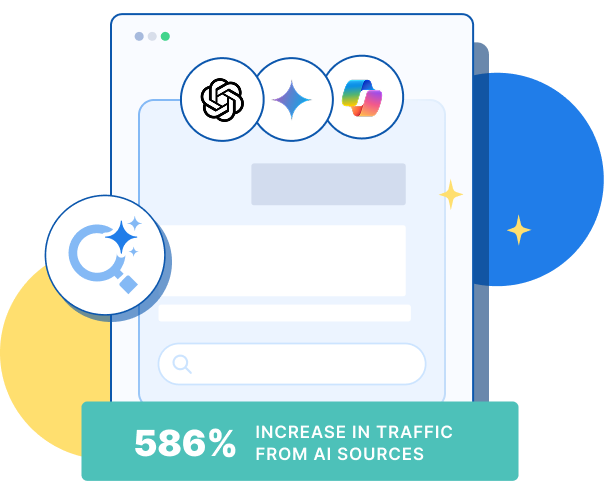
Explore how WebFX helped a regional brand get discovered in AI search experiences — proving what’s possible with today’s AI-driven marketing!
Try our free Marketing Calculator
Craft a tailored online marketing strategy! Utilize our free Internet marketing calculator for a custom plan based on your location, reach, timeframe, and budget.