Marketing moves fast. Add WebFX as a preferred source on Google and get our latest insights when you search.
Matthew Gibbons is a Senior Data & Tech Writer at WebFX, where he strives to help businesses understand niche and complex marketing topics related to SEO, martech, and more. With a B.A. in Professional and Public Writing from Auburn University, he’s written over 1,000 marketing guides and video scripts since joining the company in 2020. In addition to the WebFX blog, you can find his work on SEO.com, Nutshell, TeamAI, and the WebFX YouTube channel. When he’s not pumping out fresh blog posts and articles, he’s usually fueling his Tolkien obsession or working on his latest creative project. View full profile
Answer engine optimization helps your brand appear in AI-generated answers, citations, and recommendations.
AEO builds on SEO. Crawlable pages, helpful content, strong technical foundations, and trustworthy brand signals all support answer engine visibility.
AEO matters because prospects may use AI tools to research options before they ever visit your website.
To measure AEO performance, track AI visibility, citations, AI referral traffic, assisted conversions, and revenue impact.
Answer engine optimization (AEO) is the process of optimizing content so AI-powered answer engines can understand, cite, and recommend it in generated responses. AEO helps brands earn visibility across platforms like Google AI Overviews, ChatGPT, Gemini, Perplexity, and Copilot.
While SEO focuses on rankings and organic traffic, answer engine optimization focuses on earning citations, mentions, and visibility in AI-generated answers. By combining strong SEO fundamentals with clear, trustworthy content, businesses can increase their visibility wherever users search for answers.
Answer engine optimization (AEO) is the process of improving your content, website structure, and brand signals so AI-powered answer engines can understand, cite, and recommend your business in generated answers.
Unlike traditional SEO, which emphasizes ranking web pages in search results, AEO focuses on making your content ready for AI-generated answers, highlighting the shift in answer engine vs. search engine experiences. The goal is to make your content easy for machines to interpret and reliable enough to reference when generating responses.
AEO applies across a growing set of interfaces, including AI-powered search experiences like Google’s AI Overviews and AI Mode, generative answers within traditional search engines, and standalone answer platforms. It supports both brand visibility and information accuracy, helping your content influence how answers are shaped — not just where your pages appear.
Which platforms are answer engines?
Answer engines include AI-powered platforms and search experiences that generate direct responses instead of only showing a list of links.
Some answer engines cite sources directly, while others summarize information without always showing where each detail came from.
Common answer engines include:
Google AI Overviews and AI Mode: AI-generated search experiences that summarize information within Google
ChatGPT: A conversational AI assistant that can answer questions, summarize topics, and use browsing or connected tools in some experiences
Perplexity: An AI answer engine that commonly provides source citations with its responses
Gemini: Google’s AI assistant, which connects to Google’s broader AI and search ecosystem
Copilot: Microsoft’s AI assistant, which connects to Bing and Microsoft products
Claude and other AI assistants: AI tools that may support research, comparison, summarization, and decision-making workflows
Not every answer engine works the same way. Some pull from live search results, while others use model knowledge, connected data, browsing, or a mix of sources.
That’s why AEO works best when your brand information is consistent, specific, and easy to verify across your website and the broader web.
How does answer engine optimization differ from SEO?
SEO helps your pages earn visibility in search results, while AEO helps your content and brand earn visibility inside AI-generated answers.
SEO focuses on helping your pages rank in search results so users can find and click them. On the other hand, AEO focuses on helping your content or brand appear in AI-generated answers, even when users don’t click immediately.
“You can think of SEO as getting your ice cream shop on the main street,” Sarah B., Lead SEO Consultant at WebFX, explains. “AEO is making your shop the one tour guides bring their groups to. With AEO, your goal is to be recommended and cited.”
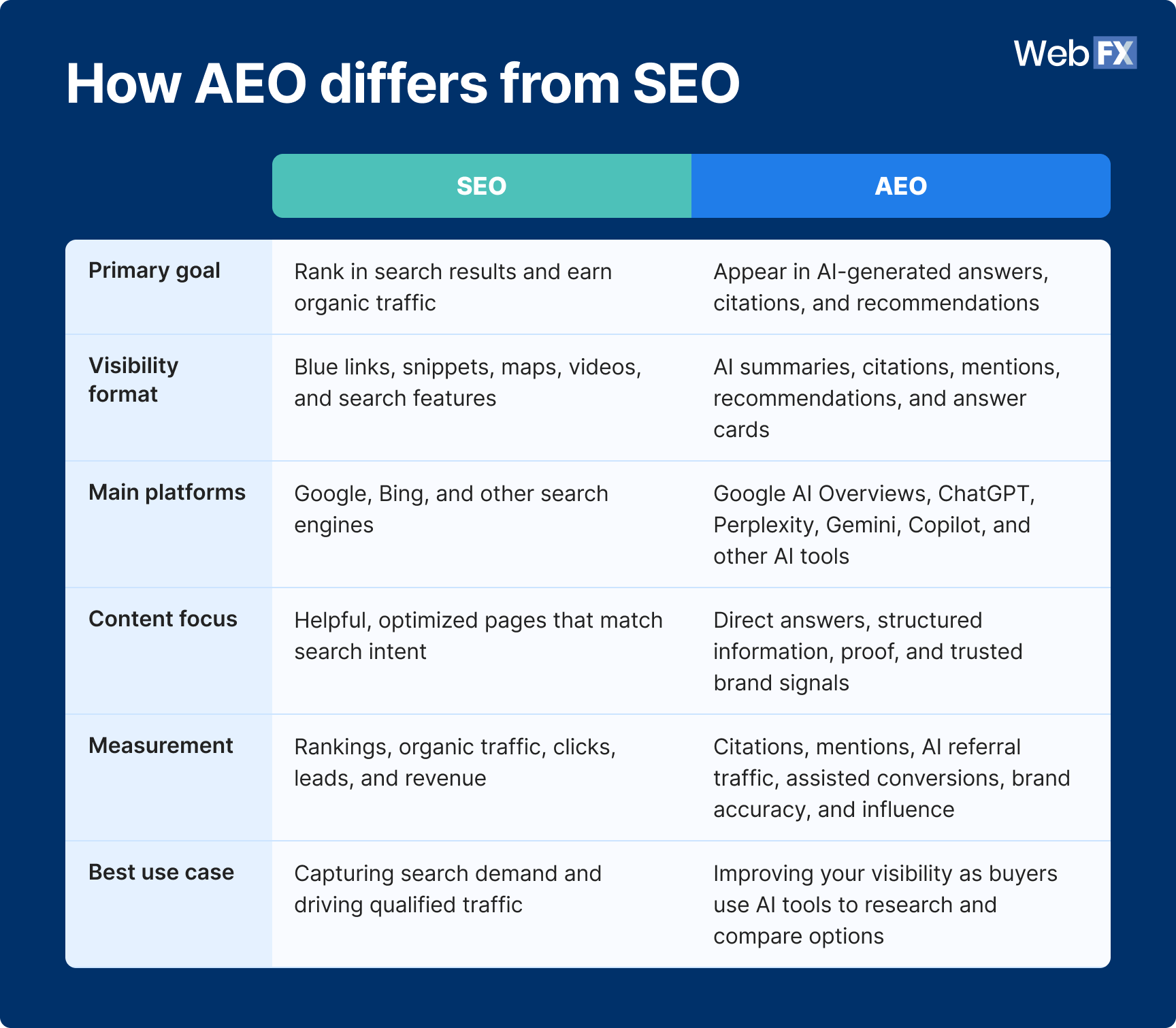
SEO and AEO support different parts of search visibility.
Appear in AI-generated answers, citations, and recommendations
Visibility format
Blue links, snippets, maps, videos, and search features
AI summaries, citations, mentions, recommendations, and answer cards
Main platforms
Google, Bing, and other search engines
Google AI Overviews, ChatGPT, Perplexity, Gemini, Copilot, and other AI tools
Content focus
Helpful, optimized pages that match search intent
Direct answers, structured information, proof, and trusted brand signals
Measurement
Rankings, organic traffic, clicks, leads, and revenue
Citations, mentions, AI referral traffic, assisted conversions, brand accuracy, and influence
Best use case
Capturing search demand and driving qualified traffic
Improving your visibility as buyers use AI tools to research and compare options
While SEO and AEO serve different purposes, they’re not mutually exclusive. SEO helps answer engines find and evaluate your content. AEO helps that content become easier to use in an answer.
Why answer engine optimization matters now
Search behavior is changing. While people still use search engines, they’re also increasingly using AI tools in their research before ever visiting a website.
That means your prospects may form an opinion about your brand before they even land on your site. If an AI answer includes your competitors but not your business, you may miss a research moment that influences the searcher’s decision.
This behavior change matters because AI visitors may act differently from traditional search visitors. According to our analysis of over 2.3 billion site visits, AI traffic represented a small share of total sessions at 0.18% in 2025, but AI visitors converted 1.2x higher than organic search visitors.
In other words, AI traffic may be smaller, but it can bring visitors who are closer to taking action.
AEO helps your business show up during those research and comparison moments. When people ask AI tools for recommendations, explanations, pricing guidance, or shortlists, your brand has a better chance of being included if your content is clear, trustworthy, and easy to cite.
For marketers, the practical takeaway is simple: Use SEO to show up in organic search, and use AEO to earn a place in AI answers.
AEO can support business results by helping your brand:
Appear in AI-generated answers during early research
Earn citations or mentions in relevant questions
Send high-intent visitors from AI platforms when users click through
Support assisted conversions when AI-referred users return later
Improve how answer engines describe your brand, products, services, and expertise
How answer engines choose what to show and cite
Answer engines use different systems, but many follow a similar process when generating responses. When a user asks a question, an answer engine may:
Interpret the query and intent
Retrieve relevant information
Synthesize content into a useful response
Evaluate trust and authority signals
Select sources to cite or reference
For example, if someone asks for the “best commercial HVAC company for warehouses,” an answer engine may look for pages that clearly explain warehouse HVAC services and show service-area relevance. Pages that include proof (like reviews or case studies) and use consistent business information across the web may also get cited.
This is why generic content often struggles in AI answers. If your page says you offer “quality service and customized solutions,” that doesn’t give an answer engine much to use.
If your page explains the exact industries you serve, the problems you solve, the locations you cover, and the proof behind your claims, you give answer engines and buyers more useful information.
Many AEO-friendly signals also overlap with Google’s Experience, Expertise, Authoritativeness, and Trustworthiness (E-E-A-T). Answer engines tend to favor content that is:
Easy to understand
Directly relevant to the question
Supported by evidence
Consistent with other trusted sources
Specific enough to attribute
Helpful without requiring the user to dig for the answer
That’s not to say your goal should be to write for bots at the expense of people. Instead, the goal is to make your best answers easier for both people and AI systems to find and trust.
6 answer engine optimization best practices
Most AEO success comes from executing a few fundamentals exceptionally well. Chasing shortcuts or formatting tricks rarely produces lasting results. A practical AEO strategy builds on four core steps.
AEO depends on your SEO foundation. If answer engines can’t crawl, understand, or trust your website, your content has a harder time appearing in AI-generated answers.
Make sure your site has:
Crawlable, indexable pages
Strong technical health
Fast-loading pages
Clear internal links
Helpful title tags and headings
Logical on-page structure
Content that matches real search intent
This is also why dropping SEO to focus only on AEO can backfire. Search visibility, website authority, and helpful content all support how answer engines understand your brand.
“One of the biggest mistakes companies make when they try to optimize for answer engines is getting into AEO without foundational SEO,” Sarah says. “Organizations need foundational SEO — and they must continue investing in it — to succeed in AEO. You can’t do one and not the other.”
2. Answer the main question early
One of the most practical AEO improvements is also one of the simplest: Answer the main question near the top of the page or section.
If a user asks a direct question, they expect a direct answer.
“Be concise, direct, and early (in answering the question),” Sarah advises. “People ask a question, and they want an answer. Don’t fall into the trap of wanting to wrap the answer in a box and a bow, forcing the user to parse the response they were looking for. Answer engines won’t cite that.”
She adds: “You can expand on the answer in subsequent headings, like providing an example through a real-life case study or analogy.”
For example, a page targeting “what is commercial HVAC maintenance?” should not start with a long paragraph about how buildings need comfortable temperatures. It should quickly explain what commercial HVAC maintenance includes, why it matters, and how often businesses typically need it.
You can expand after the direct answer. Add examples, service details, case studies, or related questions in later sections. But don’t make readers or answer engines search through several paragraphs to find the main point.
3. Structure content for clear answers
Answer engines don’t always evaluate your page as one long document. They may pull from specific sections, passages, lists, or definitions.
Use structure to make your page easier to understand:
Use descriptive H2s and H3s
Keep each section focused on one topic
Add short definitions for important terms
Use bullets or numbered lists for steps
Add tables for comparisons
Use FAQs when they answer real buyer questions
For example, a pet supply store writing about dog nutrition could create separate sections for “How often should puppies eat?” and “What is the difference between dry and wet dog food?” Each section should answer the question first, then add context.
This approach helps readers scan the page and helps answer engines identify useful passages.
4. Use schema markup where it supports the page
Schema markup helps search engines and other systems understand your content’s structure and purpose. It can support AEO by making certain details easier to interpret.
Common schema types for AEO include:
FAQ
HowTo
Article
Organization
Product
Review
LocalBusiness
Service
Schema is useful, but it’s not a shortcut. It can clarify strong content, but it can’t turn thin or vague content into a citation-worthy source.
For example, adding FAQ schema to a weak FAQ page will not solve the problem if the answers are generic, outdated, or disconnected from what buyers actually ask. Use schema to reinforce content that already gives readers useful information.
Pro tip: “You can apply schema markup sitewide with a WordPress plugin like Yoast SEO,” Sarah says.
5. Add original proof, examples, and expert insight
AI-generated answers need source material. If your content repeats the same generic advice as every other page, answer engines have little reason to cite you.
Expert insights from
Sarah B.Lead SEO Consultant at WebFX
“Include data points, first-person perspective, and insights other companies can’t replicate to make your content citable.”
“Ask yourself: If I were writing this topic, would I want to cite it? If so, why would I cite it and what for?” Sarah points out. “Often, we’re citing because of a data point, study finding, or an insightful quote, or things that make a piece of content memorable and stand out.”
Add information that makes your page more useful and attributable, such as:
Original data
Expert commentary
Case studies
First-hand examples
Product or service details
Industry-specific recommendations
Customer questions from sales or support teams
6. Build your off-site brand footprint
Answer engines may also consider how other sources describe your brand, products, services, reputation, and expertise.
Your off-site footprint can include:
Reviews
Reddit discussions
Industry directories
PR mentions
YouTube videos
Partner pages
Customer discussions
Third-party comparisons
Social media profiles
Podcast mentions or interviews
Reddit and forums can play a role here, but treat them carefully. Don’t use community platforms to force brand mentions or drop promotional answers.
Instead, use online communities to understand real customer questions. What are they asking about your brand? What pain points do they discuss online that your content can help address?
You can also monitor brand perception on these platforms and participate when you can add genuine value, not to pitch your brand.
For example, if prospects on Reddit keep asking whether a type of software works for small accounting firms, you can answer that question on your own website. If customers mention your brand in forums, those discussions can also reveal how people describe your strengths, weaknesses, and use cases.
How to check your content’s AI citation readiness
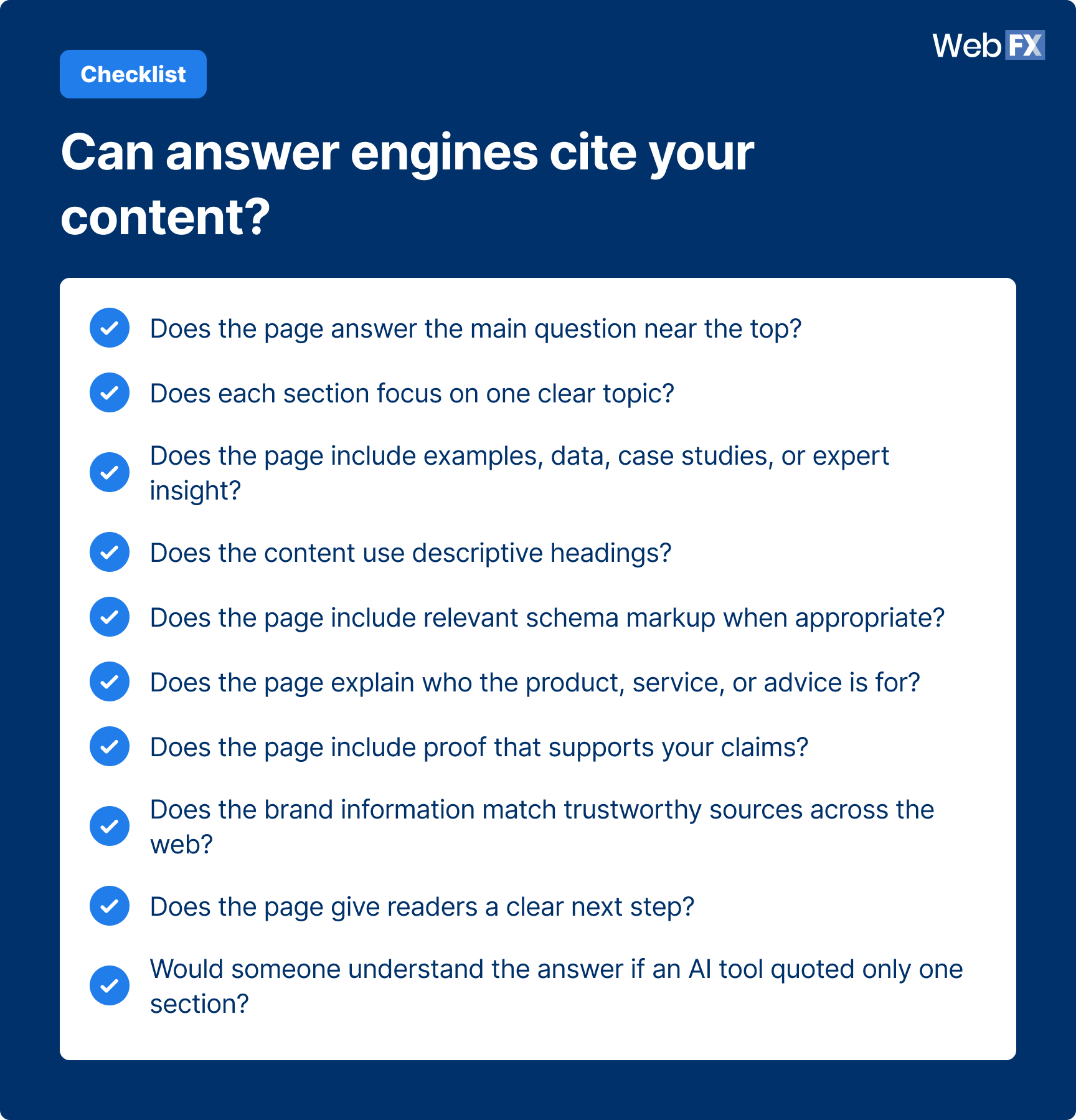
You don’t need a complex scoring system to evaluate whether your content supports AEO. Use this checklist when reviewing high-value pages:
Does the page answer the main question near the top?
Does each section focus on one clear topic?
Does the page include examples, data, case studies, or expert insight?
Does the content use descriptive headings?
Does the page include relevant schema markup when appropriate?
Does the page explain who the product, service, or advice is for?
Does the page include proof that supports your claims?
Does the brand information match trustworthy sources across the web?
Does the page give readers a clear next step?
Would someone understand the answer if an AI tool quoted only one section?
If the answer to several of these questions is no, start there. Most AEO improvements come from making useful pages more direct, specific, and easier to verify.
How to prioritize pages for answer engine optimization
Start with pages that already influence revenue or answer high-intent buyer questions. Prioritize these pages first:
Revenue-driving service or product pages: These pages explain what you sell and why buyers should consider you.
High-traffic SEO pages: These pages already attract visibility and may have a better chance of being discovered or referenced.
Comparison and “best” pages: These pages align with how buyers ask AI tools to compare options.
Pricing or cost pages: These pages answer high-intent questions that often come up before a buyer contacts sales.
Case studies and proof pages: These pages support credibility and give answer engines concrete examples.
Help center or FAQ pages: These pages can answer product, service, process, and support questions.
Industry pages: These pages help answer engines understand who you serve and where your expertise applies.
For example, a home services company might start with its “HVAC installation,” “emergency repair,” and “HVAC financing” pages before updating older blog posts. A B2B software company might start with product pages, comparison pages, integration pages, and customer stories.
Prioritization keeps AEO manageable. You can build momentum with the pages most likely to influence leads, sales conversations, and revenue.
How to measure answer engine optimization and tie it to ROI
AEO is an investment, so you need a way to tell whether your efforts are improving visibility, traffic, leads, and revenue. The challenge is that AI answers can influence a buyer before they click, which means one metric will not tell the full story.
Start by monitoring whether your brand appears for priority prompts. These prompts should reflect the questions your prospects might ask before buying from you.
Track questions like:
Does your brand appear in AI answers for your main services?
Do answer engines cite your website?
Do they mention competitors more often than you?
Do they describe your business accurately?
Do they include your brand in “best,” “top,” or “compare” prompts?
Which pages or sources do they cite?
For example, a commercial roofing company may track prompts like “best commercial roofing companies in Pennsylvania” or “commercial roof replacement cost.” The goal is to understand whether answer engines include the brand in relevant research moments.
How to track visibility: Create a prompt set for your priority services, products, industries, and locations. Then, check those prompts regularly across tools like Google AI Overviews, ChatGPT, Perplexity, Gemini, and Copilot. Record whether your brand appears, whether it gets cited, which competitors appear, and whether the answer describes your business accurately.
For more scalable tracking, the OmniSEO® platform can help monitor AI visibility, citations, mentions, and brand perception across answer engines.
2. Track AI referral traffic
Use analytics tools to track visits from AI platforms when referral data is available. In Google Analytics 4 (GA4), you can set up a custom channel group for traffic from platforms like ChatGPT and Perplexity.
Monitor:
Sessions from AI platforms
Landing pages that receive AI traffic
Engagement rate
Time on page
Form fills
Phone calls
Demo requests
Quote requests
How to track AI-referred traffic: In GA4, review your traffic acquisition and landing page reports for AI referrers. You can also create a custom channel group for known AI platforms so those visits don’t get buried under referral traffic. Then, compare AI-referred sessions with organic search sessions to see which pages they visit and whether they take meaningful actions.
AI referral data will not capture every AI-influenced visit. Some buyers may ask an AI tool for recommendations, then search your brand later or type your URL directly. Still, tracking known AI referrers gives you a baseline.
3. Track assisted conversions
AI visitors may not always convert on the first visit. They may read a page, compare options, return later through branded search, and then contact your team.
Track assisted signals such as:
Returning visitors from AI-referred sessions
Form fills from users who previously came through AI platforms
Branded search growth
Quote requests that mention AI tools
CRM notes that capture how buyers researched options
Sales-call mentions of ChatGPT, Perplexity, Gemini, or Google AI Overviews
How to track assisted conversions: Use GA4 attribution reports, user segments, and conversion paths to see whether AI-referred users return later through another channel.
In your CRM, add fields or notes for “How did you hear about us?” and “Did you use AI tools during your research?”
Our proprietary platform, RevenueCloudFX, also lets you see how AI-assisted visits relate to leads and opportunities.
4. Track brand influence
Some AEO impact may show up as brand influence before it shows up as direct traffic. That influence still matters because AI tools can shape what people know, believe, and compare before they visit your website.
Track influence through:
Branded search trends
Direct traffic changes
Share of answer compared to competitors
Brand sentiment in AI answers
Accuracy of AI-generated brand descriptions
Sales feedback about buyer research behavior
Changes in how prospects describe their needs on calls
How to track it: GA4 can help you track direct traffic and returning users. You can also use the OmniSEO® platform to review how answer engines describe your brand and whether they mention competitors more often.
Ask sales and intake teams to note when prospects mention AI tools, AI recommendations, or specific comparisons they saw during research.
5. Track revenue
Leadership teams usually care most about revenue, leads, and qualified opportunities. To tie AEO to ROI, connect your visibility and traffic data to the business outcomes they support.
A simple reporting path follows this sequence:
Visibility
AI referral traffic
Engagement
Leads
Opportunities
Revenue
Track revenue by connecting AEO-influenced activity to your CRM, call tracking, form submissions, or sales pipeline data. GA4, CRMs, and RevenueCloudFX are tools that can help you connect AI-referred visits to actions like inquiries and closed deals.
For example, if an AI-referred visitor fills out a quote form or returns later through branded search and converts, that activity should be reflected in your reporting when possible.
In the early stages, you may report more on visibility, citations, answer accuracy, and AI referral traffic. Over time, you can connect those signals to assisted conversions, sales conversations, opportunities, and revenue.
When reporting AEO performance to leadership, focus on three questions:
Are answer engines finding and citing your brand?
Are AI-referred visitors engaging or converting?
Are AEO efforts contributing to leads, opportunities, sales, or revenue?
That way, you’re showing whether AEO is helping your business attract the right prospects and turn more of them into customers.
Tools for tracking and supporting AEO performance
AEO tools can help you efficiently see where your brand appears and how answer engines describe your business. These tools can also identify which pages need improvement and whether AI visibility is driving leads or revenue.
Without the right tools, it’s harder to know whether your AEO efforts are creating measurable value.
These tools help you monitor whether answer engines mention, cite, or recommend your brand for important prompts. They can also show how your visibility compares with competitors and whether AI platforms accurately describe your business.
Use these tools to track:
Brand mentions in AI-generated answers
Citations to your website
Competitor mentions
Share of answer
Brand accuracy and sentiment
Priority prompts related to your products, services, industries, or locations
Examples: Google Search Console, Bing Webmaster Tools, Ahrefs, and Semrush
SEO performance tools help you understand how your SEO foundation supports AEO. Since answer engines often rely on crawlable, trustworthy, and well-structured web content, your organic search performance still matters.
Use these tools to track:
Branded search queries
Organic impressions and clicks
Pages gaining or losing visibility
Search queries that reveal buyer questions
Technical issues that may affect crawlability
These tools won’t show every AI citation, but they can identify which pages have strong search demand and which pages need stronger answers and structure.
Schema validation tools help you check whether your structured data is implemented correctly. Schema markup can help search engines and other systems understand your content’s structure and purpose.
These tools help connect AEO-influenced activity to leads, sales conversations, and revenue. They matter because AEO performance shouldn’t stop at citations or traffic.
Use these tools to track:
Leads from AI-referred visitors
Phone calls from AI-influenced sessions
Demo bookings
Quote requests
Sales opportunities
Transactions or closed revenue
Notes about whether prospects used AI tools during research
6 common answer engine optimization mistakes to avoid
AEO is still evolving, which makes it easy to overcorrect or chase low-impact tactics. Avoid these common mistakes as you build your strategy.
AEO mistakes to avoid (and what you should do instead)
FAQs can support AEO, but they’re not your entire strategy. Instead, focus on the questions that your audience actually asks.
“The other thing to avoid with FAQs is attempting to answer every question under the sun and every possible variable,” Sarah advises.
Expert insights from
Sarah B.Lead SEO Consultant at WebFX
“Focus on what matters to your audience and the questions they’re asking in sales, social, and customer support channels.”
2. Adding schema to weak content and expecting citations
Schema markup can make your content easier to understand, but it can’t compensate for vague copy, thin pages, or unsupported claims.
If a page lacks a direct answer, examples, proof, or useful details, start with the content itself. Then use schema markup to reinforce the structure.
Instead of adding schema first, review whether the page:
Answers the main question clearly
Includes information worth citing
Gives readers a useful next step
Once your content is strong, you can apply schema to help search and answer engines better understand your page.
3. Ignoring off-site reputation
Your website matters, but answer engines may also look at reviews, forums, articles, directories, and other sources that describe your brand.
If your website says one thing and third-party sources say something else, answer engines may struggle to describe your business accurately. Keep your brand information consistent across important platforms.
Review the places where prospects already evaluate your business. Start with your Google Business Profile.
Look at review sites, social platforms, and industry directories, too. Update outdated descriptions, respond to reviews when appropriate, and use recurring questions or complaints to improve your website content.
Pro tip: Use review management tools like ReviewAccelerationFX to generate and track online reviews for your business. These tools can help you improve your online reputation.
4. Dropping SEO
If you stop maintaining your SEO foundation, you may weaken the content and authority signals that answer engines use to understand your brand.
“SEO is foundational to AEO,” Sarah advises. “AEO considers your entire web presence, which includes an SEO-friendly website.”
Keep investing in crawlable pages, helpful content, technical health, internal linking, and search-focused updates.
5. Measuring only direct clicks
AEO can influence buyers before they visit your site. If you only measure direct AI referral traffic, you may miss branded search, assisted conversions, direct visits, and sales conversations that answer engines have influenced.
Track clicks, but don’t stop there. Set up AI referral tracking in GA4.
You can also monitor branded search in Google Search Console, review assisted conversions, and ask sales or intake teams to note when prospects mention AI tools during research.
6. Chasing every AI platform before fixing your highest-value pages
You don’t need to optimize everything for every platform at once. Start with your most valuable pages or the pages that answer important buyer questions and support revenue.
For most businesses, these pages are:
Service pages
Product pages
Comparison pages
Pricing pages
Proof pages (like case studies, testimonials, and reviews)
Once those pages clearly answer buyer questions and include strong proof, you can expand AEO updates to lower-priority educational content, help center pages, or newer AI platforms.
Answer engine optimization (AEO) and generative engine optimization (GEO) are both strategies for improving visibility on AI platforms, but they target different formats, mechanics, and goals.
If you’re building out a GEO strategy (not AEO) and weighing outside help, see our guide on how to choose a GEO agency for the criteria and red flags specific to that space.
Answer engine optimization (AEO) is the process of optimizing content so AI-powered answer engines can understand, cite, and recommend your brand in AI-generated answers.
To improve your chances of being cited, create clear, trustworthy content that answers questions directly. Strong AEO content uses structured formatting, expert insights, examples, and credible brand signals.
No. SEO focuses on improving rankings and organic traffic, while answer engine optimization focuses on earning visibility, citations, and mentions in AI-generated answers. Strong SEO supports strong AEO.
Yes. Schema markup helps answer engines understand your content and page structure. However, it works best when paired with high-quality content that answers real user questions.
You can also monitor how AI platforms describe your business and which pages they cite. Over time, connect those signals to leads, opportunities, and revenue where possible.
AEO results depend on your SEO foundation, content quality, and brand authority. Early indicators may include increased citations, AI visibility, and referral traffic, while revenue impact often takes longer to measure.
Show up in AI Search and Beyond
See how WebFX can help your brand increase visibility everywhere your audience is searching- from ChatGPT to Google and beyond.
Answer engine optimization works best when it builds on a strong SEO foundation. You need helpful content, technical SEO, structured pages, trustworthy brand signals, and reporting that shows how visibility connects to business results.
If you need help with AEO, consider partnering with WebFX. We can help you strengthen your SEO strategy and improve your answer engine visibility.
Craft a tailored online marketing strategy! Utilize our free Internet marketing calculator for a custom plan based on your location, reach, timeframe, and budget.
Craft a tailored online marketing strategy! Utilize our free Internet marketing calculator for a custom plan based on your location, reach, timeframe, and budget.








 Matthew Gibbons is a Senior Data & Tech Writer at WebFX, where he strives to help businesses understand niche and complex marketing topics related to SEO, martech, and more. With a B.A. in Professional and Public Writing from Auburn University, he’s written over 1,000 marketing guides and video scripts since joining the company in 2020. In addition to the WebFX blog, you can find his work on SEO.com, Nutshell, TeamAI, and the WebFX YouTube channel. When he’s not pumping out fresh blog posts and articles, he’s usually fueling his Tolkien obsession or working on his latest creative project. View full profile