


Contents
- What is AI brand visibility?
- Why AI brand visibility drives traffic
- The gap between looking AI-forward and being AI-recommended
- Why AI brand visibility and SEO feed each other
- What influences AI brand visibility?
- How to check your AI brand visibility
- A 30-day plan to improve your AI brand visibility
- AI brand visibility FAQs
- Turn AI search visibility into measurable demand
-
What is AI brand visibility?
AI brand visibility is how often and how favorably AI tools like ChatGPT, Gemini, Perplexity, and Google AI results recommend, cite, or describe your brand in their answers. Unlike traditional rankings, which measure where your pages appear in search results, AI brand visibility measures whether an AI tool names your brand when answering a buyer’s question. -
How does AI brand visibility drive website traffic?
AI brand visibility drives traffic by creating branded search demand. Similarweb found that users were 2.5x more likely to visit an AI-recommended brand than a competitor within seven days. Most of that traffic, 55.9%, came through search, which Similarweb interprets as users remembering the brand and looking it up by name instead of clicking directly from the AI tool. -
What influences AI brand visibility?
AI tools are more likely to recommend brands they can clearly understand, verify, and cite. Five signals carry the most weight:- Entity clarity: consistent brand information across your site, schema, profiles, and directories
- Topical authority: content that shows what your brand is known for
- Third-party proof: reviews, roundups, and publisher mentions that vouch for you
- Branded SERP control: owning the results buyers see when they search your name
- Fresh, structured content: FAQs, definitions, and comparison pages that are easy to cite
-
How can you check your AI brand visibility?
Run buyer-style prompts across ChatGPT, Gemini, Perplexity, and Google AI results, then track whether your brand appears, whether it’s cited, how it’s described, and which competitors show up. After that, check the branded-search handoff by searching your brand name with modifiers like reviews, pricing, and alternatives. -
What’s the 30-day plan to improve AI brand visibility?
A 30-day plan should strengthen both the sources AI tools read and the branded results buyers see after a recommendation:- Week 1: Audit your current AI presence across tools
- Week 2: Fix owned content with answer-first summaries
- Week 3: Build third-party validation through citations and reviews
- Week 4: Measure the lift in branded search and conversions
AI brand visibility snapshot:
- What it is: AI brand visibility is how often AI tools like ChatGPT, Gemini, Perplexity, and Google AI results recommend, cite, or describe your brand.
- What the data shows: Users were 2.5x more likely to visit an AI-recommended brand over its competitor within seven days, according to Similarweb.
- How the traffic arrives: Most of those visits came through search. People saw the recommendation, then searched the brand by name.
- The gap most brands miss: Looking AI-forward in your ad creative is not the same as being the brand AI recommends.
- What to do now: Check where your brand shows up across ChatGPT, Gemini, Perplexity, and Google AI results, then strengthen the sources those tools read.
AI brand visibility is starting to act less like a vanity metric and more like a traffic channel. A recent Similarweb report found that users were 2.5x more likely to visit an AI-recommended brand over its competitor within seven days.
The more useful part is how that traffic shows up. Most of it came through search rather than a direct click from the AI tool. People got a recommendation from ChatGPT, then went to Google and searched the brand by name.
That reframes the whole conversation. AI visibility and SEO aren’t competing for budget. AI recommendations can create branded demand, and your search presence is what captures it. Here’s what AI brand visibility means, why it drives traffic, and how to become a brand AI tools recommend:
- What is AI brand visibility?
- Why AI brand visibility drives traffic
- The gap between looking AI-forward and being AI-recommended
- Why AI brand visibility and SEO feed each other
- What influences AI brand visibility?
- How to check your AI brand visibility
- A 30-day plan to improve your AI brand visibility
- AI brand visibility FAQs
Don’t miss our Revenue Weekly emails!
Join 200K smart marketers for the hottest marketing news and insights in your inbox.
Inline Subscription Form
“*” indicates required fields
What is AI brand visibility?
AI brand visibility is how often and how favorably AI tools like ChatGPT, Gemini, Perplexity, and Google AI results recommend or cite your brand in their answers.
It’s different from traditional rankings. Rankings measure where your pages land in search results. AI brand visibility measures whether an AI tool names you at all when it answers a buyer’s question. You can rank well on Google and still go unmentioned when someone asks ChatGPT for the best option in your category.
The terms overlap in everyday use. AI visibility and AI search visibility describe the broad shift toward AI-driven discovery. AI brand visibility narrows that to your brand: does AI recommend, cite, or describe you when it counts?
It also helps to separate three things AI can do with your brand:
- Mention: names you in passing
- Citation: links to your content as a source
- Recommendation: puts you on the shortlist when a buyer asks who to consider
Recommendations are what move buyers, and they’re what the data below measures. For a closer look at how AI builds its picture of your brand, see our guide on how AI models see your brand.
Why AI brand visibility drives traffic
AI brand visibility drives traffic because an AI recommendation often sends people back to traditional search. Similarweb found that users were 2.5x more likely to visit an AI-recommended brand than a competitor within seven days, based on U.S. desktop activity in finance, travel, and beauty from July to December 2025. The study shows correlation, not causation.
Here’s the mechanism. Most of that traffic, 55.9%, came through search. Similarweb interprets this as a branded search, with users remembering the brand and looking it up by name rather than clicking an AI link. AI may not always send the click, but it creates the search.
This isn’t only Similarweb’s finding. Our own analysis of 2.3 billion sessions shows the same behavior: AI-referred visitors convert about 1.2x higher than organic search and arrive already deep in research, having compared their options elsewhere first.
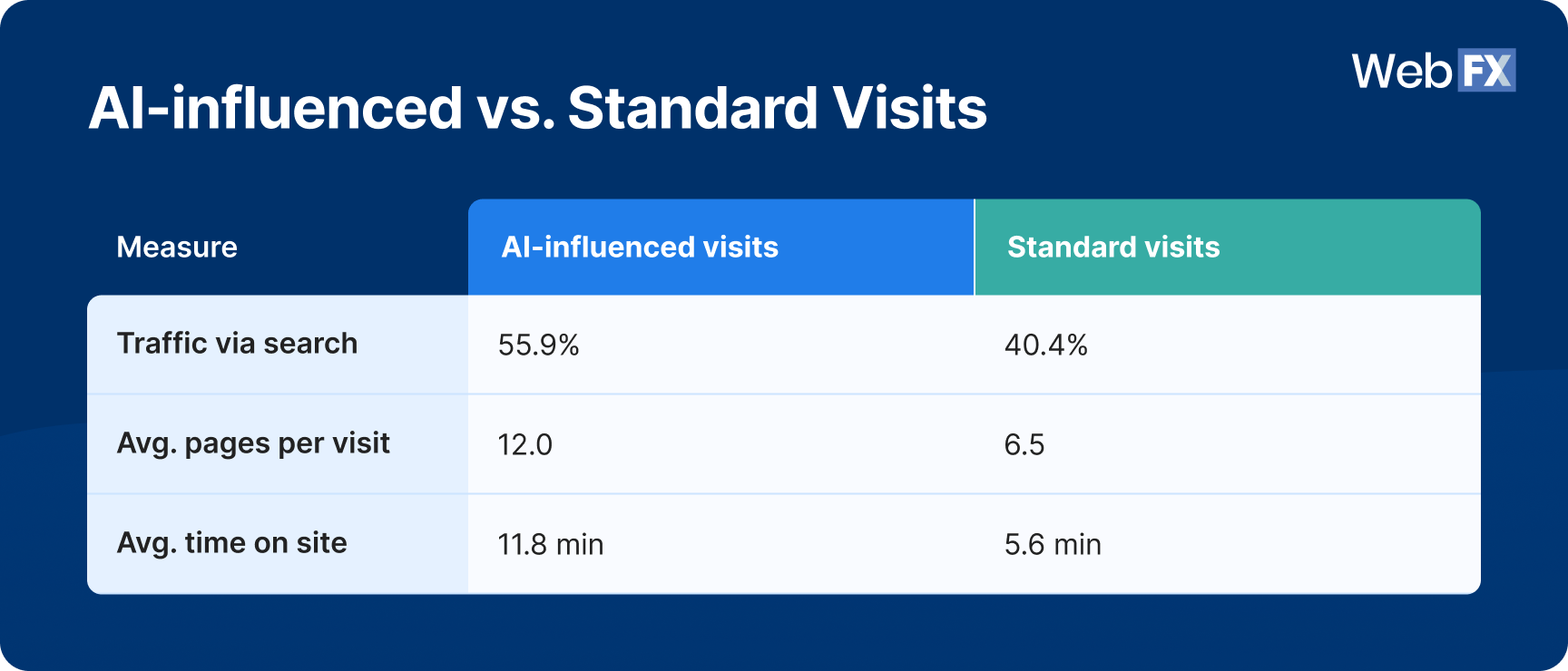
Table view
AI-influenced vs. standard visits
| Measure | AI-influenced visits | Standard visits |
| Traffic via search | 55.9% | 40.4% |
| Avg. pages per visit | 12.0 | 6.5 |
| Avg. time on site | 11.8 min | 5.6 min |
AI-influenced visitors show up informed and further along in the decision. That is also why AI’s role is easy to miss. The visit lands as branded organic or direct traffic, so your reports credit Google or direct, instead of the recommendation that started it.
The gap between looking AI-forward and being AI-recommended
Spending on ads that mention AI is not the same as being recommended by AI. Plenty of brands lean into AI language in their creative. Far fewer earn the recommendation that actually sends traffic.
The spending gap is real. Brands poured $1.3 billion into ad creative mentioning AI in the first half of 2026, up 48% year over year, according to Sensor Tower. That money buys the appearance of being current. It does nothing to make an AI tool put you on a buyer’s shortlist.
That distinction matters because the Similarweb effect cuts both ways. When AI recommends you, the visit comes to you. When it recommends a competitor instead, that same visit goes to them. AI-themed ads can make a brand look modern, but AI recommendations decide who buyers actually consider.
So an AI message in your ad reaches the people who see the ad. An AI recommendation reaches people who ask AI for advice on what to buy.
Why AI brand visibility and SEO feed each other
AI brand visibility and SEO work together because AI recommendations create branded searches, and your branded search results decide what happens next. One creates demand, the other captures it.
The path is consistent with these three steps:
- An AI tool recommends your brand
- The buyer searches your name on Google
- Your branded results decide whether the visit reaches your site, a reseller, a comparison page, or a competitor’s ad
That makes traditional SEO more important. Strong AI search optimization services combine SEO and AI search into one strategy, so you show up across Google organic, AI Overviews, AI Mode, ChatGPT, Perplexity, and Gemini, and capture the demand a recommendation creates.
What influences AI brand visibility?
AI brand visibility comes down to how clearly AI tools can understand your brand and how much trusted, third-party evidence backs it up. AI systems build their picture of you from signals across the web, then decide whether to name you when a buyer asks.
These are the five signals that carry the most weight:
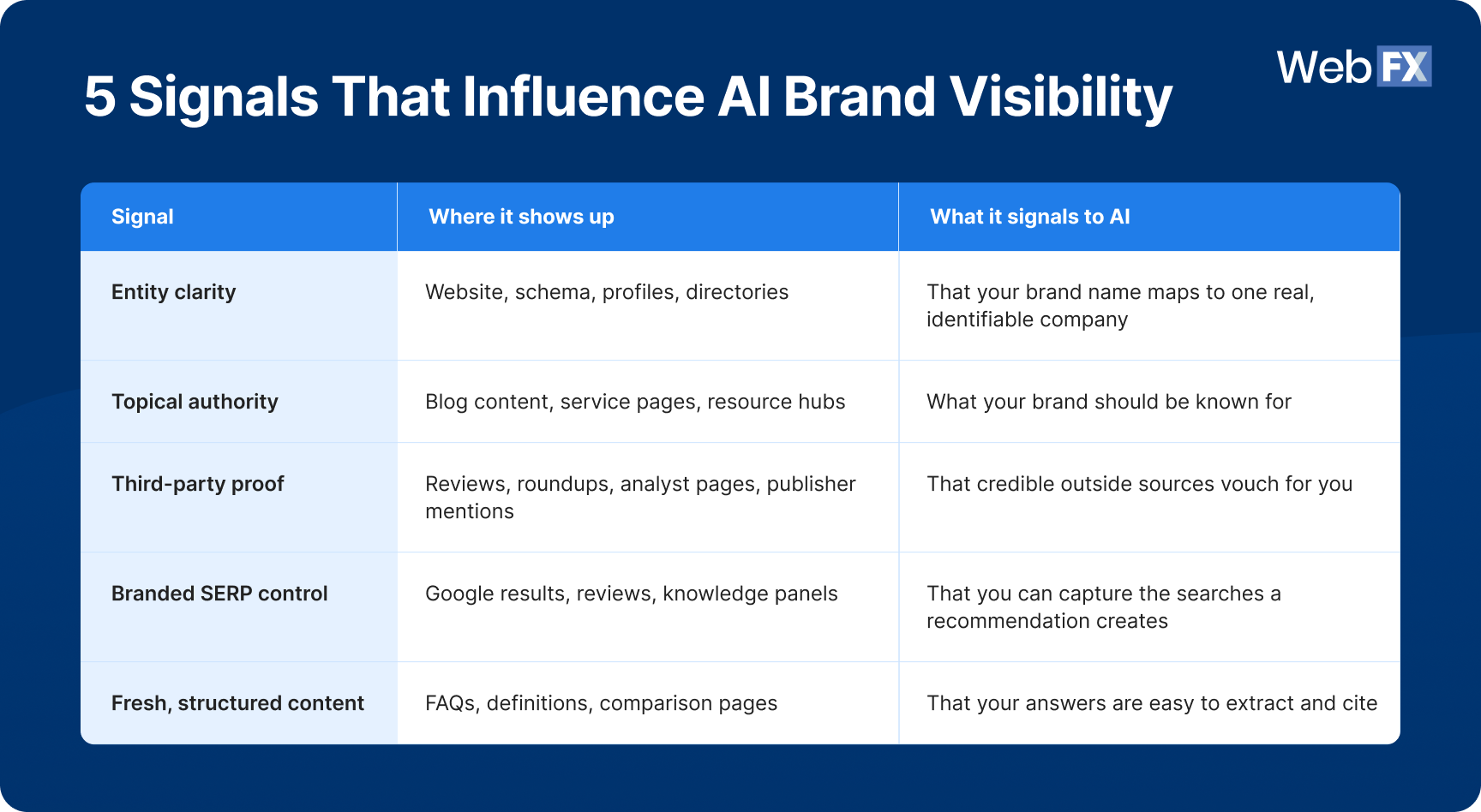
Table view
5 signals that influence AI brand visibility
| Signal | Where it shows up | What it signals to AI |
| Entity clarity | Website, schema, profiles, directories | That your brand name maps to one real, identifiable company |
| Topical authority | Blog content, service pages, resource hubs | What your brand should be known for |
| Third-party proof | Reviews, roundups, analyst pages, publisher mentions | That credible outside sources vouch for you |
| Branded SERP control | Google results, reviews, knowledge panels | That you can capture the searches a recommendation creates |
| Fresh, structured content | FAQs, definitions, comparison pages | That your answers are easy to extract and cite |
Most of these live off your own site. AI tools lean heavily on third-party sources to decide which brands to trust, so what other people say about you often matters more than what you say about yourself.
That said, owned content still carries weight for topical authority — our study of content that earns AI traffic found pages with named authors, original data, and citations earned 26% more AI traffic than those without.
How to check your AI brand visibility
You can check your AI brand visibility by testing buyer-style prompts across AI tools and noting whether your brand appears. The goal is a repeatable snapshot you can rerun and compare over time, rather than a one-off screenshot.
We call it the AI-to-search visibility check:
- Build a prompt set: Write the decision-stage questions your buyers actually ask, like “best [category] for [industry],” “top [service] providers,” or “[your brand] vs. [competitor].”
- Test across tools: Run each prompt in ChatGPT, Gemini, Perplexity, and Google AI results.
- Track four outcomes: For each prompt, note whether your brand is mentioned, whether it’s cited, how it’s described, and which competitors appear.
- Check the branded-search handoff: Search your brand name plus modifiers like reviews, pricing, and alternatives to see what a buyer finds after a recommendation.
- Compare with your analytics: Watch for movement in branded organic, direct traffic, and engagement that lines up with your AI visibility gains.
Running the AI-to-search visibility check by hand works for a spot check. To track prompt-level visibility, sentiment, and competitor share at scale, tools like OmniSEO® can monitor your brand across ChatGPT, Perplexity, AI Overviews, and other AI tools, and benchmark you against your competitors.
Show up in AI Search and Beyond
See how WebFX can help your brand increase visibility everywhere your audience is searching- from ChatGPT to Google and beyond.
A 30-day plan to improve your AI brand visibility
Improving your AI search brand visibility means strengthening both the sources AI tools read and the branded results buyers see after a recommendation. This 30-day plan breaks that into four weeks.
Week 1: Audit your current AI presence
- Run your AI-to-search visibility check
- Record where your brand appears, which competitors show up more often, and which sources the AI tools cite
- Flag any descriptions that are wrong, thin, or missing
Week 2: Fix your owned content
- Update your core service and product pages with answer-first summaries
- Add comparison and use-case sections, and strengthen your FAQs
- Place proof points next to the claims they support
- Tighten internal links between related pages
Week 3: Build third-party validation
- Target the roundups, review sites, and industry pages where competitors already appear, and prioritize the sources AI tools already cite
- Pitch expert commentary and refresh your profiles
- Keep your brand name and details consistent wherever they appear
Week 4: Measure the lift
- Track your AI mentions and citations, then check branded search in Google Search Console
- Compare branded organic, direct, and paid traffic, and review conversion quality
- Rerun the same prompt set monthly to measure movement
AI brand visibility FAQs
What is AI brand visibility?
AI brand visibility is how often and how favorably AI tools like ChatGPT, Gemini, Perplexity, and Google AI recommend, cite, or describe your brand in their answers.
How is AI brand visibility different from SEO?
SEO earns visibility in traditional search results. AI brand visibility measures whether AI tools include your brand in their answers and recommendations. The two work together, since AI recommendations often send buyers back to search.
How do AI tools decide which brands to recommend?
AI tools read signals from your website, third-party citations, reviews, directories, and publisher mentions to understand what your brand does and how credible it is. Clearer, better-supported signals make your brand easier to recommend.
How do you measure AI brand visibility?
Measure it by tracking how often your brand is mentioned, cited, and recommended across AI tools, then comparing that against branded search and conversion data. Tools like OmniSEO® track prompt-level visibility and competitor share at scale.
Why does AI brand visibility increase branded search?
Because buyers often take a brand name from an AI recommendation and search it later instead of clicking straight from the AI tool. That makes your branded search results the handoff point between an AI recommendation and a site visit.
Learn how WebFX grew a client’s AI traffic by 188% and earned 95% visibility for tracked AI questions.

Turn AI search visibility into measurable demand
Your buyers are already asking AI tools which brands to consider. The only question is whether your brand shows up, how it’s described, and whether your branded search results capture the demand that follows. Earn that, and the recommendations turn into branded searches, site visits, and revenue.
WebFX can help you get there. We’ve already generated 617,125 visits, 12,335 leads, and 93,969 mentions from AI sources for our clients, and we can do the same for your brand. Want a clearer picture first? An AI brand visibility audit shows exactly where you stand today.
Every buyer AI sends to a competitor is one it could have sent to you. Contact us online or call 888-601-5359 today to speak with a strategist about our AI brand positioning services.
-
 Albert Dandy Velasquez blends SEO strategy with compelling storytelling to help businesses boost their visibility and revenue online. With a B.A. in English and certifications from HubSpot, Semrush, and Google Analytics, he has written and optimized hundreds of articles on organic SEO, content strategy, and user experience. He regularly contributes to the WebFX blog and SEO.com, creating content that helps readers turn marketing goals into measurable results. When he’s off the clock, he’s usually exploring new neighborhoods on two wheels, filming travel content, or chasing golden hour with a coffee in hand. View full profile
 -

WebFX is a full-service digital marketing agency delivering revenue-driving strategies across online advertising, SEO and AI search optimization, and digital marketing. Backed by 1,100+ client reviews, a 4.9-star rating on Clutch, and proprietary revenue-tracking technology, our team helps businesses grow visibility and revenue across platforms, from Google to ChatGPT to LinkedIn. Discover how our expert team and revenue-accelerating tech can drive results for you. Learn more

Try our free Marketing Calculator
Craft a tailored online marketing strategy! Utilize our free Internet marketing calculator for a custom plan based on your location, reach, timeframe, and budget.
Contents
- What is AI brand visibility?
- Why AI brand visibility drives traffic
- The gap between looking AI-forward and being AI-recommended
- Why AI brand visibility and SEO feed each other
- What influences AI brand visibility?
- How to check your AI brand visibility
- A 30-day plan to improve your AI brand visibility
- AI brand visibility FAQs
- Turn AI search visibility into measurable demand
Share this article


See AI Marketing in Action
Explore how WebFX helped a regional brand get discovered in AI search experiences — proving what’s possible with today’s AI-driven marketing!
Try our free Marketing Calculator
Craft a tailored online marketing strategy! Utilize our free Internet marketing calculator for a custom plan based on your location, reach, timeframe, and budget.