



SEO for therapists is how a practice gets found when someone searches for help, whether they type “therapist near me” into Google, scan the local map results, or ask ChatGPT or Google’s AI Mode for a recommendation.
It comes down to a website that clearly explains who you help and how, an accurate Google Business Profile, and a steady stream of patient reviews.
Here’s what this beginner’s guide to therapist SEO covers:
Does your therapy practice need more than just SEO to improve your online visibility? No problem — see how digital marketing for therapists can give you the tools to succeed online!

Explore WebFX Healthcare Marketing Services
What is SEO for therapists?
Search engine optimization (SEO) for therapists is a digital marketing strategy that involves optimizing your therapy website to improve its visibility and accessibility on search engines like Google.
What are the types of SEO for therapists?
There are four types of SEO for therapists and each have different factors that affect your search engine performance:
- Local SEO: Google Business Profile, local keywords, reviews
- On-page SEO: Title tags, meta descriptions, content, keyword usage, images
- Off-page SEO: Backlinks, social shares, guest blogging
- Technical SEO: Page speed, sitemaps, index status, HTTPS, site navigation, URL structure, internal linking, structured data, mobile-friendliness
By optimizing your therapy site for things like local, technical, and on- and off-page SEO, you can improve your site’s position in search results and make your practice visible to patients looking for your help.
What are the benefits of SEO for therapists?
Now that we’ve covered what SEO for therapists is, let’s look closer at the benefits it brings to your practice and your patients:
Generate online awareness for your practice
Since most people only pay attention to the first page of results, the sites that appear there get clicked on much more often than those on later pages.
This means that unless your site is on the first page, potential clients might not even know you exist.
SEO can get your site onto that first page and into the local map results. Measure it by the calls, contact form submissions, and booked consultations it brings in, not rankings alone.
Attract your ideal patients
While being at the top of the rankings for a broad term like “therapy” might bring a lot of traffic to your site, it’s unlikely that all of those people are actually going to contact you and become a client.
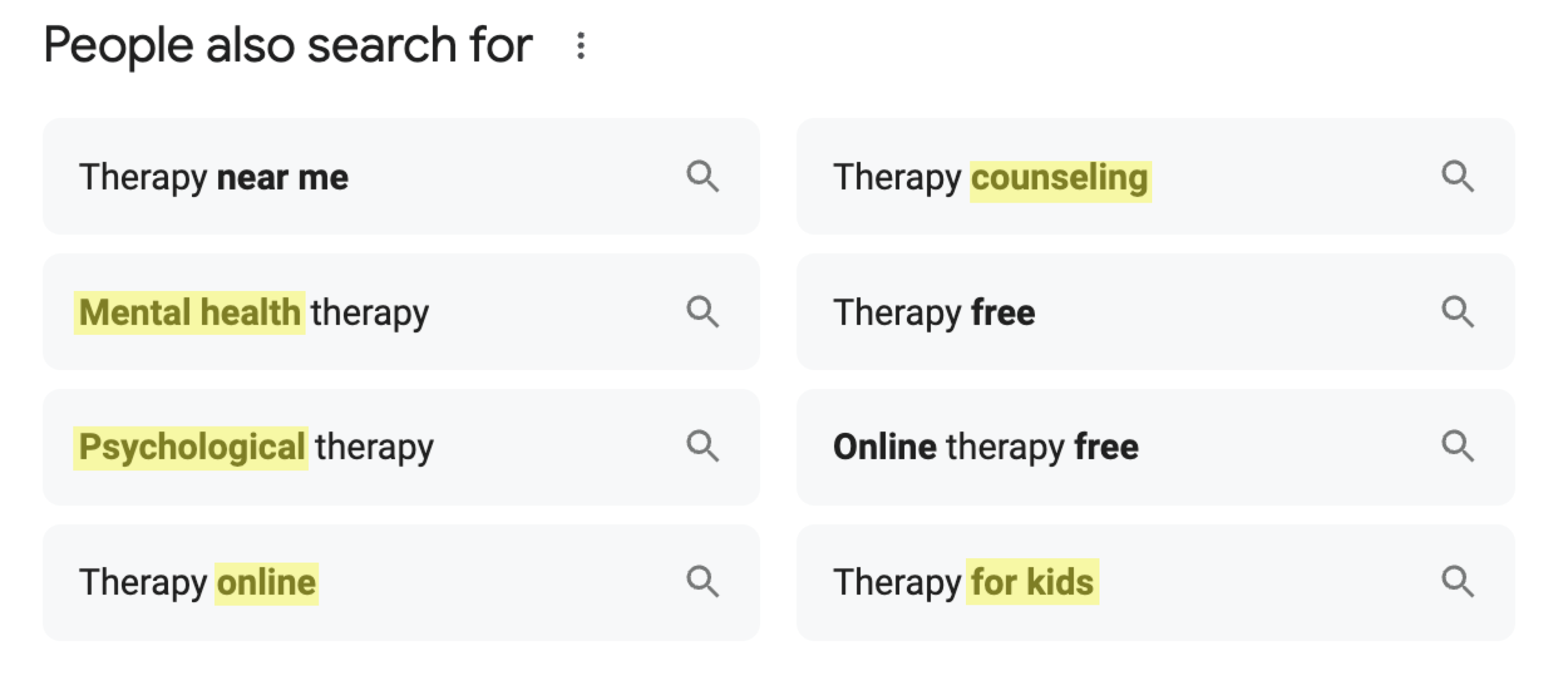
Through SEO, you can optimize your site for therapy-related queries that best fit your practice and attract your ideal patients with targeted website content.
Dedicated service pages are one way to do this.
As part of its SEO program, Merrimack Valley Psychological Associates, a counseling practice in Andover, Massachusetts, created service pages targeting high-value keywords for its counseling offerings.
The practice saw 2X revenue in 6 months.
For a broader look at the strategies that help therapy practices grow their client base, our guide on attracting more therapy clients online covers the full range of digital marketing approaches available to therapists.
Build authority online
Google’s algorithm uses many factors to rank websites in search results, one of which is “helpfulness.”
When you use SEO for therapists, you’re creating informative, educational content for your site to attract patients.
Accurate content with your clinicians’ credentials on the page tells Google your site is trustworthy, and it’s the kind of source AI Overviews and ChatGPT draw on when they answer mental health questions.
Plus, this SEO content helps prospective patients learn more about your practice and various mental and behavioral health topics.
As a result, they can confidently make informed decisions about choosing a therapist. More specifically, choosing you as a therapy provider.
7 SEO strategies for therapists
Now that you know why SEO matters, you might be wondering how to get started. It’s a process that requires time and dedication, but with the help of these seven SEO strategies for therapists, you’ll be well on your way to showing up across search results, the map pack, and AI answers.
- Conduct in-depth keyword research
- Optimize for local SEO
- Claim & optimize your Google Business Profile
- Educate with content marketing
- Improve your site’s technical SEO
- Make your site mobile-friendly
- Encourage patients to leave online reviews
1. Conduct in-depth keyword research
Keyword research and optimization is the backbone of any successful SEO strategy, no matter what industry you’re in.
Conducting extensive keyword research helps you identify what queries your target audience is using to find your practice and informs all other aspects of your SEO strategy, like deciding what kinds of content to create, how to position yourself online, and more.
When it comes to researching what keywords to use, there are a few places you can start, like Google. Google offers related searches based on your query — use those related searches to build up your keyword lists and find new phrases to target!
Look past short keywords, too.
Prospective clients often type or ask AI assistants full questions, like “how do I find a therapist for anxiety who takes my insurance,” and pages that answer those questions plainly are easier for those tools to cite.
Besides Google, there are plenty of paid and free keyword research tools you can use, like WebFX’s KeywordsFX.
Keyword needs can vary significantly by specialty, though — if you run a speech-language practice, our SEO guide for speech therapists breaks down the specific terms and strategies that apply to speech-language pathology.
2. Optimize for local SEO
SEO is about making your business visible online, and that starts with ensuring those closest to you can find you via local SEO.
Optimizing for local SEO helps you bring in more patients from your area, and appear in search results for local keywords like “therapist near me” or “therapy in [city/state].”
To do this, start by integrating location-based keywords into your website and think about potential long-tail or conversational keywords people in your community may use to find your office, like “[location] therapist for [mental illness]” or “best therapist in [location] for [mental illness].”
3. Claim and optimize your Google Business Profile
To take your local SEO efforts up a notch, remember to claim and optimize your Google Business Profile.
Your Google Business Profile acts as a quick snapshot of your business, showing searchers important information about your practice like your location, contact details, website, and reviews.
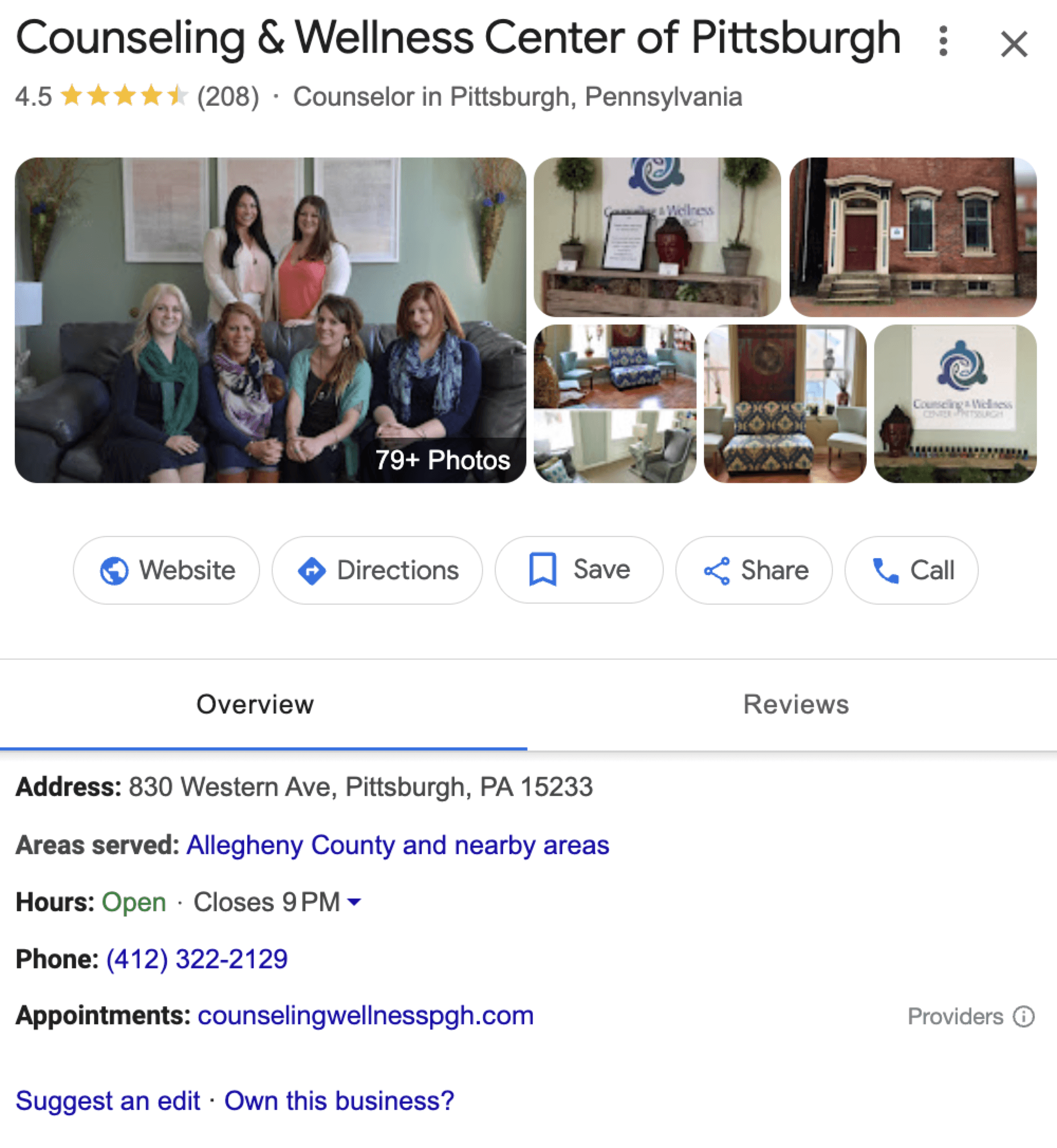
Optimize your profile by ensuring all your important information is filled in (e.g. address, phone number, business hours, etc.), and integrate relevant keywords into that content when possible. Then, add pictures to your profile, that way searchers can get a better sense of connection with you.
You’ll also want to periodically review and update your profile to ensure you’re always displaying up-to-date information for prospective patients.
4. Educate with content marketing
Whatever they’re dealing with, patients are choosing to trust you with managing their mental well-being. By using content marketing for therapists, you can begin building that trust with them before they even have a session with you.
Content marketing involves creating and distributing educational, helpful content that offers value to your patients. For you, this can come in the form of blog posts about managing mental illness, infographics, therapist bios, and more.
The more helpful people find your content, the more search engines will notice and reward you with better rankings.
The same content-driven approach works across therapy disciplines — our guide to growing an occupational therapy practice online shows how OT practices apply these same strategies to attract more clients.
5. Improve your site’s technical SEO
While it often gets overlooked in favor of more interactive things like on-page SEO, your therapy website’s technical SEO plays a major role in how well you perform on search engines.
Technical SEO involves optimizing elements of your site that contribute to user experience (UX), like site navigation and architecture, security, loading speed, and more.

Google’s algorithm rewards sites with great UX, so improving your technical SEO for faster load speeds, easy navigation, and secure browsing is crucial to winning higher rankings (and winning over patients).
6. Make your site mobile-friendly
Another important aspect of technical SEO for therapists is having a responsive website design. In other words, creating a mobile-friendly site that adapts to viewing on different devices.
A mobile-friendly site matters for your SEO because many prospective clients search for a therapist from their phones, often late at night or between other commitments. Not to mention, it’s a key ranking factor in Google’s algorithm.
7. Encourage patients to leave online reviews
Reviews are often the first thing a prospective client checks when comparing therapists, whether on your Google Business Profile or in a therapy directory.
Ask satisfied clients for reviews in a way that respects their privacy, and when you reply, never confirm that the reviewer is a client.
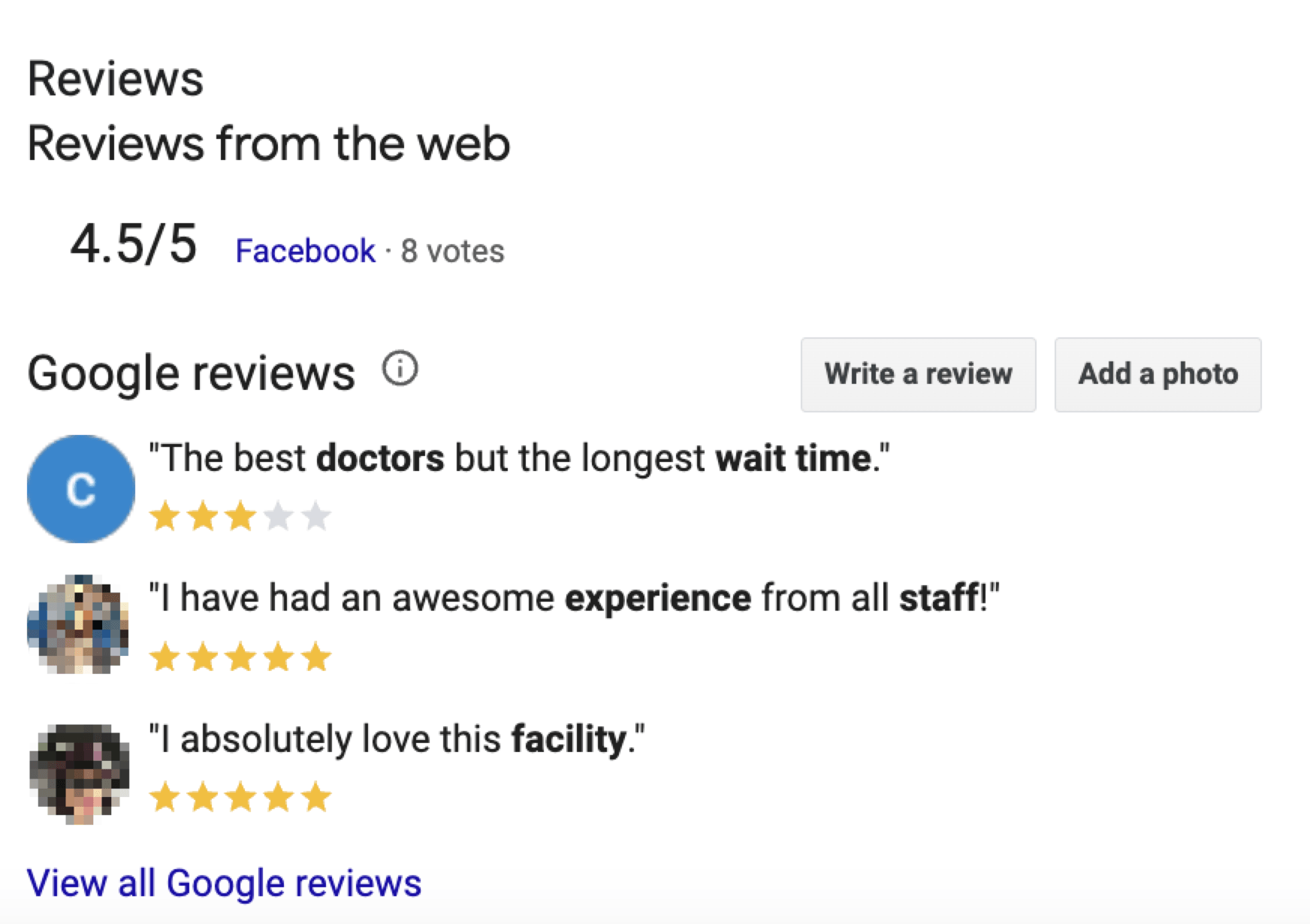
Showcasing patient reviews on your site, Google Business Profile, Yelp, and other third-party directories helps both prospective patients and your SEO.
Positive reviews help enhance your credibility and build trust with search engines. Plus, they can bolster your local SEO performance, helping you stand out among local competitors.
For physical therapy practices looking to build on these strategies, our guide to marketing a physical therapy practice online covers the full range of digital tactics that help PT practices attract and retain more patients.
How is AI search impacting SEO for therapists?
AI search is impacting SEO for therapists because more prospective clients now ask an AI tool for help before they ever open a therapist’s website.
ChatGPT, Perplexity, and Google’s AI Overviews draw on the same sources your SEO already covers: Your website, Google Business Profile, reviews, and directory listings.
And those question-style searches are where AI answers show up most.
In WebFX’s analysis of 130,070 U.S. health-related queries, informational health queries triggered an AI Overview 66.9% of the time.
That means a search like “what’s the difference between CBT and DBT” often gets answered on the results page, and the practice whose page is cited makes the first impression.
How should you adapt therapist SEO for AI search?
Adapt therapist SEO for AI search using the following tactics:
Spell out who you help
Give each specialty, therapy approach, and client group its own page, and state the insurance you accept, telehealth options, and evening or weekend hours in plain text.
Keep your details consistent
Google’s guidelines ask businesses to represent their name, address, and categories accurately. Match those details across your site, Google Business Profile, and therapy directories so AI tools don’t find conflicting information.
Check what AI tools say about you
Ask ChatGPT, Perplexity, and Google the questions your clients ask, like “therapist for anxiety in [city] who takes [insurance],” and note whether your practice appears.
Teams use OmniSEO®, WebFX’s AI search visibility platform, to track those prompts over time and see which competitors get cited instead, then update the pages AI answers skip.
Future-Proof Your SEO Strategy with OmniSEO®
Goodbye search engine optimization, hello search everywhere optimization.

Ready to implement an SEO campaign for your practice?
At WebFX, we know the mental health industry, and we understand its competitive nature.
Our marketing experts will help you decide how to effectively market your practice and see the results that you’ve been looking for from search.
Discover how our SEO services can help by contacting us today for a free quote!
-
 Savannah is a content marketer with editorial experience spanning several businesses. Specializing in social media and marketing trends, she loves talking about the latest developments in online marketing. When she’s not writing, Savannah loves traveling, hoarding books and coffee mugs, and adoring her cat. Please don’t ask her about famous true crime cases, or else she’ll tell you all about her theories and get absolutely no work done. View full profile
-

WebFX is a full-service digital marketing agency delivering revenue-driving strategies across online advertising, SEO and AI search optimization, and digital marketing. Backed by 1,100+ client reviews, a 4.9-star rating on Clutch, and proprietary revenue-tracking technology, our team helps businesses grow visibility and revenue across platforms, from Google to ChatGPT to LinkedIn. Discover how our expert team and revenue-accelerating tech can drive results for you. Learn more
Try our free Marketing Calculator
Craft a tailored online marketing strategy! Utilize our free Internet marketing calculator for a custom plan based on your location, reach, timeframe, and budget.
Plan Your Marketing Budget
Share this article


Help More Patients Find Your Practice
See how healthcare providers like Hurst Pediatric Dentistry increased local leads 5× with data-driven SEO from WebFX.
Try our free Marketing Calculator
Craft a tailored online marketing strategy! Utilize our free Internet marketing calculator for a custom plan based on your location, reach, timeframe, and budget.
Plan Your Marketing Budget