



Table of Contents
- What is SEO for speech therapists?
- 6 expert speech therapist SEO tips
- 1. Target long-tail keywords
- 2. Optimize page speeds
- 3. Earn backlinks
- 4. Implement responsive design
- 5. Create a Google Business Profile
- 6. Track analytics
- How does AI search impact SEO for speech therapists?
- How do you optimize for AI search as a part of speech therapy SEO?
- Ask AI the questions parents ask
- Give each service its own page
- Show your clinicians’ credentials
- Keep your details consistent
- Get discovered across search experiences with SEO for speech therapists
SEO for speech therapists is the work of making a speech-language pathology (SLP) clinic’s website, Google Business Profile, and reviews easy for Google and AI assistants to find, trust, and recommend. It puts your practice in front of families where they look for care: The web results, Google Maps, and AI answers like Google AI Overviews and ChatGPT.
SEO is the part of marketing your SLP clinic online that brings families to you while they are actively looking for help. Discover how to use search engine optimization for your practice now:
For hands-on help, consider partnering with WebFX — the SEO agency with over 30 years of experience — for our expert SEO services. Just call 888-601-5359 or contact us online today to get started!

Explore WebFX Healthcare Marketing Services
What is SEO for speech therapists?
SLP SEO is a strategy that involves optimizing your web content to rank in Google search results and be cited in AI answers like Google AI Overviews.
The goal is for users to encounter your content in relevant searches, leading them to your site, where they can convert into patients.
SEO is composed of various processes and tactics, but all of them aim to do the same thing — satisfy Google’s ranking algorithms, so your web content will appear in search results.
6 expert speech therapist SEO tips
SEO involves optimizing multiple facets of your marketing, so there are several things you can do to help your content rank. Some involve technical elements of your site, while others are more content-based.
Here are six fantastic speech therapist SEO tactics to try!
1. Target long-tail keywords
One of the most critical speech therapy SEO strategies you can implement is to include relevant keywords in your written content. When you write a blog post, for example, you should center it around a particular keyword like “what is slp.”
Specifically, aim to target long-tail keywords — that is, those that are several words long.
Long-tail keywords are more specific to particular search intents and tend to come with less competition. They also mirror the full questions parents type into Google or ask AI assistants, like “when should my toddler start speech therapy.”
Longer questions are also where AI answers appear most often.
In WebFX’s analysis of 130,070 U.S. health-related queries, searches of 7+ words triggered an AI Overview 73.9% of the time, versus 35.8% for 1-2 word searches. Practices need to optimize for appearing in these summarized answers.
Having keywords in your content tells Google which searches to rank your content for, and since your keywords will be so specific to particular groups of users, it will help you reach your ideal audience and bring more people to your site.
2. Optimize page speeds
Page load speed shapes whether visitors stay on your site long enough to request an evaluation. A slow page sends many of them back to the search results before they read anything, especially parents searching on a phone.
To avoid losing large swaths of your site visitors in the first few seconds of arriving, try to keep your pages loading quickly. Some ways to do this include:
- Caching web pages
- Compressing images
- Limiting redirects
- Minifying code
You can check your page load speeds with a tool like Google’s PageSpeed Insights, which also reports the Core Web Vitals scores Google uses to measure page experience.
With fast-loading pages, you’ll be able to retain more traffic and drive more conversions.
3. Earn backlinks
When it comes to SEO, you don’t just want to appear on Google — you want to rank high and get cited often.
If you’re not on the top page of search results or in Google’s AI Overviews, it’s unlikely your content will earn any impressions or clicks.
Fortunately, there are ways to rank higher, beginning with link-building.
Link-building refers to the process of earning backlinks, which are links to your content from third-party websites. Ideally, you want to earn backlinks from a few reputable websites in the field of speech therapy.
When reputable websites link to you, it tells Google that you’re reputable too, so it ranks you higher. You can earn backlinks by finding broken links on other sites and recommending that they replace those links with new ones to your content.
Local relationships help too.
Pediatricians, schools, early intervention programs, and parent groups that already refer families to you may also be willing to link to your site.
4. Implement responsive design
Many parents look for a speech therapist on their phones.
Google also uses the mobile version of your site for indexing and ranking, so a site that’s hard to use on a phone loses both visitors and visibility.
To avoid that, you need to create a mobile-friendly website, which you can do by using responsive design. A responsive website rearranges its structure depending on the device where it appears.
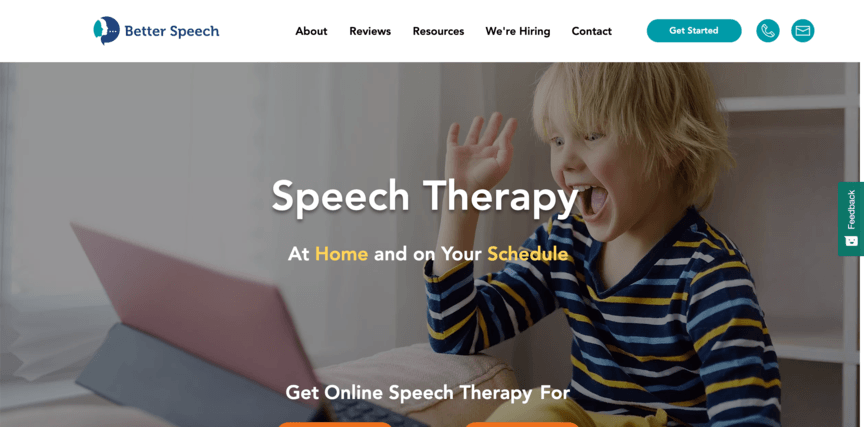

The result is that your site will retain the same elements on both desktop and mobile but will restructure them to fit the screen someone is using.
5. Create a Google Business Profile
Not all speech therapist SEO comes down solely to what’s on your website. You can also make your way into Google search results through other means, particularly Google Business Profile.
Google Business Profile is a platform that lets businesses create online profiles in Google, which can appear in local search results. You can do this for your practice by setting up an account and inputting your name, address, phone number, hours, and services.
When you set up the profile, Google recommends choosing a specific primary category that describes your practice as a whole. Add other categories only for specific services, and use as few as possible.
When people in your area search for something like “speech therapist near me,” your Google Business Profile may appear in the results as part of a local 3-pack.
Users can also find your profile when they look up your address on Google Maps.
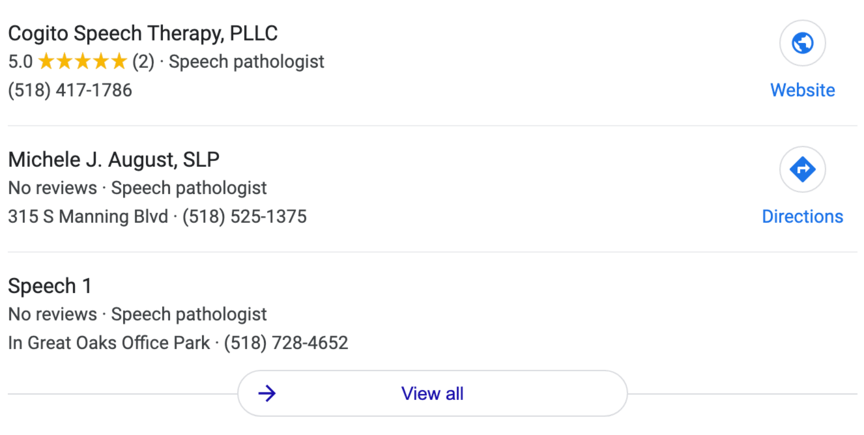
You may already have an existing profile associated with your address, in which case you can claim it by verifying ownership of your practice.
Once the profile is live, ask satisfied families to leave reviews. BrightLocal’s Local Consumer Review Survey found that 97% of consumers read reviews for local businesses.
For perspective, as a part of its local SEO program, Hurst Pediatric Dentistry optimized its local listings and managed its reviews to build trust with parents. It saw a 540% increase in leads from organic search.
When you reply to reviews, don’t confirm that the reviewer is a patient or mention details of their care, because HIPAA privacy rules apply to review responses too.
6. Track analytics
A key element of any SLP SEO campaign is analytics tracking. You absolutely want to monitor the progress of your campaigns to see what’s working for you and what isn’t.
You can do this by using tools like Google Analytics 4 (GA4).
When you set up a free Google Analytics account, you can connect it to your website to view metrics related to site traffic and user activity. You may find that certain pages are driving quite a bit of traffic, while others aren’t.
Accessing this information will allow you to figure out where you should optimize your SEO to drive better results. You can improve traffic to key pages on your site and write blog posts on topics proven to attract people’s interest.
In GA4, mark new-patient form submissions and calls as key events so you can see which pages bring in evaluations, not just visits.
GA4 also shows visits referred by AI assistants like ChatGPT and Perplexity in its AI Assistant channel, which tells you whether AI answers are sending families your way.
How does AI search impact SEO for speech therapists?
AI search impacts SEO for speech therapists by introducing a new avenue for families to find a speech therapist, whether through a ChatGPT conversation or AI Overview summary.
For perspective, 36% of consumers said an AI tool swayed their choice of a new healthcare provider, up from 17% the year before, as reported by eMarketer.
That means some parents reach your website with a recommendation already in hand, and others never reach it at all.
How do you optimize for AI search as a part of speech therapy SEO?
Optimize for AI search as a part of speech therapy SEO with these tactics:
Ask AI the questions parents ask
Try prompts like “best pediatric speech therapist in [your city]” or “speech therapy for stuttering near me” in ChatGPT and Google, and note whether your practice is named.
OmniSEO®, WebFX’s AI search visibility platform, tracks those prompts over time and shows which competitors are cited beside you, so you know which services need clearer pages.
Give each service its own page
Articulation, language delays, stuttering, feeding therapy, and augmentative and alternative communication (AAC) each deserve a page that names the ages you treat, how sessions work, and whether you offer teletherapy.
AI tools can only recommend your practice for services your site describes clearly.
Show your clinicians’ credentials
List each therapist’s CCC-SLP certification and state license on their bio, and note who reviewed your clinical content. Patients and search engines both look for signs that health information comes from qualified clinicians.
Keep your details consistent
Match your practice name, address, phone number, hours, and accepted insurance across your website, Google Business Profile, and directories like ASHA ProFind.
Get discovered across search experiences with SEO for speech therapists
Ready to get your practice found in Google results and AI answers, and turn that visibility into new patients?
Let WebFX give you a hand! With over 1,100 client testimonials, we’re the agency that speech therapists trust to drive top-tier SEO results.
With our SEO services, you’ll get help optimizing your speech therapy SEO for each of the tips listed above, plus AI search optimization, so families find you in AI answers too.
You’ll also receive a dedicated account representative to keep you informed and involved in everything we do for you.
To get started with us, just give us a call at 888-601-5359 or contact us online today!
-
 The WebFX team includes 750+ digital marketing specialists across SEO and AI search, PPC, web design, analytics, and beyond. Using proprietary RevenueCloudFX technology and transparent, data-driven strategies, we’ve collectively generated $10 billion in revenue and 24 million leads for our clients in the past five years.@webfx
-

WebFX is a full-service digital marketing agency delivering revenue-driving strategies across online advertising, SEO and AI search optimization, and digital marketing. Backed by 1,100+ client reviews, a 4.9-star rating on Clutch, and proprietary revenue-tracking technology, our team helps businesses grow visibility and revenue across platforms, from Google to ChatGPT to LinkedIn. Discover how our expert team and revenue-accelerating tech can drive results for you. Learn more
Try our free Marketing Calculator
Craft a tailored online marketing strategy! Utilize our free Internet marketing calculator for a custom plan based on your location, reach, timeframe, and budget.
Plan Your Marketing Budget
Table of Contents
- What is SEO for speech therapists?
- 6 expert speech therapist SEO tips
- 1. Target long-tail keywords
- 2. Optimize page speeds
- 3. Earn backlinks
- 4. Implement responsive design
- 5. Create a Google Business Profile
- 6. Track analytics
- How does AI search impact SEO for speech therapists?
- How do you optimize for AI search as a part of speech therapy SEO?
- Ask AI the questions parents ask
- Give each service its own page
- Show your clinicians’ credentials
- Keep your details consistent
- Get discovered across search experiences with SEO for speech therapists
Share this article


Help More Patients Find Your Practice
See how healthcare providers like Hurst Pediatric Dentistry increased local leads 5× with data-driven SEO from WebFX.
Try our free Marketing Calculator
Craft a tailored online marketing strategy! Utilize our free Internet marketing calculator for a custom plan based on your location, reach, timeframe, and budget.
Plan Your Marketing Budget