



Contents
- Why choosing an AI visibility vendor got harder so fast
- How to choose a GEO agency: 5 things to consider
- What real AI visibility work includes
- How to tell a credible GEO agency from a hype-driven vendor
- 5 red flags to watch for in an AEO or GEO pitch
- Questions to ask an AEO agency before you hire them
- FAQs about how to choose a GEO agency

What to know before you choose a GEO agency
- To choose a GEO agency, compare past GEO experience, content strategy approach, case studies and testimonials, GEO analytics and reporting, and pricing and service packages.
- A credible GEO agency builds AI visibility on top of strong SEO foundations, explains its methodology in plain language, and prioritizes high-intent pages that can drive business impact sooner.
- GEO agency red flags include guaranteed citations or rankings, vague methodology, weak reporting, and pitches that treat GEO as completely separate from SEO.
- Before hiring a GEO agency, compare what its service package actually includes, from audits and technical fixes to content updates, AI visibility monitoring, and ongoing optimization.
As pressure to show up in AI answers grows, so does the number of vendors selling promises they cannot clearly explain. That makes choosing the right partner harder than it should be.
If you’re trying to figure out how to choose a GEO agency, look for a partner that can explain how its AI visibility strategy builds on strong SEO foundations, what work it will actually do, and how it will measure business impact over time.
This guide walks you through what to look for in an AI visibility agency, which red flags to avoid, and what questions to ask before you sign anything.
- Why choosing an AI visibility vendor got harder so fast
- How to choose a GEO agency: 5 things to consider
- What real AI visibility work includes
- How to tell a credible GEO agency from a hype-driven vendor
- 5 red flags to watch for in an AEO or GEO pitch
- Questions to ask an AEO agency before you hire them
- FAQs about how to choose a GEO agency
Why choosing an AI visibility vendor got harder so fast
AI search is changing how people discover brands, compare options, and get answers. At the same time, the service language around that shift is still settling.
According to recent Digiday coverage, there is a growing disconnect in the market: Some agencies treat GEO as a completely new discipline, while others see it as an add-on to existing SEO work. That leaves buyers stuck sorting through competing claims, overlapping acronyms, and a lot of hype-heavy language.
That confusion is exactly why vendor selection matters so much right now.
You are not just choosing a new service category. You are choosing whether the partner in front of you understands how search behavior is changing without pretending the old rules have disappeared overnight.
How to choose a GEO agency: 5 things to consider
If you want to know how to choose a GEO agency, five things in particular stand out as notable GEO agency considerations:
- Past GEO experience
- Content strategy approach
- Case studies and testimonials
- GEO analytics and reporting
- Pricing and service packages
Get more information about each of those qualities below to grow your knowledge of how to choose a GEO agency!
1. Past GEO experience
One of the first things to look at is whether the agency has real experience with GEO, AEO, or broader AI visibility work.
That does not mean you need a vendor that treats GEO like a completely separate discipline from SEO. In fact, one of the strongest signs of credibility is when an agency explains that AI visibility builds on strong SEO foundations instead of replacing them.
Look for an agency that can speak clearly about:
- Technical SEO
- Content quality
- Site structure
- Authority signals
- AI-specific improvements like answer-ready formatting, citation readiness, and entity clarity
You want a partner that can adapt to new search behavior while still building on proven SEO foundations.
2. Content strategy approach
Another major aspect of what to look for in a GEO agency is a solid content strategy approach. A lot of GEO tactics ultimately boil down to how you optimize your website content. So, to know how effective an agency’s GEO services will be, look at the kind of content they produce — both for their clients and on their own website. You want an agency that focuses on:
- Building structured content
- Expanding prompt and query coverage
- Making answers easier to extract
- Reinforcing key topics and entities across the site
On top of that, of course, the agency should follow all the other best practices for content creation that have long been a part of SEO, from keyword integration to schema markup.
3. Case studies and testimonials
Case studies and testimonials can help you evaluate whether an agency’s pitch matches reality. Still, don’t stop at surface-level proof like flashy claims about “better AI visibility.” You want to see whether the agency can explain:
- What work it did
- What it prioritized first
- How it measured progress
- What kind of business impact followed over time
The best proof is usually strong case studies and positive reviews that show a clear connection between strategy, execution, and outcomes.
4. GEO analytics and reporting
Find an agency that’s transparent about how they handle GEO reporting.
Analyzing the results of your GEO is crucial for understanding how it’s performing and improving performance over time. Yet only 47% of marketers say they understand how to measure the impact of AI on their campaigns. This highlights the need for an agency with a solid approach to GEO analytics and reporting.
For each agency you talk to, be sure to ask how they’ll handle your GEO reporting. You want to find an agency with a clear plan for their analytics approach, and you want to ensure that they’ll be open with you about the performance of your campaigns.
Ideally, your agency should send you regular reports every month, or at least every quarter.
5. Pricing and service packages
You need a GEO agency that fits within your budget. You don’t want to overpay for an agency that might underperform, and you don’t want to waste money on cheaper packages that won’t deliver. When looking at prices, consider the scope behind them.
Ask what the GEO service package actually includes. When comparing GEO service costs, look for deliverables like:
- A GEO or AI visibility audit
- Technical SEO fixes or implementation support
- Updates to high-intent pages, like service pages, pricing pages, product pages, and comparison pages
- Answer-ready content formatting and content refreshes
- Entity clarity improvements across key pages
- Internal linking and site structure updates
- Schema recommendations or structured data support
- Prompt, citation, or AI visibility monitoring
- Reporting on early visibility signals and business-impact metrics
- Ongoing strategy, testing, and optimization after the initial setup
Many agencies offer service packages with varying pricing, depending on the deliverables you’re getting. So, even if you can’t afford a given agency’s highest-tier plan, they may have a less extensive plan that’s within your budget based on your website’s core needs.
What real AI visibility work includes
When comparing GEO agencies, get clear on what you are actually buying. The best GEO agencies usually explain AI visibility in two layers: the SEO foundation and the AI-specific layer built on top of it.
The foundation still looks a lot like strong SEO
A credible partner should talk about the basics that still shape discoverability, trust, and site understanding, such as:
- Crawlability
- Technical health
- Site structure
- Content quality
- High-intent page strength
- Authority and brand trust
These elements still help search engines and AI systems understand your brand, your offerings, and the reliability of your content. One agency leader in Digiday’s report reinforces that fact: “If a GEO service does not openly tell you that success in AI visibility is 80 percent good fundamental SEO, they are selling you snake oil.”
The AI-specific layer adds new visibility signals
A stronger GEO partner should also explain what changes in an AI-search environment. That can include work like:
- Improving entity clarity
- Formatting pages so answers are easier to extract
- Optimizing for citation-readiness
- Expanding prompt and query coverage
- Monitoring visibility across AI search engines
That is the difference between a credible AI visibility agency and a hype-driven one. A hype-driven vendor talks like AI visibility is magic. A credible vendor explains how it strengthens the foundation, adds AI-specific improvements, and measures both.
How to tell a credible GEO agency from a hype-driven vendor
One of the easiest ways to spot the difference between a hype-driven vendor and a credible AI visibility agency is to compare how they talk about the work.
| What a hype-driven vendor does | What a credible AI visibility agency does |
| Talks about “ranking in AI” as if AI search works like a single search engine. | Explains that AI visibility happens across multiple surfaces and requires a cross-platform strategy. |
| Treats GEO or AEO like a replacement for SEO. | Makes it clear that SEO is the foundation, and an AI-specific strategy builds on top of it. |
| Uses vague promises like “we’ll get you cited everywhere.” | Explains the specific work involved, such as technical SEO improvements, entity clarity, answer-ready formatting, and citation optimization. |
| Focuses on buzzwords more than execution. | Shows what pages it would prioritize first and why, such as service pages, pricing pages, and comparison pages. |
| Gives little detail on methodology. | Walks you through audits, prioritization, implementation, and reporting in plain language. |
| Reports on “visibility” without business context. | Connects early AI visibility signals to qualified traffic, lead quality, pipeline influence, and revenue over time. |
| Overstates certainty with guarantees. | Sets realistic expectations and explains what it can influence versus what no vendor can fully control. |
Pay close attention to the language a vendor uses in early calls and proposals. A hype-driven vendor often leans on phrases like “guaranteed citations,” “instant AI rankings,” or “exclusive GEO tactics” without showing what those claims mean in practice.
A credible partner sounds more specific. They explain what they will improve, where they will start, and how that work supports both AI visibility and SEO performance.
Our guide on how to outsource generative engine optimization covers what buyers commonly get wrong when scoping GEO work — and how to set the engagement up to produce useful data from the start.
5 red flags to watch for in an AEO or GEO pitch
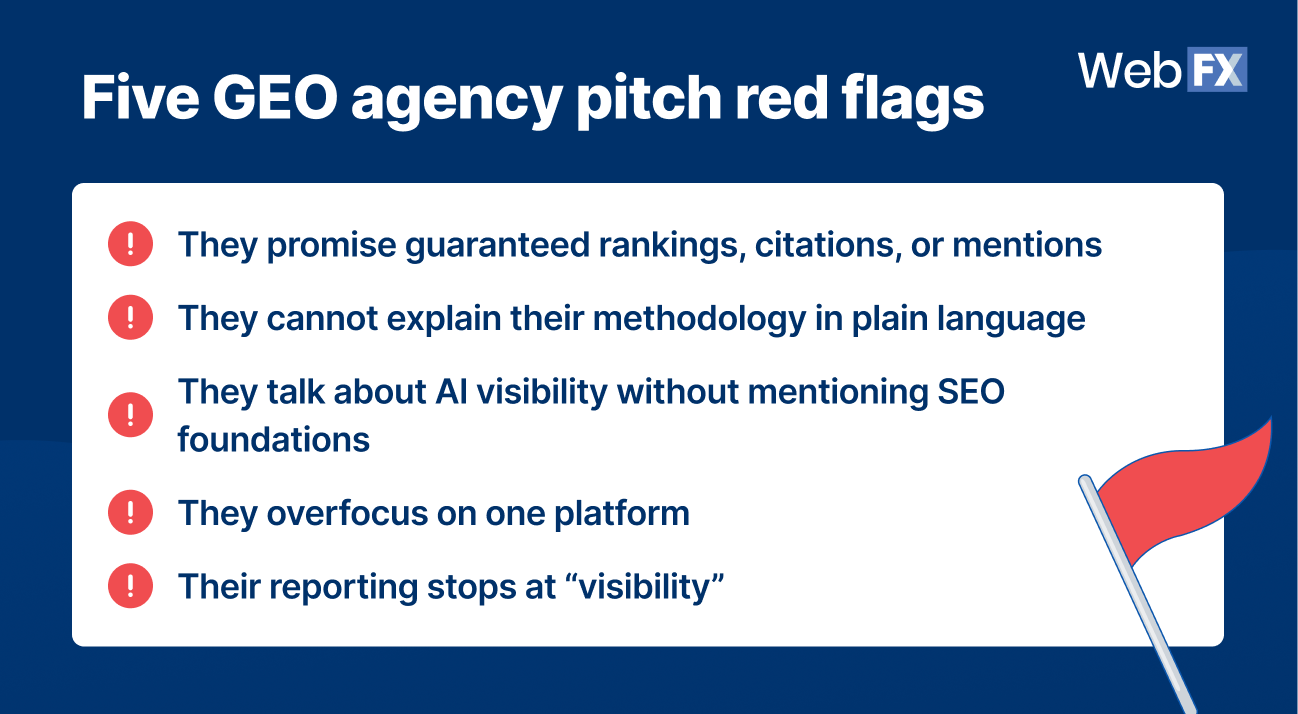
You do not need to be an AI search expert to spot weak vendor logic. You only need a few good filters. Here are the top 5 red flags that tell you an agency doesn’t specialize in GEO.
1. They promise guaranteed rankings, citations, or mentions
A credible agency can talk about increasing your chances of inclusion and improving visibility signals. It cannot guarantee how third-party AI systems will cite or summarize content on every query. When a vendor guarantees outcomes they do not control, it usually signals overconfidence or weak methodology.
2. They cannot explain their methodology in plain language
If the pitch stays at the level of “we help you rank in AI” or “we optimize for generative answers,” keep pushing. A credible partner should be able to say what they will audit, what they will improve, which page types they will prioritize, and how they will measure progress.
3. They talk about AI visibility without mentioning SEO foundations
This is one of the clearest signals that you are hearing a trend pitch instead of a strategy pitch. Strong vendors explain how technical SEO, content quality, information architecture, and authority support AI discoverability.
4. They overfocus on one platform
A partner can specialize, but they should still acknowledge that AI visibility spans multiple surfaces. If a vendor talks as if one tactic will solve visibility everywhere, that is too narrow for how search actually works now.
5. Their reporting stops at “visibility”
Visibility matters, but leadership will eventually ask what it is doing for the business. A stronger agency should be able to explain how it tracks early indicators, assisted conversions, qualified traffic, and downstream impact over time.
Questions to ask an AEO agency before you hire them
This is the part many buyers skip, even though it is one of the best ways to separate a credible partner from a vague one. Bring these questions into your discovery calls.
1. How do you define success for AI visibility?
Look for an answer that includes both early indicators and business outcomes. A weak answer stays at mentions or impressions. A stronger answer includes visibility trends, traffic quality, assisted conversions, and revenue influence over time.
Geo agencies that offer strong reporting make it easier to update leadership in your company. If you plan to pitch a GEO investment to leadership soon, I recommend reading our resource on how to build the business case for AI SEO for a more successful outcome.
2. How does your strategy build on existing SEO work?
A credible answer should make it clear that AEO or GEO does not replace SEO. It should explain how technical health, authority, and strong commercial pages support AI discoverability.
3. Which AI surfaces do you monitor, and why?
You want a thoughtful answer here, not a buzzword list. The agency should explain which platforms matter for your audience and how they track performance across them.
4. What proof can you share beyond vague “AI visibility” wins?
Ask for examples of reporting, not just claims. You want to see how the agency talks about progress, what it measures first, and how it connects that work to your funnel.
5. Which pages would you prioritize first?
A good answer should include high-intent assets like service pages, pricing pages, product pages, and comparison pages. Those pages often provide clearer commercial signals, stronger entity context, and better opportunities for answer extraction.
6. How do you adapt as AI search changes?
This is a fast-moving space. You want a partner that can test, measure, and refine instead of one that sells a fixed checklist and disappears.
FAQs about how to choose a GEO agency
Here are the answers to some of the most common questions related to how to choose a GEO agency:
How do you compare GEO agencies?
To compare different GEO agencies, consider factors like:
- How much experience they have
- How much their services cost
- The quality of their reviews and testimonials
- Their approach to GEO reporting
An agency that scores high in all these areas will likely be a good fit.
Do I need AEO and SEO together?
In most cases, yes. The strongest strategies pair SEO fundamentals with AI-specific improvements because brands still need strong technical health, content quality, and authority while adapting to AI-driven discovery.
What is the difference between a GEO agency and an AEO agency?
The terms overlap heavily in the market right now. Some agencies use AEO to emphasize answer visibility and some use GEO to emphasize generative search more broadly, but both usually sit in the same family of AI-search optimization services.
How can you tell if a GEO strategy will pay off?
A GEO strategy should sound measurable from the start. Strong agencies usually begin with high-intent pages like service pages, pricing pages, product pages, and comparison pages, then track progress in stages.
Early indicators might include:
- Visibility across target AI engines
- Citation patterns
- Inclusion on priority prompts
- Traffic from generative or AI-assisted sources
Longer-term outcomes should move toward:
- Qualified traffic
- Assisted conversions
- Lead quality
- Pipeline influence
- Revenue contribution
What should you look for in the best GEO agency for your business?
The best GEO agency for your business will have a clear strategy, credible proof, and the strongest fit for your goals.
Look for a partner that:
- Builds AI visibility on top of strong SEO foundations
- Explains its methodology in plain language
- Prioritizes the right pages first
- Measures early signals and long-term business outcomes
- Sets realistic expectations instead of making guarantees
- Offers pricing and scope that match your internal needs
How long does it take to see progress from a GEO agency?
Early visibility signals can show up before revenue impact does, especially if the work starts on strong commercial pages. A credible agency should set expectations around phased reporting rather than promising instant results.
Can one agency handle both SEO and AI visibility?
Yes, and that is often the strongest setup. The best-fit partner should be able to explain how SEO and AI visibility work together rather than force you to choose one or the other.
Choose a GEO agency with a clear strategy, not empty promises
The safest way to choose an AEO agency is not to look for the boldest promise. It is to look for the clearest strategy. The right partner should be able to explain how strong SEO foundations support AI visibility, what AI-specific work they will add, what they will prioritize first, and how they will connect progress to business outcomes over time.
If you want a partner that combines AI optimization support with strong SEO execution and the OmniSEO® platform to connect visibility to measurable outcomes, WebFX helps brands build AI visibility on top of strong SEO foundations. Learn more about how our GEO services work today.
-
 Thaakirah Abrahams is a Lead Editor at WebFX, where she leverages her 5+ years of experience to craft compelling website content. With a background in Journalism and Media studies and certifications in inbound marketing, she holds a keen eye for detail and a talent for breaking down complex topics for numerous sectors, including the legal and finance industries. When she’s not writing or optimizing content, Thaakirah enjoys the simple pleasures of reading in her garden and spending quality time with her family during game nights. View full profile
 -
 Matthew Gibbons is a Senior Data & Tech Writer at WebFX, where he strives to help businesses understand niche and complex marketing topics related to SEO, martech, and more. With a B.A. in Professional and Public Writing from Auburn University, he’s written over 1,000 marketing guides and video scripts since joining the company in 2020. In addition to the WebFX blog, you can find his work on SEO.com, Nutshell, TeamAI, and the WebFX YouTube channel. When he’s not pumping out fresh blog posts and articles, he’s usually fueling his Tolkien obsession or working on his latest creative project. View full profile
 -

WebFX is a full-service digital marketing agency delivering revenue-driving strategies across online advertising, SEO and AI search optimization, and digital marketing. Backed by 1,100+ client reviews, a 4.9-star rating on Clutch, and proprietary revenue-tracking technology, our team helps businesses grow visibility and revenue across platforms, from Google to ChatGPT to LinkedIn. Discover how our expert team and revenue-accelerating tech can drive results for you. Learn more

Try our free Marketing Calculator
Craft a tailored online marketing strategy! Utilize our free Internet marketing calculator for a custom plan based on your location, reach, timeframe, and budget.
Contents
- Why choosing an AI visibility vendor got harder so fast
- How to choose a GEO agency: 5 things to consider
- What real AI visibility work includes
- How to tell a credible GEO agency from a hype-driven vendor
- 5 red flags to watch for in an AEO or GEO pitch
- Questions to ask an AEO agency before you hire them
- FAQs about how to choose a GEO agency
Share this article


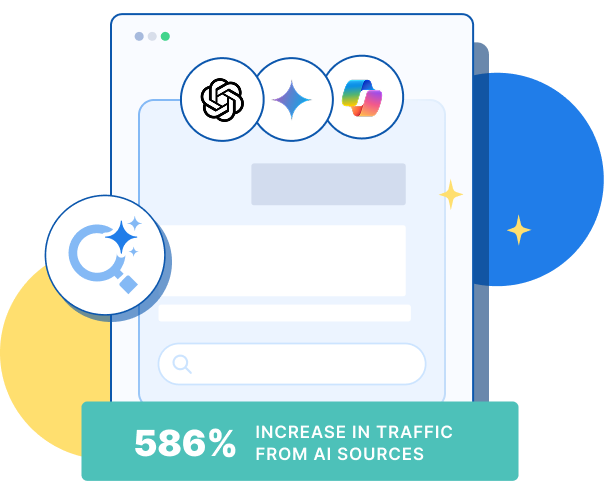
See AI Marketing in Action
Explore how WebFX helped a regional brand get discovered in AI search experiences — proving what’s possible with today’s AI-driven marketing!
Try our free Marketing Calculator
Craft a tailored online marketing strategy! Utilize our free Internet marketing calculator for a custom plan based on your location, reach, timeframe, and budget.
What to read next



FAQs about how to choose a GEO agency
Here are the answers to some of the most common questions related to how to choose a GEO agency:
How do you compare GEO agencies?
To compare different GEO agencies, consider factors like:
- How much experience they have
- How much their services cost
- The quality of their reviews and testimonials
- Their approach to GEO reporting
An agency that scores high in all these areas will likely be a good fit.
Do I need AEO and SEO together?
In most cases, yes. The strongest strategies pair SEO fundamentals with AI-specific improvements because brands still need strong technical health, content quality, and authority while adapting to AI-driven discovery.
What is the difference between a GEO agency and an AEO agency?
The terms overlap heavily in the market right now. Some agencies use AEO to emphasize answer visibility and some use GEO to emphasize generative search more broadly, but both usually sit in the same family of AI-search optimization services.
How can you tell if a GEO strategy will pay off?
A GEO strategy should sound measurable from the start. Strong agencies usually begin with high-intent pages like service pages, pricing pages, product pages, and comparison pages, then track progress in stages.
Early indicators might include:
- Visibility across target AI engines
- Citation patterns
- Inclusion on priority prompts
- Traffic from generative or AI-assisted sources
Longer-term outcomes should move toward:
- Qualified traffic
- Assisted conversions
- Lead quality
- Pipeline influence
- Revenue contribution
What should you look for in the best GEO agency for your business?
The best GEO agency for your business will have a clear strategy, credible proof, and the strongest fit for your goals.
Look for a partner that:
- Builds AI visibility on top of strong SEO foundations
- Explains its methodology in plain language
- Prioritizes the right pages first
- Measures early signals and long-term business outcomes
- Sets realistic expectations instead of making guarantees
- Offers pricing and scope that match your internal needs
How long does it take to see progress from a GEO agency?
Early visibility signals can show up before revenue impact does, especially if the work starts on strong commercial pages. A credible agency should set expectations around phased reporting rather than promising instant results.
Can one agency handle both SEO and AI visibility?
Yes, and that is often the strongest setup. The best-fit partner should be able to explain how SEO and AI visibility work together rather than force you to choose one or the other.