


Contents
- What is generative engine optimization (GEO)?
- Why businesses outsource GEO
- How to outsource GEO
- 1. Define the business outcome you want from GEO
- 2. Decide what type of help you actually need
- 3. Build a shortlist of agencies with relevant GEO capabilities
- 4. Evaluate each agency’s process, proof, and reporting
- Process: What does the GEO agency do month to month?
- Proof: What do the GEO agency’s case studies show about the results it delivered?
- Reporting: What metrics do they regularly report?
- 5. Compare scope, pricing, and ownership
- 6. Start with a pilot or phased engagement
- 7. Measure progress and refine the program
- Questions to ask before hiring a GEO agency
- Red flags to watch for when outsourcing GEO
- How long does outsourced GEO take to work?
- How much does it cost to outsource GEO?
- FAQs about outsourcing GEO
- Ready to move forward and outsource your GEO?

How to outsource generative engine optimization (GEO)
- Define the business outcome you want from GEO
- Decide what type of help you actually need
- Build a shortlist of agencies with proven GEO capabilities
- Evaluate each agency’s process, proof, and reporting
- Compare scope, pricing, and ownership
- Start with a pilot or phased engagement
- Measure progress and refine the program
Outsourcing generative engine optimization (GEO) helps businesses improve visibility across AI-powered search experiences like ChatGPT, Google AI Overviews, Gemini, and Perplexity. The right GEO agency should deliver clear deliverables, provide measurable reporting, and align its strategy with your business goals.
In this guide, you’ll learn how to outsource generative engine optimization with these topics:
- What is generative engine optimization (GEO)?
- Why businesses outsource GEO
- How to outsource GEO
- Questions to ask before hiring a GEO agency
- Red flags to watch for when outsourcing GEO
- How long does outsourced GEO take to work?
- How much does it cost to outsource GEO?
- FAQs about outsourcing GEO
What is generative engine optimization (GEO)?
Generative engine optimization (GEO) is the process of improving how your business appears in AI search experiences (such as Google’s AI Overviews and AI Mode) and in AI-generated answers from tools like ChatGPT, Perplexity, and Claude.
You may also see related terms like answer engine optimization (AEO), AI SEO, and AI visibility. In practice, these terms often overlap. They all point to the same business goal: helping AI tools understand your brand, surface your content, and mention your business when users ask relevant questions.
Why businesses outsource GEO
Most businesses don’t have an in-house team that already knows how AI-generated search experiences work. Even strong marketing teams may still be figuring out how GEO fits with SEO and other digital marketing strategies.
Businesses often outsource GEO for three main reasons: specialized expertise, broader execution support, and faster progress.
- Specialized expertise: GEO is still new enough that many internal teams are learning as they go. An outside partner can bring a more defined process for improving AI visibility.
- Broader execution support: GEO rarely fits into a single neat box. A complete program may involve website content, content structure, review signals, brand consistency, third-party mentions, reporting, and technical support. For a lean team, coordinating all of that internally can get messy fast.
- Faster progress: Many businesses do not want to spend months experimenting on their own, especially when leadership expects ROI from GEO investments and the market keeps changing.
In practice, businesses outsource GEO for several key reasons beyond these three — including better tools and seamless integration with existing marketing strategies.
How to outsource GEO
Outsourcing GEO can feel difficult to assess because you are not only evaluating an agency. You are also evaluating how that agency defines GEO, scopes the work, and measures progress. That is why it helps to start with your own goals before you compare providers.
A strong GEO outsourcing process treats the work like a scoped marketing program with deliverables, timelines, and reporting. The steps below can help you compare partners more effectively and make a lower-risk hiring decision:
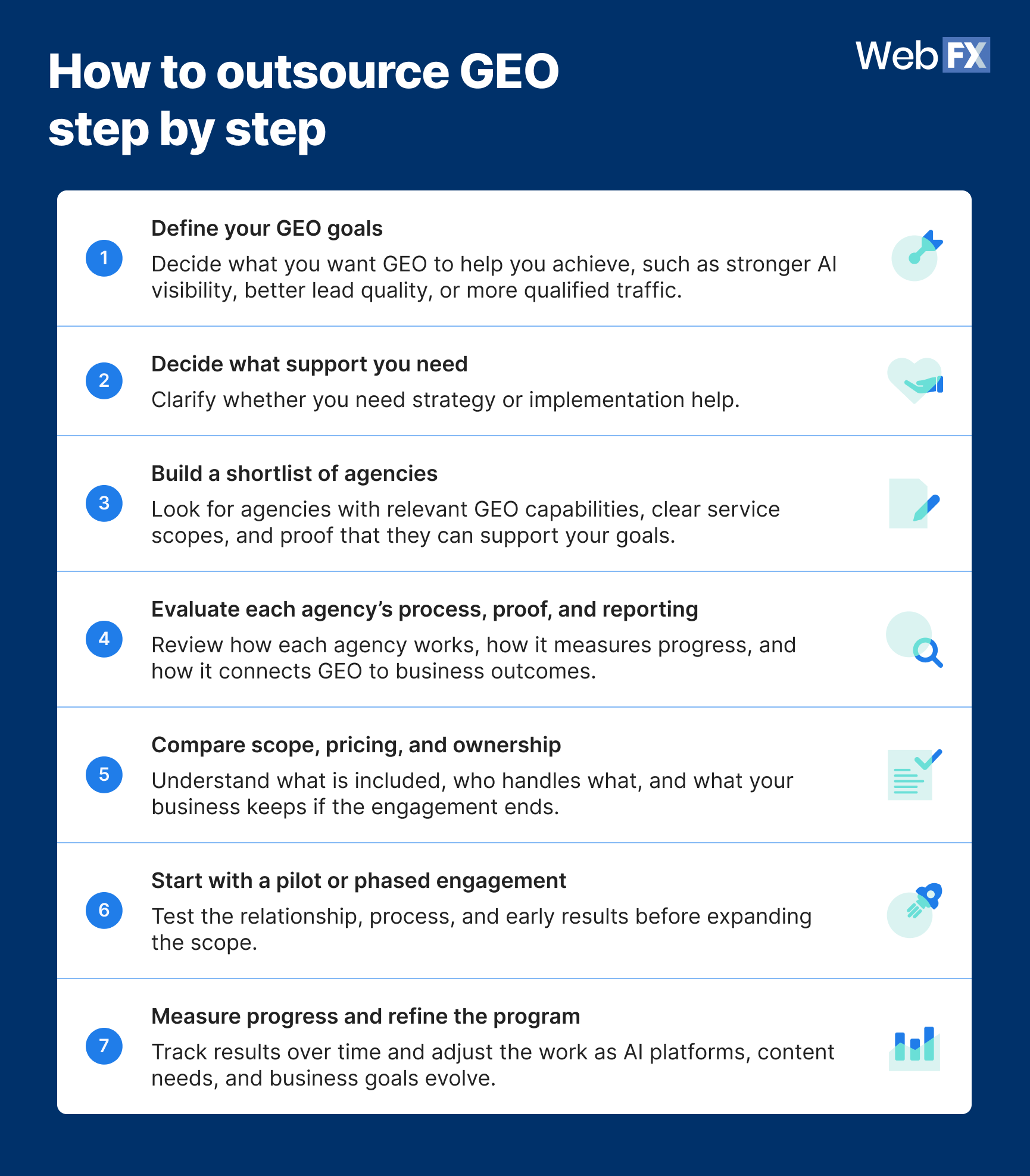
1. Define the business outcome you want from GEO
Before you compare agencies, define what a successful GEO effort looks like for your business. GEO can support visibility, but you still need to decide which outcomes matter most to you.
That may include:
- More brand mentions in AI-generated answers
- Stronger citation visibility
- More referral traffic from AI tools
- Better lead quality
- Stronger brand validation during the research stage
This step matters because visibility does not always translate into the same business value. A mention in an AI answer may support awareness, consideration, or conversion depending on the query, the buyer stage, and the action that follows.
For example, a software company may care most about showing up when buyers compare solutions. A manufacturer’s goal may be to get mentioned when prospects ask for solutions, supporting the long buying cycle in their niche.
You should also decide whether GEO is meant to support your existing SEO strategy or whether you are treating it as a newer initiative with its own scope. That distinction can affect your budget, reporting, and expectations.
Define your desired outcomes early, so you can better filter every agency conversation that follows.
2. Decide what type of help you actually need
Once you know your goals, decide what kind of support you need to achieve them.
Some businesses need strategy first. Others already know what they want and need a GEO partner to execute their strategies.
This is where many buyers get tripped up. GEO can sound like a content service because content plays such a big role. But content alone may not cover everything.
For example, you may need:
- Content audits and rewrites
- FAQ development
- Schema markup support
- Technical SEO support
- Review generation support
- Brand consistency updates across key web properties
- Reporting on mentions, citations, and AI-driven traffic trends
This step helps you choose a service mix that fits your goals, timeline, and internal resources. When you understand your needs early, it becomes easier to compare packages, spot gaps in scope, and choose a GEO partner that fits your business.
A good outsourcing decision starts with a clear view of your own needs, not a provider’s default package.
3. Build a shortlist of agencies with proven GEO capabilities
Look for agencies that can connect GEO to related strategies like SEO, content marketing, review generation, digital PR, and reporting. You need a vendor that can explain how its GEO work helps you achieve your growth goals and maximize your ROI.
GEO is still new enough that some agencies may relabel routine SEO deliverables without adding anything meaningfully tied to AI visibility.
As you review agency websites and proposals, look at the scope of their GEO work. A strong GEO offering may include:
- GEO audits
- SEO audits
- AI search strategy
- AI search optimizations
- SEO optimizations
- Performance tracking
You should also pay attention to how agencies communicate. A provider that can’t explain its process in plain English will be hard to evaluate later when you are reviewing deliverables and results.
It can also be helpful to compare a GEO vs. SEO agency as some agencies may offer both services if you need help with multiple strategies while some agencies may only offer traditional SEO services instead of GEO.
4. Evaluate each agency’s process, proof, and reporting
This step helps you understand how the agency works, what it can show you, and how it plans to measure progress. Keep your evaluation simple by reviewing three things:
Process: What does the GEO agency do month to month?
Find out how the agency approaches content structuring, third-party visibility, review signals, measurement, and collaboration with your internal team.
A good agency should be able to explain its:
- Content audits and content optimization
- Structured FAQ or answer-focused content
- Technical SEO alignment
- Schema markup recommendations
- Review and reputation support
- Third-party visibility support
- Reporting on AI mentions, citations, and related traffic trends
A reputable GEO agency should also explain how it expects GEO to connect with SEO and content strategy.
Proof: What do the GEO agency’s case studies show about the results it delivered?
Review the agency’s case studies, frameworks, sample deliverables, test results, or sample reporting. The agency doesn’t need to guarantee results for your business.
It should, however, be able to show you the work behind its claims. Ask for any of the following:
- Sample deliverables
- Case study summaries
- Content before-and-after examples
- Reporting examples
- A framework for how the agency measures progress
- Examples of how GEO fits with SEO and content work
The agency should be able to walk you through how it improved a client’s content structure for AI-generated answers. In addition, its case studies should explain how those optimizations resulted in business outcomes, such as increased qualified leads, sales, or revenue.
Reporting: What metrics do they regularly report?
The strongest agencies define success in business terms. Although mentions and citations matter, GEO agencies must be able to connect these numbers to business outcomes, like increased sales-qualified leads, sales, and revenue.
In their reporting examples, look for these details:
- What the agency did
- What changed
- What the numbers mean in the report
- What it plans to do next
Those same reporting criteria become your benchmark for evaluating an agency once the engagement is live — covering the KPIs to track at each stage, what good monthly reporting looks like, and the 30-60-90 day milestones that tell you whether execution is on track.
5. Compare scope, pricing, and ownership
Once you narrow your shortlist, compare each agency’s actual scope of work:
- Deliverables
- Support level
- Reporting depth
- Ownership terms
That gives you a clearer picture of what you are paying for and what your team still needs to handle internally.
For example, one agency may include content rewrites, reporting, review support, and technical collaboration. Another may offer a lighter plan focused mostly on audits and recommendations.
The cheaper option is not automatically worse, but it may be solving a smaller part of the problem.
You should also clarify who handles content updates, technical implementation, reviews or reputation support, third-party visibility efforts, reporting setup, and documentation.
Ownership matters too. Ask whether you keep the reporting setup, strategic documentation, and work products if you leave the engagement. That can affect the long-term value of the investment.
Buyers should know what they are paying for each month and what they still need to handle internally.
6. Start with a pilot or phased engagement
A pilot or phased engagement can give you a practical way to test the relationship, process, and the early results before you commit more budget.
That is especially true if you are still learning how GEO fits your business or if you are comparing a newer service category with limited internal benchmarks.
A good pilot does not need to cover everything. It may focus on a specific section of your site, a defined content cluster, or a reporting baseline plus an optimization roadmap.
For example, a pilot might include:
- An audit of current AI visibility signals
- Updates to a defined set of core pages
- FAQ expansion
- Review signal recommendations
- A reporting framework for early measurement
Don’t expect dramatic quick wins. Instead, you might see cleaner structured content, stronger citation readiness, improved consistency across key pages, or more useful reporting. Those are still valuable outcomes because they help you decide whether to scale.
A phased engagement gives you a lower-risk way to test the relationship and the process before you commit more budget.
7. Measure progress and refine the program
You should measure GEO progress over time because AI search experiences and model behavior can change quickly. That’s why a useful GEO strategy needs ongoing review and refinement.
Track the signals you can measure consistently. That may include trends in mentions, citations, AI-referred traffic when you can verify it, branded search lift, qualified lead trends, and influenced revenue where possible.
You should also look at operational progress:
- Is the agency completing the work it scoped?
- Is reporting improving?
- Are you seeing stronger alignment between your content, reviews, and broader brand presence?
If you cannot tie every AI mention directly to revenue, you can still assess whether the partnership is moving in the right direction. A strong GEO program gives you a process you can evaluate, refine, and improve over time.
Questions to ask before hiring a GEO agency
Save time by bringing a short set of direct questions to agency conversations. These questions can help you understand what the agency actually does and whether the scope fits your business:
- What does your GEO process include each month?
- How do you measure progress if AI answers change often?
- What outcomes do you track beyond citations?
- How do you support reviews, third-party mentions, or other off-site trust signals?
- Which parts of this work overlap with SEO, and which parts are GEO-specific?
- What should I expect in the first 90 days?
You can also ask for examples, such as a reporting template or an example of how the agency prioritized GEO work for a client with goals similar to yours.
Red flags to watch for when outsourcing GEO
Here are some red flags to watch for when outsourcing GEO:
The agency promises guaranteed placement in ChatGPT, Perplexity, or Google AI Overviews. GEO can improve your visibility, but AI platforms are too dynamic for guaranteed placements. AI models, citations, and answer formats can change frequently, which makes fixed placement guarantees unrealistic.
The agency can’t explain its GEO methodology in concrete terms. If it leans on buzzwords like “AI optimization” or “extractable content” without explaining what it will actually change on your site or across your digital presence, keep digging.
Its GEO service sounds like repackaged SEO with a new label. There can be overlap between GEO and SEO, but the agency should be able to explain what is specific to AI search visibility, such as GEO audits, content structure optimization, citation tracking, or AI-focused reporting.
It can’t show before-and-after proof of GEO-related work. A credible agency should be able to share examples or case studies that show how it has helped a client improve AI visibility and increase revenue through their GEO services.
It relies only on traditional SEO metrics and tools. GEO reporting should go beyond rankings and organic traffic. The agency should also be able to track AI mentions, citations, AI-referred traffic when it can be verified, and other visibility trends tied to AI platforms.
It optimizes for only one AI platform without explaining the trade-offs. A strong GEO strategy should account for how people search across multiple AI experiences, rather than treating one platform as the single most important channel.
Its deliverables sound heavily automated, but the agency is vague about how AI is used. AI can help with research, drafting, or workflows, but the agency should still explain what is human-led, how work is reviewed, and who is accountable for accuracy and quality.
Its pricing feels disconnected from scope or outcomes. Extremely low pricing may mean thin execution. High pricing also doesn’t automatically mean you have found a better agency. If an agency has no clear deliverables, KPIs, or business rationale, you should take a closer look before hiring them.
Its reporting focuses on vague visibility language instead of business impact. The agency should explain how it connects improved AI visibility to qualified traffic, leads, pipeline, or revenue where possible.
Its sales process feels unverifiable or overly templated. If multiple agencies sound interchangeable, use the same script, or cannot point to a credible track record, take more time to validate who they are and how they work.
How long does outsourced GEO take to work?
Outsourced GEO can show results on different timelines, from a few weeks to six months, depending on:
- Your starting point
- The AI platforms you’re targeting
- How quickly the agency can begin implementation
You also need time to vet an agency, align on the scope of work, and launch the work, so outsourcing adds an extra layer before optimization starts.
For Google AI Overviews, outsourced GEO results may appear within weeks if your site already ranks well organically. However, if you still need to improve your organic visibility, you’ll see results in four to six months.
For ChatGPT and other large language models (LLMs), timing can vary based on how the platform surfaces information. Some AI experiences may reflect content changes more slowly, while browsing-based experiences can pull in current web content faster.
For Perplexity, changes can appear more quickly because it searches the live web. Businesses with strong authority signals, recent content, and clear answer-focused structure may see faster visibility improvements there.
Several factors can affect timing, including:
- Existing organic visibility
- Content quality and structure
- Third-party mentions and reviews
- Brand authority
- How quickly your agency can implement updates
Remember that AI optimization is an ongoing process, not a one-and-done task. Businesses that already have strong SEO foundations, strong brand signals, and content that directly answers common questions often have a head start.
How much does it cost to outsource GEO?
The cost of outsourced GEO ranges from $1,500 to $50,000+ per month.
Several factors can affect agency pricing for AI search optimization services, like the size of your business, the company you decide to work with, and the scope of work.
FAQs about outsourcing GEO
How do you outsource generative engine optimization?
To outsource generative engine optimization, here are the steps you need to take:
- Define your goals
- Identify what kind of support you need
- Shortlist agencies with proven capabilities
- Review their process, proof, and reporting
- Compare their scope and pricing
- Start with a measured engagement
This process gives you a better chance of choosing a partner whose work matches your business needs.
Which is better, in-house GEO or outsourced GEO?
There is no universal answer here. In the in-house vs. outsourced GEO discussion, the better choice depends on your team’s bandwidth, budget, timeline, and internal expertise.
An in-house approach gives you more direct control and stronger internal context. Your team already knows your messaging, customers, and priorities. That can be a real advantage.
The trade-off is that in-house GEO may come with a slower learning curve and narrower execution coverage. If your team already has a full workload, GEO may become one more initiative competing for time.
An outsourced approach can give you faster access to specialized support, broader execution help, and a more defined process. That can be useful when you need momentum, outside perspective, or support across content, reporting, and related search efforts.
A hybrid approach often makes the most sense. Your internal team can own messaging, positioning, approvals, and business priorities while the agency handles audits, optimization, testing, and reporting.
For many lean marketing teams, outsourcing works best as leverage. It should support your strategy, not replace it.
What are the best GEO agencies to outsource to?
Some of the top GEO agencies you may consider are:
- WebFX
- Delante
- Search Engine People
- First Page Digital
- Major Tom
- Search + Gather
- The SEO Works
- SEO Brand
The best fit depends on your goals, budget, market, and support needs.
How long does outsourced GEO take to show results?
Some businesses may see early signals within weeks to a few months, while stronger results often take three to six months or longer. GEO usually requires ongoing optimization rather than a one-time push.
Can a small marketing team outsource GEO successfully?
Yes. In many cases, a small team is exactly the kind of team that benefits from outsourcing GEO.
An outside partner can help with specialized work, while your internal team keeps control of messaging, approvals, and business priorities.
How do you measure GEO results if AI answers keep changing?
You track and measure trends, not just one-off appearance in an AI-generated summary.
That may include citations, mentions, AI-referred traffic, branded search lift, qualified lead trends, influenced revenue, and the completion of scoped optimization work. The goal is to evaluate progress over time with context.
Ready to move forward and outsource your GEO?
Outsourcing GEO can make sense when you want specialized help without building the entire function in-house. Like any outsourced marketing service, however, the value depends on how well you define your goals, choose an agency partner, and evaluate the work.
If you’re ready to improve your visibility with GEO, consider teaming up with WebFX. We’re a full-service digital marketing agency with 30+ years of experience.
We’ve helped a heavy equipment client increase its leads from AI platforms by 500%. Our team is pumped to help drive results for your business, too.
Contact us online or call us at 888-601-5359 to learn more about our GEO services!
-
 Maria is a Lead Content Specialist at WebFX. With nearly two decades of experience in B2B and B2C publishing, marketing, and PR, she has authored hundreds of articles on digital marketing, AI, and SEO to help SMB marketers make informed strategic decisions. Maria has a degree in B.S. Development Communication major in Science Communication, and certifications in inbound marketing, content marketing, Google Analytics, and PR. When she’s not writing, you’ll find her playing with her dogs, running, swimming, or trying to love burpee broad jumps. View full profile
 -

WebFX is a full-service digital marketing agency delivering revenue-driving strategies across online advertising, SEO and AI search optimization, and digital marketing. Backed by 1,100+ client reviews, a 4.9-star rating on Clutch, and proprietary revenue-tracking technology, our team helps businesses grow visibility and revenue across platforms, from Google to ChatGPT to LinkedIn. Discover how our expert team and revenue-accelerating tech can drive results for you. Learn more

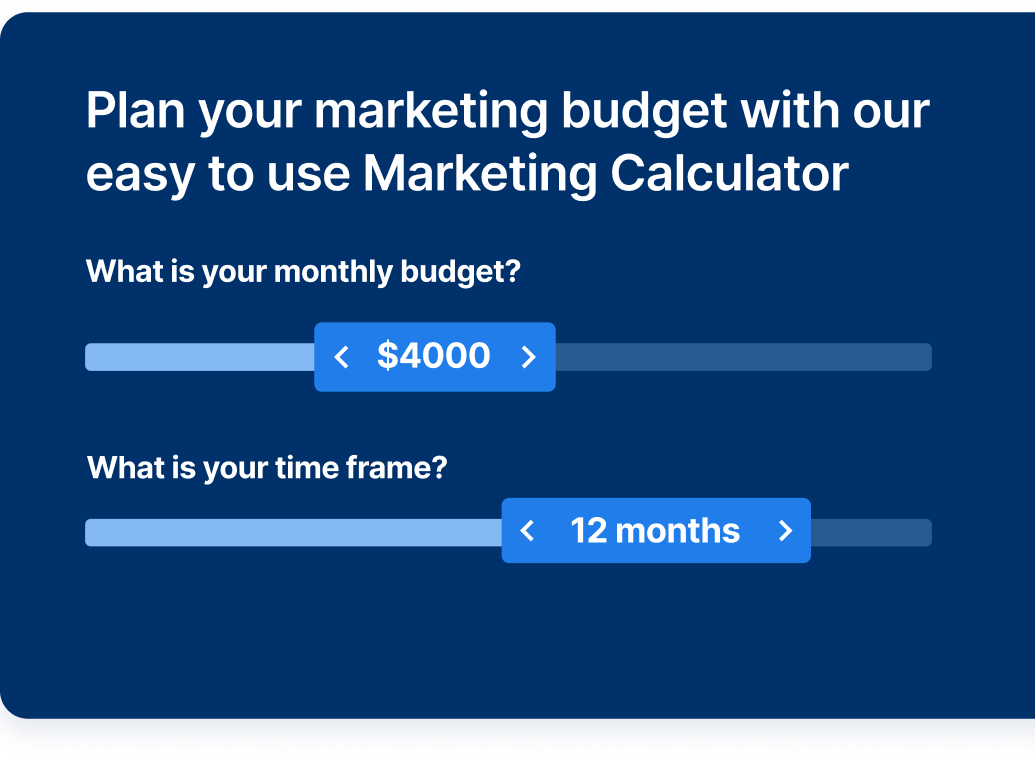
Try our free Marketing Calculator
Craft a tailored online marketing strategy! Utilize our free Internet marketing calculator for a custom plan based on your location, reach, timeframe, and budget.
Contents
- What is generative engine optimization (GEO)?
- Why businesses outsource GEO
- How to outsource GEO
- 1. Define the business outcome you want from GEO
- 2. Decide what type of help you actually need
- 3. Build a shortlist of agencies with relevant GEO capabilities
- 4. Evaluate each agency’s process, proof, and reporting
- Process: What does the GEO agency do month to month?
- Proof: What do the GEO agency’s case studies show about the results it delivered?
- Reporting: What metrics do they regularly report?
- 5. Compare scope, pricing, and ownership
- 6. Start with a pilot or phased engagement
- 7. Measure progress and refine the program
- Questions to ask before hiring a GEO agency
- Red flags to watch for when outsourcing GEO
- How long does outsourced GEO take to work?
- How much does it cost to outsource GEO?
- FAQs about outsourcing GEO
- Ready to move forward and outsource your GEO?
Share this article


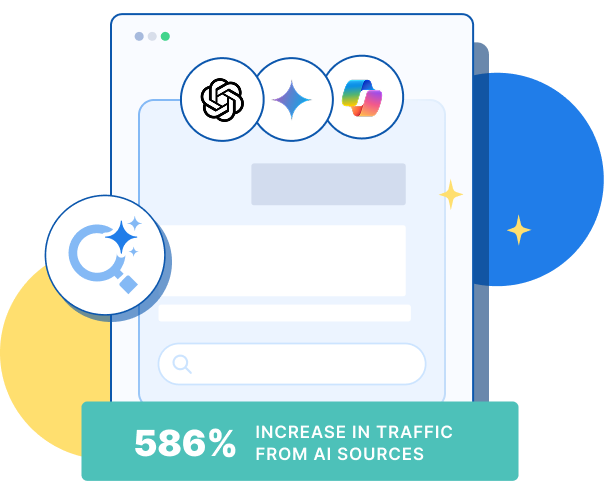
See AI Marketing in Action
Explore how WebFX helped a regional brand get discovered in AI search experiences — proving what’s possible with today’s AI-driven marketing!
Try our free Marketing Calculator
Craft a tailored online marketing strategy! Utilize our free Internet marketing calculator for a custom plan based on your location, reach, timeframe, and budget.
What to read next