


Contents
- What a GEO agency should be responsible for
- 7 signs your GEO agency is working
- How to measure GEO agency performance
- What good GEO reporting looks like each month
- What should happen in the first 30, 60, and 90 days of a GEO strategy?
- What results should you realistically expect from a GEO agency
- Red flags in an active GEO agency relationship
- Scorecard: How to evaluate whether your GEO agency is worth it
- When to push for GEO strategy changes and when to switch agencies
- FAQ on GEO agency effectiveness
- Ready to measure GEO agency performance more clearly?

How to Tell If Your GEO Agency Is Doing a Good Job
- You can tell if your GEO agency is doing a good job when it shows measurable progress in AI visibility, explains what changed, and connects that progress to qualified traffic, lead quality, and business impact over time.
- The most reliable way to measure GEO agency performance is to track a staged set of KPIs like citations, mentions, AI-influenced traffic, lead quality, and assisted conversions.
- Good GEO reporting includes baseline-versus-current trends, prompt coverage, completed work, competitor context, clear interpretation of results, and next steps tied to business goals.
- Common red flags include vague activity-only updates, no defined prompt set or benchmark, little evidence of implemented improvements, and no connection between AI visibility work and meaningful business outcomes.
So you hired a GEO agency. It’s been months, and you still haven’t received meaningful updates. This situation is why it’s important to know how to evaluate your agency. You can tell if your GEO agency is doing a good job when it shows measurable gains in AI visibility, explains what changed, and ties those changes to stronger engagement, lead quality, and business impact over time.
That matters because AI visibility is no longer a side channel. Google says AI Overviews are now used by more than a billion people, and our research shows that AI Overviews appear in one of every four U.S. searches and that AI-driven traffic is growing quickly.
This guide shows you how to tell if your GEO agency is doing a good job by reviewing deliverables, monthly reporting, KPIs, 30-60-90 day progress, and the signals that separate normal ramp-up from weak execution.
- What a GEO agency should be responsible for
- 7 signs your GEO agency is working
- How to measure GEO agency performance
- What good GEO reporting looks like each month
- What should happen in the first 30, 60, and 90 days of a GEO strategy?
- What results should you realistically expect from a GEO agency
- Red flags in an active GEO agency relationship
- Scorecard: How to evaluate whether your GEO agency is worth it
- When to push for GEO strategy changes and when to switch agencies
- FAQ on GEO agency effectiveness
What a GEO agency should be responsible for
Before you judge performance, you need to understand ownership. A GEO agency should not just talk about AI visibility. It should be accountable for building a measurement framework, improving the assets that influence AI discovery, and showing what changed after the engagement started.
After kickoff, a good GEO agency should own five things:
- Audit and baseline setup: It should document where your brand appears now, where competitors appear, and which prompts matter most.
- Prioritization: It should decide which pages, entities, and technical issues matter first.
- Implementation: It should ship real work, such as content restructuring, stronger answer formatting, internal linking improvements, entity clarity work, and technical fixes.
- Reporting: It should show what moved, what did not, and what comes next.
- Iteration: It should refine the plan if the first round of changes does not create enough movement.
That is the difference between promised work and delivered work. Once an agency is engaged, you should be able to point to audits, tracked prompts, shipped changes, and a reporting rhythm.
7 signs your GEO agency is working
The best signs show up in patterns, not isolated wins. One screenshot from ChatGPT is not enough. A strong agency should be able to show trend movement across a defined set of prompts, platforms, and business outcomes.
- Your brand appears in relevant AI answers
- AI citations or source inclusions are increasing
- Brand mentions and representation quality improve
- AI visibility rate improves across a defined prompt set
- AI-influenced traffic quality gets stronger
- Reporting is specific and tied to next steps
- Content is being actively improved for extractability and trust
1. Your brand appears in relevant AI answers
A good GEO agency would test target prompts in ChatGPT, Gemini, Perplexity, and Google, and track which brands are mentioned or cited over time. Ask your agency for:
- A tracked prompt list by topic and funnel stage
- Monthly snapshots of where your brand appears
- Competitor comparisons on the same prompt set
- Notes on which prompts matter most for commercial intent
You know this is improving when your brand starts appearing more often for service, pricing, product, comparison, and “best” queries that matter to buyers.
2. AI citations or source inclusions are increasing
Your agency should be able to pinpoint how much your company’s AI citations have grown through regular ongoing GEO reporting. Ask your agency for:
- Citation frequency by platform
- Source inclusion trends for priority pages
- Which content assets are getting cited
- Whether citation gains are happening on commercial or merely informational prompts
You know this is improving when more of your owned assets show up as cited sources across the same tracked prompts month over month.
3. Brand mentions and representation quality improve
Presence alone is not enough. You also need to know whether AI systems accurately describe your company. Online reviews, brand mentions, and reputation are major AI visibility inputs, especially for recommendation-style queries. Ask your agency for:
- Examples of how AI tools currently describe your brand
- Notes on factual accuracy, outdated positioning, or missing differentiators
- Reporting on whether descriptions now reflect your current services, specialties, or trust signals
You know this is improving when AI answers start describing your company in a way that aligns with your real positioning instead of generic or outdated summaries.
4. AI visibility rate improves across a defined prompt set
Random prompt testing is weak measurement. A good GEO agency would track findings in a spreadsheet weekly or monthly to spot trends, and competitor monitoring follows the same logic. Ask your agency for:
- A fixed prompt universe
- Visibility rate across that prompt set
- Share of voice or competitor comparison
- Segmentation by branded, non-branded, informational, and commercial prompts
You know this is improving when the percentage of tracked prompts that include your brand rises over time, especially on higher-intent queries.
To evaluate whether that improvement is meaningful, GEO benchmarks for AI SEO visibility provide the comparison point — a good visibility rate falls between 15–25%, while strong performance sits at 30–50%+, giving you an external standard to hold your agency accountable against.
5. AI-influenced traffic quality gets stronger
Traffic from AI platforms is still imperfect to track, but it is measurable enough to matter. Google says clicks from search results pages with AI Overviews are higher quality, meaning users are more likely to spend more time on the website they do click into.
This makes tracking referral traffic, bounce rate, pages per session, conversion rate, and influenced pipeline crucial to judging AI optimization success. Ask your agency for:
- Referral traffic from AI tools, where available
- Engagement metrics for AI-sourced sessions
- Conversion rate comparisons versus organic or other channels
- Evidence of assisted conversions or stronger lead quality
You know this is improving when AI-sourced users stay longer, engage more deeply, or convert at stronger rates than early baseline traffic.
6. Reporting is specific and tied to next steps
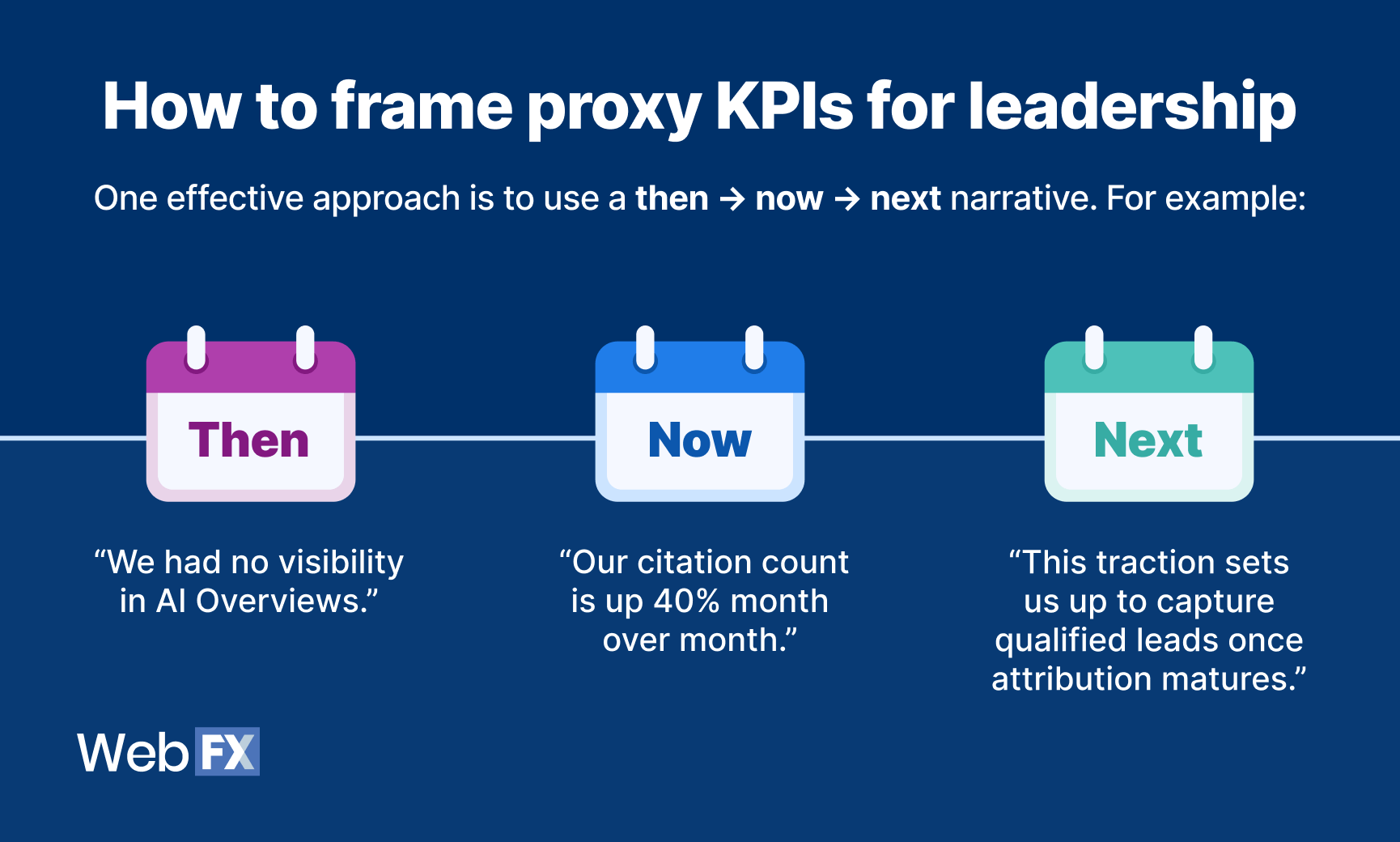
Good reporting explains movement while weak reporting lists activity. WebFX’s “then, now, next” framework is especially useful here because it forces agencies to show baseline, current movement, and what happens next if the program continues.
Ask your agency for:
- Then: The starting baseline
- Now: What changed in citations, mentions, traffic, and engagement
- Next: What the agency will prioritize next month and why
You know this is improving when reports help you explain progress to leadership in plain language instead of forcing you to translate vague updates yourself.
7. Content is being actively improved for extractability and trust
Clear structure, direct answers, strong E-E-A-T signals, internal links, textual clarity, and structured data that matches visible page text all help AI systems understand content better. Google also says there is no special AI markup required beyond those sound fundamentals. For a broader breakdown of best practices across AI-driven search platforms, this AI optimization FAQ covers common questions around content structure, visibility, and optimization.
Ask your agency for examples of:
- Reworked service or pricing pages
- Stronger headings and direct answers
- Internal linking improvements
- Schema validation and content alignment
- Reputation, review, and authority-building work
You know this is improving when your most important pages become easier to read, easier to cite, and more consistent in how they present your brand.
How to measure GEO agency performance
You need a KPI set that goes beyond activity counts. Using proxy KPIs for AI visibility ROI helps connect GEO performance to measurable business outcomes beyond surface-level visibility gains.
Our experts found that the simplest way to evaluate your agency is to group metrics into presence, engagement, and impact, as our AI optimization measurement model recommends.
| Metric category | Metric | What it tells you | How to measure it | What good reporting looks like |
| Presence | Citation rate | How often your content is used as a source in AI-generated answers | Track citations across a fixed prompt set in Google AI Overviews and AI tools | Baseline, monthly trend, page-level examples, and competitor comparisons |
| Mention rate | How often your brand appears in AI-generated answers, even without a citation | Run recurring prompt checks across platforms like ChatGPT, Gemini, Claude, and Perplexity | Brand mention trend by platform, prompt type, and topic cluster | |
| Engagement | AI-influenced traffic | Whether AI visibility is driving visits from relevant users | Use GA4 referral tracking, custom channel groups, and landing page analysis | Sessions, bounce rate, session depth, top landing pages, and traffic quality trends |
| Query and category coverage | Which prompts, topics, or commercial categories surface your brand most often | Track prompts by category and review where your brand appears most consistently | Topic-level trend reporting that shows where visibility is strengthening or staying weak | |
| Impact | Lead quality | Whether AI-driven visibility is attracting better-fit prospects | Review form quality, sales feedback, CRM source data, and opportunity quality | Lead quality notes, sales-team feedback, and close-rate patterns from AI-influenced sessions |
| Assisted conversions | Whether AI visibility is contributing to pipeline and revenue influence | Use source tagging, attribution reports, CRM tracking, and assisted-conversion analysis | Assisted conversion trends, influenced pipeline notes, and leadership-ready summaries |
Presence metrics
Presence metrics answer a basic but important question: Are you visible at all? These metrics show whether your brand is entering AI-generated answers often enough to create a real foundation for long-term growth. Two presence metrics include:
- Citation rate: Citation rate measures how often your pages or content assets appear as cited sources in AI-generated answers. Citations are one of the clearest signs that AI systems are treating your content as trustworthy and useful.
- Mention rate: Mention rate tracks how often your brand is named in AI answers, even when the tool does not directly cite your site. Repeated mentions show that your brand is entering the recommendation and discovery set for relevant queries.
These are your first checkpoints. If they are flat for too long, your agency should be able to explain why and show what it is changing.
For a complete breakdown of what to measure at this stage, the guide to AI SEO KPIs to track covers citation rate and mention rate in detail — including which sub-metrics to watch and how to distinguish meaningful trend movement from isolated wins.
If metrics remain flat, our guide on what to do when your GEO strategy isn’t driving results can help identify what to look at next — covering seven common performance issues that often explain why visibility isn’t gaining traction.
Engagement metrics
Engagement metrics show whether AI visibility is attracting the right attention, not just any attention. This is where you move from “we appeared” to “the right people are finding us.” Engagement metrics include:
- AI-influenced traffic: AI-influenced traffic measures the visits coming from AI tools and AI-generated search experiences. Stronger sessions, lower bounce rates, and better session depth show that your visibility is attracting qualified interest rather than empty clicks.
- Query and category coverage: Query and category coverage show which prompt themes, service areas, or commercial topics surface your brand most often. This helps you see whether your visibility is growing in the places most likely to influence your ideal customer profile.
These metrics matter because they help you separate vanity visibility from useful visibility.
Impact metrics
Impact metrics answer the question leadership will eventually ask: Is this helping the business? These signals usually take longer to mature, but they are critical for showing that GEO work is influencing pipeline quality and commercial outcomes over time. Two impact metrics include:
- Lead quality: Lead quality measures whether AI-driven visibility is bringing in better-fit prospects. Stronger-fit leads give you a clearer signal that visibility is aligning with the right audience instead of just boosting exposure.
- Assisted conversions: Assisted conversions track whether AI visibility contributes to the customer journey before a lead or sale happens, and they matter because GEO often influences discovery and consideration before it shows up as a direct last-click conversion.
These are the metrics that help you connect AI visibility to business performance. These usually lag behind presence metrics, which is normal. So early on, you could ask for directional evidence, but it’s wise not to expect perfect attribution since this is still developing in those early months.
What good GEO reporting looks like each month
A useful monthly report should help you answer one question fast: Is the agency creating momentum, or just documenting motion?
A good report should include:
- Baseline versus current trend
- Priority prompt coverage
- Competitor comparison
- Content and technical work completed
- Wins, misses, and interpretation
- Next actions and why they matter
- Business context you can use with leadership
A weak report usually leans on screenshots without context, generic language, or long task lists with no interpretation. A strong report shows what changed, why it matters, and what the agency is doing next because of what it learned.
The most helpful monthly reports also separate leading indicators from business outcomes. Our experts recommend starting with presence metrics, then layering in engagement and impact as AI visibility grows.
What should happen in the first 30, 60, and 90 days of a GEO strategy?
Strong GEO work needs a review cadence. This helps you avoid judging too early while still holding the agency accountable.
First 30 days
You should expect:
- Baseline AI visibility audit
- Prompt tracking setup
- Competitor benchmark
- Priority page and entity review
- Technical review tied to AI discoverability
- A clear roadmap
If your agency cannot show a documented starting point, it will struggle to prove progress later.
Days 31 to 60
You should expect:
- Implementation underway
- First reporting comparisons
- Early movement on some prompts or platforms
- Clear explanation of what is still too early to judge
- Initial engagement signals if AI traffic is measurable
This stage is about directional movement. It is too soon for sweeping revenue claims, but not too soon for visible execution.
Days 61 to 90
You should expect:
- Clearer trend lines
- Stronger understanding of which pages and prompts respond best
- A refined roadmap based on real performance
- Better evidence of whether the agency’s method is sound
By the end of this window, you should know whether the agency has a real system or just a promising pitch.
These milestones give you a structured way to evaluate progress without judging too early or waiting too long. For what comes after the first 90 days, our GEO results timeline guide maps what to expect from early signals through to compounding authority.
What results should you realistically expect from a GEO agency
Expect progress in layers.
Expect progress in layers. For businesses investing in enterprise AI search optimization, presence usually comes first, followed by engagement improvements and then measurable business impact. Early results often look like:
- More mentions on tracked prompts
- More citations from priority pages
- Better representation in AI answers
- Higher-quality AI-sourced visits
Later results look more like:
- Stronger conversion rate from AI-driven traffic
- Better assisted conversion patterns
- Clearer pipeline influence
- Better lead quality tied to AI discovery
One-off wins are not enough. According to Google, AI Overviews help users with more complex questions and can send users to a wider diversity of sites, so the real goal is sustainable visibility on the queries that matter, not a few isolated appearances.
Red flags in an active GEO agency relationship
Not every flat month is a crisis. Still, some signs point to weak execution fast.
Watch for these post-hire red flags in a GEO agency:
- No baseline or benchmarking
- No defined prompt set
- Reporting that focuses only on activity
- No explanation of what changed and why
- No evidence of shipped content or technical work
- No adjustment when performance stalls
- No connection to traffic, lead quality, or revenue influence
If your GEO agency cannot show a method, show its work, or adapt to what the data says, that is a relationship issue worth addressing.
Scorecard: How to evaluate whether your GEO agency is worth it
Use this table to evaluate your GEO agency during quarterly reviews or renewal discussions.
| Category | What good looks like | Score 1-5 |
| Strategy clarity | The agency can explain its roadmap and priorities clearly | |
| Baseline quality | You have prompt, competitor, and visibility benchmarks | |
| Implementation quality | Completed work is visible and aligned to priorities | |
| Reporting clarity | Monthly reports show movement, interpretation, and next steps | |
| Visibility progress | Mentions, citations, or visibility rate are trending up | |
| Business alignment | Reporting includes traffic quality, leads, or influenced pipeline | |
| Responsiveness and iteration | The agency adapts when results stall or change |
A score in the middle does not always mean the agency is failing. It often means you need tighter expectations, better reporting, or a clearer roadmap. Low scores across several categories usually justify a bigger conversation.
When to push for GEO strategy changes and when to switch agencies
Push for GEO strategy changes first when the execution seems real, but the reporting is weak. In that case, the problem may be communication and measurement, not capability.
Push harder when:
- Work is happening, but the agency is not connecting it to outcomes
- Reporting lacks a baseline, context, or next actions
- The roadmap feels too broad or too reactive
Start considering a switch when:
- There is no measurable progress after a reasonable review window
- The agency cannot explain its method in plain language
- Completed work is minimal or unclear
- Reporting never evolves beyond vague updates
- The team does not adapt when results stall
That keeps the decision practical. You are not looking for perfection. You are looking for a partner that can execute, measure, and improve.
If you’ve reached that decision point and need to build the internal case for a new investment, our guide on outsourcing generative engine optimization covers the audit-first approach and pilot structure that make leadership approval easier to secure before you restart the process.
FAQ on GEO agency effectiveness
How do I know if my GEO agency is working?
A working GEO agency should show growing mentions, citations, or visibility on a fixed prompt set, plus clearer reporting on what changed and what comes next.
What should a GEO agency deliver each month?
A GEO agency should deliver a report that covers:
- Baseline versus current movement
- Tracked prompt coverage
- Competitor comparisons
- Work completed
- Wins and misses
- Next steps tied to business goals
How do you measure GEO agency performance?
You can measure GEO agency performance by tracking presence metrics like mentions and citations. Then add engagement metrics like AI-driven traffic quality, and finally impact metrics, such as assisted conversions, lead quality, and influenced pipeline.
What KPIs should a GEO agency track?
A GEO agency should track KPIs like:
- Citation rate
- Mention rate
- Visibility rate across a fixed prompt set
- Representation quality
- AI-influenced traffic
- Assisted conversions
- Lead quality
How long does it take to see results from GEO?
Early presence signals can appear before the business impact does. A stronger read usually comes after your agency has baseline data, implemented improvements, and enough time to compare trends across multiple reporting cycles.
What results should I expect from an AI SEO agency?
Expect stronger visibility and citation patterns first. Over time, the program should help improve engagement quality, assisted conversions, and revenue influence if the agency is prioritizing the right assets and measuring them well.
When should I switch GEO agencies?
Consider switching GEO agencies when the agency cannot show a baseline, cannot explain its methodology, does not ship meaningful work, or fails to connect AI visibility efforts to business outcomes after a fair review period.
Can a GEO agency show progress before traffic or revenue increases?
Yes. Your GEO agency can show early progress through presence metrics that reveal how visible your brand has become in AI results. Once that has been established, you’ll be able to get more impact metrics, such as leads and conversion rates.
When proving that impact to your leadership, you can explain the progress using the “then, now, next” framework.
Ready to measure GEO agency performance more clearly?
A strong GEO agency proves its value through measurable visibility gains, clearer reporting, and effective execution on the assets most likely to influence AI discovery. If you find that your agency is not implementing effective strategies or measuring performance well, WebFX can help you improve AI visibility, qualified traffic, and revenue with our AI search optimization services.
We combine 30 years of experience with our exclusive AI visibility tracking technology to monitor brand visibility across numerous AI search engines. Explore WebFX’s GEO services to learn more or contact our team for a proposal and detailed explanation of how we can grow your AI visibility.
-
 Thaakirah Abrahams is a Lead Editor at WebFX, where she leverages her 5+ years of experience to craft compelling website content. With a background in Journalism and Media studies and certifications in inbound marketing, she holds a keen eye for detail and a talent for breaking down complex topics for numerous sectors, including the legal and finance industries. When she’s not writing or optimizing content, Thaakirah enjoys the simple pleasures of reading in her garden and spending quality time with her family during game nights. View full profile
 -

WebFX is a full-service digital marketing agency delivering revenue-driving strategies across online advertising, SEO and AI search optimization, and digital marketing. Backed by 1,100+ client reviews, a 4.9-star rating on Clutch, and proprietary revenue-tracking technology, our team helps businesses grow visibility and revenue across platforms, from Google to ChatGPT to LinkedIn. Discover how our expert team and revenue-accelerating tech can drive results for you. Learn more

Try our free Marketing Calculator
Craft a tailored online marketing strategy! Utilize our free Internet marketing calculator for a custom plan based on your location, reach, timeframe, and budget.
Contents
- What a GEO agency should be responsible for
- 7 signs your GEO agency is working
- How to measure GEO agency performance
- What good GEO reporting looks like each month
- What should happen in the first 30, 60, and 90 days of a GEO strategy?
- What results should you realistically expect from a GEO agency
- Red flags in an active GEO agency relationship
- Scorecard: How to evaluate whether your GEO agency is worth it
- When to push for GEO strategy changes and when to switch agencies
- FAQ on GEO agency effectiveness
- Ready to measure GEO agency performance more clearly?
Share this article


See AI Marketing in Action
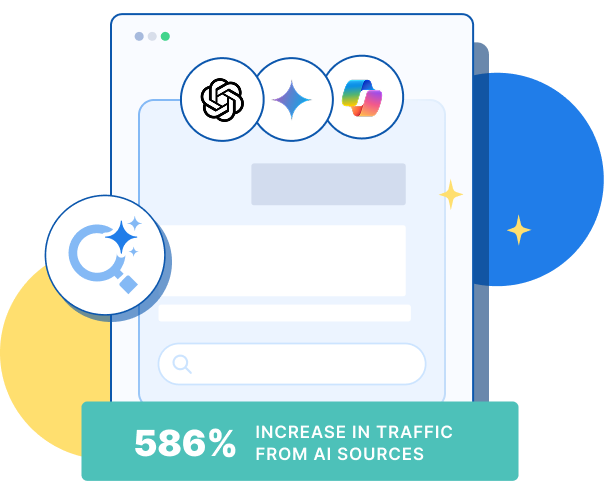
Explore how WebFX helped a regional brand get discovered in AI search experiences — proving what’s possible with today’s AI-driven marketing!
Try our free Marketing Calculator
Craft a tailored online marketing strategy! Utilize our free Internet marketing calculator for a custom plan based on your location, reach, timeframe, and budget.
What to read next