Is AI search hurting your traffic? Most likely yes, if you are seeing organic clicks decline while impressions stay flat or grow, especially on informational queries. AI Overviews, ChatGPT, and Perplexity now answer many questions directly in the results page, which reduces clicks to websites. The seven signs below will help you diagnose AI search traffic loss, confirm it in Google Search Console, and plan a recovery.
AI Workspace for Business Teams
Imagine an AI workspace where you can collaborate with team members, share prompts, and leverage personas for generative AI.
How to tell if AI search is hurting your traffic: 7 signs
How AI search affects website traffic comes down to a simple pattern: your content still appears in search, but users get their answer before they click. Our study of 2.37 million keywords found that AI Overviews now appear in 1 of every 4 US searches, contributing to the broader rise in zero-click behavior. Watch for these seven signs to know if your site is in that group:
1. Organic clicks are falling, but impressions are flat or rising
The clearest signal is a widening gap between impressions and clicks in Google Search Console. Your pages are showing up in search results (impressions are holding), but fewer people click through. That pattern means visibility is intact while AI summaries are capturing the answer.
Open Search Console, pull the last 90 days against the previous 90, and look at queries where impressions grew but clicks dropped. That delta is the signature of AI search traffic loss, and it is how to know if AI search is affecting traffic at the query level.
2. Informational and how-to content took the biggest hit
How AI search affects website traffic starts with informational content. Blog posts that answer “how to,” “what is,” “why does,” or “how long” queries are the easiest for AI to summarize, so they lose clicks faster than commercial or transactional pages. If your traffic loss clusters on guides, FAQs, definitions, and top-of-funnel articles, AI search is a strong possible contributor.
One data point: zero-click searches now make up more than 58% of all searches, and informational queries drive most of that shift.
3. Your pages rank the same, but CTR dropped
Why is your traffic dropping if AI search is a likely factor? Because click-through rate (CTR) falls even when rankings do not. A recently updated Ahrefs analysis found that when AI summaries appear, CTR at position 1 drops by about 58%. If your average position is stable but your CTR has dropped 20% or more over the past six months, AI search is likely taking a share of your clicks.
4. Branded search is steady, non-branded is shrinking
The AI search vs organic traffic decline shows up most clearly in non-branded queries, where AI affects discovery more than brand intent. People searching for your company name still reach you because they know what they want. But users running non-branded queries like “best CRM for small business” or “how to install drip irrigation” increasingly get answers from AI Overviews without needing to click. If your branded traffic looks normal while non-branded traffic slides, AI search is a strong possible reason.
5. Traffic dropped without a Google algorithm update
Google publishes a core update, and your traffic drops. That is a known problem with a known fix. But if your traffic dropped at a time that does not align with any algorithm update, and you cannot find a technical cause, check whether AI Overviews rolled out or expanded coverage for your target keywords during that window. Many site owners have seen traffic losses of 15% to 50% correlated with AI Overview expansion rather than any Google update. If you suspect your site is affected, an AI vulnerability audit can help you pinpoint which pages and query types are most at risk.
6. Featured snippets lost their click volume
Featured snippets used to drive meaningful traffic. Now, AI Overviews often sit above them, absorbing the answer and the click. If pages that used to earn clicks from a featured snippet have gone quiet, that real estate is getting eaten by the AI Overview above it.
7. Top-ranking pages lost disproportionate traffic
The top three positions used to capture the vast majority of clicks. Now, when an AI Overview appears above those positions, a high-ranking page can lose as much as 79% of its potential traffic. If your best-performing pages are the ones dropping fastest, that inversion is a strong indicator that AI search is affecting the page rather than a ranking change.
How to confirm AI search traffic loss
How to diagnose AI search traffic loss takes three checks across Google Search Console, Google Analytics 4, and a manual search engine results page (SERP) review. Follow these steps to confirm the cause before you start a recovery.
Pull your Search Console data. Compare impressions, clicks, and CTR for the last 90 days against the previous 90 or the same period last year. Filter for queries that lost clicks while holding or growing impressions.
Segment queries by intent. Separate informational queries like “how to,” “what is,” and “why” from commercial ones like “best,” “buy,” and “price.” AI search hits informational queries first, so the gap between those two segments is diagnostic.
Check GA4 landing pages. Identify which pages lost the most organic traffic, then cross-reference with Search Console to see whether those pages lost clicks or lost rankings. Clicks down with rankings stable points to AI search. GA4 can also now track AI assistant traffic. Learn more about the GA4 AI assistant traffic channel.
Run the target queries yourself. Type your top-performing query into Google and check if an AI Overview appears above the organic results. If yes, that query is likely losing clicks to AI-generated results.
Cross-check against algorithm update timelines. Use resources like Google’s Search Status Dashboard to verify whether your traffic drop aligns with a known update. If it does not, AI search becomes a stronger possible explanation.
Which content AI search hits hardest
The impact of AI search on SEO traffic falls hardest on informational, top-of-funnel content. These content types lose the most clicks:
Definitions and glossary pages
How-to guides and step-by-step tutorials
Beginner-level explainers
FAQ-style content
Basic comparison pages like “X vs. Y” at a surface level
Which content holds up better
AI search has less impact on bottom-funnel, high-intent, and branded content. These pages tend to hold their traffic:
Service and product pages
Pricing pages
Case studies and client testimonials
Branded search queries
Complex comparison pages that require deep expertise
Content requiring hands-on experience or firsthand data
What to do about AI search traffic loss
What to do about AI search traffic loss depends on your current visibility baseline, but the strategy is consistent: shift your goal from ranking to being cited. If AI summarizes your content and names you as the source, users see your brand even when they don’t click. These six moves rebuild visibility and lead flow in an AI-first search environment.
🎥Video: How to win back traffic from AI
1. Optimize your content for AI citation
Structure pages so AI systems can extract clear answers. Lead each section with a direct one-sentence answer, use question-format H2s that mirror user queries, and add FAQ sections that answer common questions in two to three sentences. AI models cite content they can quote cleanly.
2. Focus on being cited, not just clicked
Appearing in an AI answer as a named source drives brand awareness even without a click. Our analysis of 2.3 billion sessions from January 2024 through December 2025 found that generative AI traffic grew 796% during that period, and visitors who did click from AI platforms converted at roughly 1.2x the rate of organic search.
Commercial and transactional queries still drive clicks because users want to evaluate, buy, or contact. Build out service pages, pricing pages, comparison pages, and product pages. These take less damage from AI summaries because the user intent requires visiting a site.
4. Build your brand so searchers look for you by name
Branded search survives AI disruption. Invest in PR, podcast appearances, guest posting, Reddit and Quora presence, YouTube, and LinkedIn. Every branded search is a click that AI cannot intercept, and every recognizable mention compounds your authority with AI systems that weigh brand signals.
5. Update existing content for AI extraction
Rewrite your top traffic-losing pages with AI in mind. Add clear definitions using the “X is Y” format, break walls of text into short paragraphs and lists, include specific stats and numbers, and add schema markup so AI systems understand your content structure. Updates to existing pages often recover visibility faster than new content.
6. Diversify your traffic sources
Organic search is one channel of many. Email marketing delivers a 36:1 ROI, paid search delivers immediate traffic, and social and referral channels round out the mix. If AI search takes 20% of your organic clicks, a diversified traffic portfolio absorbs the blow without sinking your pipeline.
Is AI search traffic loss permanent?
AI search traffic loss is not permanent for brands that adapt, and the impact of AI search on SEO traffic varies widely by content type. Search has shifted in how visibility works, not in whether businesses can earn it. Sites that optimize for AI citation, build branded demand, and diversify their channels see traffic stabilize and often grow within two to three quarters.
Expert insights from
Sarah B.Lead SEO Consultant at WebFX
“Whether it’s happening in ChatGPT or Google’s AI Overviews, generative search is here to stay. Businesses looking to ride the wave need to start optimizing for these experiences.”
The shift to AI search is one more evolution in a discipline that has reinvented itself many times. Businesses that treat it as a new surface to optimize for, not a death sentence, earn the AI citations that competitors are leaving on the table.
FAQs about AI search and your traffic
Common questions about diagnosing AI search traffic loss and what to do next. For broader questions about optimizing for AI search, check out our AI optimization FAQ.
Yes, AI search is reducing website traffic for many sites, especially those that rely heavily on informational content. AI Overviews now appear in 1 of every 4 US searches, and zero-click searches now account for more than 58% of all searches. Running a clear AI search vs organic traffic decline analysis in Search Console is the fastest way to confirm whether your site is affected.
Check Google Search Console for queries where impressions are flat or rising, but clicks are declining. Run your top-performing queries in Google and note which ones now trigger an AI Overview. Pages that lost clicks but held rankings over the same window are the ones AI Overviews are likely intercepting.
Impressions up with clicks down means your content is still ranking, but users are not clicking through. The most common cause in 2026 is AI Overviews and other AI-generated answers satisfying the query inside the search results page, so users get what they need without visiting your site.
ChatGPT can reduce traffic to informational pages when users ask questions directly in the chat instead of running a Google search. Our research shows ChatGPT accounts for 82.6% of all generative AI referral traffic, so it is both the biggest threat to informational clicks and the biggest opportunity for AI citation visibility.
Yes, most sites can recover visibility lost to AI search by optimizing for citation, strengthening brand demand, and shifting toward bottom-funnel content. Recovery timelines vary, but sites that act within the first two quarters of a traffic drop typically rebuild pipeline within two to three more quarters.
No, AI search does not replace SEO. Traditional search still drives the majority of website traffic. AI search adds a new layer that works alongside SEO, which is why generative engine optimization (GEO) is emerging as a companion practice rather than a replacement.
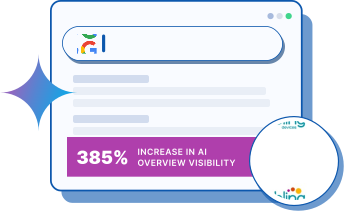
Losing clicks to AI doesn’t mean losing visibility.
Enabling Devices grew AI Overview visibility 385% with a comprehensive search strategy.
Protect your traffic with proven strategies from WebFX
AI search is here to stay, and the brands that adapt will earn the citations and branded demand that AI cannot intercept. With 30+ years of digital expertise, 1,100+ client testimonials, and the OmniSEO® platform for tracking visibility across traditional and AI-driven search, WebFX can help you protect the traffic you have and capture the visibility AI search is redistributing.
Craft a tailored online marketing strategy! Utilize our free Internet marketing calculator for a custom plan based on your location, reach, timeframe, and budget.
Craft a tailored online marketing strategy! Utilize our free Internet marketing calculator for a custom plan based on your location, reach, timeframe, and budget.







 Albert Dandy Velasquez blends SEO strategy with compelling storytelling to help businesses boost their visibility and revenue online. With a B.A. in English and certifications from HubSpot, Semrush, and Google Analytics, he has written and optimized hundreds of articles on organic SEO, content strategy, and user experience. He regularly contributes to the WebFX blog and SEO.com, creating content that helps readers turn marketing goals into measurable results. When he’s off the clock, he’s usually exploring new neighborhoods on two wheels, filming travel content, or chasing golden hour with a coffee in hand. View full profile