


Contents
- What does it mean to boycott AI?
- What does boycotting AI actually involve?
- Can you actually avoid AI in everyday life?
- AI is already here, and adoption is growing fast
- The real concerns, and what to do about them
- A smarter way to respond: Use AI intentionally
- How WebFX approaches AI
- FAQs about boycotting AI
- Boycott AI, or use it wisely?
-
Can you boycott AI completely in 2026?
You can cancel paid AI subscriptions and delete AI apps, but you can’t fully avoid AI, because it already runs quietly inside search engines, email, banking, maps, and the smartphones people use every day. -
What does an AI boycott actually involve?
A realistic AI boycott means canceling paid subscriptions like ChatGPT Plus, deleting standalone apps, disabling built-in AI features, switching to alternative tools, and opting out of data sharing. Even then, you still meet AI woven into everyday technology. -
How fast is AI adoption growing?
WebFX tracking shows ChatGPT referral traffic to the sites we monitor grew by more than 100,000% between May 2024 and May 2026, a sign of how quickly AI is reshaping how people find information. -
What are the real concerns about AI?
Common concerns include the environmental cost of data centers, job displacement in certain roles, data privacy, and limited regulation. Each is worth taking seriously, and each has a practical response beyond boycotting. -
What’s a smarter approach than boycotting AI?
Instead of quitting AI entirely, use it intentionally: choose tools from companies whose practices match your values, stay informed on AI regulation and vote accordingly, adjust your privacy settings, and decide where convenience is worth the trade-off.

Quick answers: Boycotting AI in 2026
- Can you boycott AI? Partly. You can cancel AI subscriptions, delete apps, and stop paying companies you disagree with, but you can’t avoid AI entirely.
- Can you avoid AI completely? Not in 2026. AI is built into search, email, banking, maps, and most everyday apps, so full avoidance would mean giving up most modern technology.
- Why are people boycotting AI? Common concerns include AI’s military and surveillance use, data privacy, environmental impact, use of artists’ work without consent, and job loss.
- What’s the smarter move? Instead of trying to quit AI entirely, use it intentionally: Choose tools you trust, adjust your privacy and data settings, and support companies whose practices match your values.
You can boycott AI to a point. You can cancel ChatGPT, delete AI apps, switch tools, and refuse to give money to companies whose practices you disagree with. What you cannot do in 2026 is avoid AI completely, because it already runs quietly inside the search engines, email, banking, maps, and phone you use every day. The better question isn’t whether you can quit AI, but how to use it on your own terms.
I care about getting this right for a reason. I live in Clearfield, a small town of about 5,000 people in central Pennsylvania, and a few months ago, a rumor that a data center was coming lit up our local Facebook groups. It turned out to be false, but people were angry, and a wave of posts followed from folks swearing off AI entirely.
I get the instinct. I’m an outdoorsman who hunts and fishes, and I don’t want a data center carved into my hunting land or fouling the streams I fish any more than my neighbors do. But a lot of what I read in those posts wasn’t accurate, and bad information leads to bad decisions just as much as bad policy does.
Let’s get down to brass tacks: What an AI boycott actually involves, why full avoidance isn’t realistic, and how to use AI more thoughtfully instead of swearing it off:
- What does it mean to boycott AI?
- What does boycotting AI actually involve?
- Can you actually avoid AI in everyday life?
- AI is already here, and adoption is growing fast
- The real concerns, and what to do about them
- A smarter way to respond: Use AI intentionally
- How WebFX approaches AI
- FAQs about boycotting AI
Don’t miss our Revenue Weekly emails!
Join 200K smart marketers for the hottest marketing news and insights in your inbox.
Inline Subscription Form
“*” indicates required fields
What does it mean to boycott AI?
Boycotting AI means deliberately refusing to use or pay for AI products or the companies behind them, as a form of protest. In practice, that ranges from canceling a ChatGPT subscription to avoiding an entire company’s ecosystem because you object to how it builds or deploys AI.
The broader case for boycotting AI usually comes down to concerns that reach past any single company: The environmental cost of data centers, the use of artists’ and writers’ work to train models without consent, data privacy, and the effect on jobs. I’ll get to which of those hold up and which get overstated later on.
Canceling ChatGPT is a real, valid choice, and if OpenAI’s decisions bother you, quitting sends a clear signal. But quitting one chatbot is very different from using AI deliberately, and that’s the more useful thing to get right.
What does boycotting AI actually involve?
A real AI boycott starts with the tools you choose and pay for, then runs into the AI you never signed up for. The first part is straightforward. The second is where “I’m done with AI” stops being realistic.
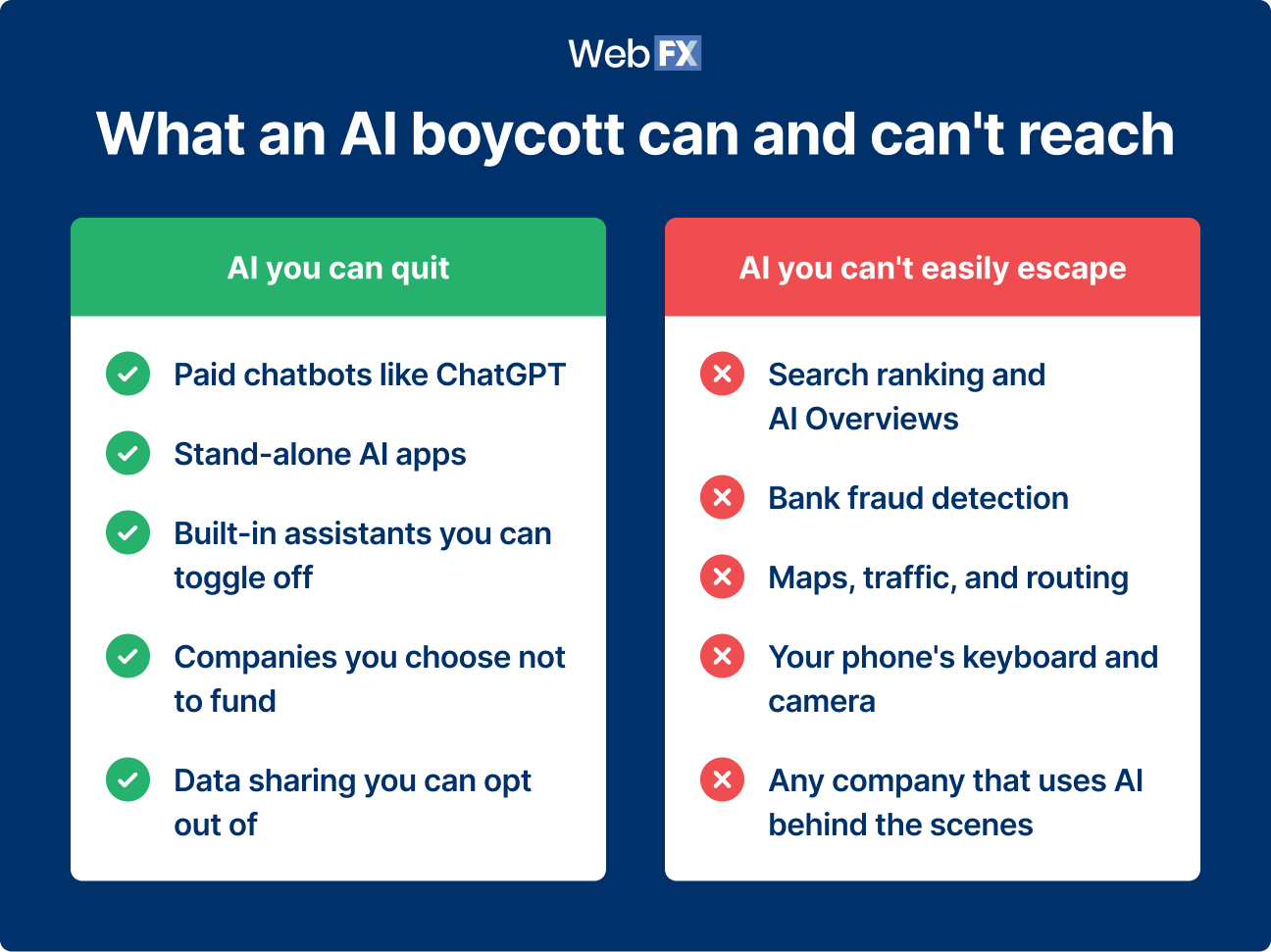
Here’s what you can actually control:
- Cancel paid AI subscriptions: Drop ChatGPT Plus, Gemini Advanced, Claude Pro, or any stand-alone AI tool you pay for. This is the most direct way to stop funding a company you disagree with.
- Delete stand-alone AI apps: Remove the chatbots and AI image or writing tools you’ve installed.
- Disable built-in AI features: Turn off assistants like Apple Intelligence, Microsoft Copilot, or Google’s AI features in your browser and operating system where the settings allow it.
- Switch to alternatives: Move to tools from companies whose policies line up better with your values, or to services that lean less on AI.
- Opt out of data sharing: Adjust privacy settings so your activity isn’t used to train models where platforms offer that option.
Do all of that and you’ve meaningfully cut your direct AI use. You’ve stopped paying the companies you object to, and you’ve sent a signal with your wallet, which is the part of a boycott that actually carries weight.
What you haven’t done is escape AI entirely, because it also runs your search engine, your bank’s fraud detection, your phone’s keyboard, and the map that gets you to work. That’s worth understanding, because it changes the goal from avoiding AI to using it on your own terms.
Can you actually avoid AI in everyday life?
You can’t fully avoid AI in everyday life without giving up most modern technology, but you can be deliberate about how you use it. Most people picture AI as ChatGPT, Gemini, or Claude, the tools you log into and ask questions. Those are easy enough to quit. The harder part is that AI is baked into the fabric of everyday technology in ways you never see.
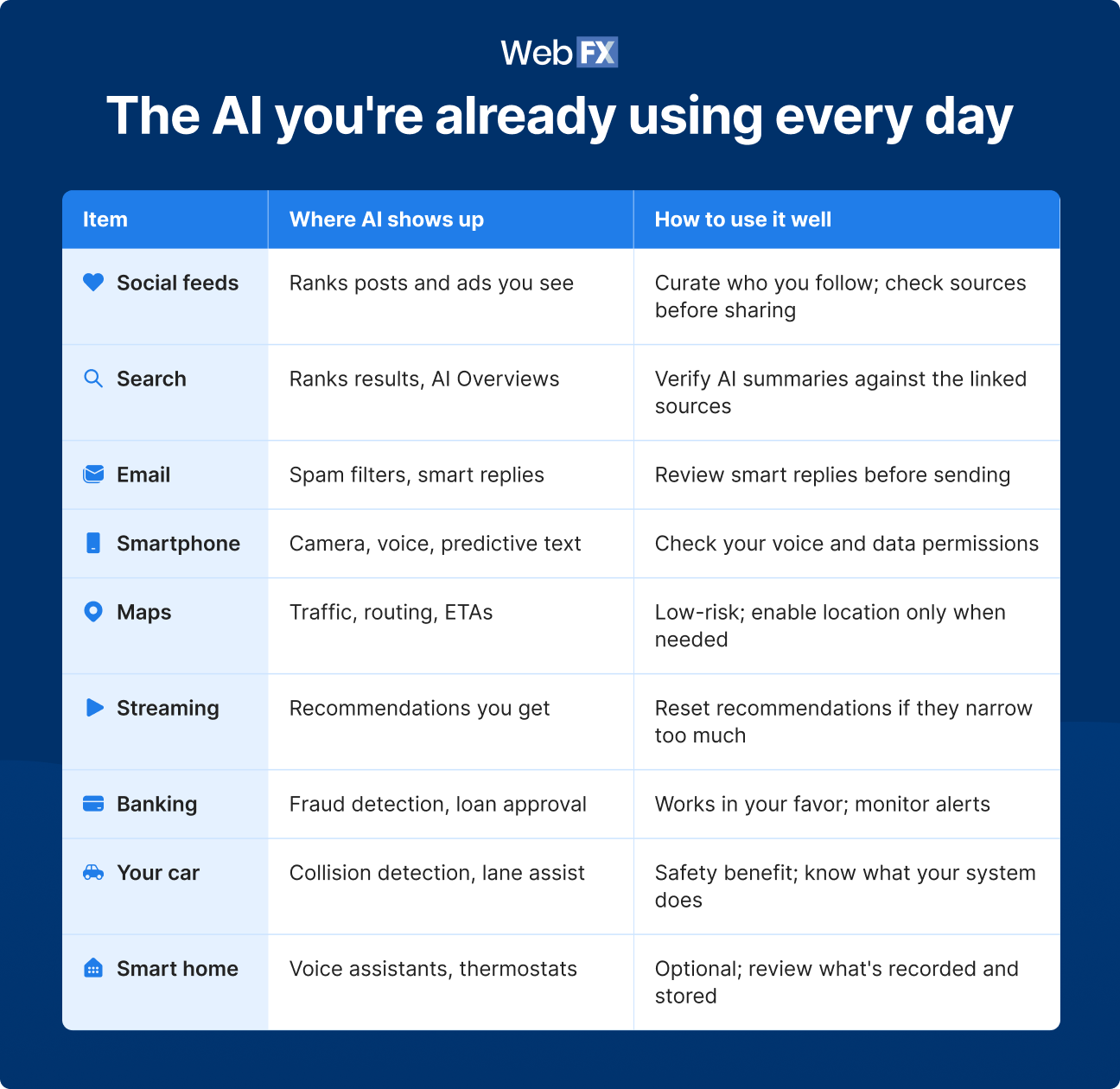
Table view
The AI you’re already using every day
| Item | Where AI shows up | How to use it well |
| Social feeds | Ranks posts and ads you see | Curate who you follow; check sources before sharing |
| Search | Ranks results, AI Overviews | Verify AI summaries against the linked sources |
| Spam filters, smart replies | Review smart replies before sending | |
| Smartphone | Camera, voice, predictive text | Check your voice and data permissions |
| Maps | Traffic, routing, ETAs | Low-risk; enable location only when needed |
| Streaming | Recommendations you get | Reset recommendations if they narrow too much |
| Banking | Fraud detection, loan approval | Works in your favor; monitor alerts |
| Your car | Collision detection, lane assist | Safety benefit; know what your system does |
| Smart home | Voice assistants, thermostats | Optional; review what’s recorded and stored |
Some of these you’d never want to turn off. AI-powered fraud detection protects your bank account, and collision detection makes your car safer. Others are worth a closer look, like how your social feed is ranked, what your phone records, or how much you trust an AI Overview before acting on it.
That’s the real takeaway because you’re not choosing between using AI and avoiding it. You’re choosing how deliberately you engage with the AI already woven into your day. Full avoidance would mean deleting your social media, ditching your smartphone, dropping online banking, and buying a car from before 2015, and even then you’d meet AI every time you dealt with a company that uses it.
Short of moving off the grid, a full AI boycott isn’t realistic in 2026. The more useful question is which tools you trust, which settings you adjust, and where the convenience is worth it.
AI is already here, and adoption is growing fast
AI adoption is accelerating quickly, and WebFX referral data shows the shift plainly. We track website visits across more than 1,000 client sites, most of them established mid-to-large businesses. That gives us a clear view of how quickly people are shifting to AI tools.
Our tracking shows ChatGPT referral traffic to those sites grew by more than 100,000% between May 2024 and May 2026. That’s the kind of growth curve you rarely see outside the earliest days of a breakout technology, and it happened in just two years.
And that’s only ChatGPT. It doesn’t count Perplexity, Gemini, Claude, Meta AI, or Google’s AI Mode, all of which send people to websites, too. Add them in and the shift is even sharper.
The reason it’s happening so fast is simply because AI removes friction that traditional search never could. Google a question and you get ads, an AI summary, ten links, cookie banners, and pages written to rank rather than to help. Ask an AI and you get a direct answer at whatever depth you want. It isn’t always right, but it answers the exact question you asked, and people are moving toward that experience quickly.
This isn’t a trend that reverses, so instead of asking whether you can avoid AI, the more useful question is how to engage with it deliberately, starting with the concerns driving people to boycott in the first place.
The real concerns, and what to do about them
Let me be clear: I’m not here to tell you AI is perfect or that there’s nothing to worry about. There are legitimate concerns, and they require policy, regulation, and accountability rather than another Facebook post. So if these are the concerns driving people to boycott, the real question is what you can actually do about each one.
What about AI’s environmental impact?
AI does require significant computing infrastructure, which means increased demand for energy, water, and data center capacity. Those environmental costs are real, but they’re also highly dependent on how and where that infrastructure is built.
For example, data centers use water for cooling, but newer approaches are reducing freshwater demand. Closed-loop cooling systems can significantly reduce water use, while companies like Microsoft are developing data center designs that eliminate water evaporation for cooling.
The same applies to energy. More efficient chips, cooling systems, data center designs, and cleaner energy sources can all change the environmental footprint of AI over time.
The takeaway: AI has an environmental cost, like other large-scale digital infrastructure. The more useful question is how that impact can be measured, managed, and reduced as the technology scales.
Will AI take everyone’s jobs?
If you’re worried about work, the practical response is to track how your own field is changing and build skills around AI rather than against it. AI will reshape more roles than it eliminates outright, though the disruption is real enough to take seriously.
Certain roles will shrink, which deserves thoughtful regulation and real investment in workforce development. As with most shifts in tech, jobs tend to evolve with the technology. AI won’t replace humans, but it could change the positions available to them in some industries.
Is AI a privacy problem?
If privacy is your concern, the responsible move is to be deliberate about which tools you use and what you share, since there’s real variance between platforms. AI does raise genuine privacy questions.
I often hear people say their phone is “listening” because they mention something and then see an ad for it. The truth is that ads are powered by millions of signals, and AI processes that intent data at scale to serve relevant ads. That pattern can often be explained by behavioral data and advertising signals without assuming the phone recorded the conversation.
Is AI regulated enough?
If governance is what worries you, the highest-impact action is to research where your local, state, and federal candidates stand on AI policy and vote accordingly. No area needs attention more than this one.
AI policy in the U.S. is underdeveloped relative to how fast the technology is moving. That’s changing slowly, but it needs to move faster. It’s going to be a major issue in elections over the next several years, so pay attention to it.
Now here’s the flip side, the stuff that rarely makes it into the angry Facebook posts.
AI is already making our lives better in ways that don’t get enough credit. It’s accelerating drug discovery and medical diagnostics, making vehicles safer through collision detection and driver assistance, and optimizing power grids and flight routes to cut waste. It’s putting world-class knowledge within reach of people regardless of where they live or what they can afford. Even the smartest people can only hold so much in their heads, and AI can pull from an almost unlimited pool of data to surface answers faster.
And again, we are in the very early stages of this. The tools people are reacting to today are a rough draft. They’ll get dramatically more efficient, more accurate, and more useful over the coming decade. Just as the early internet was slow and clunky before it became something nobody could imagine living without, AI is on a similar path, though we’ll need better solutions than massive data centers spread across the world to scale it.
A smarter way to respond: Use AI intentionally
A more useful response than boycotting is to use AI responsibly and intentionally. A full boycott isn’t realistic, but that doesn’t leave you powerless. You have real choices about which tools you support and how you use them.
Instead of asking “Can I avoid AI?”, ask better questions:
- Which tools do you actually trust with your data? Choose companies whose ethics and privacy practices line up with yours.
- Are you informed about how AI is being regulated? Factor candidates’ AI positions into how you vote.
- What trade-offs are you willing to make? Decide where you’ll reduce use and where the convenience is worth it.
That’s a more honest starting point than swearing off AI entirely. You can choose wisely, push for better regulation, and hold the companies building this technology accountable for doing it responsibly. That’s a far more useful conversation than a boycott built on bad information.
How WebFX approaches AI
At WebFX, we use AI to strengthen our team’s work, not to replace the people doing it. We call the approach AI-enabled, not AI-first. AI helps with research, analysis, and workflows, while human experts stay accountable for the strategy, quality, and results our clients actually care about.
We’re also aware that being a technology company comes with environmental responsibility. That’s why we’ve made significant commitments to offset our footprint:
- We’re a carbon-negative company, meaning we offset more than we emit.
- Through our GreenFX program and partnership with Stand for Trees, we help protect 100 acres of biodiverse forest in Guatemala, offsetting our carbon footprint by 120%.
- We’ve planted more than 2,500 trees through the Chesapeake Bay Foundation’s Keystone 10 Million Trees Project.
- We’ve partnered with The Ocean Cleanup to remove the equivalent of more than 275 football fields’ worth of plastic from the oceans every year.
- The solar panels at our Harrisburg headquarters have produced over 124,000 kWh of energy, preventing roughly 10,440 pounds of CO2 emissions.
- Our team has saved 373 gallons of gas and kept 7,313 pounds of CO2 out of the atmosphere through our Green Commute Sustainability Benefits Program.
Read more about WebFX’s sustainability initiatives. Each month, these numbers continue to grow.
FAQs about boycotting AI
What is QuitGPT?
QuitGPT is a 2026 grassroots campaign urging people to cancel ChatGPT and stop paying OpenAI. It gained traction amid broader concerns about how AI companies handle data and operate, and it points users toward competing tools instead.
Why boycott ChatGPT specifically?
People single out ChatGPT because it is one of the most visible AI products, which makes it a clear, recognizable target. Objections have centered on how OpenAI handles data, partnerships, and the direction of its business.
Does boycotting AI actually work?
A targeted boycott can work in limited ways by cutting a company’s subscription revenue and creating public pressure that pushes it to respond. A blanket boycott of all AI has little effect, because AI is embedded in services with no real opt-out. Boycotts land hardest when they have a specific target and a clear demand.
Which companies are people boycotting over AI?
The list shifts as new campaigns start, but OpenAI has been the main target in 2026. Others surface around specific issues such as training on artists’ work, data center water use, or labor practices. Pick your target based on the specific practice you object to rather than treating every AI company as identical.
Can you live without AI completely?
You can live without generative AI chatbots and stand-alone AI apps fairly easily. Living without any AI at all is another matter, since it would mean giving up search engines, smartphones, online banking, maps, and most modern digital services.
Meet WebFX
A world-class digital marketing agency with thousands of reviews applauding our transparency.
One of our experts will be in touch within 24 hours!

Boycott AI, or use it wisely?
AI isn’t going anywhere, and you can’t opt out of it just by deleting one app. It’s woven into the tools billions of people use every day, and it will keep spreading as it gets faster and more capable. The people posting “I’m boycotting AI” are, without realizing it, relying on dozens of AI systems just to publish the post.
That’s not a reason for cynicism. It’s a reason to be realistic. Decide which practices actually concern you, cut the tools you can, protect your data, support companies that meet your standards, and push for the policies that address the risks you care about.
Using AI responsibly starts with one step this week: Pick the concern that matters most to you, then take one concrete action, such as changing a privacy setting, switching to a tool you trust more, or checking where your representatives stand on AI policy.
-
 Nolan is Head of Innovation for WebFX and serves as an SME for our DataTech Solutions team. Nolan’s favorite part of digital marketing is being able to have a direct impact on growing our clients’ businesses. In his spare time, he enjoys watching NCAA wrestling, hanging out with his dogs, riding motorcycles, and woodworking. View full profile
 -

WebFX is a full-service digital marketing agency delivering revenue-driving strategies across online advertising, SEO and AI search optimization, and digital marketing. Backed by 1,100+ client reviews, a 4.9-star rating on Clutch, and proprietary revenue-tracking technology, our team helps businesses grow visibility and revenue across platforms, from Google to ChatGPT to LinkedIn. Discover how our expert team and revenue-accelerating tech can drive results for you. Learn more

Try our free Marketing Calculator
Craft a tailored online marketing strategy! Utilize our free Internet marketing calculator for a custom plan based on your location, reach, timeframe, and budget.

Contents
- What does it mean to boycott AI?
- What does boycotting AI actually involve?
- Can you actually avoid AI in everyday life?
- AI is already here, and adoption is growing fast
- The real concerns, and what to do about them
- A smarter way to respond: Use AI intentionally
- How WebFX approaches AI
- FAQs about boycotting AI
- Boycott AI, or use it wisely?
Share this article


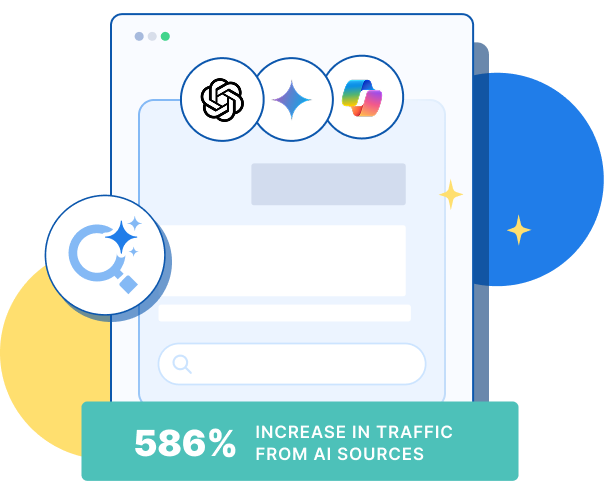
See AI Marketing in Action
Explore how WebFX helped a regional brand get discovered in AI search experiences — proving what’s possible with today’s AI-driven marketing!
Try our free Marketing Calculator
Craft a tailored online marketing strategy! Utilize our free Internet marketing calculator for a custom plan based on your location, reach, timeframe, and budget.