


Contents
- What Google's new AI research actually found
- Why AI models “forget” things they technically know
- What makes a fact hard to retrieve: the reversal curse and fact rarity
- Why “just make the AI think longer” isn't a fix
- What this means for your AI visibility
- 3 ways to make your brand's facts easier for AI to recall
- 1. State your key marketing messages more than one way
- 2. Use AI visibility tools to audit your presence in AI-powered searches
- 3. Turn your audit findings into a content action plan
- FAQs
- How to make LLMs recall your key marketing messages
- Future-Proof Your SEO Strategy with OmniSEO®
- What is the difference between AI encoding and AI recall?
- Why does ChatGPT or Gemini sometimes get facts about my business wrong?
- Can I make AI models remember my business better?

TL;DR: How Large Language Models Recall Facts
- Google’s research found that advanced AI models store 95–98% of the facts they’re trained on, but fail to directly recall 26–34% of them, even with thinking mode enabled, which still misses 11–12%.
- Retrieval fails when a question flips a fact backward from how it was learned (the reversal curse) or when the fact itself is rare.
- Marketers can’t control how LLMs evolve or how their customers phrase their questions, but they can control how to make their content easy for AI to recall.
- Three ways to improve your AI recall: State your key marketing messages in multiple directions, audit your AI visibility with a tool like OmniSEO®, and use those audit findings to decide what to reinforce and where.
Google’s latest research reveals that advanced AI models like Gemini 3 and GPT-5 can store up to 98% of the facts they’re trained on, but fail to directly recall 26–34% of them. In other words, AI models can’t always retrieve what they already know.
This study provides marketers with insights into LLMs’ capabilities and limitations, and how they can make their content easier for AI platforms to retrieve. They can do so by stating key marketing messages in multiple ways, auditing their AI visibility, and using the audit findings to turn their USPs into popular facts.
Learn more about the details of Google’s study on how LLMs recall facts and what this means for marketers with these topics:
- What Google’s new AI research found
- Why AI models “forget” things they technically know
- What this means for your AI visibility
- 3 ways to make your brand’s facts easier for LLMs to recall
- FAQs
Future-Proof Your SEO Strategy with OmniSEO®
Goodbye search engine optimization, hello search everywhere optimization.

What Google’s new AI research actually found
Google Research recently published a study called “Empty Shelves or Lost Keys? Recall Is the Bottleneck for Parametric Factuality,” which introduced a method called knowledge profiling. Researchers built the framework to test whether AI models fail to answer questions because they never learned the answer (referred to by the researchers as empty shelves), or because they learned it but can’t retrieve it on demand (lost keys), tested across 13 models using a 2,150-fact benchmark.
The researchers found that many AI factual errors stem from “lost keys”: AI models can store most of the information they’re trained on (95-98% of the facts), but can reliably recall only 26-34% of it. Even with their thinking mode turned on, these models still fail to recall 11-12% of facts.
The gap between storing and recalling info held up consistently across the advanced AI models tested. In the Gemma 3 family, the larger AI models could better store facts, but couldn’t recall them any better than their smaller counterparts, as the majority of the errors were still due to retrieval.
This study’s results shed light on how LLMs store and retrieve facts about your business: AI models generally have the facts about your business somewhere in their memory, but they can’t reliably retrieve those facts when a user asks about them.
Why AI models “forget” things they technically know
Whether an AI model can recall a fact often depends on how it learned that fact in the first place. According to Google’s study, LLMs “forget” facts when they are:
- Asked about facts backward from how they learned them
- Asked about rare or less common facts
Even giving the model extra time to “think” only helps so much with either problem.
What makes a fact hard to retrieve: the reversal curse and fact rarity
AI models “forget” for a couple of reasons. The first reason is called the reversal curse, and the second one is the rarity of the fact.
In the reversal curse, AI models can correctly store and recall the statement “A is B,” but struggle to answer the question, “What is B?” This sounds like LLMs only know facts one way, but researchers further tested their capabilities.
When faced with multiple-choice questions, LLMs recognized the right answer among the wrong ones just fine in both directions. In other words, the model knows the fact. It just can’t recall it when the question is framed backward.
The second reason is fact rarity. Lesser-known facts get stored at almost the same rate as popular ones, but rare facts are less likely to be recalled successfully.
Why “just make the AI think longer” isn’t a fix
Enabling an AI model’s thinking mode helps it recall facts more effectively. It recovers 40–65% of facts that the LLM otherwise couldn’t recall directly, but even with thinking turned on, these models still fail to recall 11–12% of facts.
So what does ‘thinking’ actually do? Rather than helping the model reason its way to generate a brand-new answer, it helps the model dig up a fact it already has stored.
What this means for your AI visibility
Generative AI search traffic grew 796% in two years, which is why the way LLMs store and retrieve facts about your business matters right now. Thanks to this study, we have a better understanding of how LLMs store and retrieve information, and where and why they fail, which is in recalling facts.
While you can’t control how LLMs evolve and how your customers ask AI tools about your brand, you have influence over your content and marketing messages. You can make your USPs easier for AI to retrieve. You can turn your marketing messages into “popular” facts by optimizing your website and having trustworthy third-party sites mention and confirm them.
That’s good news for your AI visibility strategy. If a competitor keeps getting mentioned in AI-powered searches instead of you, this research points to a clear fix: Make the facts you already have easier for AI to recall.
3 ways to make your brand’s facts easier for AI to recall
For LLMs to retrieve accurate information about your brand, you don’t necessarily have to create more content for them to “learn” your USPs. Instead, you can use these strategies to help AI easily recall your key marketing messages:
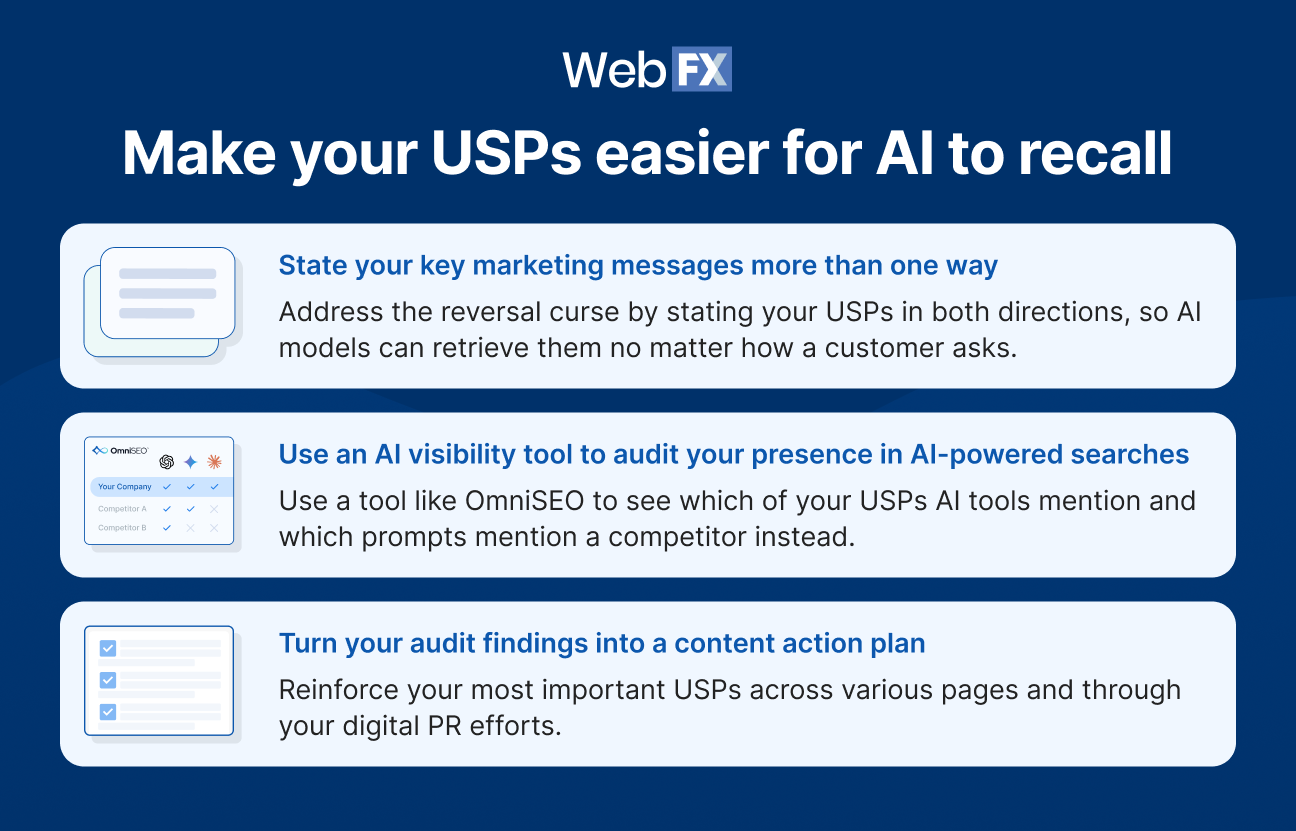
1. State your key marketing messages more than one way
AI models recall a fact more easily when a question matches the direction in which they originally learned it. Flip the question around, and they’re a lot more likely not to recall it.
To address the reversal curse, construct your key marketing messages in both directions. Think of it as delivering the same core message, but phrased in various ways so AI models have a better shot at recalling it, no matter which direction your prospect asks from.
For example, you can state “Brand A offers Service B” on your service page. In your FAQ page, you have the reverse version, “Who offers Service B?”
Let’s say you’re a heavy equipment rental company. Your service page might say, “Company A offers same-day mini excavator rental in Region B.” The reverse version is what a customer would likely ask an AI tool: “Who offers same-day mini excavator rental in Region B?”
Include both in your content, or even in PR pitches and social media posts. One version can reside on your service page, and the other can be in your site’s FAQ section and seeded to the press.
By doing so, you’re giving LLMs multiple paths to the same fact — Company A offers same-day mini excavator rental in Region B — and making it easier for AI models to recall it.
2. Use AI visibility tools to audit your presence in AI-powered searches
An audit tells you two things. It shows you whether AI tools mention or cite your brand in queries related to your business, and whether your optimization efforts are paying off.
Here’s how to run an audit:
- Identify the keywords and queries important to your business. Think about what a prospect would actually type into an AI tool when looking for what you offer. If you’re a heavy equipment rental company in Harrisburg, PA, “mini excavator rental in Harrisburg” and “heavy equipment for rent in Harrisburg” may be important phrases.
- Check whether you’re getting mentioned for those queries with an AI visibility tool. Platforms like OmniSEO® can track your brand across ChatGPT, Perplexity, AI Overviews, and other major AI-powered searches. OmniSEO® also shows you exactly which queries cite your business, which ones mention a competitor instead, and how your brand’s sentiment compares across platforms.
- Optimize for the queries important to your business. Depending on how you fare on the queries, you may need to create new pages or update existing ones to address the reversal curse. OmniSEO®’s Prompt Tracking Feature also identifies additional prompt opportunities to improve your visibility.
- Monitor results using OmniSEO® and document your best practices. Run audits again after making changes to see whether your visibility improved. Document your results and best practices so that you can scale your efforts.
3. Turn your audit findings into a content action plan
Your audit gives you your baseline data. This step is where you turn that data into actionable next steps: Identify which marketing messages are most important for your business, then decide how to make those messages easy for LLMs to recall.
Start with your own list of USPs and marketing messages
Before you even look at the audit, write down your business’s most important marketing messages and USPs. What genuinely sets you apart from competitors?
This list should come from you, so you’re starting from what actually matters to your business.
Cross-reference that list against your audit
Which of those USPs or key facts are AI tools consistently failing to mention? That overlap is your priority list. If something you consider a real differentiator isn’t coming up in AI answers, that’s exactly where your multi-directional phrasing should go first.
Using our earlier example of the heavy equipment rental company in Harrisburg, PA, let’s say that same-day mini excavator rental is an important marketing message. If your audit reveals that your business isn’t getting mentioned for these queries (and your competitors are), optimize for that key USP.
Your AI visibility tool may also show you prompts where your competitors are showing up and where you must also be present. Consider optimizing for those prompts, too.
Watch for a new differentiator you hadn’t considered
Sometimes this cross-reference works in reverse. The audit might show that AI tools are already picking up on a USP you never thought to optimize for. You might also discover prompts that your real customers use to find your competitor or your services.
If that happens, consider adding that USP or marketing message to your list of prompts to optimize for. After all, your customers are already using these terms.
Decide where each USP must live
A single mention of your key message on your homepage isn’t enough. Place your USP across the specific pages where it applies:
- Product or service pages
- Bottom-of-funnel pages
- Case studies
- Blog posts related to the topic
By having these USPs available on different pages, each phrased slightly differently, you’re turning that USP into a “common” fact, one that’s easier for LLMs to recall.
Bonus tip: Include your key marketing messages in your PR pitches. Doing so increases the likelihood that other trustworthy websites will mention them, thereby making your marketing message a widely known fact that LLMs can retrieve easily.
FAQs
What is the difference between AI encoding and AI recall?
“Encoding” refers to whether an AI model stored a fact during training, while “recall” refers to whether the model can successfully retrieve and state that fact when asked. Google’s research found that for the advanced AI models it tested, encoding is close to saturation (95–98%), but recall lags well behind, with models failing to directly recall 26–34% of stored facts.
Why does ChatGPT or Gemini sometimes get facts about my business wrong?
AI models can generate incorrect answers for various reasons: They may never have “encoded” your business information, or may have encoded outdated info from another source. It’s also possible that they can’t retrieve the information when asked.
According to Google’s latest research, the more likely explanation is a retrieval failure, as most AI models can only recall 26-34% of facts.
Can I make AI models remember my business better?
You can’t directly control which facts AI models store or how they reason. However, you can control your marketing messages and how to make them easier for AI models to retrieve by:
- Stating USPs in multiple ways
- Auditing their AI visibility
- Using the audit findings to make their USPs popular facts
- Earning mentions of your key marketing messages on trustworthy third-party websites
How do I know if AI tools are giving accurate information about my brand?
Run a brand visibility audit using a tool like OmniSEO®. OmniSEO® shows you exactly which of your marketing messages are being recalled correctly across AI platforms, which are being missed, and which are being attributed to your competitors instead.
Learn how we increased visibility in Google AI Overviews by 136% and leads from AI platforms by 500% for a heavy equipment client.

How to make LLMs recall your key marketing messages
Googe’s research shows that AI models’ factual errors are mostly retrieval failures. While you can’t control how LLMs store or recall information, and how your customers prompt AI tools, you can control your own content and how to distribute it. You also have influence over how to make your USPs easy for AI to retrieve.
You can use OmniSEO®, an AI visibility tool, to audit your brand’s presence in AI-powered searches. Based on your audit’s findings, you can strategize how to make your content easier for LLMs to recall and improve your visibility in AI searches.
However, if you prefer working with a team of experts to improve your AI visibility, you can partner with WebFX. Our team has helped our clients generate 12,335 leads from AI sources.
Let’s work together. Call us at 888-601-5359 or contact us online to speak with a strategist about our AI SEO services!
-
 Maria is a Lead Content Specialist at WebFX. With nearly two decades of experience in B2B and B2C publishing, marketing, and PR, she has authored hundreds of articles on digital marketing, AI, and SEO to help SMB marketers make informed strategic decisions. Maria has a degree in B.S. Development Communication major in Science Communication, and certifications in inbound marketing, content marketing, Google Analytics, and PR. When she’s not writing, you’ll find her playing with her dogs, running, swimming, or trying to love burpee broad jumps. View full profile
 -

WebFX is a full-service digital marketing agency delivering revenue-driving strategies across online advertising, SEO and AI search optimization, and digital marketing. Backed by 1,100+ client reviews, a 4.9-star rating on Clutch, and proprietary revenue-tracking technology, our team helps businesses grow visibility and revenue across platforms, from Google to ChatGPT to LinkedIn. Discover how our expert team and revenue-accelerating tech can drive results for you. Learn more

Try our free Marketing Calculator
Craft a tailored online marketing strategy! Utilize our free Internet marketing calculator for a custom plan based on your location, reach, timeframe, and budget.
Contents
- What Google's new AI research actually found
- Why AI models “forget” things they technically know
- What makes a fact hard to retrieve: the reversal curse and fact rarity
- Why “just make the AI think longer” isn't a fix
- What this means for your AI visibility
- 3 ways to make your brand's facts easier for AI to recall
- 1. State your key marketing messages more than one way
- 2. Use AI visibility tools to audit your presence in AI-powered searches
- 3. Turn your audit findings into a content action plan
- FAQs
- How to make LLMs recall your key marketing messages
- Future-Proof Your SEO Strategy with OmniSEO®
- What is the difference between AI encoding and AI recall?
- Why does ChatGPT or Gemini sometimes get facts about my business wrong?
- Can I make AI models remember my business better?
Share this article


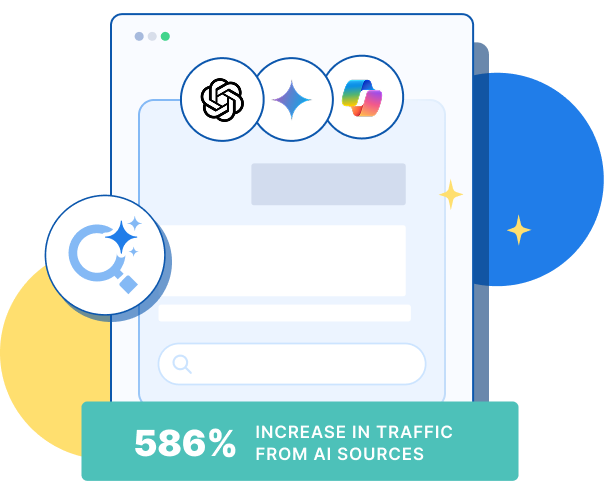
See AI Marketing in Action
Explore how WebFX helped a regional brand get discovered in AI search experiences — proving what’s possible with today’s AI-driven marketing!
Try our free Marketing Calculator
Craft a tailored online marketing strategy! Utilize our free Internet marketing calculator for a custom plan based on your location, reach, timeframe, and budget.