


Contents
- What are GEO KPIs?
- The core AI SEO KPIs to track
- 1. AI citation rate
- 2. AI brand mention rate
- 3. AI visibility rate
- 4. Query coverage
- 5. Content inclusion rate
- 6. AI-driven traffic
- 7. Conversion rate from AI traffic
- 8. Engagement metrics from AI users
- 9. Assisted conversions or pipeline influence
- How to measure visibility in AI search
- 1. Track the important topics and queries relevant to your business
- 2. Measure visibility across multiple AI platforms
- 3. Monitor citations, mentions, and answer presence
- 4. Compare your visibility against competitors
- 5. Review changes over time
- Which GEO KPIs matter most?
- Tools for tracking AI SEO KPIs
- Common mistakes when tracking GEO KPIs
- FAQs about GEO KPIs
- Use GEO KPI data to guide better reporting and next steps

9 AI SEO KPIs to track
GEO and AI SEO KPIs measure how visible and effective your brand is across AI-driven search platforms like ChatGPT, Google AI Overviews, Gemini, and Perplexity.
Instead of tracking rankings alone, businesses now need to measure AI citations, brand mentions, referral traffic, conversions, and revenue generated from AI search experiences.
In this guide, you’ll learn the most important AI SEO KPIs to track and how to measure GEO performance effectively.
- What are GEO KPIs?
- The 9 core AI SEO KPIs to track
- How to measure visibility in AI search
- Which GEO KPIs matter most?
- Tools for tracking AI SEO KPIs
- Common mistakes when tracking GEO KPIs
- FAQs about GEO KPIs
What are GEO KPIs?
Generative engine optimization (GEO) KPIs are the measurable indicators you use to track performance in AI search experiences like Google’s AI Overviews, ChatGPT, and Perplexity.
GEO or AI SEO KPIs show whether your brand or content appears in AI-generated answers and whether that visibility drives business outcomes like qualified leads, sales, and revenue. These KPIs can help you measure:
- Visibility in AI-generated responses
- Citations in AI answers
- Brand mentions in AI platforms
- Traffic from AI platforms
- Conversions and downstream impact
Traditional SEO KPIs still matter. You still want to track rankings, organic traffic, and conversions from search.
GEO KPIs build on SEO KPIs and help you evaluate how AI platforms surface and reference your brand in generated answers. That added layer matters because buyers can encounter your business before they ever click through to your site.
The core AI SEO KPIs to track
These nine KPIs show how your brand appears in AI search, how often AI platforms cite or mention your content, and whether that visibility contributes to business results. Unlike traditional SEO KPIs, which focus on rankings, clicks, and organic traffic, these GEO KPIs help you measure visibility inside AI-generated answers.
1. AI citation rate
Why this GEO KPI matters: It shows whether AI platforms treat your content as a source worth citing.
AI citation rate measures how often AI answers cite or link to your content.
This KPI matters because it shows whether AI systems treat your pages as a reliable and relevant source worth citing. A mention can be helpful, but a citation often carries more weight because it signals that the platform pulled supporting information directly from your content.
For example, if you’re marketing SaaS for doctors, you want your content and business to get cited for queries that doctors use to look for your product. Your prospects may use AI platforms to compare SaaS solutions for healthcare or to find patient intake solutions.
AI citation rate can show whether your site appears as a cited source for these topics.
When tracking AI citation rate, look at these metrics:
- Citations by platform
- Citations by prompt set
- Citation trends over time
- Competitor citation frequency
2. AI brand mention rate
Why this GEO KPI matters: It tells you how often AI platforms mention your brand, even when they don’t link to your site.
AI brand mention rate measures how often AI-generated answers mention your brand, whether the mention includes a link or not.
This KPI matters because AI platforms can shape your prospect’s perception even when they don’t click. If your brand appears in answers about the best providers or leading tools in your niche, you are still influencing consideration.
For example, if a buyer asks an AI platform for the best ERP software for manufacturers and your brand appears in the answer, that mention can affect shortlist decisions even if it does not include a citation.
When evaluating the AI brand mention rate, review these metrics:
- Brand mention frequency
- Branded vs. non-branded prompts
- Mention context
- Competitor mention frequency
3. AI visibility rate
Why this AI SEO KPI matters: It shows how often your brand appears in AI-generated answers across your target topics.
AI visibility rate measures the percentage of tracked prompts where your brand or content appears in the AI answer.
This KPI gives you a high-level view of how often your business shows up in AI search. It can help you understand whether your visibility is broad and consistent or limited to a small set of topics and queries.
For example, if your brand appears in 30 out of 100 tracked prompts, your AI visibility rate is 30%.
To know whether your rate is competitive, use GEO benchmarks for AI visibility as your comparison point — a good visibility rate falls between 15–25%, while strong performance sits at 30–50%+, especially for informational queries.
When analyzing your AI visibility rate, look at these metrics:
- Visibility by platform
- Visibility by topic cluster
- Visibility by funnel stage
- Visibility vs. competitors
4. Query coverage
Why query coverage matters: It shows how broad your AI visibility is across the queries that matter to your business.
Query coverage measures the percentage of relevant prompts where your brand appears.
This KPI helps you see whether your visibility is limited to a narrow set of prompts or spans a wider topic set. That matters because you want to know whether AI platforms surface your brand only for branded searches or for broader, non-branded discovery and comparison queries, too.
To measure this KPI, consider these metrics:
- Total prompt coverage
- Coverage by topic
- Coverage by branded vs. non-branded intent
- Coverage gaps across the buyer journey
5. Content inclusion rate
Why this GEO KPI matters: It shows which pages or content types AI platforms pull into their answers.
Content inclusion rate measures how often your important pages appear in AI-generated answers.
This KPI helps you connect AI visibility back to the content you invest in creating. It can show whether your glossaries, comparison pages, blog posts, service pages, or guides actually appear when AI platforms answer questions related to your business.
For example, if you market heavy equipment, you may find that your maintenance guides and equipment comparison pages appear in AI answers more often than your product category pages. That can help you see which content types AI platforms use most often.
When tracking content inclusion rate, look at:
- Inclusion by URL
- Inclusion by content type
- Inclusion by content cluster
- Inclusion trends over time
6. AI-driven traffic
Why this AI SEO KPI matters: It shows whether your AI visibility is turning into site visits.
AI-driven traffic measures sessions from AI platforms, giving you a directional view of how visibility turns into traffic. It can help you identify which pages attract AI-referred users and whether that traffic grows over time.
That said, traffic should not be your only KPI. AI influence doesn’t always appear as a clean referral, since some users may first discover your brand through an AI answer and then return later via organic search or direct traffic.
When evaluating AI-driven traffic, look at:
- Sessions
- Landing pages
- Source or referral patterns
- Traffic growth over time
7. Conversion rate from AI traffic
Why this GEO KPI matters: It shows whether AI-referred visitors are taking meaningful action on your site. AI Overview traffic quality varies significantly by user engagement frequency, daily users click cited sources 50% of the time versus 14% for occasional users, which means conversion rate from AI-referred sessions can differ substantially depending on your audience’s AI usage habits.
Conversion rate from AI traffic measures the percentage of AI-referred visitors who complete a desired action, such as filling out a form, signing up for your newsletter, or booking a demo call.
This KPI helps connect AI visibility to business results that matter to your leadership.
When measuring conversion rate from AI traffic, track:
- Conversion rate found in your analytics platform
- Total conversions
- Conversion value
- High-intent landing pages from AI traffic
8. Engagement metrics from AI users
Why this AI SEO KPI matters: They show how AI-referred visitors behave after they land on your site.
Engagement metrics from AI users measure on-site behavior from visitors who arrive through AI search experiences.
These are supporting metrics rather than headline KPIs, but they can still help you judge traffic quality. They can show whether AI-referred visitors actually engage with your content after they reach your site.
Did your AI-referred visitors spend time on your pricing, service, or comparison pages? Or did they just browse your blog posts? If AI-referred traffic engaged with your pricing and service pages, they have stronger purchase intent.
To evaluate this KPI, look at:
- Time on page
- Engagement rate
- Pages per session
- Scroll depth
- Return visits
9. Assisted conversions or pipeline influence
Why this KPI matters: It shows whether AI visibility drives conversions that occur later through another channel.
Assisted conversions or pipeline influence measure the role AI-referred visits play in later conversions. It’s a more advanced KPI, but it matters because last-click reporting can undercount AI’s contribution.
A buyer may first encounter your brand through an AI platform, then return later through direct traffic or branded search before converting.
- You can measure this GEO KPI through:
- Assisted conversions
- Branded search lift after visibility gains
- Direct traffic trends
- Lead or pipeline trends that align with AI visibility growth
How to measure visibility in AI search
You can measure AI visibility more efficiently with a combination of AI visibility tools and analytics platforms. While your team still needs to define the topics, buyer intent, and competitors, you don’t need to rely on a manual process to track citations, mentions, and visibility over time.
A practical measurement approach should help you do the following:
Measuring visibility in AI search
1. Track the important topics and queries relevant to your business
Identify the products, services, industries, pain points, and comparison topics your buyers care about most. This gives your reporting more direction and helps you measure visibility against the queries that actually influence consideration and conversions.
For example, a manufacturer selling industrial pumps may want to monitor visibility for topics like pump maintenance, pump replacement, industrial pump suppliers, and product comparisons.
2. Measure visibility across multiple AI platforms
Cross-platform tracking gives you a more reliable picture of how your brand appears in AI search. At a minimum, evaluate your visibility in the following:
- ChatGPT
- Google AI Overviews
- Perplexity
- Gemini
3. Monitor citations, mentions, and answer presence
Use AI visibility tools and analytics platforms to find out whether:
- Your brand appears in AI search results
- Your content gets cited
- Your brand gets mentioned without a citation
- Competitor brands appear in the same answers
Instead of documenting every result manually, you can use tools that monitor answer visibility and citations more efficiently across your target topics.
4. Compare your visibility against competitors
AI visibility becomes more useful when you compare it with the brands your buyers also consider.
If your site has a modest AI citation rate but your top competitors appear even less often, that changes how you interpret your performance. On the other hand, if competitor brands dominate non-branded prompts while you mainly appear for branded ones, your reporting should call that out.
5. Review changes over time
A single prompt audit can help you spot patterns. It can’t tell you much about momentum, though.
That is why ongoing reporting matters. Review prompt-level visibility, citations, and mentions on a recurring schedule to see whether your brand’s presence expands, stalls, or declines.
Which GEO KPIs matter most?
Most teams don’t need to track every metric at once. If you are building an early GEO reporting framework, focus on the KPIs that best show presence, source trust, and business value, such as:
- AI visibility rate
- AI citation rate
- AI brand mention rate
- Query coverage
- AI-driven traffic
- Conversion rate from AI traffic
If you can only track three KPIs at first, start with AI visibility rate, AI citation rate, and conversion rate from AI traffic. If your conversion data is still limited, substitute AI-driven traffic until your attribution becomes stronger.
Tools for tracking AI SEO KPIs
The easiest way to track AI SEO KPIs is to use a combination of AI visibility tools and analytics platforms. AI visibility tools can help you monitor citations, mentions, and answer presence, while analytics tools can help you connect that visibility to traffic and conversions.
For example, tools like the OmniSEO® platform can help you monitor AI visibility, while your analytics platform can help you review AI-referred traffic, landing pages, and conversions.
The three best tools you can use for tracking GEO KPIs are the following:
- OmniSEO®
- AthenaHQ
- Peec AI
Common mistakes when tracking GEO KPIs
Some GEO reporting mistakes can make your visibility look stronger, weaker, or simpler than it really is. Avoid them so you can build reporting that reflects both AI visibility and business impact. Here are the common mistakes to avoid:
- Tracking traffic alone and ignoring visibility: Your brand can appear in AI-generated answers without producing a clean referral visit, so traffic-only reporting can miss citations, mentions, and answer presence.
- Ignoring unlinked brand mentions: If your brand appears in AI answers about the best providers or solutions in your category, that mention can still influence buying decisions.
- Using only traditional SEO reports to judge AI search performance: SEO KPIs still matter, but they don’t tell you how AI platforms surface and reference your brand.
- Monitoring only one platform: ChatGPT, Perplexity, Gemini, and Google AI Overviews don’t always produce the same answers or surface the same sources. Track these most commonly used AI platforms.
- Tracking a few prompts to reveal real patterns: You need enough relevant topics and queries to understand where your visibility is actually strong or weak.
- Mixing branded and non-branded prompts in the same readout: Branded and non-branded prompts behave differently. If you combine them, your visibility numbers can look stronger than they really are.
- Treating snapshots as trends: Don’t get too excited with one strong result, as that doesn’t prove steady growth. Review visibility, citations, and mentions over time before drawing conclusions.
- Tracking vanity metrics without context: Engagement metrics without business outcomes and mention counts without considering competitors look good on paper, but they are vanity metrics that don’t tell you much about revenue growth or how competitive your visibility is.
FAQs about GEO KPIs
What KPIs should you track for GEO?
The important GEO KPIs to track are:
- AI visibility rate
- AI citation rate
- AI brand mention rate
- Query coverage
- AI-driven traffic
- Conversion rate from AI traffic
If your reporting is more advanced, you can also track content inclusion rate, engagement metrics from AI users, and assisted conversions.
What vanity metrics should you avoid when tracking GEO KPIs?
Avoid overvaluing the following:
- Raw AI traffic
- Isolated prompt wins
- Branded-only appearance gains
- Mention counts without competitor context
- Engagement metrics that don’t connect to business outcomes
These metrics can add context, but you shouldn’t look at them in isolation.
How do you measure visibility in AI search?
Use AI visibility tools and analytics platforms to monitor the topics, queries, and competitors that matter to your business.
A strong setup should help you track your AI visibility across platforms like ChatGPT, Google AI Overviews, Perplexity, and Gemini, then connect that visibility to traffic and conversions over time.
What is an AI visibility metric?
An AI visibility metric measures how often your brand, content, or information appears in AI-generated answers. AI visibility rate is one example because it shows the percentage of tracked prompts in which your brand appears.
Are traditional SEO KPIs still relevant?
Yes. Rankings, organic traffic, and organic conversions are still relevant because they help measure search performance and business impact.
GEO and AI SEO KPIs extend that reporting so you can also measure answer visibility, citations, and AI-driven influence.
How do you measure AI SEO performance?
Measure AI SEO performance by combining visibility metrics, citation metrics, traffic metrics, and business outcome metrics. That usually means tracking AI visibility rate, citation rate, mention rate, query coverage, AI-driven traffic, and conversions from AI traffic together.
Can you measure conversions from AI traffic?
Yes, to a point. You can track conversions from AI-referred sessions when analytics tools capture those visits clearly. You should also remember that some AI influence may not appear as a direct referral, which is why assisted conversions and other supporting signals can be useful.
Use GEO KPI data to guide better reporting and next steps
The AI SEO KPIs that matter tell you whether your GEO efforts are paying off and improving your bottom line.
That reporting can help you spot visibility gaps, prioritize the right content updates, and explain AI search performance more clearly to management.
If you want help building an AI SEO strategy that supports both visibility and business results, consider teaming up with WebFX. We’re a full-service digital marketing agency that has helped our clients optimize their websites for both organic search and AI platforms.
Contact us online or contact us at 888-601-5359 to speak with a strategist about our AI SEO services!
-
 Maria is a Lead Content Specialist at WebFX. With nearly two decades of experience in B2B and B2C publishing, marketing, and PR, she has authored hundreds of articles on digital marketing, AI, and SEO to help SMB marketers make informed strategic decisions. Maria has a degree in B.S. Development Communication major in Science Communication, and certifications in inbound marketing, content marketing, Google Analytics, and PR. When she’s not writing, you’ll find her playing with her dogs, running, swimming, or trying to love burpee broad jumps. View full profile
 -

WebFX is a full-service digital marketing agency delivering revenue-driving strategies across online advertising, SEO and AI search optimization, and digital marketing. Backed by 1,100+ client reviews, a 4.9-star rating on Clutch, and proprietary revenue-tracking technology, our team helps businesses grow visibility and revenue across platforms, from Google to ChatGPT to LinkedIn. Discover how our expert team and revenue-accelerating tech can drive results for you. Learn more

Try our free Marketing Calculator
Craft a tailored online marketing strategy! Utilize our free Internet marketing calculator for a custom plan based on your location, reach, timeframe, and budget.
Contents
- What are GEO KPIs?
- The core AI SEO KPIs to track
- 1. AI citation rate
- 2. AI brand mention rate
- 3. AI visibility rate
- 4. Query coverage
- 5. Content inclusion rate
- 6. AI-driven traffic
- 7. Conversion rate from AI traffic
- 8. Engagement metrics from AI users
- 9. Assisted conversions or pipeline influence
- How to measure visibility in AI search
- 1. Track the important topics and queries relevant to your business
- 2. Measure visibility across multiple AI platforms
- 3. Monitor citations, mentions, and answer presence
- 4. Compare your visibility against competitors
- 5. Review changes over time
- Which GEO KPIs matter most?
- Tools for tracking AI SEO KPIs
- Common mistakes when tracking GEO KPIs
- FAQs about GEO KPIs
- Use GEO KPI data to guide better reporting and next steps
Share this article


See AI Marketing in Action
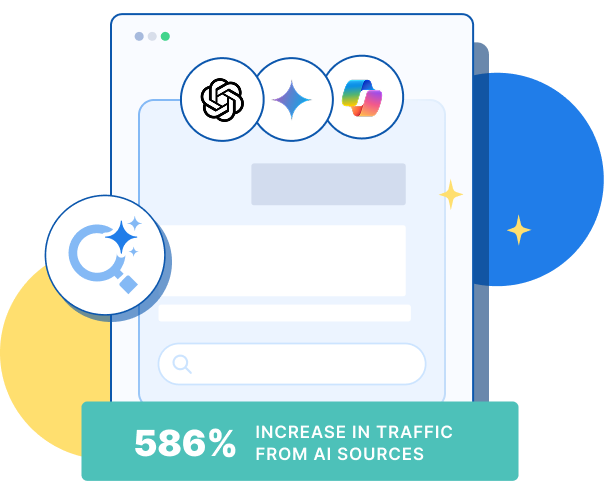
Explore how WebFX helped a regional brand get discovered in AI search experiences — proving what’s possible with today’s AI-driven marketing!
Try our free Marketing Calculator
Craft a tailored online marketing strategy! Utilize our free Internet marketing calculator for a custom plan based on your location, reach, timeframe, and budget.