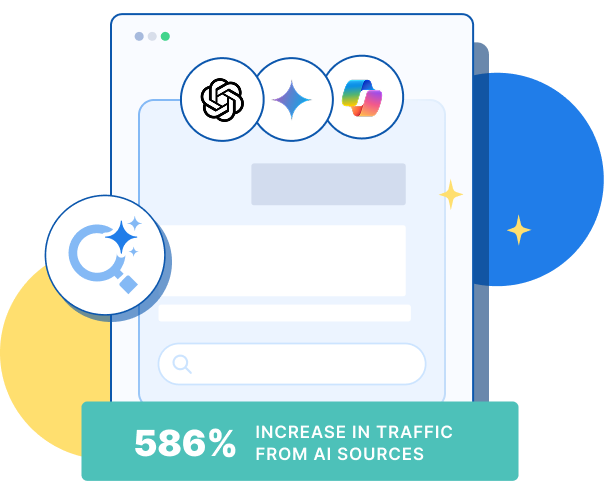
GEO ROI (generative engine optimization ROI) is the return on investment from optimizing visibility in AI-driven search platforms like Google AI Overviews, ChatGPT, and Perplexity.
Instead of relying on rankings alone, GEO ROI is measured using AI citation visibility, AI-referred traffic, conversion rate, and pipeline impact.
Combines traffic, conversions, and pipeline influence
Requires attribution beyond traditional analytics
To measure GEO ROI, you need a structured framework. Below, we break down the exact steps, metrics, and calculations to do it accurately.
What is GEO ROI?
GEO ROI (generative engine optimization ROI) is the business return generated from optimizing your content and brand for visibility inside AI-generated search results on platforms like ChatGPT, Google AI Overviews, Perplexity, Claude, and Gemini. It captures revenue, pipeline, and brand value created by appearing as a cited source in AI answers, not by ranking in traditional organic results.
GEO ROI overlaps with AI SEO ROI and AEO (answer engine optimization) ROI because all three measure visibility in AI-mediated discovery, but each focuses on a different layer.
Term
What it measures
Primary focus
AI SEO ROI
Return from adapting traditional SEO infrastructure for AI consumption
Technical optimizations, structured data, content formatting for AI extraction
AEO ROI
Return from appearing in direct-answer formats
Featured snippets, AI Overviews, question-based queries
GEO ROI
Return from being cited across generative engines
Citation rate, brand mentions, pipeline influence across ChatGPT, Gemini, Perplexity, Claude
In practice, most businesses measure all three together as one AI visibility ROI number.
The conventional ROI formula, (revenue − cost) ÷ cost × 100, breaks down for GEO because AI-driven influence often happens in zero-click environments where no referral session is logged. Our study of 2.37 million keywords found that AI Overviews now appear in 1 of every 4 US searches, redirecting answers away from click-throughs and toward AI summaries. Proving the return on investment of GEO requires a framework that captures both the trackable fraction and the influenced pipeline.
GEO ROI matters because AI search is no longer a future channel. It’s already reshaping how buyers discover, evaluate, and shortlist vendors. In fact, in our analysis of 2.3 billion site sessions across numerous industries from January 2024 to December 2025, we found that generative AI traffic grew 796%, and converted ~1.2x higher than organic search.
“With more users, particularly Gen Z, turning to AI-based tools for information retrieval, improving visibility on these emerging platforms (through ads or organically) gives you a nice early mover advantage. There is a lot of innovation in the space right now, so I’d expect continued user growth for those platforms, which makes it a smart target for marketers looking for new channels to invest in.”
How to measure GEO ROI
How to measure GEO ROI takes a two-tier metric framework plus a financial formula that ties AI visibility to your pipeline. The formula is:
This formula expresses GEO ROI as a revenue return multiple, which is more practical for AI-driven channels where attribution is incomplete and traditional percentage-based ROI formulas lose accuracy.
Here’s how to calculate GEO ROI with realistic inputs. Let’s say a mid-market B2B company runs a GEO program at $8,500 per month. The program generates 2,400 AI-attributed visits per month, which convert at 3.2% into demo requests, at a customer lifetime value of $18,000.
Monthly GEO ROI = $1,382,400 ÷ $8,500 = 162.6x return
Even trimmed conservatively for attribution loss, the math still clears traditional channel benchmarks by a wide margin. The formula scales down just as cleanly for SMB inputs, so the structure matters more than the numbers.
To populate that formula, track six metrics organized in two tiers:
Tier 1: Leading indicators (visibility signals)
These tell you what metrics matter for GEO at the visibility layer and whether AI engines are recognizing your brand. Track weekly, report monthly.
Citation rate: percentage of AI responses that cite your domain as a source across a defined prompt set.
Mention rate: percentage of AI responses that name your brand, with or without a link.
Share of AI voice: your mention frequency compared to competitors for the same queries.
Tier 2: Revenue indicators (pipeline signals)
These connect AI visibility to dollars. Track monthly, correlate quarterly.
AI-referred traffic: sessions from ChatGPT, Perplexity, Gemini, and other AI platforms (tracked via UTM and referrer data where available).
Conversion rate from AI traffic: form fills, demo requests, or sales from AI sessions.
Pipeline correlation: branded search lift, deal-source attribution, and self-reported AI discovery on intake forms.
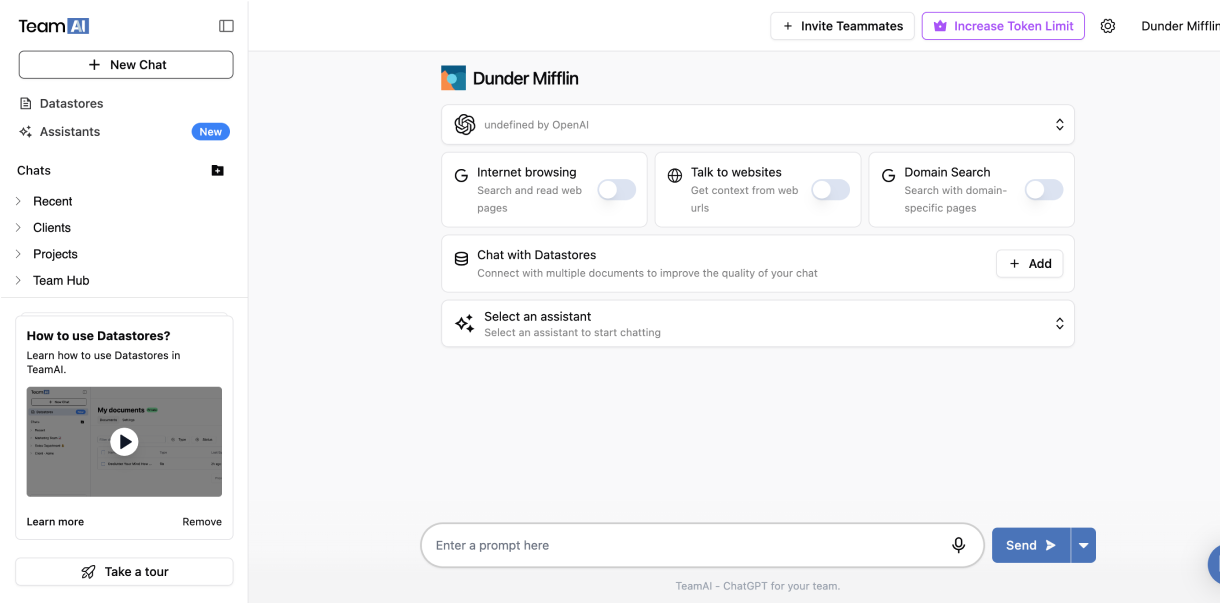
AI Workspace for Business Teams
Imagine an AI workspace where you can collaborate with team members, share prompts, and leverage personas for generative AI.
How to track AI visibility ROI when attribution is incomplete starts with understanding what analytics misses. GEO ROI attribution is incomplete by design because AI platforms often answer queries without sending a click.
Industry research suggests that standard GA4 tracking captures only 10% to 20% of the true financial return from AI citations, with the rest sitting in influenced pipeline, branded search lift, and accelerated sales cycles. On top of that, roughly 70% of AI-referred visits arrive without referrer headers, landing in direct or unattributed buckets in your analytics.
That doesn’t mean GEO ROI is unmeasurable. It means measuring AI visibility performance requires layering three signals that standard attribution misses:
Self-reported attribution. Add a “How did you hear about us?” field to intake forms with AI platforms listed as options. This single change surfaces AI influence that analytics can’t see.
Branded search lift. Track increases in branded queries in Google Search Console after a citation visibility push. If branded search rises while you haven’t spent on brand campaigns, AI exposure is the likely driver.
Pipeline correlation. Cross-reference periods of high AI citation rate against deal pipeline velocity in your CRM. Correlation doesn’t equal causation, but over two quarters, the pattern gets clear.
The honest framing is that GEO ROI is real and significant, but a portion of it compounds invisibly. Plan the program to capture what you can measure, and communicate the rest as an influenced pipeline rather than pretending every dollar maps to a click.
GEO ROI timeline: when to expect returns
The return on investment of GEO shows up on a faster curve than traditional SEO, but compounds over a longer one. Based on aggregated industry data, here’s a realistic timeline:
Weeks 2 to 4: First AI visibility lifts are measurable. Citation rate begins climbing for priority queries.
Weeks 4 to 12: Meaningful citation improvements across the prompt set. Share of AI voice starts shifting against competitors.
Weeks 6 to 10: Hard pipeline attribution appears. Self-reported AI discovery shows up on intake forms. Branded search begins trending up.
Two quarters and beyond: Compounding returns. Each citation-earning piece of content generates a signal that improves future targeting, and brand authority in AI systems strengthens.
Set expectations with leadership accordingly: visibility within a quarter, pipeline correlation within two quarters, and durable compounding after that.
If you’re still building toward the initial budget conversation, our guide on how to pitch generative engine optimization to your boss gives you a framework for presenting this same timeline to leadership — and recommends starting with a scoped pilot so the first quarter’s visibility signals serve as proof of concept rather than a leap of faith.
Is GEO worth the investment?
GEO is worth the investment for most businesses where AI-driven discovery can meaningfully influence buyer shortlisting. This now includes most B2B verticals, high-LTV professional services, and any market where informational and comparison content drives evaluation. The strongest ROI cases are companies with customer lifetime values above $5,000, long sales cycles, and content strategies already anchored in authority and expertise.
GEO ROI is weaker (though rarely negative) for pure ecommerce with short sales cycles, hyperlocal services where Google Business Profile and Maps dominate discovery, and commodity markets where price is the primary decision driver. Even in those cases, the early-mover position may justify a smaller investment as a hedge.
For businesses, understanding which metrics matter for GEO — and what good performance looks like across citation rate, visibility rate, and query coverage — helps build the internal case for investment before the pipeline attribution fully materializes.
If you want to maximize your reach and visibility, it’s recommended to pair your GEO strategy with an LLM advertising campaign. For example, when it comes to ChatGPT ads vs. GEO, both strategies ensure your brand reaches the people searching for your products or services across multiple platforms like ChatGPT, Gemini, and more.
Common questions about measuring AI visibility performance and proving ROI from AI search optimization. For broader AI optimization questions, check out our comprehensive AI optimization FAQ page.
Calculate GEO ROI with the formula: (AI-attributed traffic × conversion rate × customer lifetime value) ÷ total GEO investment. Total investment includes content production, AI visibility platform costs, agency fees, and internal staff time. A $10,000 monthly investment generating 500 AI-attributed visits at a 3% conversion rate and $8,000 customer lifetime value produces 12x monthly ROI.
GEO shows first visibility lifts within two to four weeks and meaningful citation improvements within four to twelve weeks. Hard pipeline attribution typically surfaces in six to ten weeks, and compounding returns become visible after two quarters. This timeline is faster than traditional SEO on the visibility side but slower on the attribution side because of zero-click AI answers.
GEO ROI is different from SEO ROI, but not universally better. GEO converts at a higher rate per visit (~1.2x higher than organic search) but drives lower absolute traffic volume today. Organic and direct still dominate (63% of sessions), while AI accounts for just 0.18%.
The two work best together: SEO secures baseline organic traffic, while GEO captures the AI-driven discovery layer that increasingly shapes shortlists before a click happens.
Yes, AI citations and mentions are trackable, and how to measure AI SEO performance starts with specialized AI visibility platforms that run defined prompt sets against ChatGPT, Claude, Gemini, Perplexity, and other engines on a scheduled cadence. These platforms report citation rate, mention rate, share of AI voice, and source URL data. Manual tracking is possible for small prompt sets but doesn’t scale.
Invest in SEO first if your site has weak foundational rankings, because AI engines draw heavily from well-ranked organic sources. Invest in GEO alongside SEO if you already rank in the top 10 for core queries, since the 38% overlap between Google rankings and AI Overview citations means strong SEO no longer guarantees AI visibility. For most businesses, the right answer is both, sequenced by baseline maturity.
Yes, generative engine optimization drives ROI for small businesses when customer lifetime value is high enough to absorb longer attribution windows, typically $2,000 or more. Small businesses in professional services, B2B SaaS, and high-consideration consumer categories often see stronger per-dollar returns than enterprises because their content strategies can be more focused and their competitors are slower to invest in AI visibility.
Prove ROI from AI search optimization with WebFX
AI search is redistributing visibility, and the brands measuring GEO ROI correctly will capture the citations, pipeline, and branded demand that competitors leave on the table. With 30+ years of digital expertise, 1,100+ client testimonials, and an OmniSEO® platform for tracking visibility across traditional and AI-driven search, WebFX helps you build, measure, and prove the ROI of generative engine optimization.
Craft a tailored online marketing strategy! Utilize our free Internet marketing calculator for a custom plan based on your location, reach, timeframe, and budget.
Craft a tailored online marketing strategy! Utilize our free Internet marketing calculator for a custom plan based on your location, reach, timeframe, and budget.








 Albert Dandy Velasquez blends SEO strategy with compelling storytelling to help businesses boost their visibility and revenue online. With a B.A. in English and certifications from HubSpot, Semrush, and Google Analytics, he has written and optimized hundreds of articles on organic SEO, content strategy, and user experience. He regularly contributes to the WebFX blog and SEO.com, creating content that helps readers turn marketing goals into measurable results. When he’s off the clock, he’s usually exploring new neighborhoods on two wheels, filming travel content, or chasing golden hour with a coffee in hand. View full profile