



Table of Contents
- What makes healthcare SEO unique
- Our framework: The five pillars of effective healthcare SEO
- Build a HIPAA-aware technical SEO foundation
- Dominate local search where patients actually look
- Create patient-first content that builds trust and supports E-E-A-T
- Build authority and reputation patients can verify
- Measure what matters (calls, appointments, and inquiries)
- Why compliance matters in healthcare SEO
- FAQ on healthcare SEO
- A sustainable approach to healthcare SEO
- How does E-E-A-T affect healthcare websites?
- What do healthcare SEO services typically include?
- Should healthcare SEO be handled in-house or by an agency?
- What makes healthcare SEO different from other industries? Healthcare SEO operates in a trust-sensitive environment where patients search during moments of concern or urgency, requiring websites to demonstrate credibility, relevance, and clarity while carefully handling patient privacy and data compliance.
- What are the five pillars of effective healthcare SEO? The framework includes building a HIPAA-aware technical foundation, improving local search visibility, creating patient-first content that supports E-E-A-T (experience, expertise, authoritativeness, trustworthiness), building verifiable authority through reviews and reputable mentions, and measuring meaningful metrics like calls and appointment requests rather than just rankings.
- Why is local search optimization critical for healthcare practices? Patients typically search for providers near them with high-intent queries like “primary care near me,” making an optimized Google Business Profile with accurate hours, services, location details, and consistent NAP (name, address, phone number) across platforms essential for visibility and patient acquisition.
- What metrics should healthcare practices track for SEO success? Instead of focusing solely on clicks and rankings, practices should prioritize tracking patient inquiries like phone calls, appointment requests, and contact form submissions—actions that indicate real patient interest and demonstrate that SEO efforts are actually driving patient acquisition over time.
Healthcare SEO is the process of improving a healthcare provider’s online visibility. Its goal is to increase the number of patients who find, evaluate, and contact the practice through organic search.
SEO for healthcare has become more complex, though. Before patients call an office, they compare providers online. Search algorithms have been evolving, too, changing organic rankings and local map results.
Our research found that 52% of health-related searches now display Google AI Overviews, the highest rate of any industry. That means patients may see AI-generated answers before they ever reach your website.
Despite these changes, healthcare SEO still works. The strongest strategies help you show up where patients search, answer their questions, and earn their trust so they’ll take the next step of contacting you or booking an appointment.
In this guide, you’ll learn the five pillars of effective healthcare SEO:
- Building a HIPAA-aware technical SEO foundation
- Improving local visibility where patients search
- Creating patient-first content that supports E-E-A-T
- Building authority and reputation patients can verify
- Measuring calls, appointments, and patient inquiries
Our framework: The five pillars of effective healthcare SEO
Healthcare SEO is most effective when it’s treated as a system, so we came up with a framework that’s easy to follow for healthcare practitioners. To help patients discover you and earn their trust, use the five-pillar framework below to assess your current SEO efforts and identify where to focus next:
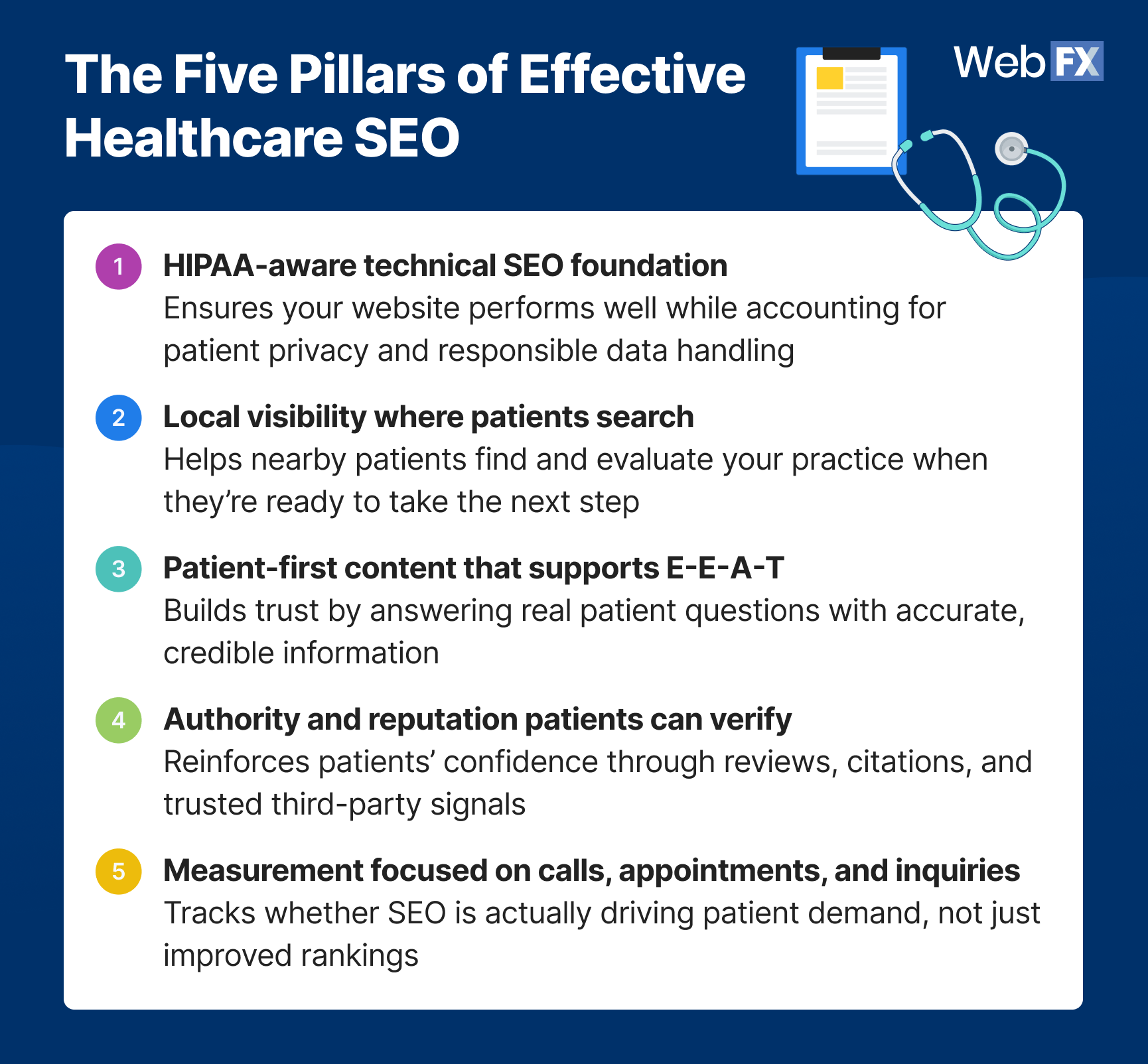
You don’t need to perfect every pillar at once. The goal is to understand how they work together and determine which improvements will have the greatest impact on patient growth.
Build a HIPAA-aware technical SEO foundation
Technical SEO ensures your website is accessible, secure, and easy for patients to use. In healthcare, it also requires awareness of how technical decisions affect patient data and trust.
In simple terms, HIPAA (Health Insurance Portability and Accountability Act) sets expectations around how patient information is handled, which is why marketing tools that collect or track data need extra consideration in healthcare settings.
Your website should load quickly, function smoothly on mobile devices, and provide a secure browsing experience. These elements affect both search visibility and how patients perceive your practice before they ever contact you.
What healthcare practices should review before adding SEO tools
Many healthcare websites use third-party tools to track performance or capture inquiries. Before adding or expanding these tools, you should understand:
- What data is being collected
- Where that data is stored
- Who has access to it
- Whether all data collection is necessary for patient acquisition goals
Addressing these questions early helps you strengthen your technical foundation without compromising your patients’ data and privacy.
Dominate local search where patients actually look
Patients typically search for providers near them, especially when care is time-sensitive or ongoing. Searches like “primary care near me” or “orthopedic doctor in [city]” signal high intent. or a comprehensive look at how to build and execute a local SEO strategy for healthcare practices, our dedicated guide walks through every tactic that helps medical providers rank in local search results.
Your Google Business Profile (GBP) plays a central role in how patients find and evaluate your practice. Optimize your GBP by adding:
- Accurate operating hours
- Services and categories
- Location details
- Contact information
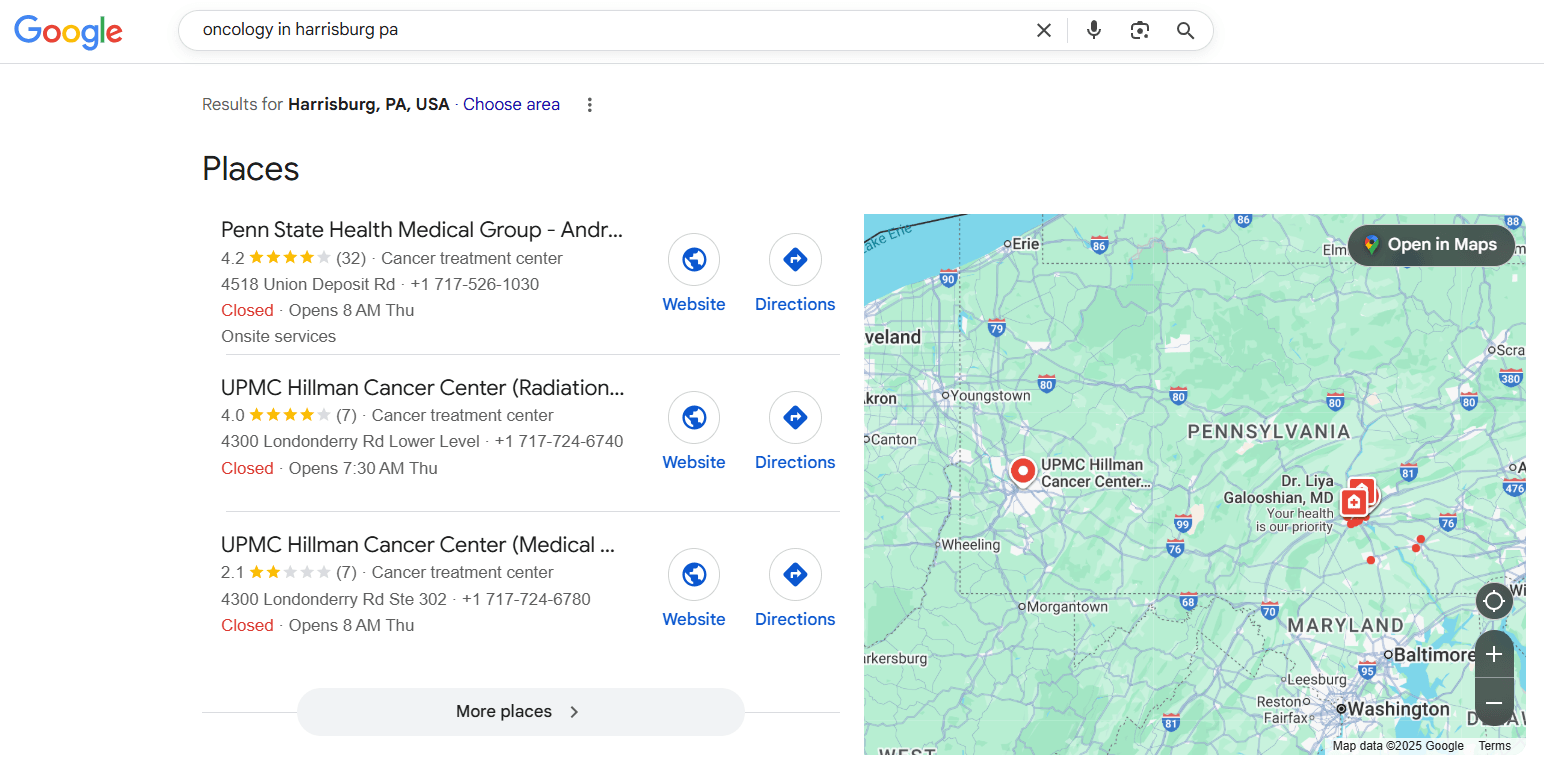
You can also improve your local visibility by:
- Publishing location-specific service pages
- Keeping your NAP (name, address, and phone number) consistent across platforms such as your website, GBP, and directory listings
- Getting more patient reviews that boost trust signals
These signals establish legitimacy and relevance in local search results.
Create patient-first content that builds trust and supports E-E-A-T
Healthcare SEO content must prioritize answering patients’ questions with trustworthy, expert-reviewed pieces.
That’s because patients typically search for symptoms, conditions, treatments, and before and after care. When you publish content relevant to these concerns, you help patients make informed decisions while improving your visibility in search engines (and even in AI-powered queries).
Search engines evaluate healthcare content through the lens of experience, expertise, authoritativeness, and trustworthiness (E-E-A-T). Clear authorship, accurate information, and regularly updated content all contribute to stronger performance.
Publish the following pages to help patients understand your offerings and reinforce your practice’s credibility:
- Service and treatment pages
- Condition-specific educational content
- Frequently asked questions
Build authority and reputation patients can verify
When patients compare healthcare providers online, they’re looking for reassurance that others have had positive experiences. Those same trust signals also help search engines determine which practices are credible and relevant enough to show in search results.
Online reviews play an important role, but they’re only part of the picture. Patients and search engines also look for mentions on reputable websites and links from trusted sources.
In healthcare SEO, quality matters more than volume. So a smaller number of strong, relevant signals builds more confidence than dozens of low-quality listings or links.
So what should you focus on? Here are ways you can improve your online reputation:
- Encourage and maintain patient reviews: Earn reviews ethically by asking your patients to leave a review on Google and healthcare-specific sites. Share glowing reviews on your website (with your patient’s consent) while protecting your patient’s identity.
- List your practice on reputable healthcare and local platforms: Focus on trusted directories and networks, like Healthgrades or Zocdoc, where patients expect to find provider information.
- Prioritize credibility and relevance over sheer volume: Instead of trying to be listed and reviewed everywhere, focus on select trusted healthcare and local platforms that patients actually use.
Over time, these consistent, credible signals make your practice easier for patients (and search engines) to trust.
Measure what matters (calls, appointments, and inquiries)
Healthcare practices must look beyond clicks and rankings when they think about their SEO results. Rankings explain your visibility, but they don’t tell you if your SEO efforts are actually helping you acquire patients.
The most meaningful indicators of SEO performance are actions tied to patient intent, such as phone calls, appointment requests, and contact form submissions. Track these metrics, which show that patients are finding your practice and taking a step toward care.
Here’s what to prioritize:
- Track patient inquiries from your website: Monitor phone calls, appointment requests, and contact form submissions so you can see when SEO is driving real patient interest.
- Determine where those inquiries originate: Look at which pages or search results are driving patients to call you, inquire, or fill out your forms.
- Evaluate progress over time, not week to week: Look for steady increases in patient inquiries instead of reacting to week-to-week ranking changes.
In healthcare SEO, consistent patient engagement is a stronger signal of success than temporary movement in search results.
What makes healthcare SEO unique
Healthcare SEO is the process of optimizing a medical practice’s online presence so patients can easily find providers, services, and information through search engines. While the fundamentals of SEO apply, healthcare operates in a more trust-sensitive and risk-aware environment than most industries. For specialty practices like dermatology, our guide to SEO for dermatology practices covers how these principles apply to attracting the right patients for skin care services.
Patients typically search during moments of concern, uncertainty, or urgency. Aside from projecting credibility, healthcare providers’ websites must also show relevance and clarity to gain a searcher’s trust and rank in search engines.
Healthcare websites also rely heavily on tools like forms, online scheduling, and analytics. These tools make it easy for patients to book appointments online and for healthcare practices to track their site’s ROI, but these tools must be implemented carefully. Effective healthcare SEO also considers patient privacy and responsible data handling.
Taken together, healthcare SEO works best when it’s approached with structure, prioritization, and long-term intent. It’s pretty much like patient care itself, where improved health is a result of clear diagnosis, appropriate treatment planning, and ongoing follow-through. Staying current with the broader shifts in the industry is equally important — our 2026 healthcare industry trends report covers the key developments shaping how patients search for and engage with healthcare providers.
Can AI content hurt healthcare SEO?
AI-assisted content creation is not automatically bad for healthcare SEO. It becomes risky when healthcare providers use it to publish unreviewed medical advice, inaccurate claims, generic condition pages, or content that sounds helpful but doesn’t reflect the provider’s real expertise.
AI can support parts of the content workflow. For example, it can create outlines, summarize patient questions, draft content briefs, or suggest FAQ ideas. Those use cases can save time for small marketing teams.
Your published content still needs human review. For healthcare topics, it may include editing, fact-checking, compliance review, and clinical review when appropriate.
In healthcare, trust matters more than the speed of content generation.
You can use AI as a workflow tool. Here’s what a safe AI-assisted content process may look like:
- Identify your patients’ questions. Start with real questions you get from your patients via search data, call logs, or conversations with them. Then, use an AI tool to group similar questions by topic. Have your team rank the questions by importance.
- Build a content outline with AI. Once you’ve identified the topics you need to cover, use an AI tool to organize your page. Let a human review and finalize your outline to ensure it addresses your patients’ concerns and unique context.
- Draft the content with AI. AI can help create a first draft using approved service, provider, and location details. Treat this draft as a starting point. Never publish AI-generated healthcare content without human review.
- Edit and revise the draft for your patients. Have a team member or content specialist revise the draft to make it helpful for your patients. This step should improve explanations and remove generic language.
- Verify medical accuracy. Have a qualified clinical reviewer check medical claims when needed, especially for content about symptoms, diagnoses, treatments, procedures, risks, or recovery. The medical reviewer should confirm that the content is accurate, current, appropriately scoped, and not misleading.
- Add trust signals before publishing. Include a byline, reviewer’s details, and provider credentials to improve the content’s credibility. These details tell patients that they can trust your content.
AI can help you move faster. Your review process helps make the content useful, accurate, and aligned with your practice’s standards.
Why compliance matters in healthcare SEO
Adding analytics tools, updating contact forms, and enabling online scheduling all affect how patient data is handled. That’s why compliance awareness must be handled early on.
Before implementing new SEO tools or integrations, healthcare practices must review potential risks in a structured way. Check out our comprehensive HIPAA compliance guide and checklist to ensure you have the required policies in place and HIPAA-compliant web forms.
FAQ on healthcare SEO
Can healthcare SEO benefit me if I do telehealth?
Yes! SEO is the perfect strategy for telehealth because it can help you reach patients beyond your local community. You can do this by targeting regional keywords, or Internet-based health terms like, “online health consultations.”
If you’re a telehealth provider, your SEO strategy can be easily adjusted to help you reach a broader spectrum of patients that need your services.
Will SEO help me stand out from larger hospitals or chains?
Yes. One of the biggest benefits of SEO for healthcare is that it levels the playing field for marketing a private practice. Google cares about delivering the most relevant search results to searchers.
That does not mean a small clinic will outrank a major hospital for every broad medical keyword. The stronger opportunity often comes from more specific searches, such as “sports injury physical therapy in [City]” or “pediatric dentist accepting new patients near me.”
How long does healthcare SEO take to work?
Most practices see early signals within a few months, with stronger patient growth developing over time as efforts compound.
How does E-E-A-T affect healthcare websites?
E-E-A-T stands for experience, expertise, authoritativeness, and trustworthiness. For healthcare websites, it helps frame how credible and useful your content appears to patients and search systems.
Practical E-E-A-T signals can include:
- Accurate content
- Reviewer credentials
- Provider bios
- Updated pages
- Reputable sources, trusted mentions, patient reviews, and clear contact information
These signals help patients understand who stands behind the content and why they can trust it.
Is AI-assisted content generation safe for healthcare SEO?
AI-assisted content generation can be safe for healthcare SEO when it is reviewed, edited, fact-checked, and aligned with compliance standards. It becomes risky when providers use AI to publish unverified medical advice or mass-produce generic pages without expert review.
You can use AI to support your content workflow. Always let qualified humans make the final call on medical accuracy, patient usefulness, and brand trust.
What do healthcare SEO services typically include?
Healthcare SEO services typically include the following:
- Technical SEO
- Local SEO
- On-page and off-page optimization
- Content strategy
- Authority building
- Review strategy
- Conversion tracking
- Reporting
Should healthcare SEO be handled in-house or by an agency?
The right approach depends on your team’s time, expertise, and comfort managing technical and compliance-aware decisions. Some practices manage SEO internally, while others work with specialized partners. If you’re exploring outside support, our list of the top digital marketing agencies for healthcare practices can help you compare options.
Learn how we increased leads from organic search by 540% for a healthcare practice.

A sustainable approach to healthcare SEO
Healthcare SEO works best when it’s built on trust, structure, and realistic expectations. By focusing on the five pillars outlined in this guide, practices can improve visibility while supporting patient confidence and long-term growth. For a more specialty-specific look, our guide to SEO for doctors dives deeper into the tactics that help medical practices rank higher and earn patient trust online.
If you want a trusted partner who can do healthcare SEO for you, team up with WebFX. We have over 98,500+ hours of experience in the industry, helping practices not only to rank in search but to acquire and retain patients.
Contact us online or call us today at 888-601-5359 to speak with a strategist about our SEO services!
-
 Macy Storm is a Content Marketing Consultant at WebFX. She has 5+ years of experience creating content for all digital strategies and across 10+ industries. With a B.A. in Communications, she’s used her writing skills to write over 1,000+ pages for WebFX and SEO.com. Her work has been featured by Search Engine Journal, HubSpot, Entrepreneur, Clutch, and more. When she’s not clacking her keys, she’s playing video games, reading, or counting how many times people say her puppy Daisy is cute (it’s a lot of times). View full profile
 -

WebFX is a full-service digital marketing agency delivering revenue-driving strategies across online advertising, SEO and AI search optimization, and digital marketing. Backed by 1,100+ client reviews, a 4.9-star rating on Clutch, and proprietary revenue-tracking technology, our team helps businesses grow visibility and revenue across platforms, from Google to ChatGPT to LinkedIn. Discover how our expert team and revenue-accelerating tech can drive results for you. Learn more
Try our free Marketing Calculator
Craft a tailored online marketing strategy! Utilize our free Internet marketing calculator for a custom plan based on your location, reach, timeframe, and budget.
Plan Your Marketing Budget
Table of Contents
- What makes healthcare SEO unique
- Our framework: The five pillars of effective healthcare SEO
- Build a HIPAA-aware technical SEO foundation
- Dominate local search where patients actually look
- Create patient-first content that builds trust and supports E-E-A-T
- Build authority and reputation patients can verify
- Measure what matters (calls, appointments, and inquiries)
- Why compliance matters in healthcare SEO
- FAQ on healthcare SEO
- A sustainable approach to healthcare SEO
- How does E-E-A-T affect healthcare websites?
- What do healthcare SEO services typically include?
- Should healthcare SEO be handled in-house or by an agency?
Share this article


Help More Patients Find Your Practice
See how healthcare providers like Hurst Pediatric Dentistry increased local leads 5× with data-driven SEO from WebFX.

Try our free Marketing Calculator
Craft a tailored online marketing strategy! Utilize our free Internet marketing calculator for a custom plan based on your location, reach, timeframe, and budget.
Plan Your Marketing Budget
What to read next




Additional Reading



Health & Wellness Case Studies
Solving key challenges for healthcare
Our website isn’t driving enough traffic
Our expert SEO specialists, copywriters, and digital advertisers will help you increase your website’s rankings when your target audience searches for your treatments online, so you can continuously drive traffic and revenue for your practice, hospital, or business.

We’re opening a new location
Set your new hospital, brand, or practice up for future success with a range of digital marketing strategies that get your new practice in front of potential patients or B2B buyers.

We’re not attracting enough patients
Get a steady flow of new patients to your practice, hospital, or brand with expertly crafted strategies that provide a seamless, engaging user experience for your website visitors, encouraging them to become patients.

We have high patient turnover
Offer new treatments or services and need to get them in front of your potential client’s eyes? Our range of revenue-driving digital advertising and marketing services have you covered and reach the people who need your facility the most.
