

- How has branded search dependency changed in recent years? Branded search dependency has dropped 6.7 percentage points from 74.7% two years ago, indicating that consumers are increasingly discovering products and services through conversational AI queries rather than searching for specific brand names.
- Which industries have been most affected by AI-driven search changes? Media and entertainment (-5.0 points), fintech (-4.9 points), EdTech (-4.7 points), and real estate (-4.5 points) experienced the largest drops in branded search dependency, while health and wellness (+3.6 points) and travel and hospitality (+4.3 points) remained resilient due to higher trust requirements.
- Why does AI-powered search favor challenger brands? AI systems prioritize answering specific questions over brand recognition, so when users ask detailed conversational queries like “running shoes for wide feet in wet conditions,” smaller specialized brands can compete directly with market leaders who previously dominated generic branded searches.
- Where are consumers discovering brands in the AI era? Brand discovery now happens across multiple channels including direct LLM queries (ChatGPT, Claude, Perplexity), social search on TikTok and Instagram, Reddit threads, Google AI Overviews, and community platforms like Discord rather than traditional search alone.
- What strategies help brands succeed in the new discovery landscape? Brands should audit where audiences actually discover solutions, create content answering specific long-tail questions, and build consistent presence across multiple discovery channels (AI platforms, social media, forums) rather than relying solely on traditional branded search optimization.
Nobody searches for “Nike running shoes” anymore.
Okay, that’s not entirely true. But our analysis of over 1,000 domains across four years reveals a big shift in search patterns and how AI is changing brand discovery: the way people discover products and services is becoming less brand-dependent.
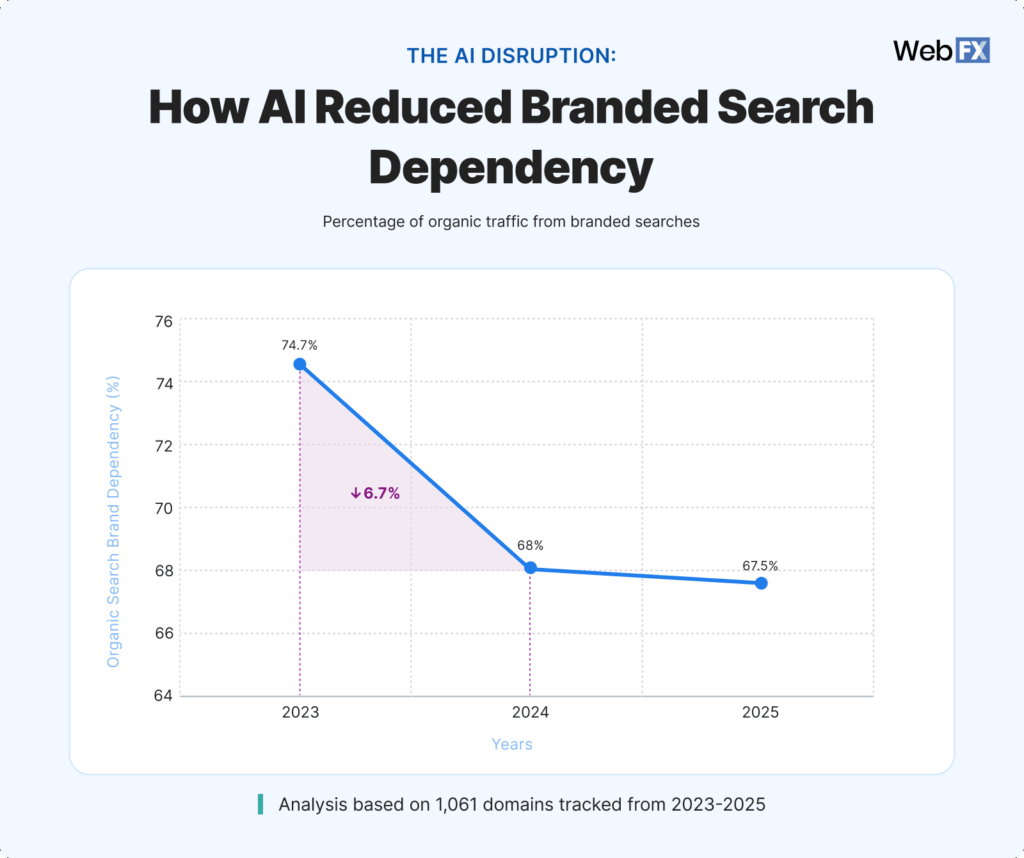
The data tells a fascinating story. Two years ago, 74.7% of organic traffic came from branded queries. As LLMs like ChatGPT have grown in popularity and conversational search patterns emerged, we saw a 6.7 point drop in brand dependency, a notable shift in just two years.
A few percentage points swing doesn’t mean branded search is dead, but it’s enough of a trend to signal a massive opportunity for challengers.
Consider how search behavior has evolved.
A few years ago, someone shopping for running shoes might search for “best Nike running shoes for flat feet.” Today? They’re asking ChatGPT or even Google, “I’m a new runner training for my first 10K, running 30 miles a week with really wide feet and need to run in bad weather. What are some good options?”
It’s a much longer query and, frankly, a fundamentally different discovery mechanism that didn’t exist prior to 2022.
But here’s where it gets interesting: not every industry is experiencing this disruption equally.
The impact of industry on branded search dependency
While branded search volume has decreased overall, the patterns vary when you drill down into specific industries. Think about how you go through product or service discovery now.
There are some topics that you may be more brand-dependent with naturally, despite AI’s advances. For example, if you already follow certain publishers (think travel bloggers or tech reviewers), you’re likely still engaging with them.
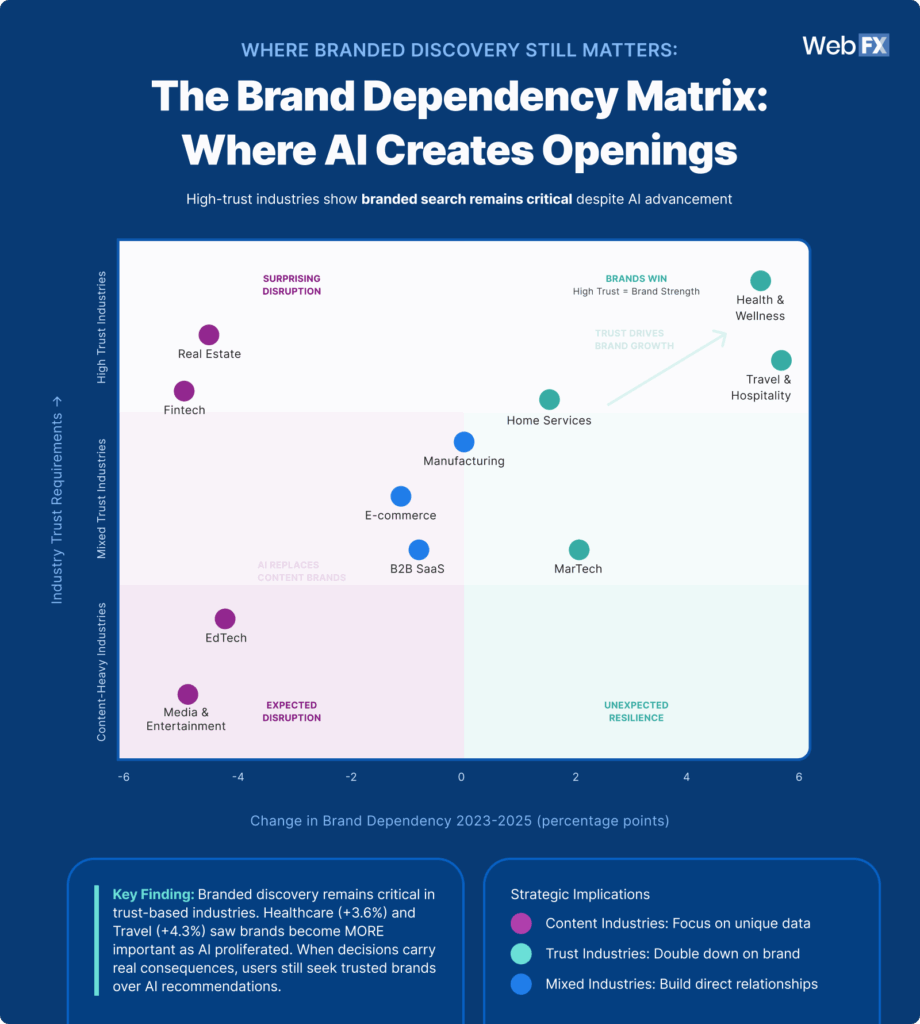
Changes in brand dependency hit different industries in surprisingly different ways.
The hardest hit:
- Media and entertainment: -5.0 points
- Fintech: -4.9 points
- EdTech: -4.7 points
- Real estate: -4.5 points
The resilient:
- Health and wellness: +3.6 points
- Travel and hospitality: +4.3 points
- MarTech: +1.4 points
The pattern reveals something crucial: AI didn’t equally disrupt all branded discovery. It specifically ate into industries where “good enough” answers suffice.
- Need a quick explanation of mortgage rates? AI can handle that.
- Looking for study materials? AI’s got you covered.
- Want movie recommendations? AI aggregates reviews instantly.
But need cancer treatment options? Planning your honeymoon? Choosing enterprise software that could make or break your career? Suddenly, brand trust matters more than ever. Let’s dive into a few specific examples.
If you’re looking for, say, a book recommendation, providing a long conversational query is most likely going to net you a better result.
So you’d search something like, “Give me a good book recommendation for my dad. He really enjoys the history of how things are built and engineered and also enjoys reading long biographies with multiple volumes. This is a gift for Christmas.”
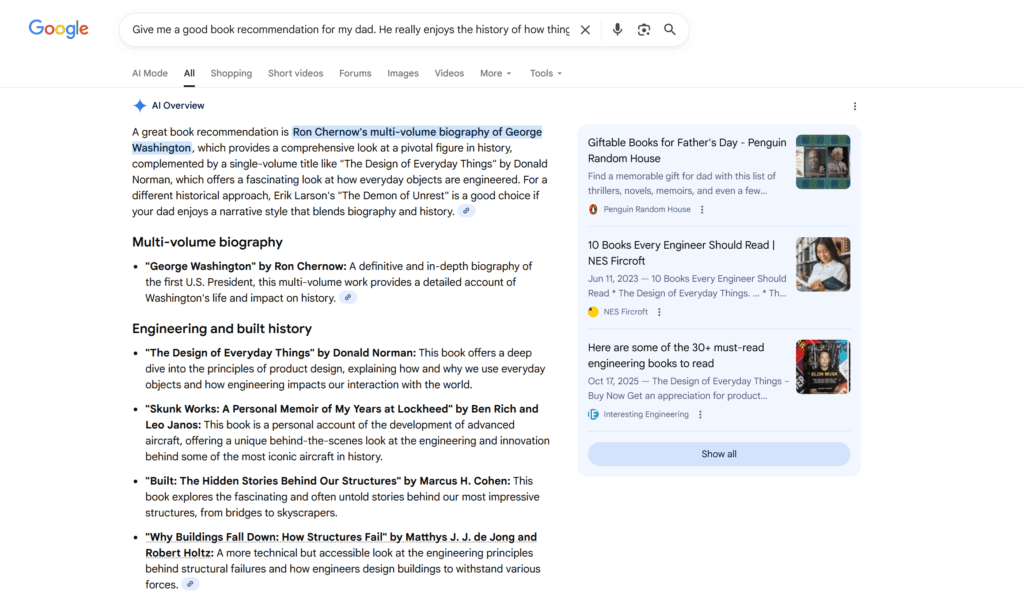
Traditionally, somebody may have searched for “NY Times bestsellers in history” or “Barnes & Noble book recommendations.”
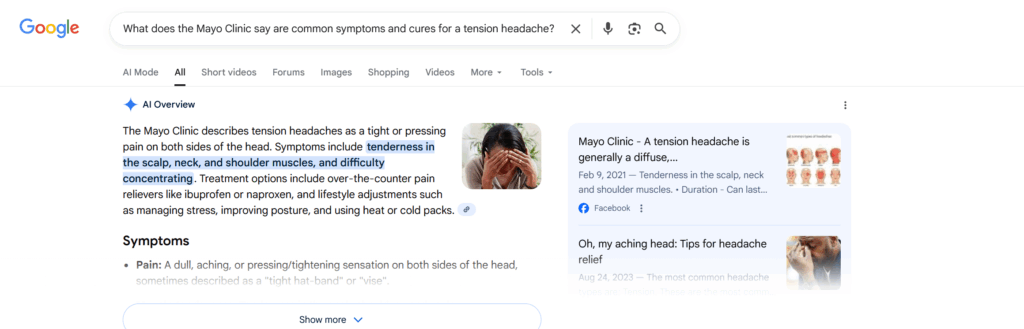
On the other hand, if you are searching for something that is more sensitive, like a health query, searchers are more likely to include a brand name, even in the age of AI-powered answers. So you might have a preference for a particular source in your conversational query by asking something like, “What does the Mayo Clinic say are common symptoms and cures for a tension headache?”
The new brand discovery landscape
With AI usage and conversational search on the rise, there are more opportunities than ever for non-market-leading brands to thrive.
While two channels (search and social) dominated brand discovery for the last decade-plus, consumers are increasingly diversifying how they discover brands, both in terms of the channels they use and in the way they engage in those existing powerhouse channels.
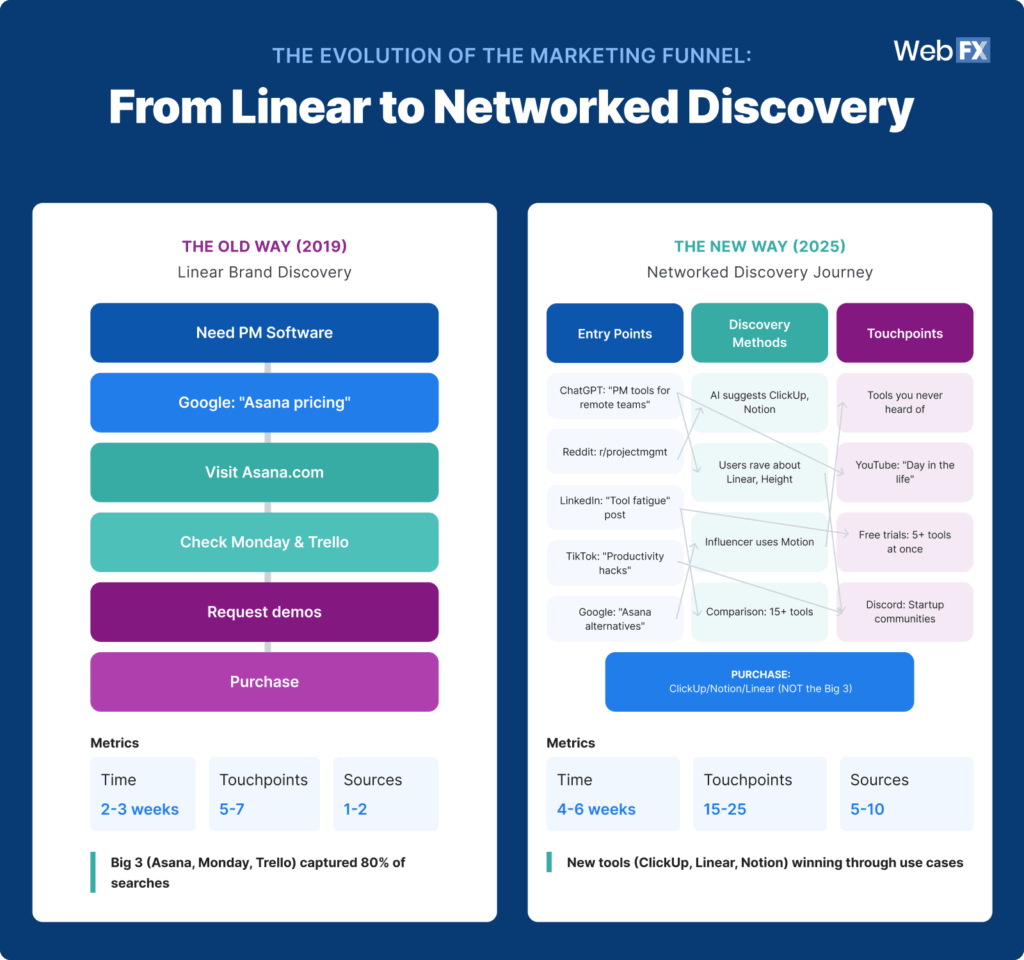
Where brand discovery actually happens now:
- Direct LLM queries: ChatGPT, Claude, and Perplexity are becoming primary research tools.
- Social search: TikTok and Instagram search are replacing Google for product discovery.
- Reddit threads: Unfiltered user opinions increasingly shape brand perceptions.
- AI-powered features: Google’s AI Overviews, Bing Chat, and SGE are eating traditional SERP real estate.
- Community platforms: Discord, Slack communities, and niche forums are driving recommendations.
Take the running shoe example.
When someone searches “Nike running shoes,” Nike wins by default. They’ve spent decades and millions ensuring that outcome. But when that same person searches: “I’m a new runner training for my first 10K, running 30 miles a week with really wide feet and need to run in bad weather” — suddenly, the playing field levels.
AI cares about answering the specific question. And if you’re a smaller brand like Topo Athletic or Altra that specializes in wide-fit, weather-resistant running shoes? You just got invited to a conversation Nike used to own.
This dynamic is playing out across every industry where ‘good enough’ used to mean the market leader. And this is also true for businesses looking to rank in B2C and B2B AI Overviews.
Instead of fighting for branded search dominance, smart brands are building what I call “Discovery Networks” that have multiple touchpoints across channels that guide users from problem recognition to solution selection, regardless of where that journey starts.
For businesses, this means leaning in and investing across marketing channels vs. pulling back and hoping for the best. As someone once said, “The best time to pass your competition is in the rain,” and it’s pouring.
The winners won’t be those with the most branded searches. They’ll be those who show up with the right answer, in the right channel, at the right moment.
Key strategies to maximize your brand’s visibility in the AI era
These changes are something every marketer should be putting a gameplan together for.
- Start by auditing where your audience actually discovers solutions. If you’re in one of the harder-hit industries like EdTech or real estate, your prospects are likely asking conversational questions across multiple platforms before they ever type your brand name. Map those discovery paths and ensure you have presence at each touchpoint.
- Focus on answering specific, long-tail questions with genuinely useful content. AI systems prioritize content that directly addresses user intent, which means the hyper-specific page about “running shoes for wide feet in wet conditions” outperforms the generic “best running shoes” roundup. This is where challenger brands gain ground…you don’t need Nike’s budget to be the definitive answer to a niche query.
- Build your discovery visibility by treating each channel as a piece of a larger ecosystem rather than isolated tactics. Your Reddit presence should reinforce what prospects find in AI Overviews, which should align with what appears when they search TikTok. Consistency across these touchpoints builds the kind of brand recognition that survives the fragmentation of discovery. And for industries where trust remains paramount – healthcare, enterprise software, travel – double down on authoritative content and credentialed expertise that AI systems recognize as reliable sources.
The bottom line on modern brand discovery
Our analysis of 1,061 domains confirms what many marketers suspect but few want to admit: the age of branded search dominance is ending.
But rather than spelling doom for brands, it’s redistributing opportunity in ways that favor expertise over budget, specificity over generalization, and authentic utility over SEO manipulation.
For established brands, this means defending trust while expanding discovery mechanisms. For challengers, it means the gates that once protected market leaders are finally opening.
If you’re looking to make your mark, now is the time to get started. Overwhelmed at the prospect of building your discovery network? See how our award-winning AI search optimization services can help.
-
 Trevin serves as the VP of Marketing at WebFX. He has worked on over 450 marketing campaigns and has been building websites for over 25 years. His work has been featured by Search Engine Land, USA Today, Fast Company and Inc. Read his review of working with WebFX for the last 15 years.
 -

WebFX is a full-service marketing agency with 1,100+ client reviews and a 4.9-star rating on Clutch! Find out how our expert team and revenue-accelerating tech can drive results for you! Learn more
Try our free Marketing Calculator
Craft a tailored online marketing strategy! Utilize our free Internet marketing calculator for a custom plan based on your location, reach, timeframe, and budget.
Plan Your Marketing Budget
Share this article


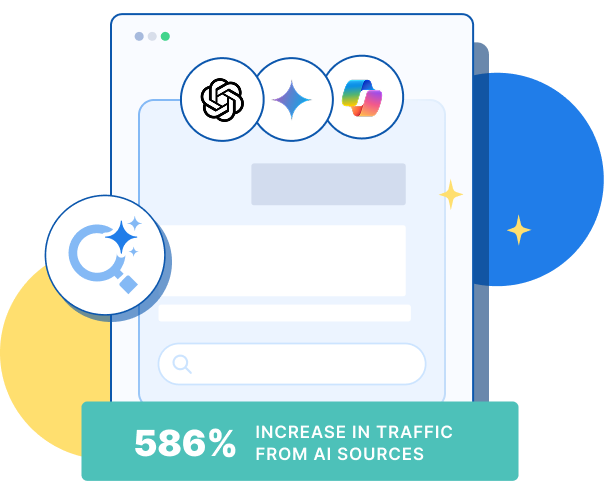
See AI Marketing in Action
Explore how WebFX helped a regional brand get discovered in AI search experiences — proving what’s possible with today’s AI-driven marketing!
Try our free Marketing Calculator
Craft a tailored online marketing strategy! Utilize our free Internet marketing calculator for a custom plan based on your location, reach, timeframe, and budget.
Plan Your Marketing Budget
What to read next