


Contents
- How to build the business case for AI SEO in 5 steps
- Step 1: Quantify how much revenue organic search drives
- Step 2: Identify where AI already affects your search visibility
- Step 3: Model a conservative revenue-at-risk scenario
- Step 4: Compare protectable revenue against AI SEO investment
- Step 5: Frame the ask around protection, not experimentation
- What is AI search optimization, and how is it different from SEO?
- What happens if you do nothing?
- What early AI SEO investment looks like in practice
- Thompson Tractor (heavy equipment)
- RC Mowers (manufacturing)
- URAC (healthcare accreditation)
- FAQs about AI SEO
- Protect and grow your organic revenue with AI SEO
-
What is AI search optimization and how does it differ from traditional SEO?
AI search optimization structures your website, content, and brand signals so AI platforms like Google AI Overviews, ChatGPT, Perplexity, and Copilot recognize, trust, and cite your business in their responses, while traditional SEO focuses on ranking pages in search results. -
How much revenue is at risk from AI-driven search changes?
Studies show AI Overviews correlate with a 58% to 61% lower click-through rate for top-ranking pages, and zero-click searches grew from 56% to 69% between May 2024 and May 2025, putting significant organic revenue at risk. -
What is the ROI framework for justifying AI SEO investment?
Calculate revenue at risk by multiplying organic revenue by projected decline percentage, then compare protected revenue against AI SEO investment costs to demonstrate return multiples. -
How should you present the business case to leadership?
Frame AI SEO as margin preservation and risk management rather than experimentation by quantifying organic revenue, identifying where AI already affects visibility, modeling conservative revenue-at-risk scenarios, and positioning the investment as protecting existing revenue streams. -
What results have early AI SEO adopters achieved?
Companies like Thompson Tractor, RC Mowers, and URAC gained measurable competitive advantages by securing AI citations in trusted sources, creating targeted seed content, building authoritative backlinks, and establishing visibility before competitors recognized AI search as a critical channel.
“We already invest in SEO. Why do we need AI SEO?” If you’ve heard this question from your CFO, VP, or CEO, you know the conversation that follows. Skeptical looks, requests for proof, and a budget line that stays on hold until someone makes a compelling case.
Building the business case for AI SEO starts with three questions your leadership team needs answered: How much revenue depends on organic search? Where is AI already eroding that visibility? And what does it cost to protect that revenue before competitors lock in the advantage? Once you quantify those answers, the budget conversation shifts from “why” to “when.”
So what exactly are you making the case for? AI search optimization is the practice of structuring your website, content, and brand signals so AI platforms like Google AI Overviews, ChatGPT, Perplexity, and Copilot recognize, trust, and cite your business in their responses. It protects and extends the value of your existing SEO investment as search shifts toward AI-generated answers.
This guide shows you how to build the business case for AI SEO and bring it to leadership with confidence, including a five-step ROI framework and real client results that you can present to your executive team this week.
Here’s your roadmap:
- How to build the business case for AI SEO in 5 steps
- What is AI search optimization, and how is it different from SEO?
- What happens if you do nothing?
- What early AI SEO investment looks like in practice
- FAQs about AI SEO
How to build the business case for AI SEO in 5 steps
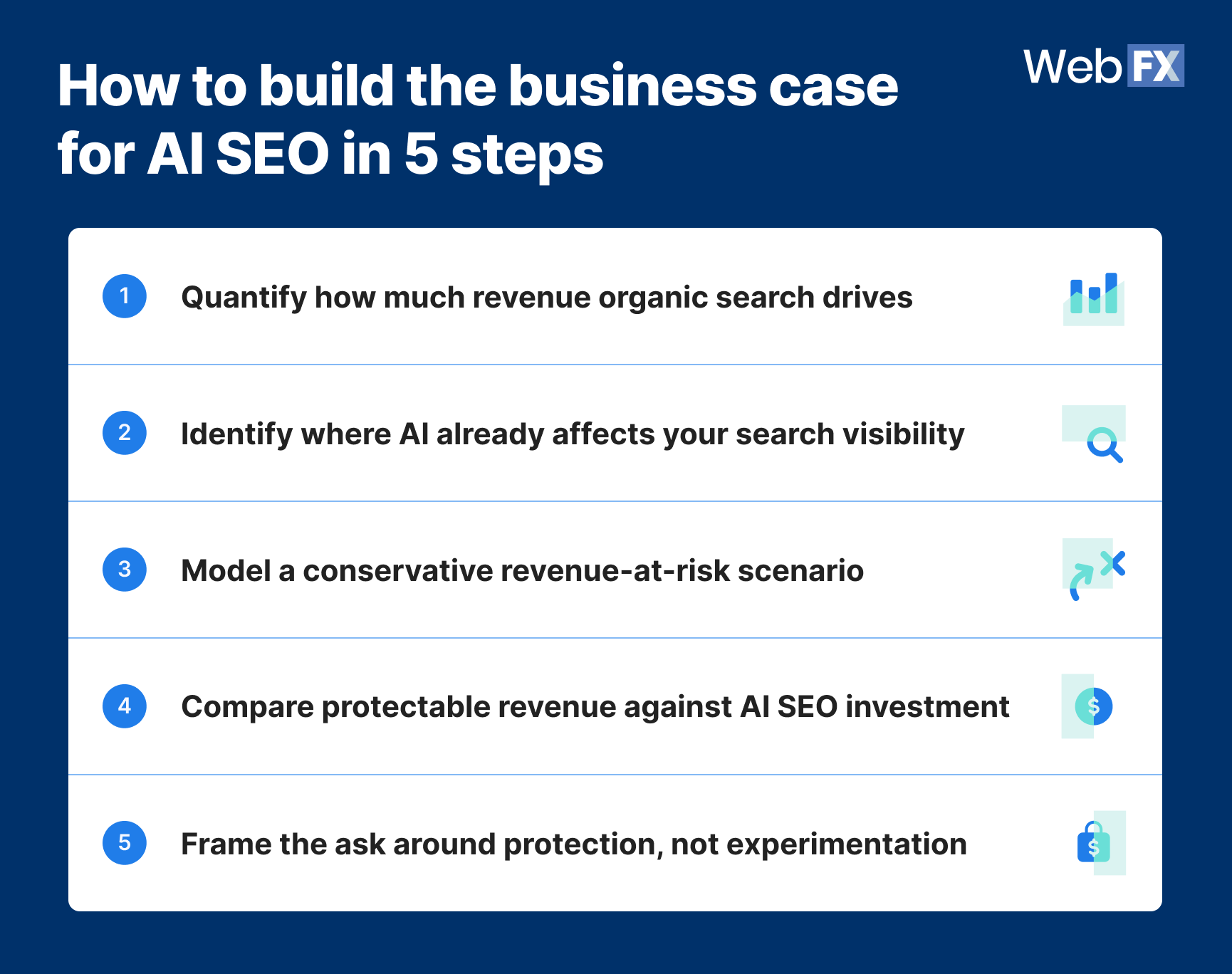
Building the business case for AI SEO comes down to one thing: translating visibility risk into financial terms your leadership team can evaluate. This five-step framework gives you the structure to do exactly that:
- Quantify how much revenue organic search drives
- Identify where AI already affects your search visibility
- Model a conservative revenue-at-risk scenario
- Compare protectable revenue against AI SEO investment
- Frame the ask around protection, not experimentation
Step 1: Quantify how much revenue organic search drives
Open Google Analytics 4 (GA4) or your customer relationship management (CRM) system and pull the actual revenue, leads, and pipeline value that organic search generated over the past 12 months.
If organic search drives $5 million in annual revenue for your company, that number becomes the anchor for every calculation that follows. If it drives $500,000, that still matters. The point is to ground the conversation in currency your CFO already tracks.
Step 2: Identify where AI already affects your search visibility
Search your core keywords on Google. Count how many trigger an AI Overview at the top of the results page. Then open ChatGPT and Perplexity and ask the questions your buyers ask. Note which competitors show up in those AI responses and whether your brand appears at all.
Look for three warning signs:
- AI Overviews appearing on your highest-value keywords
- Competitors getting cited in ChatGPT or Perplexity for queries you should own
- Declining click-through rate (CTR) in Google Search Console without corresponding ranking drops
If you spot even one of these, your buyers are already getting answers from someone else.
Step 3: Model a conservative revenue-at-risk scenario
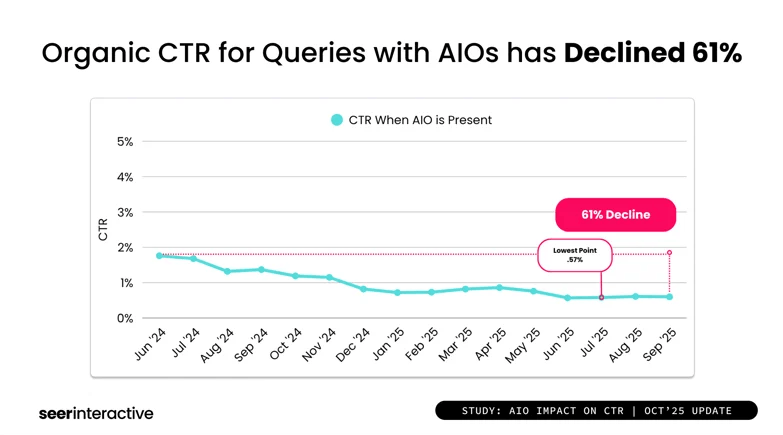
The data on click erosion is hard to argue with. Ahrefs analyzed 300,000 keywords in December 2025 and found that AI Overviews correlate with a 58% lower click-through rate for the top-ranking page. Seer Interactive tracked 25.1 million organic impressions across 42 organizations and found a 61% drop in organic CTR on queries where AI Overviews appeared.
You don’t need to model the worst case. Even a conservative 15% to 20% erosion scenario over two to three years creates real exposure. If organic drives $5 million and you project a 15% decline, that’s $750,000 in revenue at risk. That number gets attention in a boardroom.
Step 4: Compare protectable revenue against AI SEO investment
Now put the investment in context. A comprehensive AI SEO program typically runs $3,000 to $12,000+ per month, depending on scope. That’s $36,000 to $144,000 per year. Compare that against the revenue you identified at risk.
The AI SEO return multiple formula
(Revenue at Risk × % Mitigated) ÷ AI SEO Investment = Return Multiple
Here’s an example:
- Revenue at Risk: $5M organic revenue × 15% projected decline = $750K at risk
- % Mitigated: 50% conservative estimate of erosion prevented
- AI SEO Investment: $60K/year
- The math: ($750K × 50%) ÷ $60K = 6.25x return
In this scenario, every $1 invested in AI SEO could help protect an estimated $6.25 in organic revenue.
Frame this as capital efficiency. You’re spending a fraction of the exposed revenue to protect a significant portion of it. That’s actual risk management, not a mere experiment.
Step 5: Frame the ask around protection, not experimentation
This is the difference between a request that gets approved and one that gets tabled. Leadership teams don’t fund experiments when budgets are tight. They fund strategies that protect existing revenue streams and create competitive separation.
Position AI SEO as margin preservation and an efficient allocation of marketing dollars. If organic search already works for your business, AI search optimization helps it keep working as search behavior shifts.
Here’s what to bring into the leadership meeting:

Your business case for AI SEO checklist:
- Organic revenue, leads, and pipeline value from the past 12 months
- Target keywords where AI Overviews or competitor citations currently appear
- A 15-20% revenue erosion scenario with the dollar amount at risk
- Your AI SEO return multiple calculation using actual company numbers
- A one-page summary framing AI SEO as revenue protection, not just an experiment
What is AI search optimization, and how is it different from SEO?
AI search optimization is the process of engineering your brand’s digital presence so AI systems recognize, trust, and surface your business in their responses. Platforms like Google AI Overviews, ChatGPT, Perplexity, and Microsoft Copilot all decide which brands to recommend based on authority signals, content structure, and entity clarity.
Traditional SEO gets your pages ranked. AI SEO helps your brand get cited, mentioned, and surfaced in AI-generated responses. Both matter, and they work best together. Here’s how they compare:
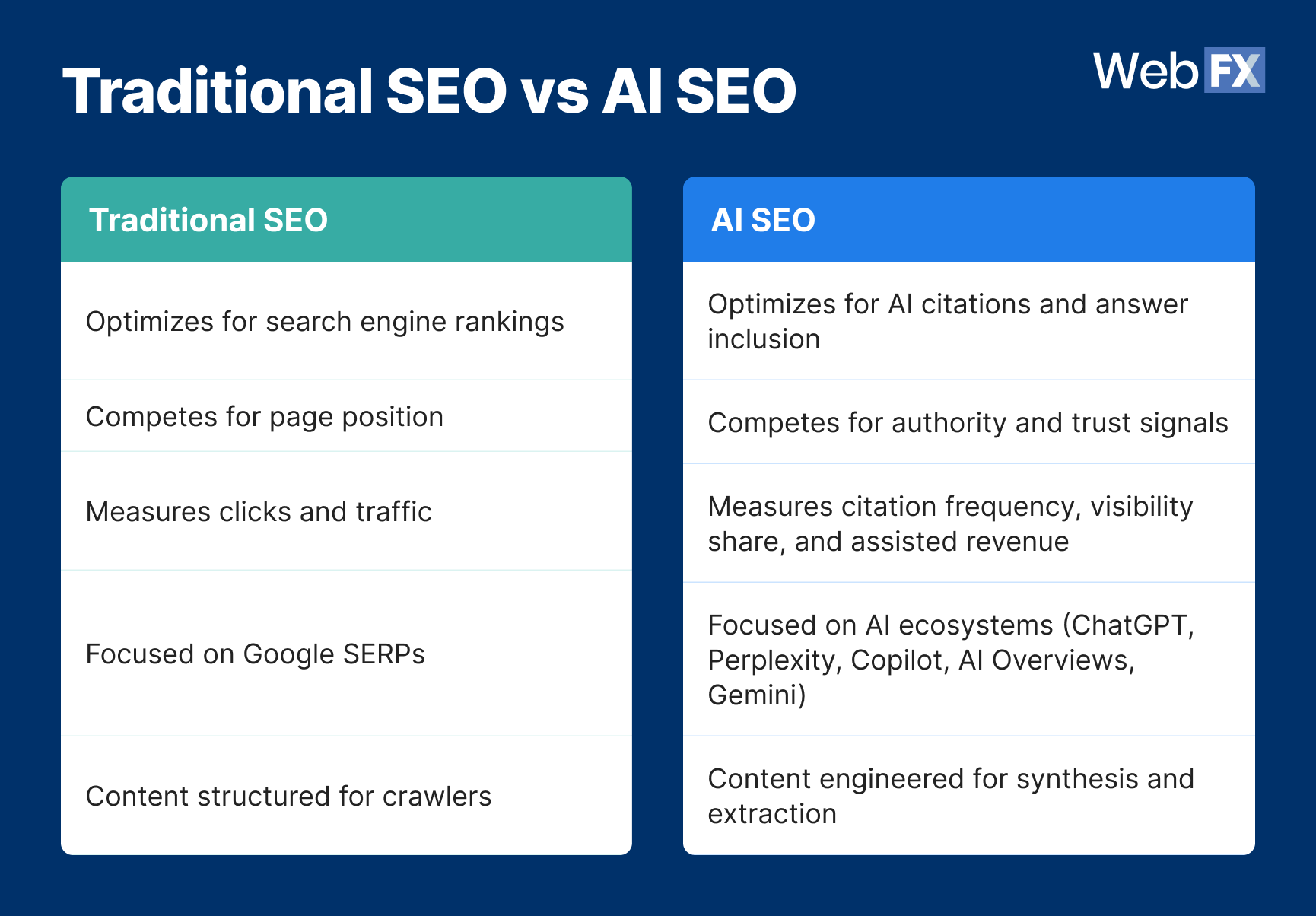
Table view
Traditional SEO vs AI SEO
| Traditional SEO | AI SEO |
| Optimizes for search engine rankings | Optimizes for AI citations and answer inclusion |
| Competes for page position | Competes for authority and trust signals |
| Measures clicks and traffic | Measures citation frequency, visibility share, and assisted revenue |
| Focused on Google SERPs | Focused on AI ecosystems (ChatGPT, Perplexity, Copilot, AI Overviews, Gemini) |
| Content structured for crawlers | Content engineered for synthesis and extraction |
AI SEO amplifies the SEO foundation already in place. It expands your visibility into the AI-driven channels where more and more buyers start their research.
What happens if you do nothing?
The click erosion is already measurable. Pew Research Center tracked 68,879 Google searches by 900 U.S. adults in March 2025 and found that CTR dropped from 15% to 8% when AI summaries appeared on a results page. Similarweb reported that zero-click searches grew from 56% to 69% between May 2024 and May 2025. Ahrefs’ December 2025 study put the CTR decline at 58% for the number-one ranking position when an AI Overview is present.
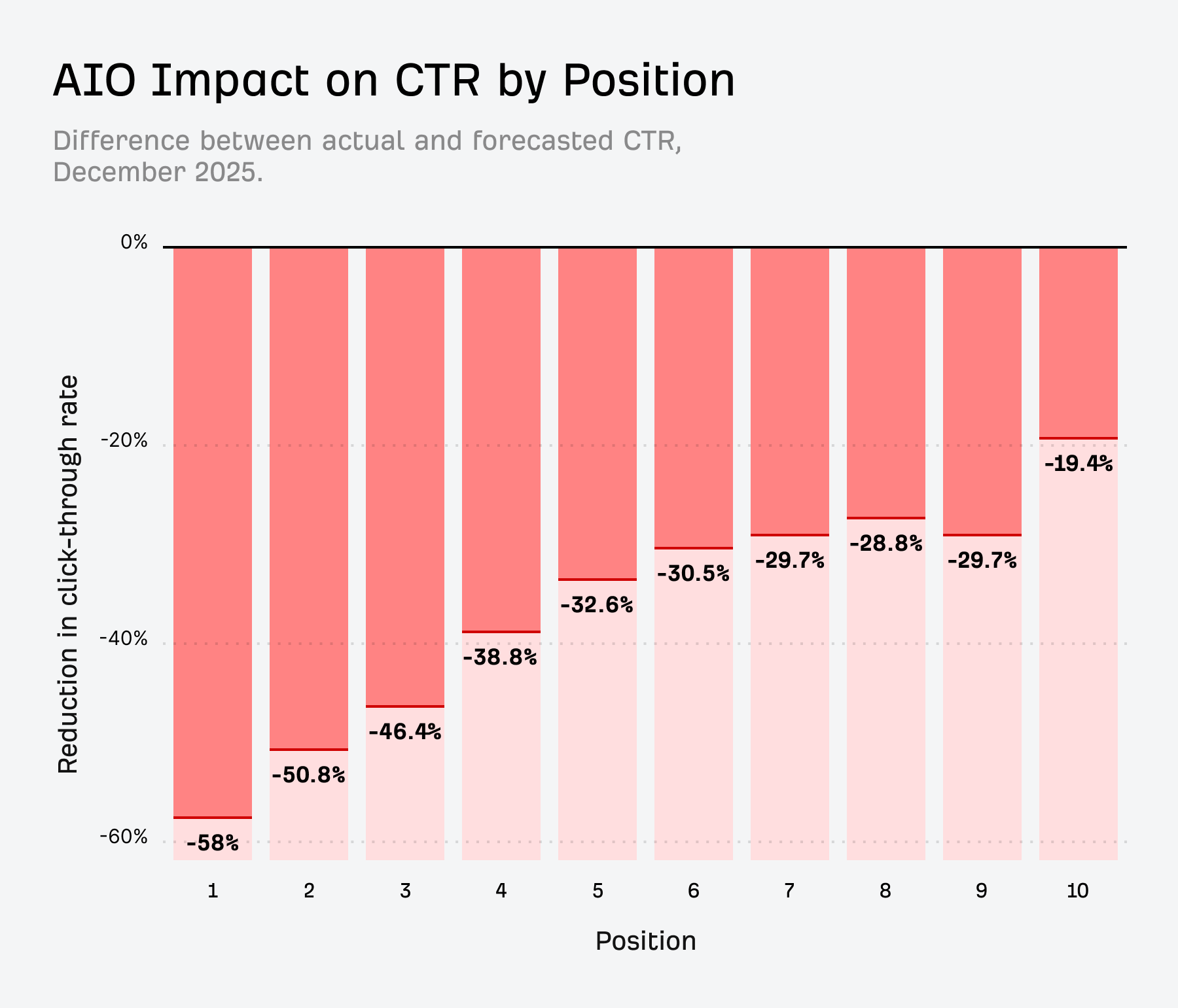
These numbers represent traffic that used to flow to your site and no longer does, even when your rankings haven’t changed. And the impact compounds. Less organic traffic means less brand exposure. Less brand exposure means lower familiarity with buyers. Lower familiarity drives up your cost per acquisition (CPA) as you rely more heavily on paid channels to make up the difference.
Meanwhile, the competitors who invest in AI SEO today are building citation authority across every major AI platform. That authority compounds, too. The longer they hold those positions, the more expensive it becomes to displace them. Every quarter you wait doesn’t just maintain the status quo. It widens the gap.
What early AI SEO investment looks like in practice
The business case gets easier to make when you can point to real results. Here are three companies that invested in AI SEO through WebFX’s OmniSEO® and saw measurable returns:
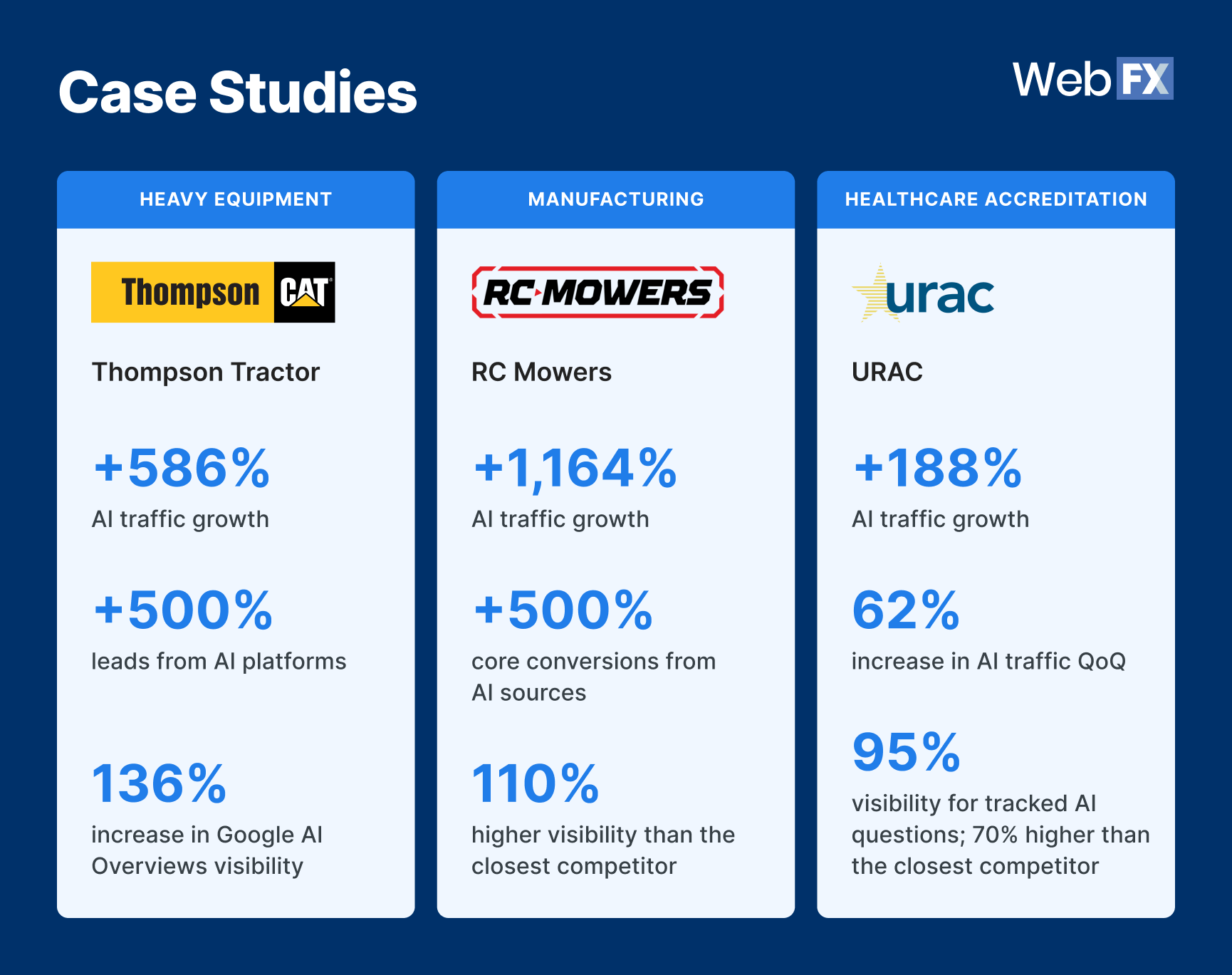
Table view
AI SEO case studies
| Client | AI Traffic Growth | AI Performance Growth | AI Visibility |
| Thompson Tractor (Heavy Equipment) | +586% | +500% leads from AI platforms | 136% increase in Google AI Overviews visibility |
| RC Mowers (Manufacturing) | +1,164% | +500% core conversions from AI sources | 110% higher visibility than the closest competitor |
| URAC (Healthcare Accreditation) | +188% | 62% increase in AI traffic QoQ | 95% visibility for tracked AI questions; 70% higher than the closest competitor |
Thompson Tractor (heavy equipment)
Thompson Tractor became the first CAT dealer at WebFX to launch an OmniSEO® strategy. The WebFX team analyzed which sources AI Overviews cited for top industry keywords, then secured Thompson Tractor placements in those trusted sources. They also created targeted seed content to answer the questions AI tools surface most often in the heavy equipment space.
RC Mowers (manufacturing)
RC Mowers invested before competitors in the commercial landscaping space even recognized AI search as a channel. WebFX set up custom GA4 tracking for generative AI traffic, created long-form content that ranked for nearly 200 keywords within a month, and built authority through targeted link acquisition around high-opportunity topics.
URAC (healthcare accreditation)
URAC, a healthcare accreditation leader trusted by organizations like Johns Hopkins Medicine and CVS Pharmacy, leaned on WebFX’s healthcare-experienced content team to produce expert-written seed content across topics like telehealth, specialty pharmacy, and health equity. The earned media team secured 95+ authoritative backlinks that boosted both search rankings and AI citation likelihood.
The common thread across all three is that each company built AI SEO on top of an existing organic foundation, each moved before their direct competitors did, and each created measurable separation that gets harder to close with every passing quarter.
FAQs about AI SEO
What is AI search optimization?
AI search optimization is the practice of structuring your website, content, and brand signals so AI platforms like Google AI Overviews, ChatGPT, Perplexity, and Copilot recognize, trust, and cite your business in their responses. It works alongside traditional SEO to expand your visibility into AI-driven search channels where a growing share of buyer research now begins.
How much does AI SEO cost?
AI SEO costs vary by scope and provider. At WebFX, our services start at $3,000 per month, with enterprise-level programs scaling based on prompt monitoring volume, content production, and the number of AI platforms tracked. The investment should always be evaluated against the organic revenue at risk from AI-driven click erosion.
Does AI SEO replace traditional SEO?
No. AI SEO builds on traditional SEO rather than replacing it. Your existing rankings, domain authority, and content foundation make AI search optimization more effective. Research shows that over 75% of AI Overview links are from the top 12 organic rankings. Therefore, a strong SEO program is the starting point, not something you swap out.
How do you measure AI SEO results?
Measure AI SEO results by tracking citation frequency across platforms like ChatGPT and Perplexity, AI-driven traffic through custom GA4 channels, visibility share compared to competitors, and leads or revenue attributed to AI referral sources. WebFX’s OmniSEO® platform includes a dedicated AI visibility dashboard that monitors brand mentions across multiple AI platforms in real time.
When should you invest in AI SEO?
Invest in AI SEO when you see organic traffic plateaus despite strong rankings, declining CTR without ranking drops, AI Overviews appearing on your target keywords, or competitors showing up in AI-generated answers for queries you should own. If your business relies on organic search for revenue and two or more of those signals apply, the window for cost-effective entry is still open but narrowing.
What does an AI SEO strategy include?
A comprehensive AI SEO strategy includes AI visibility auditing across major platforms, seed content creation engineered for citation, authority link building focused on sources AI systems trust, entity optimization so AI understands your brand clearly, and ongoing monitoring and reporting. WebFX’s OmniSEO® approach combines these elements with traditional SEO to build visibility across Google, ChatGPT, Perplexity, Copilot, Meta AI, and other platforms where buyers search.
Future-Proof Your SEO Strategy with OmniSEO®
Goodbye search engine optimization, hello search everywhere optimization.
Protect and grow your organic revenue with AI SEO
Your buyers are already using AI to research, compare, and shortlist businesses. They’re asking ChatGPT, Perplexity, Copilot, and Gemini the exact questions your sales team hears on discovery calls. If your content isn’t built to get cited by AI platforms today, your competitors’ content becomes the answer your buyers see tomorrow.
With 30+ years of experience and a team of 750+ digital experts, WebFX helps businesses like yours stay visible through every search shift. Our proprietary tech and platform, OmniSEO®, can future-proof your brand visibility everywhere with a tailored strategy and next-gen software to prove it.
Your SEO investment built the foundation. Let’s make sure it keeps paying off as search evolves. Get your free proposal or call 888-601-5359 to speak with a strategist today about our proven AI search optimization services.
-
 Albert Dandy Velasquez blends SEO strategy with compelling storytelling to help businesses boost their visibility and revenue online. With a B.A. in English and certifications from HubSpot, Semrush, and Google Analytics, he has written and optimized hundreds of articles on organic SEO, content strategy, and user experience. He regularly contributes to the WebFX blog and SEO.com, creating content that helps readers turn marketing goals into measurable results. When he’s off the clock, he’s usually exploring new neighborhoods on two wheels, filming travel content, or chasing golden hour with a coffee in hand.
 -

WebFX is a full-service marketing agency with 1,100+ client reviews and a 4.9-star rating on Clutch! Find out how our expert team and revenue-accelerating tech can drive results for you! Learn more

Try our free Marketing Calculator
Craft a tailored online marketing strategy! Utilize our free Internet marketing calculator for a custom plan based on your location, reach, timeframe, and budget.
Contents
- How to build the business case for AI SEO in 5 steps
- Step 1: Quantify how much revenue organic search drives
- Step 2: Identify where AI already affects your search visibility
- Step 3: Model a conservative revenue-at-risk scenario
- Step 4: Compare protectable revenue against AI SEO investment
- Step 5: Frame the ask around protection, not experimentation
- What is AI search optimization, and how is it different from SEO?
- What happens if you do nothing?
- What early AI SEO investment looks like in practice
- Thompson Tractor (heavy equipment)
- RC Mowers (manufacturing)
- URAC (healthcare accreditation)
- FAQs about AI SEO
- Protect and grow your organic revenue with AI SEO
Share this article


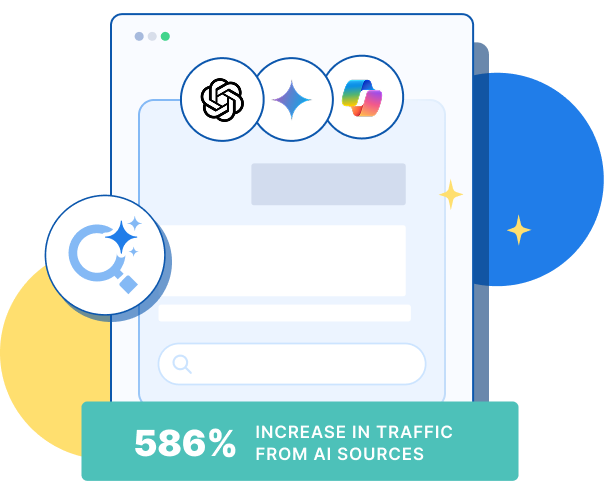
See AI Marketing in Action
Explore how WebFX helped a regional brand get discovered in AI search experiences — proving what’s possible with today’s AI-driven marketing!
Try our free Marketing Calculator
Craft a tailored online marketing strategy! Utilize our free Internet marketing calculator for a custom plan based on your location, reach, timeframe, and budget.