



Table of Contents
- What is healthcare PPC?
- Why use PPC advertising for healthcare?
- How does healthcare PPC work?
- What should a healthcare PPC strategy include?
- 1. High-intent keywords
- 2. Location targeting
- 3. Dedicated landing pages
- 4. HIPAA-aware tracking and analytics
- 5. Call tracking and intake follow-up
- 6. Budget controls
- 7 healthcare PPC best practices
- 1. Build campaigns around patient intent
- 2. Use location targeting carefully
- 3. Send clicks to service-specific landing pages
- 4. Make calls and appointments easy
- 5. Keep compliance involved in tracking decisions
- 6. Measure qualified inquiries, not just clicks
- 7. Pair PPC with local SEO
- 5 common healthcare PPC mistakes to avoid
- 1. Sending every ad to your homepage
- 2. Using the same campaign structure for every service
- 3. Tracking clicks but not patient inquiries
- 4. Ignoring compliance until after launch
- 5. Evaluating PPC results without looking at your intake process
- Should healthcare practices use Google Ads, Meta Ads, or both?
- FAQs about healthcare PPC
- Grow your practice with healthcare PPC services from WebFX

At a glance: PPC for healthcare
- PPC for healthcare is a paid advertising strategy that helps healthcare organizations reach people searching for medical services online.
- Healthcare PPC can drive patient inquiries faster than organic channels alone, especially for high-intent searches like “urgent care near me.”
- High-intent keywords, service-specific landing pages, call tracking, and a smooth intake process help turn inquiries from PPC into appointment opportunities.
- Healthcare PPC requires privacy-aware tracking and compliance review because campaigns may involve sensitive health-related searches, calls, forms, and remarketing decisions.
Pay-per-click advertising (PPC) for healthcare helps practices, clinics, hospitals, and other healthcare organizations reach people who are actively searching for care. With the right strategy, PPC ads can help you promote priority services, increase appointment inquiries, and show up for high-intent searches like “urgent care near me” or “dentist accepting new patients.”
Healthcare PPC needs more planning than a typical paid ad campaign. The challenge? Healthcare ads can get expensive, and a click on your ad doesn’t always translate into a new patient.
Your campaigns need high-intent keywords, service-specific landing pages, privacy-aware tracking, and a smooth appointment process to make your ad spend count.
This guide breaks down how healthcare PPC works, what your strategy should include, and best practices that can help you turn more clicks into patients:
- What is healthcare PPC?
- Why use PPC advertising for healthcare?
- How does healthcare PPC work?
- What should a healthcare PPC strategy include?
- 7 healthcare PPC best practices
- 5 common healthcare PPC mistakes to avoid
- Should healthcare practices use Google Ads, Meta Ads, or both?
- FAQs about healthcare PPC
🎥Video: WebFX’s approach to healthcare marketing
Explore WebFX Healthcare Marketing Services
What is healthcare PPC?
Healthcare PPC is a paid digital advertising strategy that helps healthcare organizations reach people looking for care online. With PPC, you pay when someone clicks your ad, rather than paying only for the ad to appear.
For example, a physical therapy clinic may run a Google Search ad for “physical therapy near me.” A dental practice may promote “dentist accepting new patients” to people in its service area.
Healthcare PPC ads can appear across several platforms, including:
- Google Ads
- Microsoft Advertising
- Meta Ads
- Display networks, such as banner or image ads on health-related websites, local news sites, or other online placements where your audience may spend time
- Video platforms, such as YouTube ads that introduce a service, explain a treatment option, or promote a provider before or during relevant video content
Search ads are often a strong starting point because they help you reach people who already have intent. Someone searching “urgent care near me open now” is much closer to scheduling care than someone casually scrolling social media.
That being said, healthcare PPC needs a thoughtful setup. Your campaigns may involve sensitive health-related searches, which means your targeting, ad copy, landing pages, tracking, and remarketing decisions need careful review. Strong healthcare PPC balances visibility with patient trust and privacy-aware measurement.
Why use PPC advertising for healthcare?
PPC advertising gives healthcare organizations a faster way to reach people who need care and guide them toward an appointment inquiry. Here are three reasons to use PPC for healthcare:
- Reach patients when they’re searching for care: Search ads can help your practice appear when people look for services like “urgent care near me,” “dentist accepting new patients,” or “physical therapy in [city].” These searches often show stronger intent than general healthcare research because the person already has a need and wants to compare care options.
- Help your SEO strategy build momentum: Healthcare search engine optimization (SEO) is an excellent way to improve your online visibility, but it takes time to rank for competitive keywords. With PPC, your practice can show up sooner for priority services or locations while your organic strategy is in its earlier stages.
- Promote your priorities: Healthcare PPC can help you put budget behind the services, providers, or locations that matter most to your organization. For example, you may use paid ads to promote high-value services, fill appointment gaps, or support a newly opened office location.
A click doesn’t become revenue until someone books, shows up, and receives care. That’s why healthcare PPC works best when your campaigns connect targeting, landing pages, tracking, and intake follow-up.
How does healthcare PPC work?
Healthcare PPC works by showing your ads to people who search for relevant medical services or who match your campaign targeting.
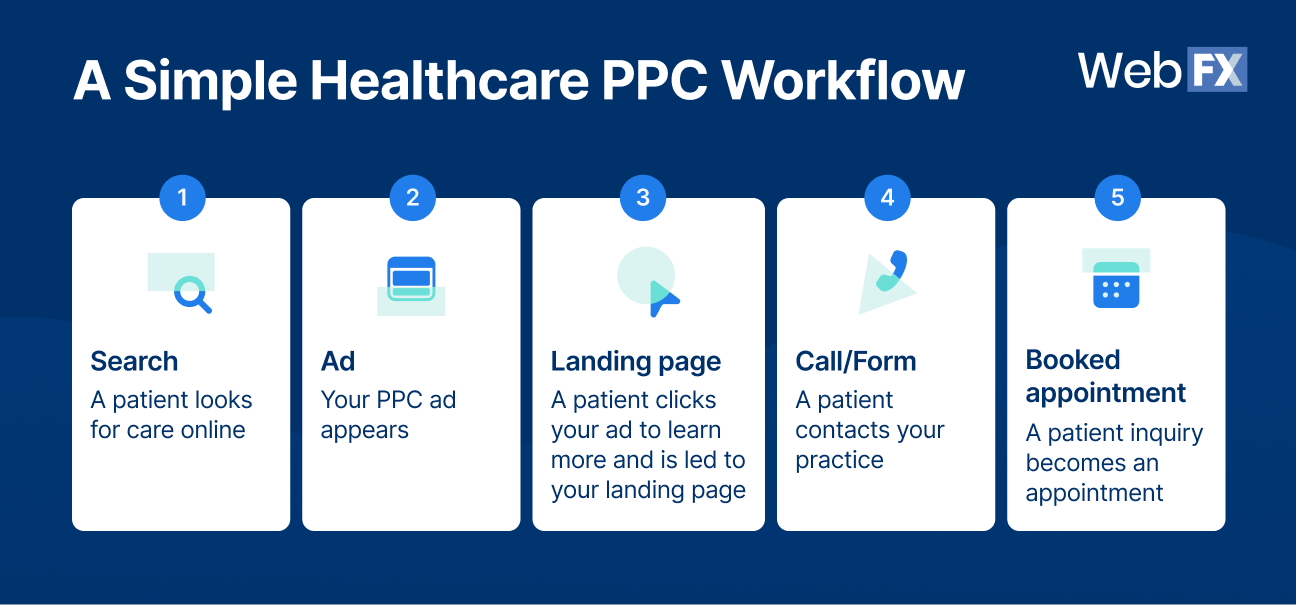
Think of PPC as an auction for attention, but the highest bid doesn’t automatically win. When someone searches, your ad can bid for a prominent spot that your audience can see. The ad platform evaluates factors like your bid, ad relevance, and landing page experience to determine whether your ad appears and where it shows.
Here’s the basic process:
- A patient searches for a service or matches your targeting criteria.
- Your ad enters the ad auction.
- The platform evaluates your bid, relevance, and landing page experience.
- The patient clicks your ad.
- Your landing page encourages a call, form fill, or appointment request.
- Your tracking connects the inquiry to the campaign.
For example, say a pediatric dental office wants to attract more families. The practice targets “children’s dentist near me” and sends visitors to a landing page.
That page highlights the office location, accepted insurance, dentist credentials, patient reviews, and appointment instructions. Calls and forms are then tracked so the pediatric dental office can see which campaigns drive inquiries.
What should a healthcare PPC strategy include?
A healthcare PPC strategy needs to connect what patients search, what your ads promise, and what happens after someone clicks. When these elements work together, you can reach the right people, guide them to the next step, and reduce wasted ad spend.
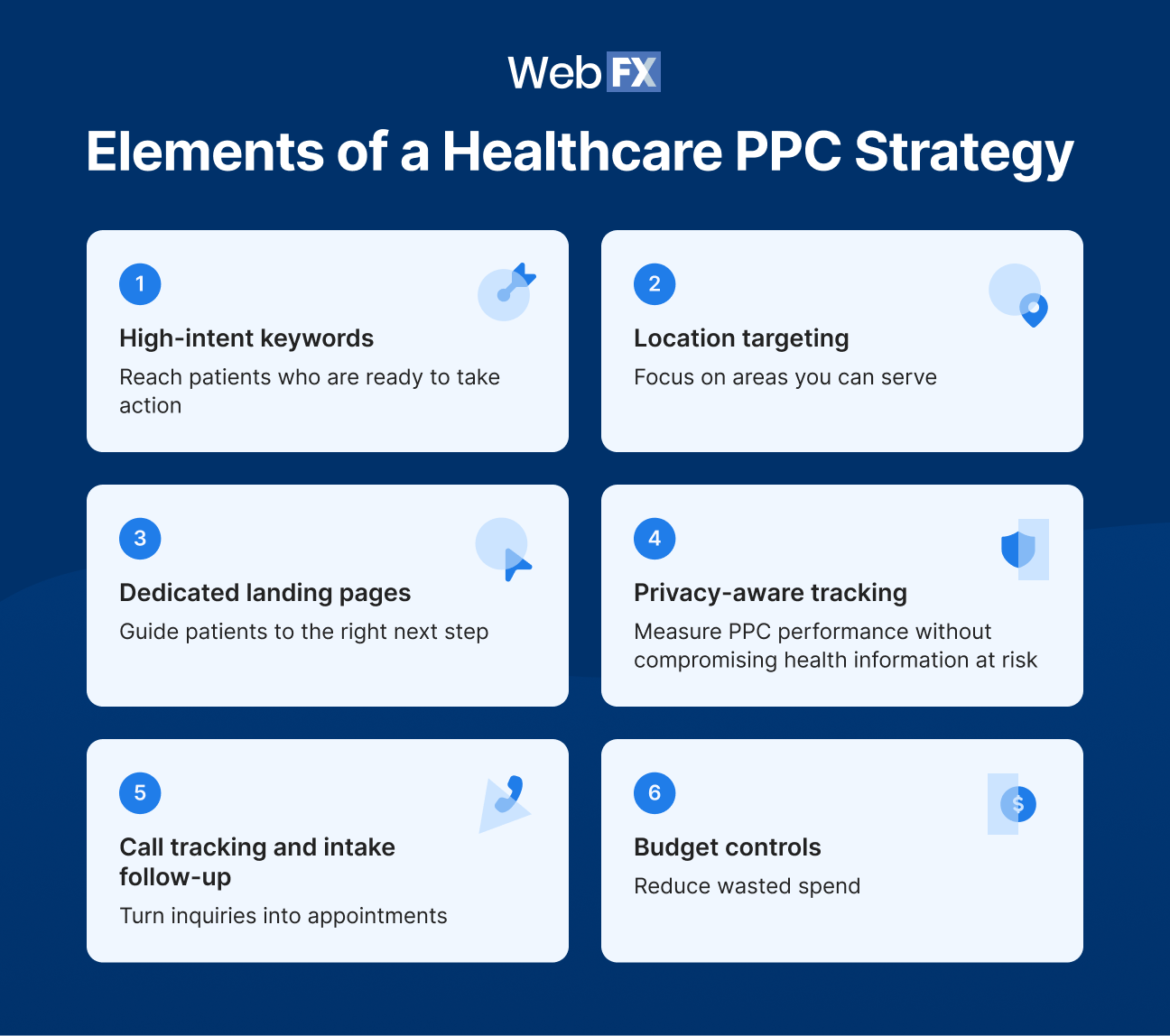
A strong healthcare PPC strategy should include:
- High-intent keywords
- Location targeting
- Dedicated landing pages
- Privacy-aware tracking
- Call tracking and intake follow-up
- Budget controls
1. High-intent keywords
High-intent keywords help you reach patients who are closer to booking an appointment or calling your practice. In healthcare, these keywords often include:
- Service: An example of a service keyword is “knee replacement surgery” for an orthopedic surgeon in Dallas, Texas.
- Symptom: “knee pain when walking”
- Provider type: “orthopedic surgeon near me”
- Location: “orthopedic clinic in Dallas, Texas”
- Urgency modifier: “same-day orthopedic appointment.”
Use keyword groups related to your services and patients’ needs.
For example, a dermatology practice may need separate campaigns for acne treatment, skin cancer screenings, cosmetic dermatology, and eczema care. A single generic campaign that runs all ads for the practice’s different services can make it harder to understand which ads or services drive qualified inquiries.
2. Location targeting
Even if your organization serves multiple cities or counties, patients usually want care within a realistic travel distance.
Use location targeting to focus your ad budget on the areas you can actually serve. For example, an urgent care clinic may prioritize a tight radius around each location, while a specialty practice may target a wider region because patients are more willing to travel for specialized care.
For multi-location practices, consider separate campaigns or ad groups by office location. This setup helps you tailor ad copy, landing pages, budgets, and reporting to each office.
3. Dedicated landing pages
A dedicated landing page gives paid visitors a direct path from ad click to appointment inquiry. Include:
- Services offered
- Location
- Insurance accepted (when applicable)
- Provider credentials
- Reviews, awards, affiliations, or other trust signals
- Clear call or appointment options.
Pro tip: Your ad should lead to a dedicated landing page, not your homepage. You don’t want paid visitors to look around your homepage to find the service page they expected.
If they clicked an ad they saw when they searched “dental braces for teenagers in Dallas, Texas,” they expect to land on a page that provides details about the service, pricing, and how to book an appointment.
4. HIPAA-aware tracking and analytics
Healthcare PPC tracking should help you measure performance without putting protected health information at risk. Before using pixels, call tracking, remarketing, call recordings, or customer relationship management (CRM) integrations, make sure your legal, compliance, or qualified marketing partner reviews your setup.
This step matters because healthcare campaigns can involve sensitive intent. A patient’s search, form submission, or call may reveal information they expect your organization to handle carefully.
Keep your analytics focused on performance signals your team can use responsibly, such as which campaigns drive calls, forms, and appointment requests. Avoid collecting or sharing sensitive patient details through ad platforms unless your compliance team has approved the process.
5. Call tracking and intake follow-up
Many potential patients contact healthcare practices by phone. A strong PPC campaign can generate calls, but missed calls, slow follow-up, or unclear intake scripts can make the campaign look weaker than it is.
Track calls from ads, form submissions, booked appointments when possible, missed calls, and lead quality by service line. These metrics help you see whether your PPC campaigns are attracting the right patients and whether your team can turn inquiries into appointments.
For example, if one campaign drives 50 calls but your team misses 20 of them, the campaign may not be the only issue. Your intake process may need attention, too.
6. Budget controls
Healthcare costs per click (CPCs) can get expensive, especially in competitive specialties. Budget controls help you spend where patient intent and revenue potential are strongest.
Here’s how:
- Use negative keywords to filter out irrelevant searches. For example, if a dermatology practice treats medical skin conditions but does not offer cosmetic procedures, it may add negative keywords like “Botox,” “filler,” or “laser hair removal.”
- Use location controls to focus on serviceable areas. This helps you avoid paying for clicks from people who live too far away to become patients.
- Segment your campaigns by service. Separate campaigns make it easier to control budget, write relevant ads, and see which ads drive qualified inquiries.
- Schedule your ads for times when your team can answer calls. If calls are your main conversion point, running ads when no one can answer may waste budget.
You should also avoid judging every service by the same cost per lead. A higher-value procedure may support a higher cost per inquiry than a lower-margin appointment type.
7 healthcare PPC best practices
Healthcare PPC best practices help you build campaigns that attract qualified patient inquiries while reducing wasted spend. Use these tips to guide your strategy whether you manage ads internally or work with an agency.
1. Build campaigns around patient intent
Start with the patient’s reason for searching.
Someone looking for “emergency dentist near me” needs different messaging from someone searching for “teeth whitening cost.” The first search is urgently looking for a dentist, while the second search is comparing costs.
Group your campaigns by service line, location, and urgency level. This structure helps you write more relevant ads and send patients to landing pages that match their needs.
2. Use location targeting carefully
Location targeting helps you avoid paying for clicks from people who are unlikely to visit your practice. Target the cities, ZIP codes, counties, or radius areas that match your real patient base.
If your practice has multiple locations, avoid sending all paid traffic to one generic page. A patient searching for a provider near them shouldn’t land on a page that makes them dig for the nearest office. Use location-specific landing pages when possible.
Pro tip: Review location performance regularly. If one area spends heavily without producing inquiries, adjust your targeting or budget.
3. Send clicks to service-specific landing pages
Your landing page should continue the conversation your ad started. Think of your landing page like your front desk. It should guide your patients to take the next steps.
If your ad promotes a specific service, your landing page should focus on that service. The next steps should be clear, too. Include:
- Appointment options
- Click-to-call buttons
- Provider credentials and other trust signals
- Insurance information when applicable
- A short explanation of what the patient can expect
If it gives vague answers, hides key information, or makes the next step hard to find, patients may leave before contacting you.
4. Make calls and appointments easy
Healthcare PPC often succeeds or fails on the appointment path. Make it easy for patients to find your phone number, appointment button, location, or service details.
Here are tips on how to do that:
- Use click-to-call on mobile ads
- Place your phone number or appointment call-to-action near the top of your landing page
- Keep your forms short and ask only for the information your team needs to follow up
Make sure your intake team knows which services your campaigns promote. If a patient calls from a PPC landing page and the front desk can’t answer basic questions about availability, insurance, or next steps, you may lose the lead.
5. Keep compliance involved in tracking decisions
Compliance should shape your campaign before launch, not after a reporting problem appears. Pixels, remarketing, call recordings, CRM integrations, and audience targeting can all carry extra considerations for healthcare advertisers.
Work with your internal compliance team, legal team, or a qualified healthcare marketing partner to review your setup. This review helps your organization understand what you can track, how you can track it, and which tactics you should avoid.
This best practice may slow down setup, but it can help you prevent bigger issues later.
6. Measure qualified inquiries, not just clicks
Clicks show whether people interact with your ads. They don’t show whether your campaigns attract the right patients.
Track calls, forms, booked appointments when available, cost per inquiry, cost per booked appointment, call answer rate, and landing page conversion rate. These metrics help you understand whether your ad spend supports patient acquisition.
For example, a campaign with a low CPC may look efficient, but if it drives unqualified calls or irrelevant form fills, it may waste budget. A campaign with a higher CPC may perform better if it produces booked appointments for a high-value service line.
7. Pair PPC with local SEO
PPC can help you show up quickly for priority searches, but local SEO for healthcare can build visibility over time. Together, they can support both immediate patient acquisition and long-term growth.
Here are some local SEO tips for your healthcare practice:
- Optimize your Google Business Profile
- Create location-specific pages
- Encourage reviews from your patients
- Keep your name, address, and phone number consistent across local listings
These local SEO efforts can support your paid campaigns by strengthening trust and visibility around your locations.
5 common healthcare PPC mistakes to avoid
Healthcare PPC mistakes can cost you more than ad budget. They can also send patients to the wrong page, create a confusing next step, or make it harder for your team to turn inquiries into appointments.
Watch for these common mistakes before they affect your patient acquisition results.

Healthcare PPC mistakes
1. Sending every ad to your homepage
Your homepage has to serve many audiences. A PPC landing page has one job: to help the visitor take the next step for the service they searched for.
If someone clicks an ad for “IVF consultation,” they shouldn’t have to navigate through your homepage to find fertility services, provider information, or appointment options.
What you should do instead: Send your paid traffic to the most relevant service or location page, or create a dedicated landing page.
2. Using the same campaign structure for every service
Even within the same practice, your services can attract patients with different needs, timelines, and questions. If you’re marketing a dental office, you may need separate campaigns for dental implants and routine cleanings because each service calls for different PPC keywords, ad copy, landing pages, and budget decisions.
What you should do instead: Segment campaigns by service or location, so you can control budget, messaging, landing pages, and reporting. Doing so helps you see which campaigns produce qualified inquiries and which ones you need to refine for better results.
3. Tracking clicks but not patient inquiries
If you only track clicks or traffic, you may miss the more important question: Are your healthcare PPC ads driving the right patients to contact your practice?
What you should do instead: In addition to clicks, track calls, forms, and booked appointments when possible. This approach helps you evaluate campaigns by patient acquisition outcomes.
4. Ignoring compliance until after launch
Healthcare PPC campaigns shouldn’t treat compliance as a final checklist item. Compliance can affect which platforms you use, which audiences you target, which tracking tools you enable, and which messages appear in your ads.
What healthcare practices should do: Bring compliance into the process before launching your PPC campaigns. It’s easier to build a privacy-aware campaign from the start than to rebuild one after performance data, tracking, or ad copy creates concerns.
5. Evaluating PPC results without looking at your intake process
When evaluating your PPC results, look at your intake process, too. Are inquiries getting answered on time? When patients call, do they get clear answers and guidance to book an appointment?
When your patient calls go unanswered, it may look like your PPC campaigns didn’t drive results, even when your intake process needs improvement.
What healthcare practices should do: Review your call answer rate, response time, and scheduling process alongside ad performance. If campaigns generate qualified inquiries that don’t turn into appointments, you may need to evaluate and optimize your intake process.
Should healthcare practices use Google Ads, Meta Ads, or both?
Healthcare practices should usually start with the platform that best matches patient intent. For many healthcare organizations, Google Ads is the strongest starting point because it reaches people who are actively looking for care.
Meta Ads can support awareness, education, and demand generation, while Microsoft Advertising can supplement search visibility. If you want to run remarketing ads, consider display or video ad campaigns when compliance review allows.
That being said, the best PPC platform depends on a few factors, such as your:
- Specialty
- Location
- Audience
- Budget
- Compliance requirements
Start where patient intent is strongest. Then expand once your tracking, landing pages, and intake process can support more channels.
FAQs about healthcare PPC
What is healthcare advertising?
Healthcare advertising is the practice of promoting medical services, providers, locations, and care options through offline and online channels. It helps healthcare organizations reach patients who may need care now or in the future.
What is healthcare PPC?
Healthcare PPC is a paid digital advertising strategy where healthcare organizations pay when someone clicks an ad for their services. These ads can appear in:
- Search results
- Social media feeds
- Websites as display placements
- Video platforms
Why should I use PPC advertising for healthcare?
Healthcare practices can use PPC advertising to reach people actively searching for care, promote priority services, and increase appointment requests. PPC can also help you gain visibility while your organic strategy grows.
What is the best PPC platform for healthcare?
Google Search is often the strongest starting point for high-intent patient searches, but the best platform depends on your specialty, location, audience, budget, and compliance requirements.
Some organizations may also use Microsoft Advertising, Meta Ads, display, or video campaigns as part of a broader healthcare PPC strategy.
How much should healthcare practices spend on PPC?
The right PPC budget depends on your specialty, location, competition, average cost per click, and patient lifetime value. You can also compare your CPC against healthcare marketing benchmarks to see whether your campaigns are in a reasonable range for your industry.
How do you know if healthcare PPC is working?
Healthcare PPC is working when your campaigns generate qualified patient inquiries at a sustainable cost. To find out, track:
- Calls, form submissions, and booked appointments from your PPC campaigns
- Cost per inquiry
- Cost per booked appointment
- Call answer rate
- Landing page conversion rate
Grow your practice with healthcare PPC services from WebFX
Healthcare PPC works best when every part of your campaign supports patient acquisition — from keyword targeting and ad copy to landing pages, tracking, reporting, and intake follow-up. When those pieces work together, paid ads can help you reach more people who are actively looking for care.
WebFX has been helping healthcare organizations build PPC campaigns designed to attract more qualified patient inquiries. With over 98,500+ hours of experience in healthcare marketing, we’ve driven $33.8M+ in revenue for our healthcare clients.
Ready to attract more patient inquiries from paid ads? Contact us online or call us at 888-601-5359 to speak with a strategist!
-
 The WebFX team includes 750+ digital marketing specialists across SEO and AI search, PPC, web design, analytics, and beyond. Using proprietary RevenueCloudFX technology and transparent, data-driven strategies, we’ve collectively generated $10 billion in revenue and 24 million leads for our clients in the past five years.@webfx
 -

WebFX is a full-service digital marketing agency delivering revenue-driving strategies across online advertising, SEO and AI search optimization, and digital marketing. Backed by 1,100+ client reviews, a 4.9-star rating on Clutch, and proprietary revenue-tracking technology, our team helps businesses grow visibility and revenue across platforms, from Google to ChatGPT to LinkedIn. Discover how our expert team and revenue-accelerating tech can drive results for you. Learn more
Try our free Marketing Calculator
Craft a tailored online marketing strategy! Utilize our free Internet marketing calculator for a custom plan based on your location, reach, timeframe, and budget.
Plan Your Marketing Budget
Table of Contents
- What is healthcare PPC?
- Why use PPC advertising for healthcare?
- How does healthcare PPC work?
- What should a healthcare PPC strategy include?
- 1. High-intent keywords
- 2. Location targeting
- 3. Dedicated landing pages
- 4. HIPAA-aware tracking and analytics
- 5. Call tracking and intake follow-up
- 6. Budget controls
- 7 healthcare PPC best practices
- 1. Build campaigns around patient intent
- 2. Use location targeting carefully
- 3. Send clicks to service-specific landing pages
- 4. Make calls and appointments easy
- 5. Keep compliance involved in tracking decisions
- 6. Measure qualified inquiries, not just clicks
- 7. Pair PPC with local SEO
- 5 common healthcare PPC mistakes to avoid
- 1. Sending every ad to your homepage
- 2. Using the same campaign structure for every service
- 3. Tracking clicks but not patient inquiries
- 4. Ignoring compliance until after launch
- 5. Evaluating PPC results without looking at your intake process
- Should healthcare practices use Google Ads, Meta Ads, or both?
- FAQs about healthcare PPC
- Grow your practice with healthcare PPC services from WebFX
Share this article


Help More Patients Find Your Practice
See how healthcare providers like Hurst Pediatric Dentistry increased local leads 5× with data-driven SEO from WebFX.
Try our free Marketing Calculator
Craft a tailored online marketing strategy! Utilize our free Internet marketing calculator for a custom plan based on your location, reach, timeframe, and budget.
Plan Your Marketing Budget
What to read next




Additional Reading


Health & Wellness Case Studies
Solving key challenges for healthcare
Our website isn’t driving enough traffic
Our expert SEO specialists, copywriters, and digital advertisers will help you increase your website’s rankings when your target audience searches for your treatments online, so you can continuously drive traffic and revenue for your practice, hospital, or business.

We’re opening a new location
Set your new hospital, brand, or practice up for future success with a range of digital marketing strategies that get your new practice in front of potential patients or B2B buyers.

We’re not attracting enough patients
Get a steady flow of new patients to your practice, hospital, or brand with expertly crafted strategies that provide a seamless, engaging user experience for your website visitors, encouraging them to become patients.

We have high patient turnover
Offer new treatments or services and need to get them in front of your potential client’s eyes? Our range of revenue-driving digital advertising and marketing services have you covered and reach the people who need your facility the most.
