Which channel appears most consistently in home services searches? The Local Pack, appearing in 98% of searches (488 of 500). It is the most reliable feature on home services SERPs and the visibility foundation businesses should prioritize through local SEO.
How often do Local Services Ads actually appear? Local Services Ads appeared in about 28% of searches overall, but nearly 49% of city-specific searches like “hvac repair dallas,” and they claimed position 1 every time they appeared.
What role do traditional Google Ads play? Traditional Google Ads appeared in just 8% of searches (42 of 500) at an average first position of 11.3, making them best for specific jobs like brand defense, retargeting, and seasonal promotions rather than primary visibility.
What is the typical SERP layout for home services? The top of the page is a two-way contest between Local Services Ads when present and the Local Pack when LSAs are absent, with traditional Google Ads rarely reaching the top.
Where should home services businesses invest first? Based on visibility, prioritize local SEO to win the Local Pack, layer in Local Services Ads where they appear consistently in your market, and use Google Ads for control and retargeting rather than broad visibility.
TL;DR: Local Services Ads vs. Google Ads vs. Local Pack
The Local Pack appeared on 98 of 100 home services keywords studied, making it the most consistent search feature by a wide margin.
Local Services Ads (LSAs) appeared at least once for 78 of 100 keywords, but across all repeated searches, they showed up only about 28% of the time.
Traditional Google Ads appeared on just 26 of 100 keywords, far less often than most home services marketers expect.
When LSAs appeared, they took the top position every time. When LSAs were absent, the Local Pack led the page in nearly every search.
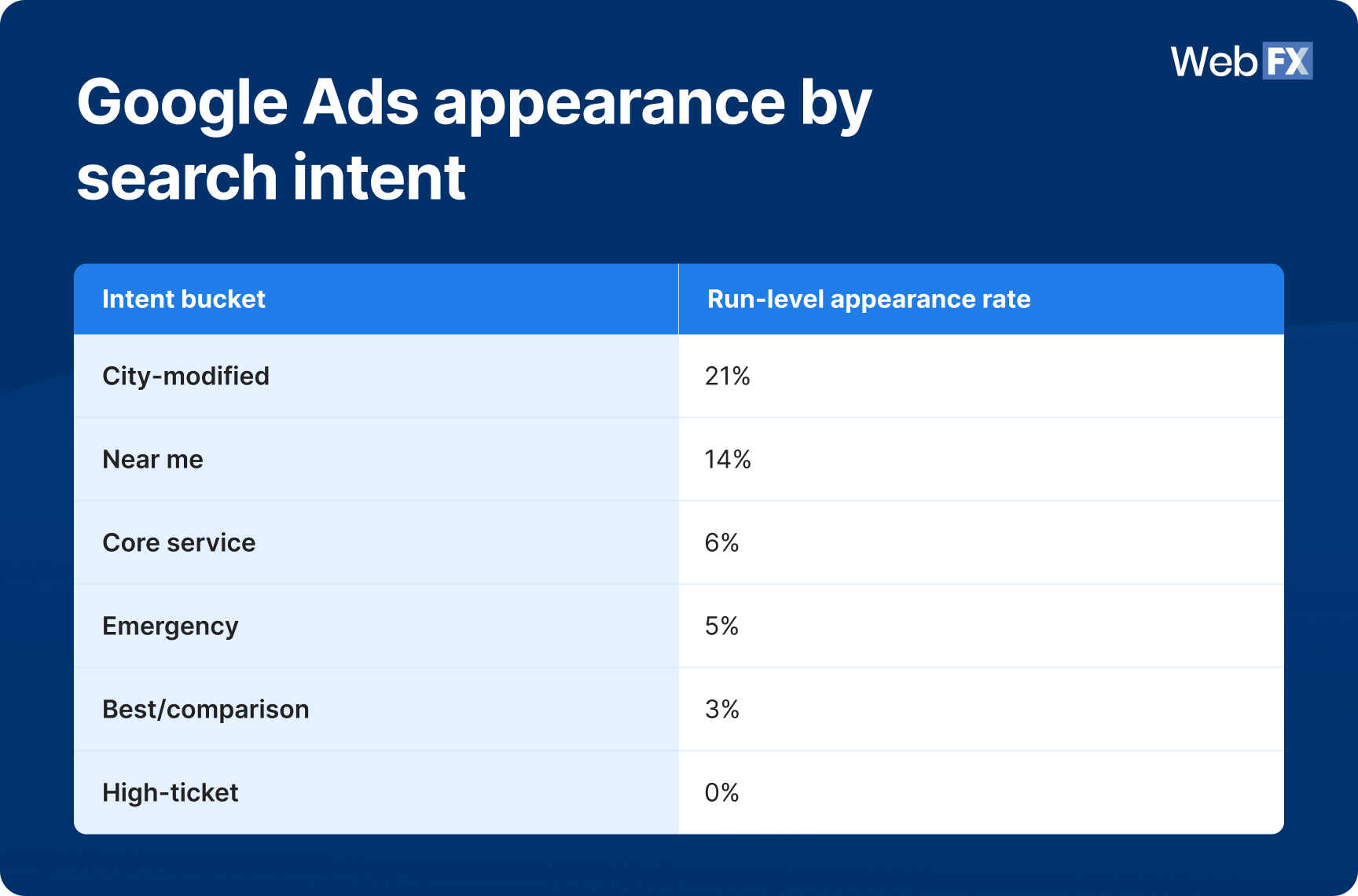
City-modified searches (like “hvac repair dallas”) triggered LSAs at nearly double the rate of generic queries, roughly 49% versus 25%.
For home services businesses, the Local Pack deserves real investment in local SEO, since it appears more consistently than either paid channel.
Local Services Ads (LSAs), Google Ads, and the Local Pack each play a different role in home services marketing. Our 2026 study analyzed 100 keywords across five home service industries to determine which channel appears most often, when each one dominates search results, and where businesses should invest their advertising budget.
So we pulled real search data across HVAC, plumbing, roofing, electrical, and garage door queries to measure which features appear, how often they appear, and where they land on the page. Here is what we found:
Insights from 48,000+ hours of home services marketing experience
Join 200,000+ savvy marketers in getting free marketing insights straight to your inbox.
“*” indicates required fields
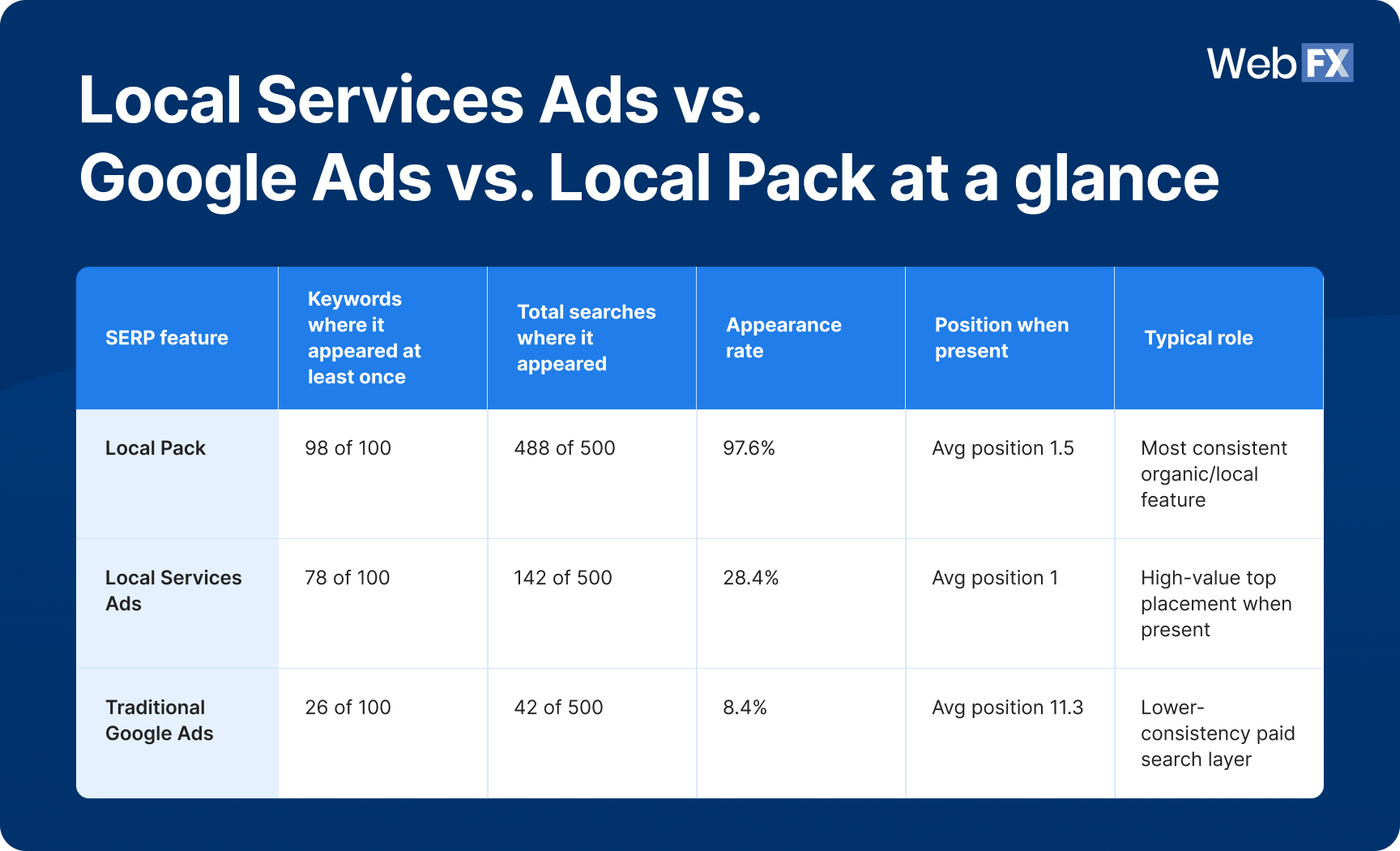
Local Services Ads vs. Google Ads vs. Local Pack at a glance
To compare the visibility of Local Services Ads, Google Ads, and the Local Pack, we studied 100 U.S. home services keywords across five verticals: HVAC, plumbing, roofing, electrical, and garage door services. Each keyword was run 5 times through a third-party search engine results page (SERP) data provider, for a total of 500 searches, to measure which features appeared, how often they appeared, and where they landed on the page.
The three features we tracked were Local Services Ads (the pay-per-lead units with the Google Verified badge), traditional Google Ads (the sponsored pay-per-click results), and the organic Local Pack (the map-based block of local business listings).
Local Services Ads vs. Google Ads vs. Local Pack at a glance
SERP feature
Keywords where it appeared at least once
Total searches where it appeared
Appearance rate
Position when present
Typical role
Local Pack
98 of 100
488 of 500
97.6%
Avg position 1.5
Most consistent organic/local feature
Local Services Ads
78 of 100
142 of 500
28.4%
Always position 1
High-value top placement when present
Traditional Google Ads
26 of 100
42 of 500
8.4%
Avg position 11.3
Lower-consistency paid search layer
The rest of this study breaks down what each row means for your visibility and your budget.
Finding 1: The Local Pack dominates home services SERPs
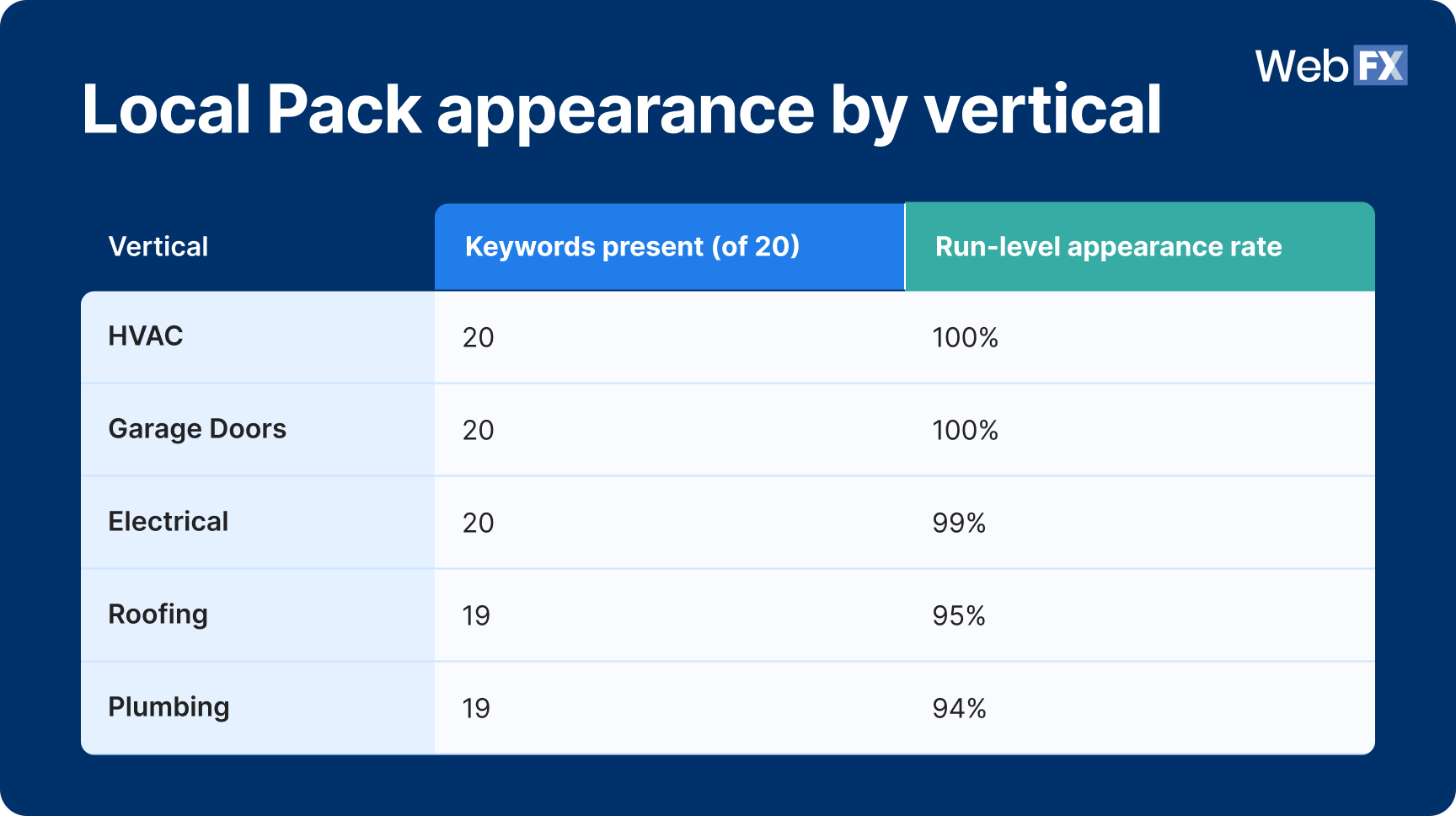
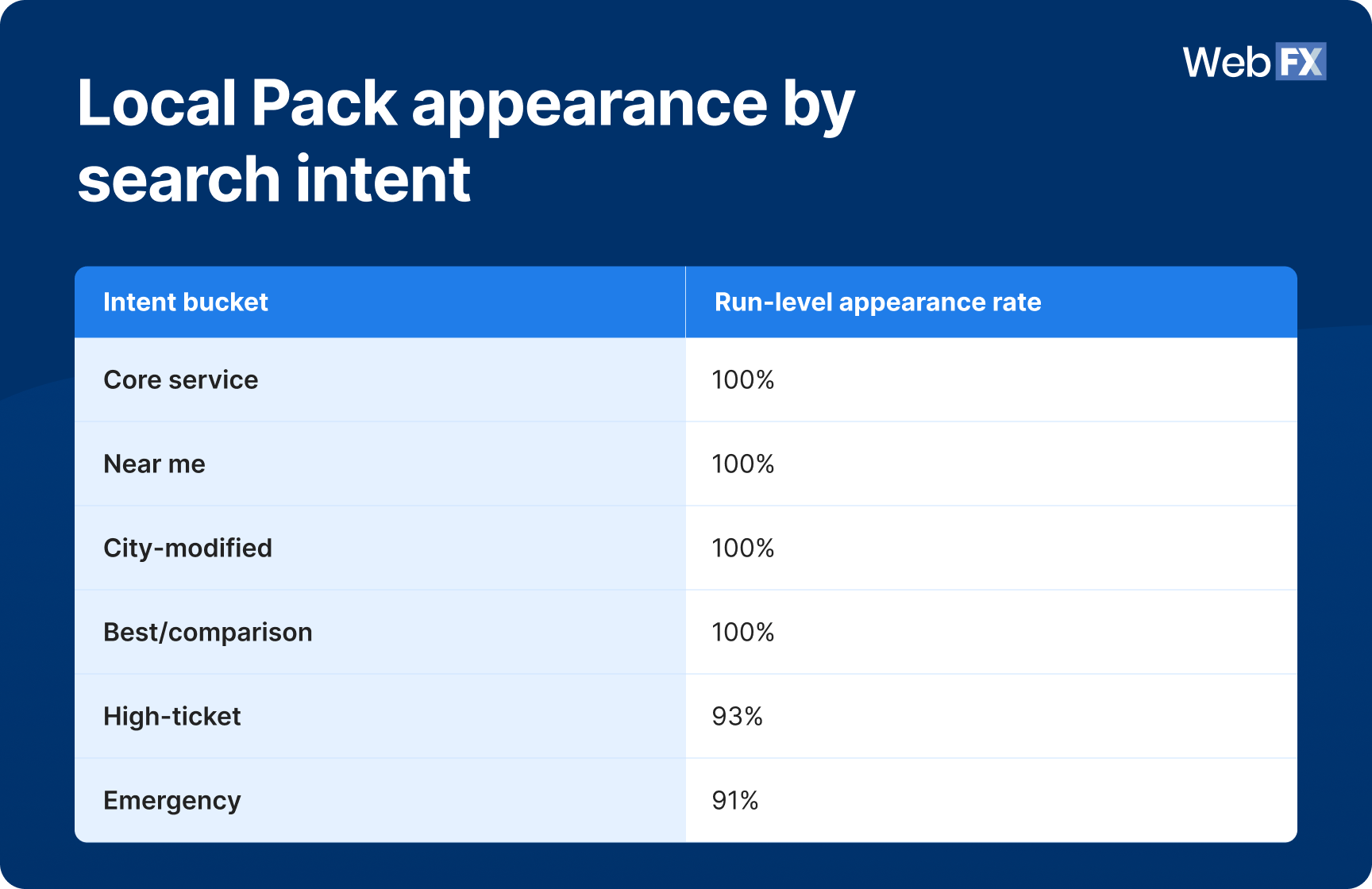
The Local Pack is the most consistent feature on home services search results, appearing on 98 of 100 keywords studied and in 488 of 500 searches (about 98%). No other feature comes close to that reliability.
The Local Pack is close to a fixed feature of the home services SERP. It appeared in all five runs for 96 of the 100 keywords, so in nearly every search we ran, the map block showed up.
It is the one channel you earn rather than buy. Placement comes from your Google Business Profile, reviews, and local relevance signals, not ad spend. The most visible feature in home services search is also the one you can win without paying per click or per lead.
That makes Local Pack visibility your foundation, the thing you secure before relying on paid channels. Without it, you are paying to compete around the most consistent feature on the page instead of building visibility in the place customers are most likely to see.
Finding 2: Local Services Ads appear far less consistently than marketers assume
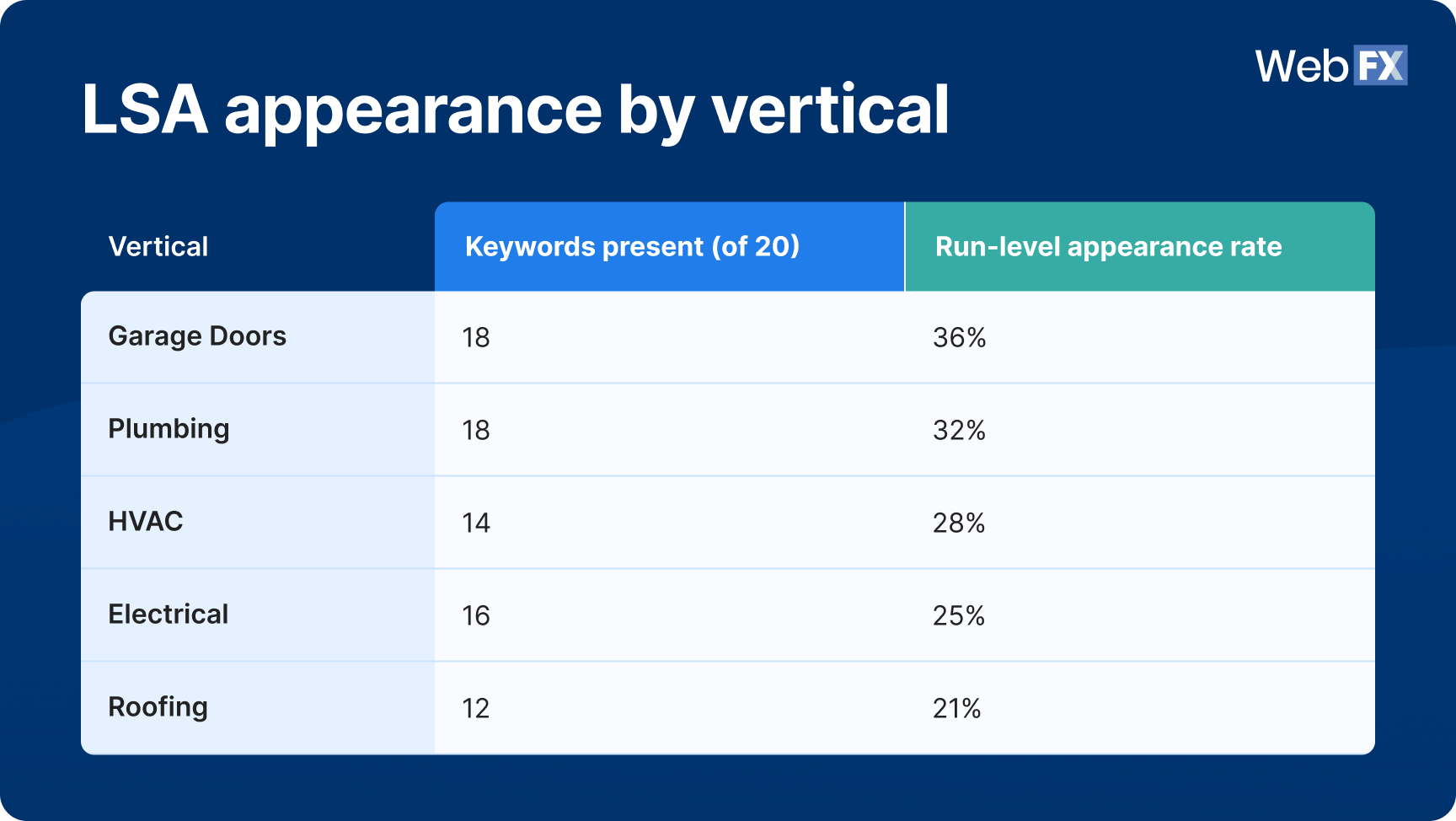
Local Services Ads appeared at least once for 78 of 100 keywords, but in only 142 of 500 searches (about 28%). LSAs are eligible for most home services keywords, yet they do not show on every search the way many marketers assume.
LSA visibility is a high-value, low-consistency play. In all 142 searches where an LSA appeared, it held position 1, above the Local Pack and everything else. Powerful when it surfaces, but never guaranteed: Only one keyword (“roof repair houston”) triggered LSAs in all five runs.
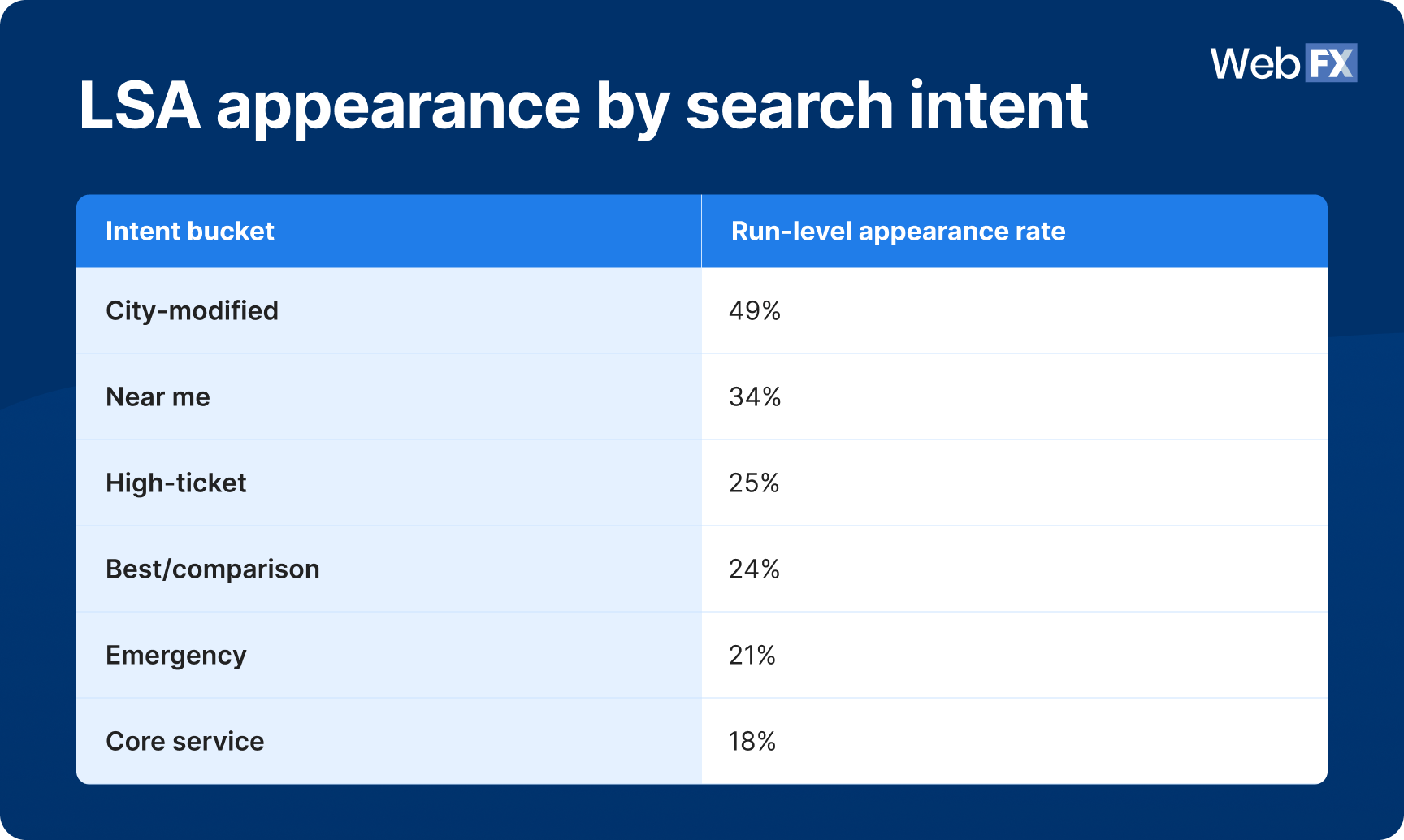
City-specific searches are the exception. Queries that name a city (like “hvac repair dallas”) triggered LSAs in 49% of searches, nearly double the 25% rate for all other queries, because an explicit location gives Google a stronger local signal to match providers against.
For businesses in defined metros, LSAs likely appear more often in your real market than the cross-keyword average suggests, which strengthens the case for testing the LSA budget in the specific cities you serve.
Treat LSAs as a layer on top of your Local Pack foundation. If you rely on them as your primary channel, you are betting on a feature that appears in roughly one of every three to four searches.
Expert insights from
Kayla J.PPC Specialist at WebFX
“LSAs showing up less often overall but more often on city-modified searches lines up with their pay-per-lead model. Because city-specific queries often signal stronger local intent, it makes sense that Google would show LSAs more selectively on searches that are more likely to turn into a qualified lead.”
Finding 3: Google Ads play a smaller but strategic role in home services SERPs
Traditional Google Ads appeared on just 26 of 100 keywords and in only 42 of 500 searches (about 8%), making it the least visible of the three features by a wide margin. For a channel many home services businesses treat as their default, these sponsored search ads showed up far less than expected.
Placement is low. When Google Ads appeared, their average first position was 11.3, below the Local Pack and any LSAs above them. In 16 of the 26 keywords where they showed up, they landed below position 10.
Their value is control, not coverage. Google Ads let you choose keywords, write ad copy, design landing pages, present offers, and retarget past visitors, things that the other two features cannot do.
Use them for specific jobs, like defending your brand name, promoting seasonal offers, and reaching searches where the Local Pack and LSAs do not fully cover your service area.
The takeaway is not to drop Google Ads, but to stop treating them as your primary visibility engine in home services. They work best as a targeted layer with a clear use case.
Finding 4: SERP order changes the budget conversation
The order that features appear tells you more than whether they appear at all. Across the 500 searches we ran, the top of the home services SERP came down to a contest between two features: Local Services Ads when they appeared, and the Local Pack when they did not. Traditional Google Ads rarely entered the picture at the top.
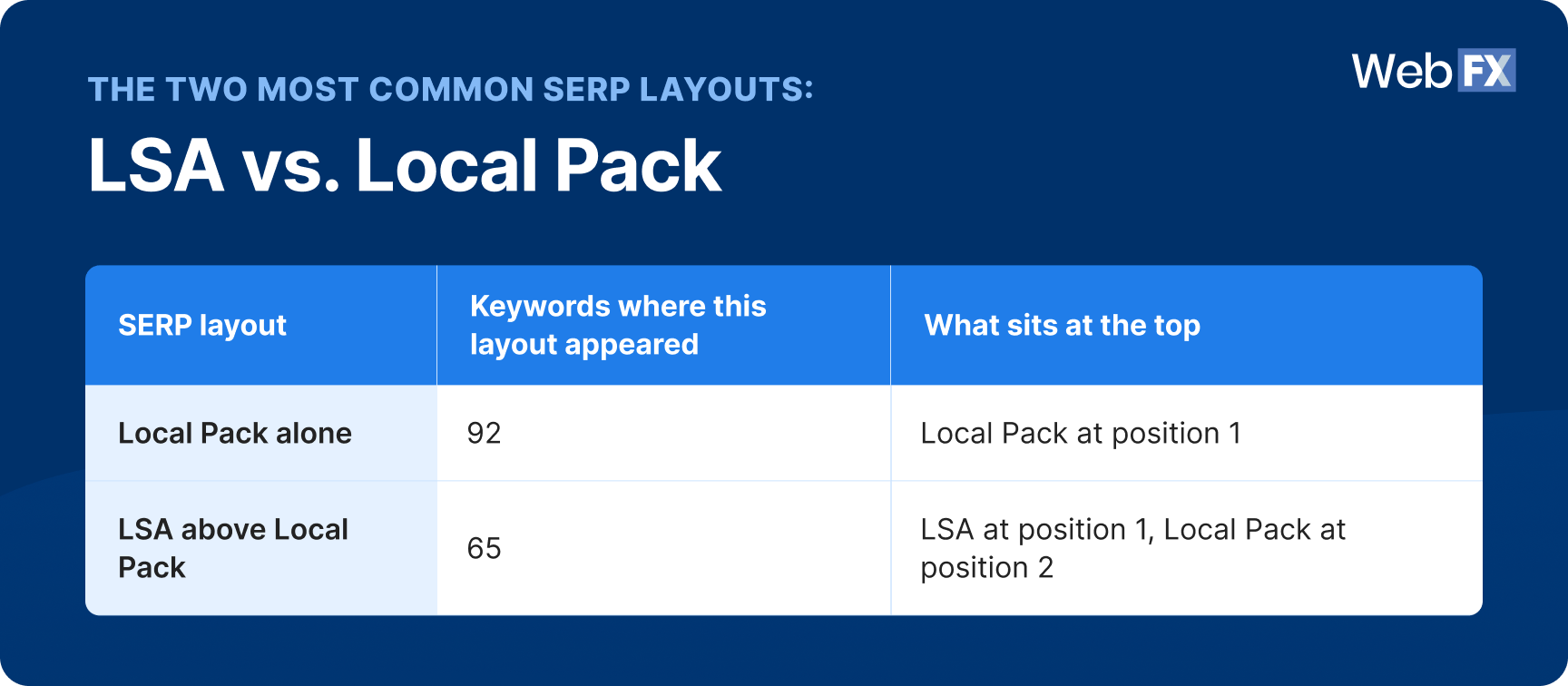
The two most common SERP layouts: LSA vs. Local Pack
SERP layout
Keywords where this layout appeared
What sits at the top
Local Pack alone
92
Local Pack at position 1
LSA above Local Pack
65
LSA at position 1, Local Pack at position 2
Note: Layout counts can overlap because the same keyword can show different SERP layouts across repeated runs.
Two facts define the top of the page:
When an LSA appeared, it owned position 1. In all 142 searches where an LSA showed up, it sat above the Local Pack and everything else. No exceptions.
When LSAs were absent, the Local Pack led. In nearly all of the layouts we observed without an LSA, the Local Pack appeared first.
So the question at the top of a home services SERP is rarely “ad or organic.” It comes down to LSA vs. Local Pack. In the Google Ads vs. Local Pack matchup, sponsored ads rarely reached the top, landing lower on the page than either.
This reframes the budget question. If the top of your SERP is a two-horse race of LSA vs. Local Pack, your first two priorities are clear: Earn the Local Pack through local SEO so you lead when LSAs are absent, and run LSAs so you lead when they appear. Google Ads still matter, but they compete for lower real estate, which is exactly why they belong in a supporting role.
Expert insights from
Colton W.Sr. PPC Consultant at WebFX
“The organic Local Pack gets the majority of visibility on most searches, but LSAs operate on a pay-per-lead model, not pay-per-click. That makes the Local Pack your Swiss Army knife of local visibility and your LSA the scalpel. You show up organically across relevant local searches, and when it really matters who is on the other end of that search, your LSA helps capture the lead. LSAs do not appear all the time, but when they do, the SERP positioning is the strongest.”
Where should home services businesses invest first?
Based on visibility alone, home services businesses should prioritize local SEO to win the Local Pack, layer in Local Services Ads where they appear consistently, and use Google Ads as a targeted support channel. The data point to a clear order of priority because the three features do not provide equal visibility.
The order matters more than any fixed budget split. Your exact mix depends on your market, your current visibility, and how often LSAs appear for the searches that matter to you. Here is how to think through it:
1. Start with Local Pack visibility
The Local Pack appeared in 488 of 500 searches, so this is the visibility you cannot afford to skip. Because it is earned through local SEO rather than paid for, it also delivers the most durable return: Once you rank in the map block, you keep showing up without paying per click or per lead.
To compete for the Local Pack, focus on the signals Google rewards:
Optimize your Google Business Profile completely, with accurate categories, services, hours, and current photos.
Build a steady flow of reviews, since recency and volume both influence local ranking.
Strengthen local relevance with location-specific pages and local citations.
Earn local backlinks from community sites, suppliers, and local press.
If you are not appearing in the Local Pack for your core services, make that a priority before you rely too heavily on paid channels. Otherwise, you are paying to compete for lower-visibility placements while the feature customers see most often shows up without your business in it.
2. Layer in Local Services Ads where they appear consistently
Local Services Ads earned the top position in every search where they appeared, so they are worth capturing, but only where they show up often enough to justify the spend. Since LSAs appeared in about 28% of searches overall and nearly 49% of city-specific searches, their value depends heavily on your market.
Check how often LSAs appear for your highest-intent keywords in the cities you serve. Where they appear regularly, especially in defined metros, LSAs are a strong investment because they put you above everything else on the page. To capture them:
Complete Google verification, including license, insurance, and background checks, since you cannot run LSAs without it.
Respond quickly to leads, because response speed influences your placement.
Maintain a strong review rating, which LSAs weigh heavily.
Demand also shifts across the year, so the months when LSAs are worth the most spend often line up with seasonal search shifts in home services demand like peak HVAC season or post-storm roofing surges.
Editor’s note (Aug 2026): Local Services Ads are migrating into the Google Ads platform as a Performance Max for pay per lead goals campaign type, rolling out in phases from August 2026 through 2027.
This gives readers current framing on where LSAs are headed as a product. It doesn’t change the visibility findings in this study.
3. Use Google Ads for control, retargeting, and brand defense
Traditional Google Ads appeared in only about 8% of searches, so they are not your visibility foundation, but they give you control that the other two features cannot. Use them for specific jobs rather than broad service capture:
Defend your brand name so competitors do not bid against your own searches.
Retarget visitors who left your site without converting.
Promote seasonal offers or high-margin services with custom landing pages.
Cover service areas where the Local Pack and LSAs do not fully reach.
Deployed this way, Google Ads complement your local SEO and LSA presence instead of competing with them for the same budget.
4. Run all three when your SERPs show layered competition
In the most competitive home services searches, all three features appear together. Across the study, 22 of 100 keywords showed an LSA, a sponsored ad, and the Local Pack at least once. In those markets, a single-channel strategy lets competitors occupy the SERP from angles you are not covering.
If your priority keywords consistently show all three, the strongest approach is a layered one: Local SEO to anchor the Local Pack, LSAs to claim the top when they appear, and Google Ads to control the messaging and retargeting around both. The goal is not to spread your budget evenly, but to make sure you are present at every level of a crowded SERP.
Expert insights from
Sarah B.Lead Web Marketing Consultant at WebFX
“With the Local Pack appearing in 98% of searches, it’s non-negotiable for home services companies. You need to prioritize taking care of your listing in order to appear in front of homeowners and property managers. That doesn’t mean you should ignore paid opportunities like Google LSAs, though, as these ads can serve as a lead gen accelerator during slow seasons or after weather events, like a hailstorm.”
FAQs about Local Services Ads vs. Google Ads vs. Local Pack
Local Services Ads charge per qualified lead and appear at the very top of search results with a Google Verified badge, while Google Ads charge per click and give you control over keywords, ad copy, landing pages, and offers. LSAs are set up by selecting your service categories and areas, and Google matches you to local searches. Google Ads require you to build campaigns, write ads, and manage bids. In our 2026 study of 100 home services keywords, LSAs appeared in about 28% of searches and always at position 1, while traditional Google Ads appeared in only about 8% of searches at an average position of 11.3.
Yes. Local Services Ads appear above traditional Google Ads and above the Local Pack when they show up. In our study, LSAs held position 1 in all 142 searches where they appeared, with no exceptions. Traditional Google Ads, by contrast, averaged position 11.3 when present, placing them well below the top of the page.
Local Services Ads are worth it when they appear consistently in your market, because they claim the top of the page every time they show. In our 2026 study, LSAs appeared in about 28% of home services searches overall, but in nearly 49% of city-specific searches, such as “hvac repair dallas.” If LSAs appear often for your core services in the cities you serve, they are a strong investment. If they rarely appear in your market, that budget may be better spent strengthening your Local Pack presence through local SEO.
Yes. The Local Pack is the organic, map-based block of local business listings, and you earn placement through local SEO instead of paid ads. Ranking factors include your Google Business Profile, your reviews, your proximity to the searcher, and your local relevance signals. In our study, the Local Pack appeared in 488 of 500 searches (about 98%), making it the most consistent home services search feature and the only top feature you can win without ongoing ad spend.
Traditional Google Ads appear less often in home services searches because Google’s local SERP layout prioritizes Local Services Ads and the Local Pack for service-intent queries. In our 2026 study, sponsored Google Ads appeared on only 26 of 100 keywords and in about 8% of searches, often below position 10. Google Ads still matter for control, retargeting, brand defense, and reaching searches the Local Pack and LSAs do not cover, but they are not the dominant feature in home services results.
Home services businesses should prioritize local SEO first because the Local Pack appeared in about 98% of searches in our study and is earned rather than paid for. Local Services Ads work best as a second layer, capturing the top of the page in markets where they appear consistently. The strongest approach is to build Local Pack visibility through local SEO as your foundation, then add LSAs where they show up often enough to justify the spend.
Turn SERP visibility into more home services jobs
Home services SERPs are not one-channel environments. Local Services Ads, Google Ads, and the Local Pack each deliver visibility on very different terms. The smartest budget decision starts with knowing what appears for your priority keywords, then funding the channels that own your SERPs in the right order. Done right, that mix turns search visibility into more booked jobs and a better return on every marketing dollar.
That is where the right partner makes the difference. With over 30+ years of expertise and a team of 750+ seasoned experts, WebFX has already generated 24 million qualified leads and $10 billion in revenue for home services businesses like yours. Our strategy is built on the same data-driven approach that underpins this study, helping you gain visibility across every layer of the SERP.
The WebFX marketing team conducted this study in May 2026 to measure how often Local Services Ads, traditional Google Ads, and the organic Local Pack appear on home services search results, and where each feature lands on the page.
Data scope
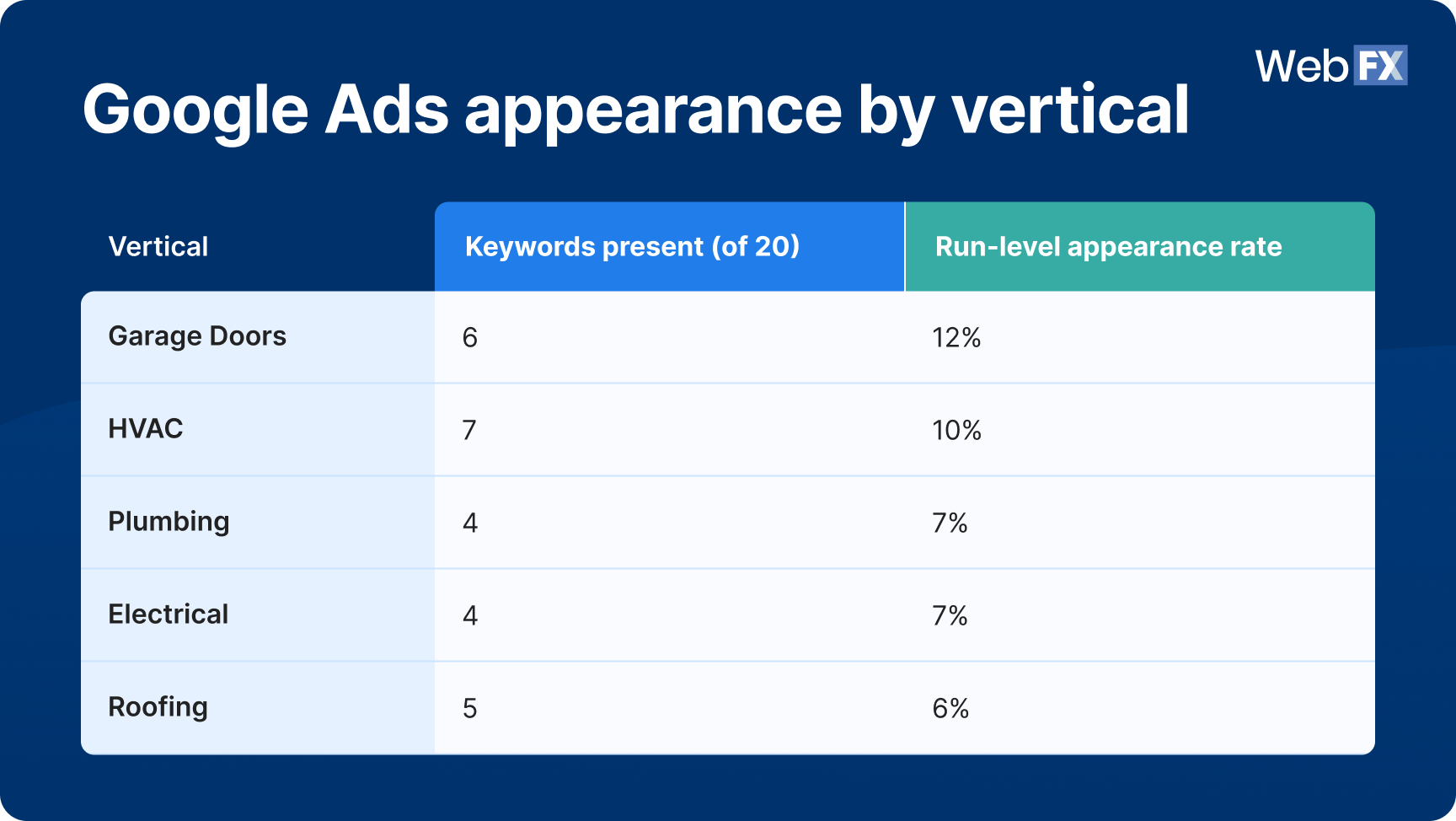
We analyzed 100 U.S. home services keywords across five verticals: HVAC, plumbing, roofing, electrical, and garage door services. Each vertical was represented by 20 keywords distributed across six intent buckets: Core service, near me, city-modified, emergency, high-ticket, and best/comparison queries.
Keyword selection
All 100 keywords were validated through Ahrefs and selected to reflect real home services search behavior. Keywords were chosen for commercial or transactional intent, with all carrying a monthly search volume of 500 or higher and a keyword difficulty of 30 or higher. The set includes a strong mix of near-me, emergency, and city-specific queries to match how customers actually search for home services providers.
Data collection
For each keyword, we retrieved SERP data from a third-party provider. Each keyword was queried 5 times, for a total of 500 searches, to account for the variability in how SERP features appear from one search to the next. Each search was pulled at a depth of 20 results to capture features that appear lower on the page.
Local Services Ad detection was pulled directly from a SERP feature object rather than inferred from page structure, which gives high confidence in the LSA presence and provider data. Traditional Google Ads were captured through the sponsored results feature, and the Local Pack was captured through the map-based local results feature.
Sponsored results were captured across the full requested 20-result depth, not just top-of-page placements, so the low Google Ads appearance rate is not a result of limited capture. It more likely reflects how often Google surfaces traditional sponsored ads on these local home services SERPs, where Local Services Ads and the Local Pack occupy most of the high-visibility space.
Location targeting was applied at the city level for city-modified keywords, using the city named in the query (Dallas, Houston, Phoenix, or Chicago). For all other keywords, New York, New York was used as the default location to reflect a competitive local search environment.
Metrics captured
For each keyword across its five runs, we recorded feature presence, appearance rate across runs, maximum block and provider counts for LSAs, first-position minimum, maximum, and average for each feature, and the order in which features appeared on the page.
How to read the metrics
This study reports three distinct measures:
Keyword-level presence counts how many of the 100 keywords showed a feature in at least one of five runs.
Run-level appearance counts how many of the 500 total searches showed a feature, which reflects how often a feature actually appears.
Layout patterns describe the order in which features appear for a given keyword and reflect unique patterns rather than raw search counts.
Limitations
This study measures SERP feature visibility, not click-through rates, lead quality, or conversion outcomes.
The study reflects a single point-in-time snapshot from May 2026 and may shift as Google updates its search layouts, including the continued rollout of AI Overviews in home services. It does not account for seasonal search shifts in home services demand, such as peak HVAC season or storm-driven roofing demand, which can affect both search volume and which businesses advertise.
For non-city-modified keywords, we used New York, New York as the default location to represent a competitive local market, so appearance rates for paid features may differ in smaller or less competitive markets. Appearance rates may also vary by device and time of day.
The findings represent a directional visibility benchmark across the sampled keywords and locations rather than guaranteed visibility for every home services business.
Try our free Marketing Calculator
Craft a tailored online marketing strategy! Utilize our free Internet marketing calculator for a custom plan based on your location, reach, timeframe, and budget.
Craft a tailored online marketing strategy! Utilize our free Internet marketing calculator for a custom plan based on your location, reach, timeframe, and budget.











 Albert Dandy Velasquez blends SEO strategy with compelling storytelling to help businesses boost their visibility and revenue online. With a B.A. in English and certifications from HubSpot, Semrush, and Google Analytics, he has written and optimized hundreds of articles on organic SEO, content strategy, and user experience. He regularly contributes to the WebFX blog and SEO.com, creating content that helps readers turn marketing goals into measurable results. When he’s off the clock, he’s usually exploring new neighborhoods on two wheels, filming travel content, or chasing golden hour with a coffee in hand. View full profile
 Ryan Maake is the Sr. Marketing Operations Manager at WebFX, where he leads the strategy, implementation, and optimization of the company’s marketing technology ecosystem. With more than 10 years of experience in marketing operations, Ryan specializes in building the systems, automations, and integrations that power scalable digital marketing and revenue growth. His expertise includes marketing automation, CRM strategy, lead management, campaign operations, systems integration, data governance, and marketing analytics. Ryan is passionate about using technology to solve complex operational challenges and help marketing teams work smarter at scale. View full profile@rmaake107