Every digital marketing plan should track return on investment, or ROI. Your ROI, a measure of how much revenue you gain compared to your expenses, tells you whether your marketing investments were worthwhile. If your ROI is positive, you’re on the right track.
If it’s not, you need to reevaluate your marketing strategies. You’ll want to evaluate the ROI of your digital marketing over the long term, but you may also want to assess the ROI of individual campaigns. To do so, you need to know which digital marketing metrics to use.
In this post, we’ll go over some of the most important digital marketing ROI metrics and explain how to use them to assess your return.
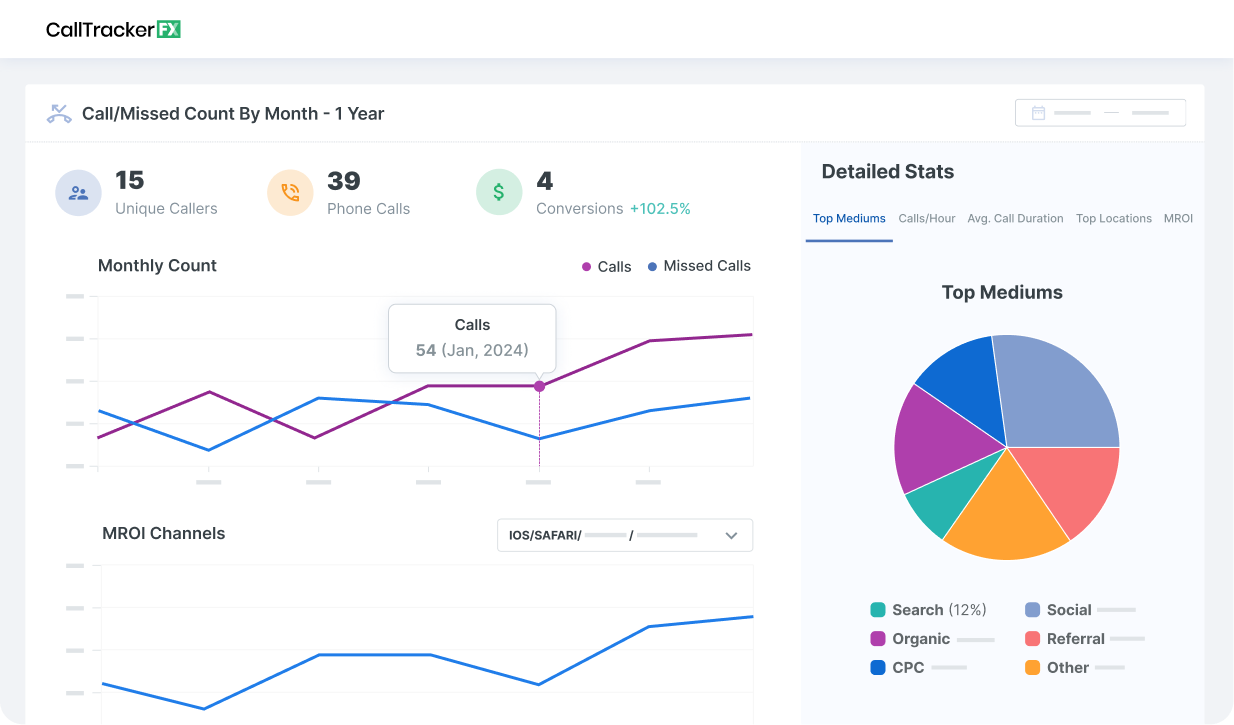
Measuring the metrics that affect your bottom line.
Are you interested in custom reporting that is specific to your unique business needs? Powered by RevenueCloudFX, WebFX creates custom reports based on the metrics that matter most to your company.
- Leads
- Transactions
- Calls
- Revenue

Digital marketing ROI metrics
Tracking the right metrics helps you improve your marketing’s effectiveness. Here are some of the most useful marketing success metrics for calculating ROI.
1. Cost per lead
Cost per lead (CPL), sometimes called cost per conversion, is typically used for paid traffic. Your CPL is simply how much it costs you to acquire a lead — a user who expresses interest in your products, services, or company and may become a customer. To calculate CPL, divide the number of leads you gained over a given period by your ad spend over the same period.
- The formula looks like this: ad spend / number of leads gained = CPL
2. Customer lifetime value
Customer lifetime value (CLV) measures how much a customer is worth to your business over the entirety of their time as a customer. It’s useful for calculating the ROI of your marketing over the long term. To calculate CLV, multiply the average revenue you get from a customer in a year by the average number of years your customers stay with your company.
Then, subtract the cost of acquiring a single customer from that number.
- The formula looks like this: (average annual revenue from a single customer x average number of years as a customer) – customer acquisition cost = CLV
For example, if customers spend, on average, $300 a year over 10 years, and it costs you $1000 to acquire a new customer, your CLV is $2,000. Your formula would look like this: ($300 x 10) – $1000 = $2000 To quickly find your CLV, use our handy CLV calculator!
3. Average sale price
Average sale price is a relatively simple metric, but it’s useful in calculating your digital ROI. Your average sale price is the average gross revenue for a sale. Simply add up your gross sales revenue for a certain period and divide it by the number of sales you made.
Taking the average allows you to account for differences in price due to sales, discounts, and product variation.
4. Lead close rate
Your lead close rate is the percentage of your leads that close, meaning they make a purchase. To determine your lead close rate, divide the total number of leads by the number of closed leads. Then multiply that by 100 to get the percentage.
- Here’s the formula: (number of closed leads / total number of leads) x 100 = lead close rate
You can use your lead close rate as part of a digital ROI calculation using the following formula:
- [(number of leads x lead close rate x average sale price) – cost of marketing] / cost of marketing x 100 = ROI
5. Cost per acquisition
Your cost per acquisition is how much it costs you to gain a new customer. To calculate this digital marketing metric, divide your marketing costs for a period or campaign by the number of sales you earned during that period or campaign.
- Here’s the formula: number of sales generated / marketing costs = cost per acquisition
If your cost per acquisition is sufficiently lower than your average revenue from a sale, you’re on the right track.
6. Cost per click
Your cost per click (CPC) is the amount you pay each time someone clicks on your pay-per-click ad. To calculate your CPC, determine the total cost of your clicks over a given period. Then, divide that by the number of clicks you received.
The result is your CPC.
- Here’s the formula: total cost of clicks / number of clicks = CPC
You can also use our CPC calculator to quickly calculate your CPC. If you’re using Google Ads, you can find CPC data in Google Analytics. You’ll find it under Acquisition, then Google Ads, then campaigns — alongside other useful information about your ad campaigns.

For a positive ROI, your leads must be worth more to you than your CPC.
To determine CPC for a specific campaign, you can use the following ROI formula:
- [(number of leads x lead close rate x average sale price) – CPC] / CPC x 100 = ROI
Keep in mind, though, not every click will convert right away.
7. Conversion rate
Your conversion rate is the percentage of visitors that convert, whether that means making a purchase, signing up for an email list, or something else. This metric is similar to lead close rate. While you can measure lead close rate over a long period, conversion rate is typically used for specific campaigns.
With the conversion rate metric, the conversion also doesn’t necessarily have to come from a pre-existing lead. To determine your conversion rate, divide the number of clicks by the number of conversions.
- The formula is: conversions / number of clicks = conversion rate
Your conversion rate tells you how well your landing pages are working. The more conversions you have, the better your chances of having a positive ROI.
Tracking digital marketing success metrics with WebFX
Whatever your marketing goals are, it’s crucial to track the right digital marketing ROI metrics. When you can accurately calculate your ROI, you can gain insight into what’s working well and what isn’t and use that information to improve your campaigns.
At WebFX, we provide our clients with detailed data about their campaigns, including ROI data, through RevenueCloudFX, our proprietary marketing platform.
Using artificial intelligence powered by IBM Watson, RevenueCloudFX analyzes billions of data points to provide custom strategic recommendations. As a performance marketing agency, WebFX ties every campaign to measurable outcomes — so you always know what’s driving leads, sales, and revenue.
For help calculating the ROI of your digital marketing efforts, check out our suite of free tools. To learn more about RevenueCloudFX or our digital marketing services, contact us today.
-
 Sarah Berry is a Lead SEO Consultant at one of the largest digital marketing agencies in the USA — WebFX. With more than 10,000 hours of experience, she offers practical insights and strategies to grow your digital revenue. Her work has been cited by Michigan State University, Business Insider, and Ars Technica. When she isn’t polishing her Time Magazine Person of the Year Award, she’s spending time with her flock of ducks. View full profile
 -

WebFX is a full-service digital marketing agency delivering revenue-driving strategies across online advertising, SEO and AI search optimization, and digital marketing. Backed by 1,100+ client reviews, a 4.9-star rating on Clutch, and proprietary revenue-tracking technology, our team helps businesses grow visibility and revenue across platforms, from Google to ChatGPT to LinkedIn. Discover how our expert team and revenue-accelerating tech can drive results for you. Learn more
Try our free Marketing Calculator
Craft a tailored online marketing strategy! Utilize our free Internet marketing calculator for a custom plan based on your location, reach, timeframe, and budget.
Plan Your Marketing Budget
Share this article


Proven Marketing Strategies
Try our free Marketing Calculator
Craft a tailored online marketing strategy! Utilize our free Internet marketing calculator for a custom plan based on your location, reach, timeframe, and budget.
Plan Your Marketing Budget
What to read next