Marketing moves fast. Add WebFX as a preferred source on Google and get our latest insights when you search.
Sarah Berry is a Lead SEO Consultant at one of the largest digital marketing agencies in the USA — WebFX. With more than 10,000 hours of experience, she offers practical insights and strategies to grow your digital revenue. Her work has been cited by Michigan State University, Business Insider, and Ars Technica. When she isn’t polishing her Time Magazine Person of the Year Award, she’s spending time with her flock of ducks. View full profile
AI search ranking factors determine how content appears in AI-driven search engines like ChatGPT, Google AI Overviews, and Perplexity.
To improve AI search visibility, focus on creating well-structured, factually accurate content that directly answers user questions and supports fast extraction.
Let’s dive into the AI ranking factors that impact your placement in AI search results and how can you improve your rankings to soar above your competitors.
Important AI ranking factors in 2026
The AI search ranking factors below reflect the signals marketers can most directly influence. You don’t need to optimize for all of them at once, but understanding how they work together will help you prioritize improvements that actually affect visibility:
AI-assisted searches and answer engines are built to answer questions.
If your content doesn’t directly address the intent behind a query, AI-powered search tools are unlikely to surface it — even if the page ranks well organically, which is why clear answers and search intent match is one of the most important AI search visibility ranking factors.
AI-powered searches look for the following:
Clear answers early on the page
A focused topic rather than broad coverage
Supporting context that anticipates follow-up questions
If someone asks an AI search tool for the best action camera for long-distance cycling, content that addresses battery life, mounting stability, weather resistance, and vibration is more useful than a generic “best action cameras” list. Even if both pages rank well, the cyclist-focused guide is more likely to be cited because it aligns with search intent.
What you can do to improve content quality
Match content to a specific search intent: Identify the exact questions your audience is asking and shape the page around that use case instead of a broad category.
Explain why your product or content fits that query: Don’t just list features. Instead, connect your product’s features to your audience’s needs.
Use features as proof of suitability: For example, if you want your action camera mentioned when someone asks for the best camera for cyclists, your product page should clearly explain how long the battery lasts on long rides, how stabilization handles road vibration, and how the mounting options work on a bike.
Expert insights from
Abby F.SEO Consultant at WebFX
“The biggest misconception about improving content quality is that you have to make content appeal to AI by not being conversational and by just giving answers that don’t appeal to human readers. The best way to optimize for AI is to create genuinely helpful, high-quality content and give users a good experience.”
2. Authority, trust, and credibility signals
AI search tools often infer trust from patterns. High rankings or backlinks alone don’t guarantee visibility if other trust signals are weak.
Authority signals you must note are:
Consistent brand mentions across credible sources
Citations from reputable websites
Original research or expert commentary
Strong reputation supported by reviews
This is where traditional SEO continues to play a role because it determines whether your content is eligible to be cited in the first place. Factors like backlinks, topical authority, and crawlability help AI-powered search tools discover and evaluate your pages.
Once your content is eligible, rankings alone don’t determine what gets cited. AI-powered search is more likely to choose content that demonstrates authority in the context of the specific query, not just authority in general.
In practice, this means authority signals need to reinforce why your content is a credible source for that topic.
How to boost authority signals
Demonstrate subject-matter expertise through depth, specificity, or original insight
Get referenced or mentioned by credible sources in the same topic area
Show consistent expertise across related content, not just on a single page
In our earlier example of the action camera, if a brand wants its product cited when someone asks for the best camera for cyclists, authority comes from showing real expertise in that context.
That might mean doing the following:
Publishing cyclist-focused product guides, such as mounting or capturing excellent videos while riding
Creating articles that explain how their stabilization performs on rough roads and how their battery performs on long rides
Earning mentions from cycling publications and reviewers
Over time, this kind of focused, topic-specific coverage helps AI-powered search associate the brand with cycling use cases.
3. Structured content and extractability
Structure is one of the most overlooked — and most influential — AI ranking factors.
AI search tools parse content more effectively when it’s clearly organized. Pages with strong structure reduce ambiguity and make it easier for AI to extract reliable information.
How to improve your site’s structure
Use clear heading hierarchies, such as H2s and H3s
Use lists, tables, and summaries to help readers (and even bots) skim your content
Use relevant schema markup
For example, two pages may cover the same topic with similar depth. The page that includes a summary, descriptive headings, and structured sections is more likely to be cited than one with dense paragraphs and vague headers.
Expert insights from
Abby F.SEO Consultant at WebFX
“Checking that your content answers search intent, is structured and has up-to-date information, and also includes schema markup are high-impact optimizations to make.”
4. Content usability and readability
Answer engines inherit many assumptions from traditional search engines.
Poor user experience often correlates with low-quality or unreliable content, which makes user experience (UX) an indirect but meaningful signal for AI visibility.
How to achieve better user experience
Improve your page speed
Make your website mobile-friendly
Use readable font sizes and user-friendly layouts
Use clear spacing and scannable formatting
Improving readability and accessibility not only helps users but also increases the likelihood that answer engines will treat your content as trustworthy and usable.
5. Freshness, accuracy, and consistency
Fifth on the list of AI search ranking factors is freshness, accuracy, and consistency. AI-powered search prefers content it can trust to reflect the current state of a topic. When information appears outdated, incomplete, or inconsistent, AI search tools are less likely to mention or cite it, even if the page ranks well organically.
This ranking factor matters because many AI answers rely on facts, examples, and guidance that can change over time. Content that shows signs of recent review and validation is more likely to be treated as reliable.
How to keep your content fresh
Do’s:
Keep statistics, examples, screenshots, and product references current
Add a visible “last updated” date to your important pages
Review high-impact pages on a regular schedule so outdated information doesn’t linger
Don’ts:
Let evergreen pages go untouched for years
Reference tools, features, or data that no longer exist
Update dates without actually revising the content
For AI visibility, freshness is about maintaining credibility over time. Pages that appear actively maintained are easier for AI-powered search to trust and reuse.
6. Brand authority and online reputation
AI-powered search evaluates credibility by looking beyond individual pages. It pays attention to how consistently and credibly a brand appears across the web when deciding which sources to cite.
This ranking factor matters because AI-powered search tools want to reference sources that look established, legitimate, and supported by external validation, not just content that claims expertise on its own site.
Brands that show up consistently across trusted sources give AI-powered search more confidence when choosing what to cite.
What marketers should do to improve online reputation
Earn reviews and ratings on platforms your buyers actually use
Publish expert-led content or original research that others can reference
Secure relevant third-party mentions from credible publications or industry sources
Keep brand information consistent across your website and external profiles
Do not buy links, mentions, or reviews. Artificially inflating your online reputation can hurt your brand over time.
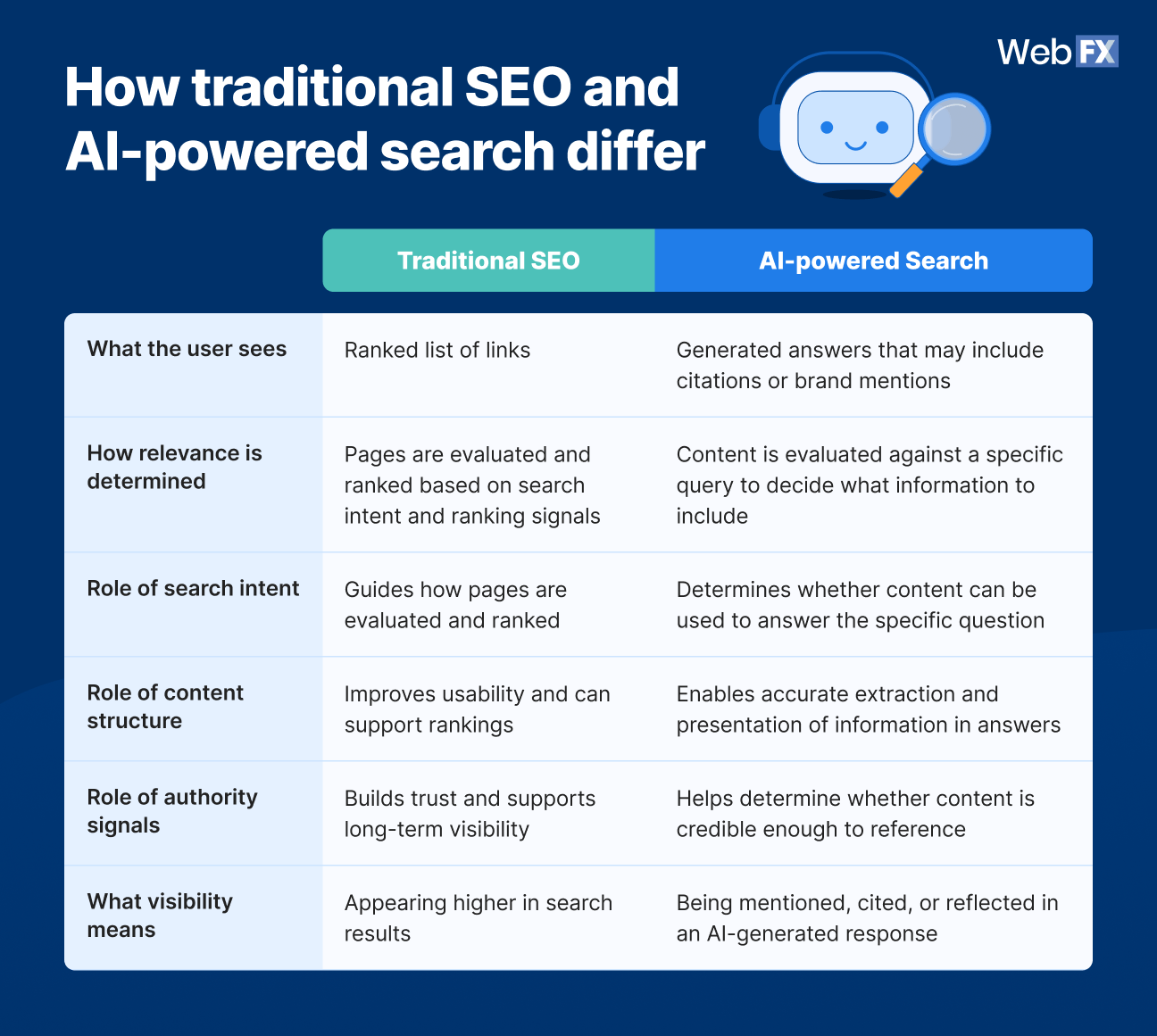
Traditional SEO vs. AI search: How they differ
Traditional SEO and AI-powered search rely on many of the same signals, but they apply them differently. The table below highlights where their approaches overlap and where they diverge — especially in how content is evaluated and used to answer a specific question.
Traditional SEO and AI-powered search rely on many of the same signals, but they apply them differently
Generated answers that may include citations or brand mentions
How relevance is determined
Pages are evaluated and ranked based on search intent and ranking signals
Content is evaluated against a specific query to decide what information to include
Role of search intent
Guides how pages are evaluated and ranked
Determines whether content can be used to answer the specific question
Role of content structure
Improves usability and can support rankings
Enables accurate extraction and presentation of information in answers
Role of authority signals
Builds trust and supports long-term visibility
Helps determine whether content is credible enough to reference
What visibility means
Appearing higher in search results
Being mentioned, cited, or reflected in an AI-generated response
Traditional rankings are only part of the picture. If your organic traffic is declining even though your rankings remain stable, learn how to determine whether AI search is hurting your traffic.
Expert tips: How to track AI search visibility
Knowing the AI ranking factors is step one. But how do you actually track AI search rankings and check if you’re showing up in AI-powered results? While there’s no universal dashboard yet, here are a few ways to start keeping tabs:
Manual checks: Run prompts in ChatGPT, Gemini, Perplexity, or Google like “best [product/service] in [location]” or “top [service] providers.” Look for brand mentions, summaries, or links, and track them in a spreadsheet.
Google Search Console: Go to Performance → Search results → +New filter → Search appearance. If available, select AI Overview to view impressions, clicks, queries, and URLs included in AI snippets.
Semrush & Ahrefs: Use their SERP feature filters (like AI Overview) to see which of your keywords trigger AI summaries, and whether your pages are cited in those results.
OmniSEO®: Track your visibility and your competitors’ across AI search experiences with this AI search visibility software. Plus, receive actionable insights into improving your citations and brand mentions across ChatGPT, AI Overviews, and other LLMs.
GA4 (Google Analytics 4): Create a custom channel group labeled Generative AI using source filters like chat.openai.com, perplexity.ai, and others. This lets you track referral traffic from AI tools.
Want the full step-by-step breakdown? Read our complete guide to tracking AI search visibility. Teams that want a more ChatGPT-specific tracking workflow can also use resources like our alongside manual checks, analytics data, and AI visibility tools.
AI ranking factors are the signals that AI-powered search experiences (such as Google’s AI Overviews and AI Mode) and answer engines (like Perplexity and ChatGPT) use to decide what content to include in generated answers, summaries, and citations.
Traditional search engines primarily rank pages based on relevance and authority signals, and then present a list of links for searchers to choose from. On the other hand, AI-powered searches go a step further by evaluating large sets of content and choosing which sources to reference when responding to a question.
In practice, AI-powered searches evaluate these signals:
Content relevance to inquiries
Depth and accuracy
Authority and trust
Structure and readability
Consistency across sources
One necessary clarification: AI ranking factors are not a checklist. There isn’t a single formula you can follow to “optimize for AI.
AI-powered search evaluates multiple signals together, which means visibility depends on whether your content is clear, well-structured, trusted, and suited to address a particular query.
Yes. Traditional SEO factors still matter because they determine whether your content is discoverable and eligible to be considered in the first place. Strong SEO tactics (including technical health, content quality, and backlinks) increase your chances of being cited in AI responses.
To adapt to AI search experiences, use OmniSEO®. OmniSEO® focuses on making your business visible across a variety of online channels, from traditional search engines to social media to LLMs and the AI search experiences they power.
Not exactly. You can’t submit your site to LLMs directly, but you can boost your chances of being surfaced by how well content answers a question, how easy it is to interpret, and whether it appears credible. There isn’t a set of tactics that works exclusively for one tool and not others.
Trying to “optimize for ChatGPT” or “optimize for Gemini” often leads teams to chase surface-level patterns instead of improving their content’s substance.
Focus on creating content that clearly answers real user questions, reflects genuine expertise, and is easy to understand. Those qualities travel better across platforms than platform-specific tricks.
AI results vary by platform because each experience is designed with different goals, constraints, and presentation models. In addition, each AI experience is powered by different large language models (LLMs) and data sources.
Use manual prompt checks, GA4 tracking, and tools like Google Search Console, Semrush, and Ahrefs to monitor visibility across AI platforms.
AI visibility tools like OmniSEO® can effectively monitor your brand’s visibility in various AI searches and answer engines like ChatGPT, Google AI Overviews, Gemini, Microsoft Copilot, Perplexity, and more.
If you’re seeing impressions, it means you’re being cited — and with the right AI SEO optimization, you can scale that visibility further.
Become the brand AI can’t ignore
AI platforms are shaping the next generation of brand discovery. But here’s the catch: They’re selective. And if your content doesn’t match these AI ranking factors, it gets skipped — even if you’re #1 in Google.
At WebFX, we don’t just follow the future of search — we help shape it.
With over 30+ years of digital marketing expertise, we’ve engineered a first-class generative engine optimization (GEO) strategy designed to get your business cited, surfaced, and seen across today’s leading AI platforms.
When you partner with us, you’ll get:
A personalized roadmap to earn placement in AI-driven results
Data-driven optimization that bridges traditional SEO with AI-powered search
A dedicated strategist backed by over 750 subject-matter experts
RevenueCloudFX access to track AI visibility, engagement, and ROI in real time
The rules of search are changing at a breakneck pace. Let’s make sure AI picks your brand first. Contact us online or call 888-601-5359to speak with a strategist today about our high-impact GEO services.
Try our free Marketing Calculator
Craft a tailored online marketing strategy! Utilize our free Internet marketing calculator for a custom plan based on your location, reach, timeframe, and budget.
Craft a tailored online marketing strategy! Utilize our free Internet marketing calculator for a custom plan based on your location, reach, timeframe, and budget.











 Sarah Berry is a Lead SEO Consultant at one of the largest digital marketing agencies in the USA — WebFX. With more than 10,000 hours of experience, she offers practical insights and strategies to grow your digital revenue. Her work has been cited by Michigan State University, Business Insider, and Ars Technica. When she isn’t polishing her Time Magazine Person of the Year Award, she’s spending time with her flock of ducks. View full profile