


Table of Contents
- Why AI advertising matters for today’s marketing teams
- How AI is used in advertising today
- 1. Predictive targeting and audience modeling
- 2. Real-time bidding and budget optimization
- 3. Creative optimization and variation testing
- 4. Performance analysis and attribution modeling
- How to build your AI advertising strategy using a maturity model
- Common pitfalls and ethical considerations in AI advertising
- FAQs about AI advertising
-
What is AI advertising?
AI advertising uses artificial intelligence to support targeting, bidding, creative decisions, and campaign measurement—helping marketers optimize at scale while keeping human oversight. -
Why is AI advertising important today?
It improves campaign efficiency, personalization, and targeting by analyzing data in real time and automating processes to boost ROI. -
How do you start an AI advertising strategy?
Begin in stages: define goals, ensure proper tracking and data, and introduce AI gradually with oversight. -
How do you maintain control while scaling AI?
Implement guardrails like budgets, exclusions, and rules, expanding automation only after validating results. -
What is the ultimate benefit of AI advertising?
It enables smarter, data-driven campaigns that scale efficiently and deliver better results without removing human decision-making.
AI adoption is no longer a novelty. In fact, 88% of organizations reported using AI in at least one business function.
Advertising is one of the first places where teams feel pressure to “use AI” fast. But AI advertising doesn’t reward speed without strategy and structure.
Most ad platforms already use AI in bidding, targeting, and optimization. To get real value from AI in advertising, use it intentionally and ethically with clear goals, reliable data, and guardrails.
This guide provides practical use cases and strategies. Learn how you can implement AI advertising for your business with these topics:
- Why AI advertising matters for today’s marketing teams
- How AI is used in advertising today
- How to build your AI advertising strategy using a maturity model
- Common pitfalls and ethical considerations in AI advertising
- FAQs
Why AI advertising matters for today’s marketing teams
Advertising has become harder to manage manually, because online advertising platforms have gotten more complex. In addition, businesses must run campaigns across different platforms, formats, and audience types.
AI in advertising matters because it helps teams do the following at scale:
- Respond faster: AI can adjust bids and allocate budget in real time as auctions change.
- Identify patterns sooner: AI can examine performance signals across audiences, creatives, and placements that you might miss in manual reporting.
- Scale smartly: With AI, marketers can test more variations and optimize across more campaigns.
When used well, AI becomes a way to manage complexity while human marketers stay on top of the overall advertising strategy.
How AI is used in advertising today
AI isn’t the whole engine of your advertising strategy. Instead, it functions like one of the systems inside your ad engine. It handles real-time decisions, detects performance patterns, and optimizes ads based on your goals and guardrails.
Here are the core use cases of AI in advertising:
- Predictive targeting and audience modeling
- Real-time bidding and budget optimization
- Creative optimization and variation testing
- Performance analysis and attribution modeling
Let’s go through each one:
1. Predictive targeting and audience modeling
AI supports targeting by analyzing signals like site behavior, conversion history, and engagement trends to identify audience patterns. In other words, it helps you get closer to the people most likely to take action, without guessing based on demographics alone.
With AI in advertising, marketers can expand beyond their “obvious” audience with lookalike or similar audience modeling. AI can also help analyze how customers who converted behave by answering questions like:
- Which landing pages did they visit?
- Which ads and touchpoints convinced them to convert?
- Which messages resonated with them?
- Which high-quality customer segments should we prioritize?
For example, let’s say you market a SaaS platform for outpatient clinics. You already know your best customers tend to request demos after visiting your pricing page and reading your HIPAA and integrations pages. AI can use those conversion paths to help the ad platform prioritize similar users, even if they don’t match your original audience assumptions.
However, you still control the following:
- Whom to exclude: Such as your competitors, job seekers, and traffic from irrelevant geographic locations.
- What counts as success: You can count demo requests as a macro conversion, but newsletter signups are considered micro conversions.
- Which offers you promote: Such as a free trial, demo, or consultation
2. Real-time bidding and budget optimization
Speed is one of the clearest wins for AI. Paid ad auctions move too quickly for manual bidding to keep up consistently.
With AI-powered bidding, you can respond to changes in competition and conversion likelihood in real time, without waiting for your next reporting review. That’s not to say you should let AI take the reins of your bidding.
This use case works best only when you set maximum bids, budget constraints, and guardrails. Here are some best practices to make AI bidding safer and more effective:
- Set clear KPIs: Choose targets like Target cost per acquisition (tCPA) or Target return on ad spend (ROAS) so the system learns toward the outcome you really care about.
- Use first-party data where possible: Bring in signals from your customer relationship management platform (CRM) on lead quality so AI doesn’t optimize for low-quality conversions.
- Build guardrails to prevent waste: Use budget caps, exclusions, and bidding limits where applicable to avoid overspending.
- Give the system stable learning time: Frequent changes can disrupt optimization and learning. Instead of daily manual edits, make adjustments on a deliberate cadence once you have enough data to judge performance.
3. Creative optimization and variation testing
AI can help you test more creative variations faster. However, it can’t replace the human part of creativity: the positioning, the message, and the judgment.
When using AI for creative optimization and testing, remember that humans dictate the strategy, and AI only helps scale the testing. Here are two practical ways to use AI for creative optimization:
- Dynamic creative optimization (DCO): AI swaps or prioritizes creative elements such as headlines, images, layouts, and calls to action (CTAs) based on what performs best for different audience segments.
- Automated A/B testing at scale: Instead of testing two versions at a time, AI can evaluate many combinations and shift delivery toward winners as it learns.
Let’s use our earlier example of the healthcare SaaS provider to better explain this use case. Our sample company wants to test two core messages: “Reduce admin time” and “Improve patient intake.”
AI-assisted testing can help you identify which message performs better for different audiences. For example, operations managers may respond to time savings, while clinic owners are drawn to the patient acquisition and retention message.
Of course, human marketers still control the following:
- Brand voice and compliance
- The messages and claims you can (and can’t make)
- What “good performance” means, such as leads, qualified demos, and pipeline impact
4. Performance analysis and attribution modeling
Analyzing advertising performance across channels generates large volumes of data. AI helps you identify the following:
- Trends: What improved? What declined?
- Anomalies: What suddenly changed?
- Relationships and correlations: Which audiences, messages, or channels seem connected to results?
Let’s use our example of the SaaS provider for healthcare practices to demonstrate this use case. The team notices demo requests dipped, but ad impressions and landing page visits stayed steady.
Their AI-assisted analysis might reveal that the drop is concentrated in one segment. For example, mobile visitors coming from a specific campaign type were not signing up for demo requests after an ad creative refresh.
That insight doesn’t “solve” attribution. But it helps the SaaS provider find the story faster and then validate it with their own business context through sales feedback, CRM notes, conversion tracking.
🎥Video: 5 ways to use AI to your advantage
How to build your AI advertising strategy using a maturity model
AI can feel like a shortcut. In practice, though, it won’t work well without a human strategizing how it’s used.
That’s why teams need an AI advertising strategy that defines:
- Where AI fits
- What AI is allowed to optimize
- What success looks like
- How teams stay accountable with automation and AI in place
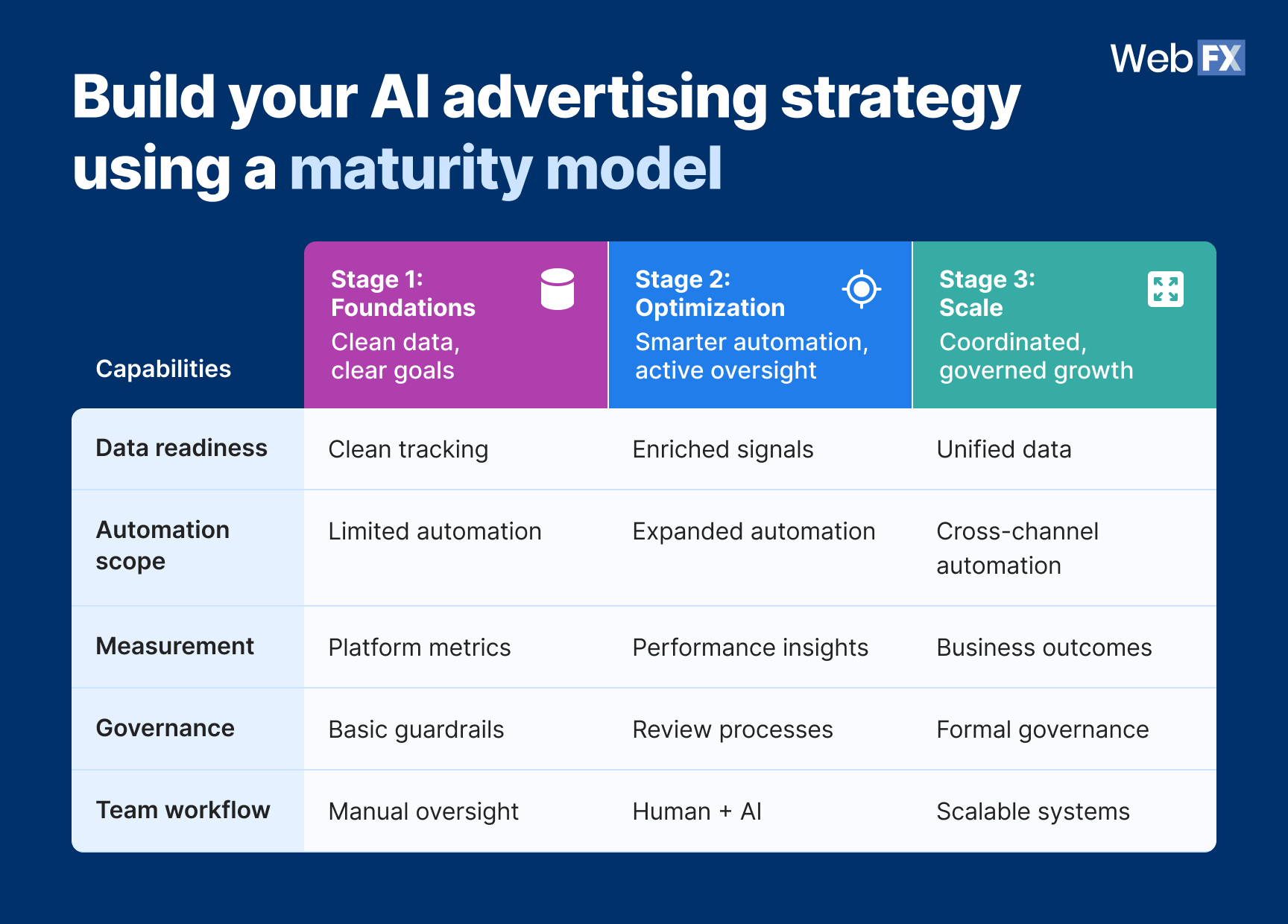
Use this maturity model to self-assess your readiness and progress over time. As your data, confidence, and governance improve, you can move into more advanced AI use cases without losing control.
Here are three different stages:
- Foundations (Getting started): This stage sets foundations and uses low-risk automation
- Optimize (Expanding and optimizing): At this stage, teams use AI to broaden automation with review processes
- Scale (Scaling and innovating): At this stage, teams use AI to coordinate across channels with governance and measurement discipline
1. Foundations: Getting started with AI in advertising
This stage is about readiness. You’re setting the conditions AI needs to optimize responsibly. Here are the foundational requirements to put in place:
- Clear conversion goals: What counts as a meaningful result from your ads?
- Clean tracking: What are the KPIs you’ll monitor?
- Baseline audience definitions: Which prospects do you want to target (and not target)?
- Budget boundaries: Give AI enough stability to learn, but not so much freedom that the system can waste ad budget.
With foundations in place, you can use AI in the following:
- Automated bidding with conservative targets
- Basic audience expansion with exclusions
- Simple creative testing of message variations
Watch out for common mistakes, though. Some teams realize later that they’re not optimizing for the right conversions.
At the foundational stage, ensure you’re optimizing for the right conversion. For example, you should consider lead quality and volume as measures of success rather than just lead volume alone.
In addition, don’t change too many variables (like targeting and messages) at the same time for testing. For example, you might misinterpret an increase in conversions as a direct impact of your new targeting and messages, even when in reality, it was only your targeting that contributed to the results.
2. Optimize: Expanding and optimizing AI-powered campaigns
This stage is about controlled expansion. In the previous stage, you’ve proven that AI can improve outcomes in a limited scope, and now you’re widening where it can operate.
At this level, you can expand automation to more campaigns and audiences. You can also build a structured testing cadence that involves creatives, landing pages, and offers. Equipped with enough performance insights, you can use these to guide decisions as you move forward.
How will you know if you’re ready to progress to this stage? Here are signs:
- Your tracking is stable and trusted
- You have enough conversion volume for learning
- You can explain performance changes credibly
Once you’re in the optimization stage, you can gauge your success when you see performance improvements without constant manual intervention. Another measure of success is when you can scale spend while maintaining your budget’s efficiency. At this stage, identifying what drives wins and results is an indicator that you’re expanding and optimizing AI advertising well.
When optimizing and expanding your AI-powered campaigns, watch out for the following mistakes:
Letting automation expand faster than your review process
As AI makes decisions across bidding, targeting, and creative, it also generates more outputs that require interpretation. When automation expands without review process that catches up with it, you might lose visibility into why performance changes.
The result? Performance issues might emerge later, when your budget was already misallocated. Your optimization efforts might then become reactive instead of strategic.
To ensure you’re still on top of AI advertising strategies, expand automation in stages. Tie each expansion to a defined review cadence.
For example, when you enable broader bid automation or audience expansion, establish weekly checks to look at lead quality, spend distribution, and alignment with campaign goals.
Chasing short-term gains at the expense of lead quality
AI systems often optimize toward the signals you prioritize. If your signals focus too heavily on volume metrics like clicks, form fills, or low-cost conversions, the system may favor ease over intent.
As a result, you get more leads, but fewer qualified ones. Your cost per lead (CPL) tells you that your campaigns are efficient, but your sales pipeline performance declines.
To avoid this, incorporate quality-based criteria into your optimization strategy. Criteria may include downstream conversion events, CRM data, or the sales team’s feedback on lead relevance. By doing so, you’re training AI models to optimize for outcomes that grow your revenue.
Measuring success only inside a specific ad platform
Platform-level reporting shows what happens within a channel, but this report doesn’t reflect how advertising contributes across the full buying journey. AI systems can optimize efficiently inside silos while still underperforming at the business level.
How is this possible, you ask? Your campaign in a specific ad platform — Google Ads, for example — may appear successful individually, but may be competing with your other efforts. In the end, your seemingly successful ad campaign is actually inefficient.
Looking at platform-level reporting alone may not account for long sales cycles. If you see in your ad platform a less-than-stellar performance, you might think you’re wasting ad dollars. What you might not see, though, is how your ads contribute throughout the long customer journey and the conversions they’ve assisted.
Let’s use our healthcare SaaS provider example. Doctors’ offices don’t change SaaS providers daily. When they shop around for new software, they take time to research and compare vendors.
A prospect might have seen a search ad and clicked, but didn’t immediately convert. After a few months of further research, including a branded search that turned into an organic visit, they finally requested a demo.
While the first touchpoint (the search ad) didn’t result in a conversion, it somehow assisted the conversion that happened later, a conversion that wasn’t directly attributed to your AI-powered ad campaign.
3. Scale: Innovating and scaling with AI advertising
This stage is about turning AI into an organizational capability, not as a single tactic.
You’re at this level when your AI-powered optimization spans multiple campaigns and channels. In addition, your team can scale your efforts without “breaking” your performance.
At this level, you can do the following:
- Perform coordinated AI-driven optimization across channels
- Align your campaigns with business objectives and pipeline outcomes
- Establish consistent governance by assigning who approves and who audits, and what’s documented
Once you’re scaling your efforts with AI advertising, exercise discipline in the following:
- Measuring results: Track only the metrics that matter to your business growth.
- Experimenting: Test with a goal in mind.
- Compliance and trust: Use AI in advertising ethically and responsibly.
Common pitfalls and ethical considerations in AI advertising
Ethics in AI advertising becomes easier to remember when it’s tied to real operational risks. Use this checklist to learn the common pitfalls of AI in advertising:
- Data bias and data quality risks: Models learn from what you feed them. Incomplete or skewed data can lead to unfair targeting and misleading optimization.
- Over-automation and loss of context: AI can optimize toward the wrong outcome if humans don’t review decisions and downstream impact.
- Transparency, accountability, and compliance: You need to understand what the system optimizes and be able to explain why, especially in regulated industries. In some industries, using AI to process customer data may require disclosure or consent. Marketers should work with their legal and compliance teams to ensure their AI advertising practices comply with applicable regulations.
- Human oversight: AI should only support decisions, and humans remain accountable for claims, targeting boundaries, and user trust.
This aligns with the practical principle: Ethical AI use in advertising balances personalization with privacy, transparency, and fairness.
FAQs about AI advertising
What is AI advertising?
AI advertising refers to using artificial intelligence to support advertising decisions across targeting, bidding, creative testing, and measurement. It helps you optimize campaigns at scale while keeping humans accountable for strategy and oversight.
How is AI used in advertising?
AI supports specific parts of the advertising workflow. For example, it can help identify higher-likelihood audiences, adjust bids in real time, test creative variations faster, and identify performance patterns across campaigns.
What are the main benefits of using AI in advertising?
AI advertising can help you:
- Improve speed: respond to auction changes faster than manual adjustments
- Scale optimization: manage more campaigns and variations without extra headcount
- Get clearer insights: detect patterns and issues earlier in reporting
Perhaps the biggest benefit is operational. AI helps your team keep up with complexity without losing strategic control.
What are some examples of AI advertising tools?
Most marketers already use AI through the platforms they advertise on. Beyond that, “AI tools” usually fall into a few categories:
- Bidding and budget optimization systems: You’ll find automated bidding features within Google Ads and Microsoft Advertising. Third-party tools are available, too.
- Audience modeling and segmentation tools: They analyze behavioral and performance data to help identify, expand, or refine audience segments. Examples include audience modeling features in ad platforms and customer data platforms (CDP).
- Creative testing and optimization tools: You can test variations of ad copy and visuals with the help of these tools. You have platform-native solutions like Google’s Performance Max and Meta’s Meta Advantage+, and third-party tools like Creatify.ai.
- Analytics and attribution support tools: These use AI to spot trends, anomalies, and relationships from your data sets. Examples include analytics platforms, attribution modeling tools, CRMs, and our very own RevenueCloudFX.
The best choice depends on your goals, data readiness, and how much governance your team can support.

AI Workspace for Business Teams
Imagine an AI workspace where you can collaborate with team members, share prompts, and leverage personas for generative AI.
Empower My Team with AI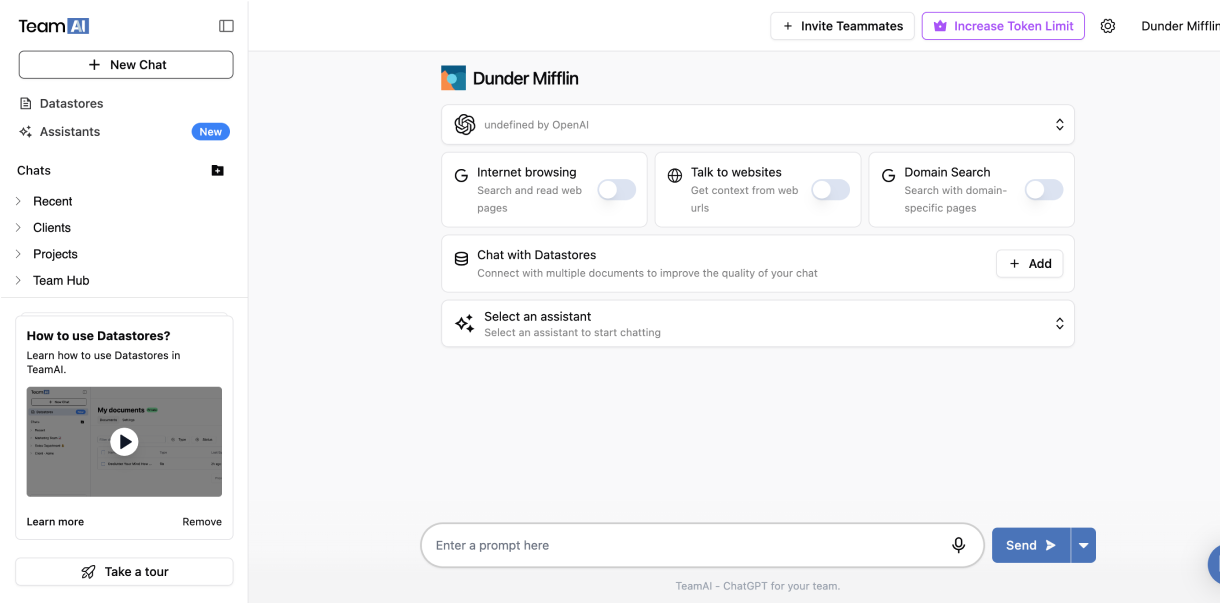
Use AI advertising responsibly and effectively
AI can benefit your advertising efforts when used ethically and set up correctly. If you’re considering leveraging AI to optimize your advertising campaigns, consider teaming up with WebFX.
We’re a full-service digital marketing agency that has helped our customers successfully run over 650 ad campaigns. Our team of 750+ digital marketing experts is committed to providing excellent customer service and helping you use AI for your campaigns and drive bottom-line growth.
Contact us online or call us at 888-601-5359 to speak to a strategist about our AI services and other digital marketing services!
-
 Maria is a Lead Emerging Trends & Research Writer at WebFX. With nearly two decades of experience in B2B and B2C publishing, marketing, and PR, she has authored hundreds of articles on digital marketing, AI, and SEO to help SMB marketers make informed strategic decisions. Maria has a degree in B.S. Development Communication major in Science Communication, and certifications in inbound marketing, content marketing, Google Analytics, and PR. When she’s not writing, you’ll find her playing with her dogs, running, swimming, or trying to love burpee broad jumps.
 -

WebFX is a full-service marketing agency with 1,100+ client reviews and a 4.9-star rating on Clutch! Find out how our expert team and revenue-accelerating tech can drive results for you! Learn more
Try our free Marketing Calculator
Craft a tailored online marketing strategy! Utilize our free Internet marketing calculator for a custom plan based on your location, reach, timeframe, and budget.
Plan Your Marketing Budget
Table of Contents
- Why AI advertising matters for today’s marketing teams
- How AI is used in advertising today
- 1. Predictive targeting and audience modeling
- 2. Real-time bidding and budget optimization
- 3. Creative optimization and variation testing
- 4. Performance analysis and attribution modeling
- How to build your AI advertising strategy using a maturity model
- Common pitfalls and ethical considerations in AI advertising
- FAQs about AI advertising
Share this article


See AI Marketing in Action
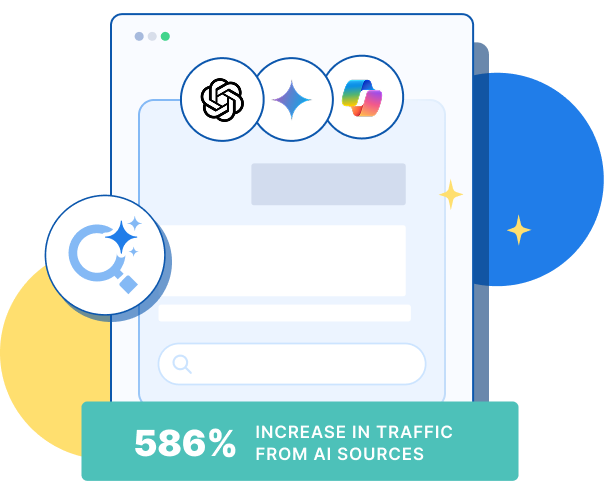
Explore how WebFX helped a regional brand get discovered in AI search experiences — proving what’s possible with today’s AI-driven marketing!
Try our free Marketing Calculator
Craft a tailored online marketing strategy! Utilize our free Internet marketing calculator for a custom plan based on your location, reach, timeframe, and budget.
Plan Your Marketing Budget