


Contents
- The TEA framework for 24/7 competitive monitoring
- Track competitor updates continuously
- Evaluate which changes matter
- Act on the insight
- What 24/7 competitive monitoring looks like in practice
- Why marketers need a better way to monitor competitors
- FAQs
- The AI platform that enables your team to collaborate and build AI agents
- What’s difference between manual competitive monitoring using AI chatbots and AI agents for competitor analysis?
- What competitor data should AI agents track?
- Can AI agents detect competitor pricing changes?
- How do AI agents help monitor competitor content strategy?
- Should I audit my AI agent for competitive monitoring?

Key takeaways
- Advanced AI models and agents can help marketers monitor competitors 24/7.
- The TEA framework provides a practical way for marketing teams to track competitor changes, prioritize what matters, and act on useful insights with human oversight.
- These AI-powered tools are not meant to replace marketers. Instead, they’re built to help teams respond faster to meaningful changes in competitor strategy, positioning, and messaging.
- Human oversight still matters because marketers need to interpret context and decide what to do next.
Using AI for drafting blog posts is so 2023. As advanced AI models and systems become available (think OpenAI’s GPT-5.4 and Perplexity Computer), marketers can use these tools to do more than create content.
One practical use is 24/7 competitive monitoring with AI agents. An AI agent uses large language models (LLMs) like ChatGPT to autonomously plan, reason, and perform specific tasks. Unlike plain old ChatGPT, an AI agent can interact with other tools and software to do tasks independently.
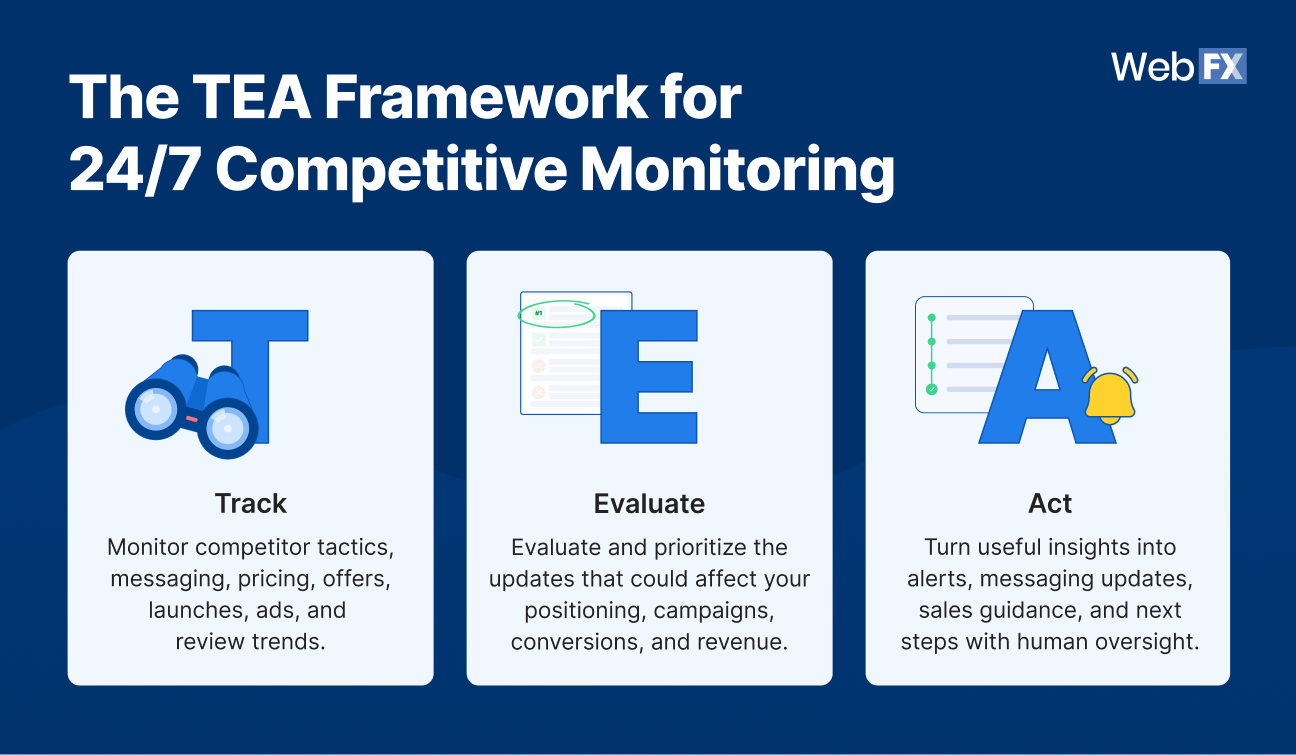
AI competitive analysis using agents lets you continuously track your competitors and receive alerts about key updates. To plan the workflow for AI competitor monitoring, use our TEA framework:
The TEA framework for 24/7 competitive monitoring
Marketers need a clear workflow for deciding what an AI agent should track, how it should prioritize updates, and when a human should step in.
Our TEA framework gives marketers a practical way to structure 24/7 competitive monitoring so it produces valuable output for your marketing and sales teams.
When used well, this workflow can help you catch competitor changes earlier, prioritize updates that matter most, and respond faster when those changes could affect your positioning, campaigns, and the bottom line.
- T: Track your competitors’ new tactics and messaging
- E: Evaluate new opportunities or threats
- A: Act on useful insights with human oversight
Track competitor updates continuously
The first step is deciding what your AI agent should monitor and where it should look. This step includes identifying your competitors and tracking their tactics, messaging, pricing, offers, and launches over time.
What should your AI agent monitor then? Focus on sources and updates such as:
- Homepage headlines: Are their homepages highlighting new products or positioning, or changing their key messages?
- Product and pricing page copy: Are they adding new product features, highlighting new pain points, or adjusting their pricing or packages?
- Offers or promotions: What new discounts, bundles, or promotions are they using to entice or retain customers?
- Ad creatives: Are your competitors rebranding or adjusting their ad creatives to appeal to new customers?
- Landing and other web pages: Are there repeated new content themes in their landing pages or other website sections?
- Review websites: What themes or sentiments are emerging from review websites about your competitors?
- Launch announcements: Are they introducing new product features or services?
When those updates are tracked over time, marketers can see whether a competitor is changing its positioning, emphasizing a new pain point, pushing a new offer or feature, or testing a different angle in the market.
The goal of 24/7 tracking is to give your team a steady view of what competitors are doing new so you can spot patterns earlier. If your team members rely on occasional manual checks, you may miss emerging trends earlier or misinterpret a one-time update as a new trend.
Evaluate which changes matter
Aside from surfacing competitors’ updates, your agent must help you decide which changes matter most. This is the step that turns a stream of observations into something a marketing team can actually use.
Some updates are minor, while other changes are more significant. The goal is to identify the competitor changes that could affect how buyers compare vendors, how sales teams handle objections, or how your brand should position itself.
For example, let’s say you market medical equipment to healthcare systems and large hospitals. A competitor launches their new pricing and updates their ad messaging 24 hours later.
These changes may indicate your competitors’ broader strategic move. In other words, you must know which updates to prioritize before deciding how to respond.
Use these guide questions when evaluating these competitor updates:
- Does this change affect how my competitor is positioning itself?
- Does it introduce a new offer, target audience, or value proposition?
- Could it influence campaign performance or conversion rates?
- Could it create a new objection or comparison point for sales?
- Is this a one-off update or part of a larger pattern?
Act on the insight
Once marketers know which updates matter, they can decide how to use that information. The right action depends on the change, the channel, and the business impact.
Not all updates require the same action items. Some changes require a quick response, while others may need to be documented and monitored over time.
What matters is that the team has a process for turning competitor intelligence into something useful.
Possible next steps include:
- Alerting the right teams to a meaningful change: For example, product teams and management must know about pricing updates or new feature announcements.
- Updating your internal competitive intelligence documents: This action lets you monitor observed changes over time.
- Revising campaign messaging: If your competitor updates its positioning or communicates a new, stronger proof point, you may need to refine campaign messaging to stay competitive and relevant.
- Refreshing sales talking points: If you spot opportunities, you can adjust your sales team’s talking points when nurturing prospects.
- Identifying a new content opportunity: This doesn’t necessarily mean you’ll publish the same content as your competitor. For example, if a competitor publishes a comparison page of your product and theirs, you can update your own pages or create new content that highlights your product’s strengths.
This is where AI-supported monitoring can save time. Instead of marketers manually hunting for updates and performing all these actions, they can review automated reports, sense-check data to verify, and finalize the next steps with a click or a prompt!
Pro tip: Keep human oversight in the loop
AI can surface updates quickly, but marketers still need to review the context and decide how the business should respond.
For example, a messaging change may look important at first glance, but it may only be an A/B test. A new offer may look aggressive, but it may not matter for your ideal customer profile. Human review helps teams avoid overreacting, missing nuance, or acting on incomplete information.
That is why the final step in TEA is always action with human oversight. The marketer still decides what matters, what deserves a response, and what the next step should be.
What 24/7 competitive monitoring looks like in practice
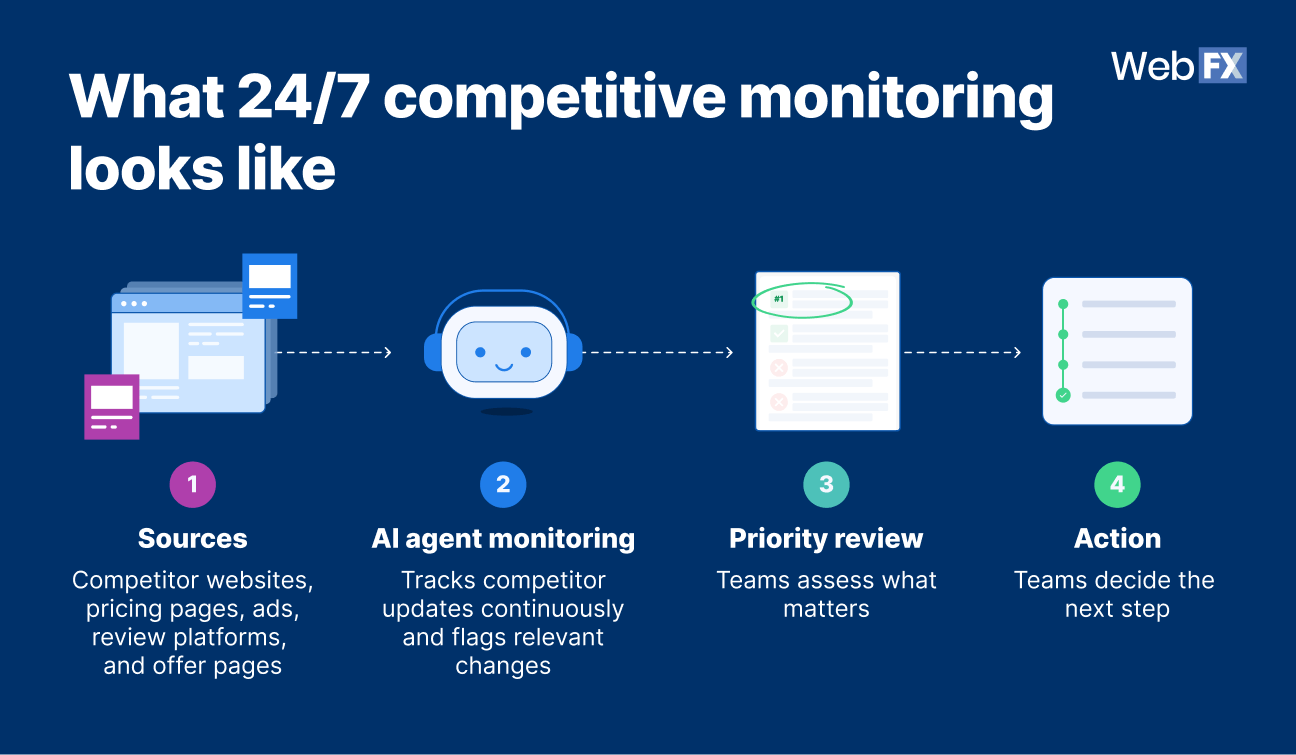
A 24/7 competitive monitoring workflow starts with a defined set of sources (like your competitors and websites) and rules (relevant changes or activities to track). The agent monitors those sources, flags relevant updates, and sends them to the right people for review.
A team might monitor competitor homepages, pricing pages, ad libraries, review platforms, and offer pages. If a competitor introduces updates simultaneously, such as a core headline, a new discount, a new product tier, or a new claim in paid ads, the agentic AI can automatically surface that update.
From there, the team in charge reviews the update and decides whether it calls for action from different teams. Should the sales enablement team revise their internal guidance? Should the marketing team create new content to address a topic gap?
This automated workflow gives teams a more reliable way to keep up with the market. The humans are making the decisions. The 24/7 AI agent simply reduces the time it takes to catch and prioritize competitor updates.
Why marketers need a better way to monitor competitors
Most businesses already do some competitor research. It’s typically not a consistent process, though.
Your team may review competitor pages before launching a campaign, revisit your competitors’ pricing during quarterly planning, or scan a few ads before rewriting your own messaging. That work can still be useful, but it usually depends on time, memory, and whoever owns the task that week.
When there are other projects to prioritize, competitive monitoring takes a back seat. The result? Teams may overlook changes in positioning, pricing updates, or important marketing messages.
To avoid the consequences of inconsistent competitor tracking, create an agentic AI-assisted process that’s repeatable and enables you to catch opportunities and threats sooner.
FAQs
What’s difference between manual competitive monitoring using AI chatbots and AI agents for competitor analysis?
The biggest differences are consistency and a repeatable workflow.
When you use an AI chatbot manually, you ask it to analyze competitor pages, compare messaging, or summarize pricing changes one prompt at a time. That approach can still be useful, especially for one-off research, but it depends on someone remembering to check competitor sources and prompt the chatbot each time.
On the other hand, AI agents for competitive intelligence let you monitor competitor updates more consistently through a repeatable workflow. They can monitor selected sources on an ongoing basis, alert you of updates, and organize findings for your review.
This table summarizes their differences:
| AI chatbots for manual checking | AI agents for 24/7 competitor monitoring | |
| Monitoring frequency | Periodic checks | Continuous tracking |
| Insight style | Reactive insights | Proactive alerts |
| Pattern recognition | Missed patterns | Trend detection |
What competitor data should AI agents track?
AI agents should track the competitor data most likely to affect your positioning, campaigns, sales conversations, and the bottom line. For most businesses, that includes:
- Homepage and product page messaging
- Pricing updates
- New promotions
- Ad copy and creative updates
- Landing page changes
- Launch announcements
- Customer reviews
- Recurring customer complaints
- Blog themes and content topics
Your AI agent doesn’t need to track everything, though. Focus on updates that influence how buyers compare options in your market.
For example, let’s say you’re marketing an automotive dealership. If your sales team often gets pricing objections from prospects, prioritize tracking your competitors’ pricing pages over blog post updates.
Can AI agents detect competitor pricing changes?
Yes. AI agents can detect pricing changes if you set them up to monitor pricing-related pages and updates.
For example, an AI agent can watch competitor pricing pages, product comparison pages, or promotional landing pages. That can help your team catch updates earlier instead of discovering them after your own prospects start bringing them up with your sales team.
AI-powered pricing monitoring has limits, though. Some businesses don’t publish their pricing details and instead disclose them to prospects during demos or sales calls, while other businesses test price language without really adjusting their prices.
So once your AI agent flags pricing updates, check other sources to verify what changed and whether it’s meaningful. Yes, human oversight still matters.
How do AI agents help monitor competitor content strategy?
AI agents can help you track how competitors are using content over time. They can monitor changes like:
- New blog topics
- Repeated themes across articles
- Changes in target audience or pain points
- Comparison pages
- Use-case pages
- Gated resources
- Content tied to new offers or launches
For example, if you’re a pet supplies store owner and your competitor starts publishing multiple articles around one pain point and introduces new landing pages, it may be a sign that it’s changing its content strategy. Your AI agent can alert you about those patterns faster than a manual check every few weeks.
Instead of reacting late, your team can use those insights to refine your content plan or strengthen your positioning.
Should I audit my AI agent for competitive monitoring?
Yes. Businesses should not assume an AI agent is working well just because it is generating updates.
To audit the workflow, teams should regularly review the following:
- What the agent is monitoring: Check whether it is tracking the right competitor sources, such as product pages, pricing pages, ads, review platforms, and offer pages.
- What the agent is flagging: Make sure it’s picking up meaningful competitor updates instead of overwhelming the team with minor changes.
- How it’s prioritizing updates: Is your AI agent correctly identifying the changes that are most likely to affect your positioning, campaigns, buyer comparisons, and sales?
- What the AI agent is recommending: Gauge whether the suggested next steps are relevant and proportional to the change.
- What your team actually did: Keep a record of the agent’s reports, what action it recommended, and what your team decided to do. Doing so lets you also help track the results of your actions.
- Where human review is required: Identify new decision points that need your team’s approval, especially when a response could affect messaging, pricing, sales guidance, or campaign strategy.
Regular auditing can catch false positives, missed updates, or weak recommendations. Plan an annual or semi-annual audit of your AI agent.

AI Workspace for Business Teams
Imagine an AI workspace where you can collaborate with team members, share prompts, and leverage personas for generative AI.
Empower My Team with AI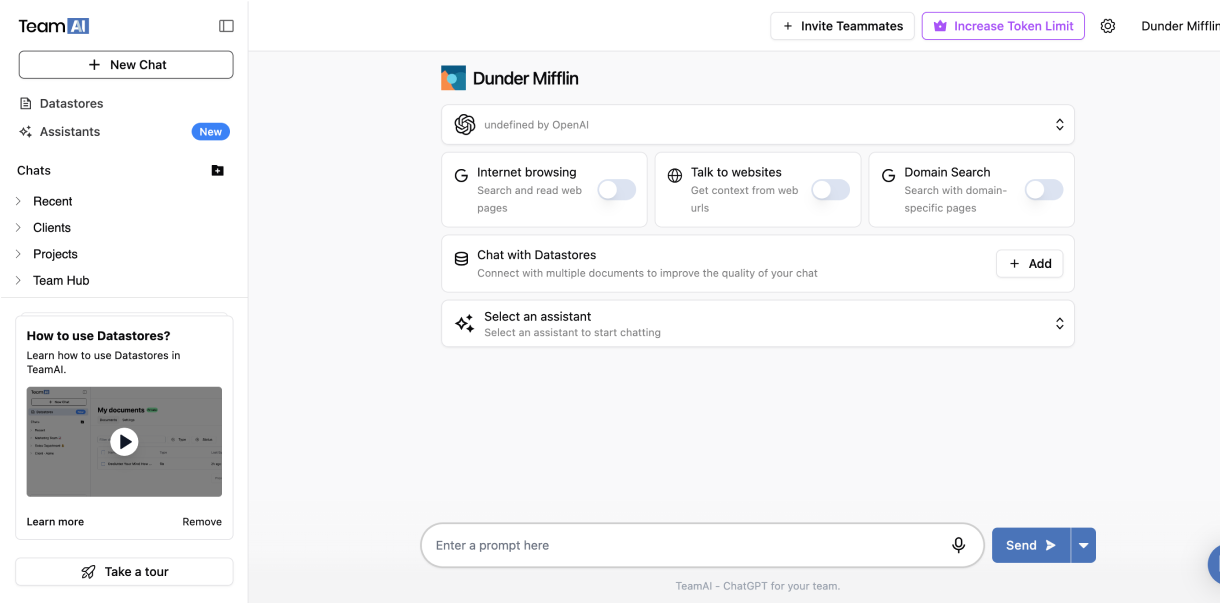
The AI platform that enables your team to collaborate and build AI agents
For many teams, one of the most practical uses of advanced AI models and systems is supporting ongoing, time-consuming work like competitive monitoring. The TEA framework gives marketers a practical way to structure that workflow so AI can assist teams without replacing human judgment.
If you’d like to build a 24/7 competitive monitoring AI agent, a platform like TeamAI lets your team members collaborate in the same space to build one. You can create and share prompts, conversations, and agents for your internal use.
-
 Maria is a Lead Emerging Trends & Research Writer at WebFX. With nearly two decades of experience in B2B and B2C publishing, marketing, and PR, she has authored hundreds of articles on digital marketing, AI, and SEO to help SMB marketers make informed strategic decisions. Maria has a degree in B.S. Development Communication major in Science Communication, and certifications in inbound marketing, content marketing, Google Analytics, and PR. When she’s not writing, you’ll find her playing with her dogs, running, swimming, or trying to love burpee broad jumps.
 -

WebFX is a full-service marketing agency with 1,100+ client reviews and a 4.9-star rating on Clutch! Find out how our expert team and revenue-accelerating tech can drive results for you! Learn more

Try our free Marketing Calculator
Craft a tailored online marketing strategy! Utilize our free Internet marketing calculator for a custom plan based on your location, reach, timeframe, and budget.
Contents
- The TEA framework for 24/7 competitive monitoring
- Track competitor updates continuously
- Evaluate which changes matter
- Act on the insight
- What 24/7 competitive monitoring looks like in practice
- Why marketers need a better way to monitor competitors
- FAQs
- The AI platform that enables your team to collaborate and build AI agents
- What’s difference between manual competitive monitoring using AI chatbots and AI agents for competitor analysis?
- What competitor data should AI agents track?
- Can AI agents detect competitor pricing changes?
- How do AI agents help monitor competitor content strategy?
- Should I audit my AI agent for competitive monitoring?
Share this article


See AI Marketing in Action
Explore how WebFX helped a regional brand get discovered in AI search experiences — proving what’s possible with today’s AI-driven marketing!
Proven Marketing Strategies
Try our free Marketing Calculator
Craft a tailored online marketing strategy! Utilize our free Internet marketing calculator for a custom plan based on your location, reach, timeframe, and budget.
What to read next