


Contents
- Where does programmatic advertising fit into your overall sales and marketing strategy?
- How does programmatic advertising support sales and marketing?
- Where can you use programmatic advertising to support marketing and sales?
- When does using programmatic advertising for marketing and sales work best?
- How do I use programmatic advertising in a marketing and sales strategy?
- How do I align programmatic advertising efforts between sales and marketing?
- How can I use programmatic advertising alongside other marketing and sales efforts?
- When should sales and marketing teams adopt programmatic advertising?
- When shouldn’t sales and marketing teams invest in programmatic advertising?
- 7 best practices for adding programmatic advertising to your sales and marketing strategy
- FAQs
- Make programmatic advertising work with your sales and marketing strategy

TL;DR
- Programmatic advertising fits into your sales and marketing strategy as a targeted paid media channel that helps you reach and retarget specific audiences across digital placements.
- Programmatic ads work best when they support channels like SEO, paid search, paid social, email marketing, content marketing, and sales outreach.
- You can use programmatic ads across your funnel, from building awareness with new audiences to re-engaging prospects and promoting renewals or repeat purchases.
- Programmatic advertising makes the most sense when you have a defined audience, enough budget, useful audience data, and clear tracking.
Programmatic advertising fits into your overall sales and marketing strategy as an automated ad-buying channel that helps you reach and retarget specific audiences throughout the customer journey.
That sounds simple, but you’re probably asking: Is programmatic advertising for brand awareness, sales support, or direct conversions?
The answer depends on the job you assign it. You can use programmatic ads to introduce your brand to a new market. Or you can run these automated ads to retarget users who previously visited your product pages.
Regardless of the goal you assign it, programmatic advertising works best when it supports a specific part of your strategy. Learn more about how programmatic fits in your sales and marketing strategy, how it supports each funnel stage, and when it makes sense for your business.
Where does programmatic advertising fit into your overall sales and marketing strategy?
Programmatic advertising fits into your sales and marketing strategy as an automated, audience-based media buying method that helps you reach prospects across digital channels based on data, behavior, intent, or account fit.
How does programmatic advertising support sales and marketing?
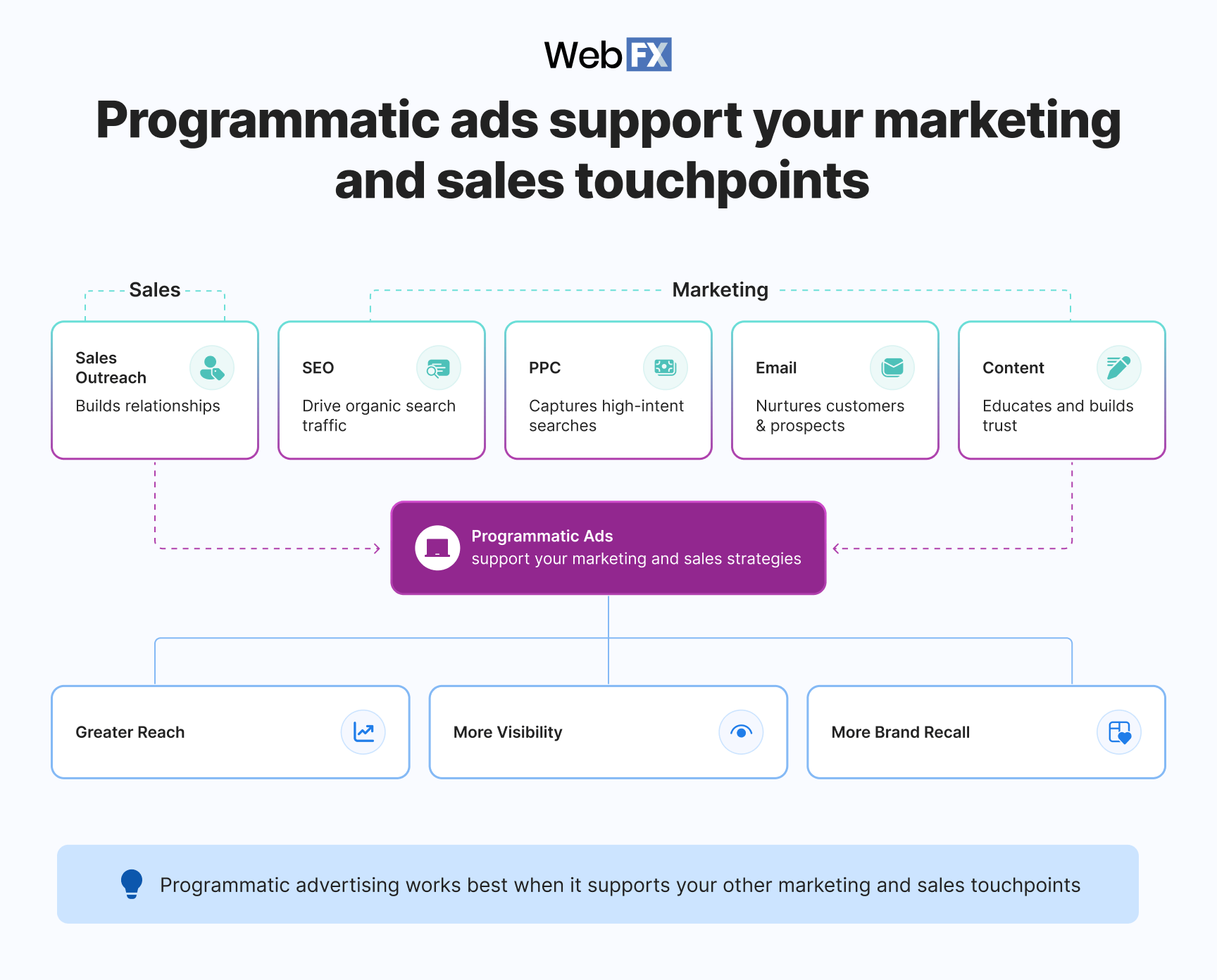
At a strategic level, programmatic helps marketing and sales teams:
- Reach new audiences before they search for you
- Stay visible to people who have already visited your site
- Support account-based marketing campaigns
- Reinforce sales outreach with ads to target accounts
- Promote content, offers, demos, products, or events
- Turn cold leads warm
- Keep your brand present during long buying cycles
- Support both shorter and longer buying journeys
Where can you use programmatic advertising to support marketing and sales?
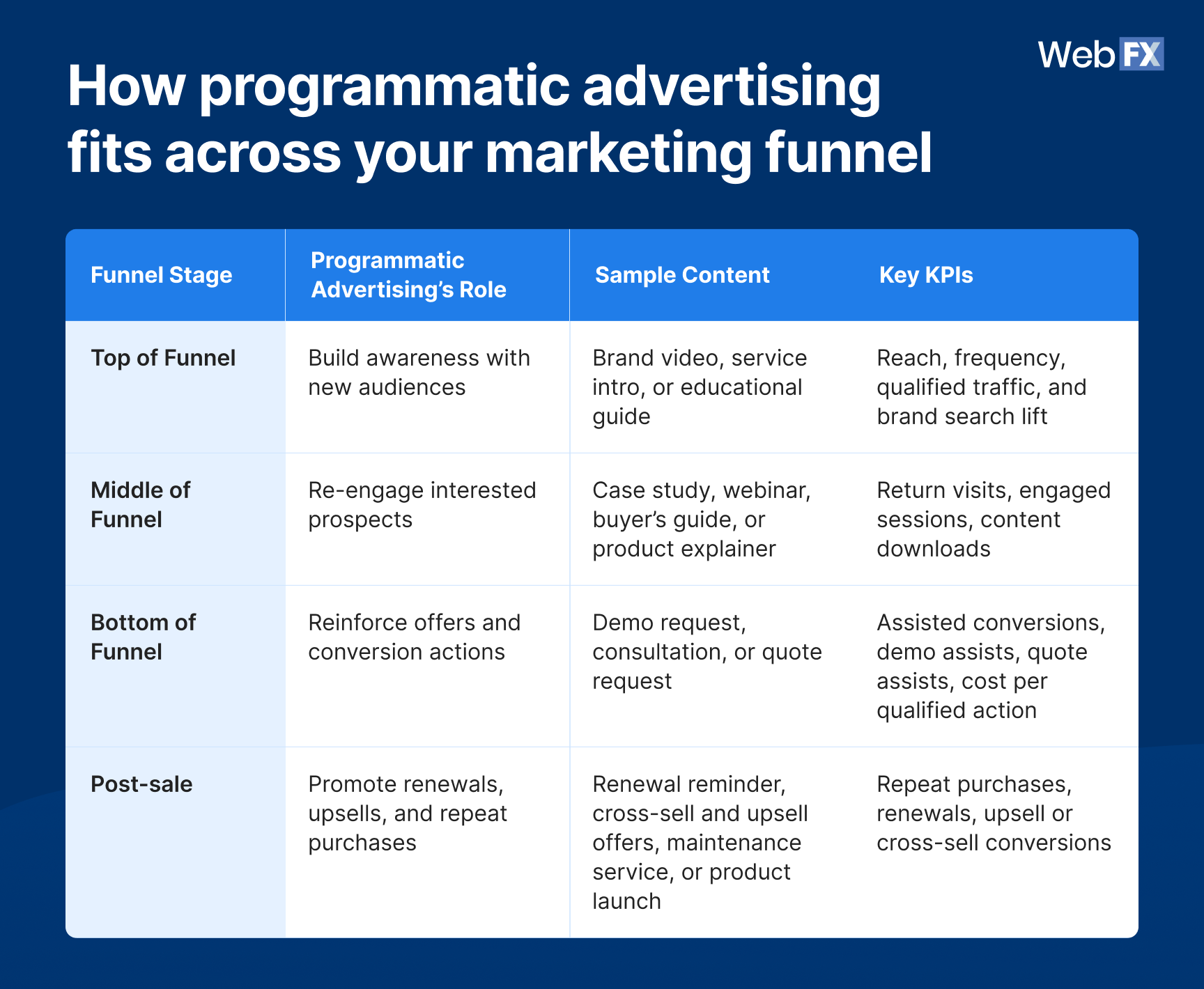
Table view
| Funnel Stage | Programmatic Advertising’s Role | Sample Content | Key KPIs |
| Top of Funnel | Build awareness with new audiences | Brand video, service intro, or educational guide | Reach, frequency, qualified traffic, and brand search lift |
| Middle of Funnel | Re-engage interested prospects | Case study, webinar, buyer’s guide, or product explainer | Return visits, engaged sessions, content downloads |
| Bottom of Funnel | Reinforce offers and conversion actions | Demo request, consultation, or quote request | Assisted conversions, demo assists, quote assists, cost per qualified action |
| Post-sale | Promote renewals, upsells, and repeat purchases | Renewal reminder, cross-sell and upsell offers, maintenance service, or product launch | Repeat purchases, renewals, upsell or cross-sell conversions |
You can use programmatic across the marketing funnel to support different sales and marketing goals (which often align on using programmatic ads to scale lead gen):
- Top of funnel (TOFU): Programmatic helps you reach new, relevant audiences before they search for your brand or products.
- Middle of funnel (MOFU): Programmatic can re-engage people who previously visited your website or matched your target audience.
- Bottom of funnel (BOFU): Programmatic reinforces offers, demos, consultations, product reminders, and sales conversations.
- Post-sale: Programmatic can promote renewals, upsells, cross-sells, events, or new product launches to existing customers.
Programmatic ads can appear across channels like:
- Display ads
- Native ads
- Video ads
- Audio ads
- Connected TV (CTV)
- Digital out-of-home placements, when available through a platform
- Mobile in-app inventory
Because of its flexibility, programmatic ads can support different parts of your strategy, but only when your targeting, creative, offer, and measurement plan match the campaign goal.
When does using programmatic advertising for marketing and sales work best?
Programmatic works best when you assign it a clear job, such as building awareness, re-engaging site visitors, influencing target accounts, or supporting sales conversations.
Think of programmatic advertising like a delivery system for your marketing message. The system can move that message across display, video, audio, connected TV (CTV), native placements, and mobile inventory.
Your strategy decides:
- Who should see the message
- Why they should see it
- What action should happen next
How do I use programmatic advertising in a marketing and sales strategy?
Programmatic can support every stage of the funnel, but the message, audience, and success metric should change at each stage. Match your campaign to the funnel stage to avoid wasted spend.
Here’s how:
Top of funnel: Build awareness with the right audience
Programmatic ads are a great way to introduce your brand to people who don’t know your business yet. Run campaigns to help create demand by targeting users who match your ideal customer profile.
This use case works well when you want to:
- Enter a new market
- Promote a new product or service
- Reach a niche audience
- Build familiarity before a sales push
- Support a brand campaign with audience targeting
For example, a commercial HVAC company expanding into a new metro area could use programmatic display and video ads to introduce its brand to facility managers before those buyers start searching for vendors.
The goal of your programmatic campaigns doesn’t always revolve around immediate form fills or inquiries. Instead, measure your campaign’s:
- Reach
- Frequency
- Qualified traffic
- Video completion rate for video ads
- Engaged site visits
- Branded search lift
Middle of funnel: Re-engage prospects who showed interest
Use programmatic in the middle of the funnel to re-engage people who showed interest in your brand. They may have taken meaningful action like visiting your website, watching your video, or viewing your pricing pages.
Middle-of-funnel campaigns can promote:
- Case studies
- Comparison guides
- Webinars
- Buyer guides
- Product explainers
- Demo offers
- Industry-specific resources
At this stage, your ads should answer your buyer’s next concern. For example, a software-as-a-service (SaaS) company can retarget people who viewed its product page with a programmatic ad that leads them to a case study.
Bottom of funnel: Support conversion without expecting magic
Programmatic can support bottom-of-funnel campaigns by keeping your offer, product, or proof points in front of people who are close to taking action.
At this stage, your audience may already know your brand. They may have visited a pricing page, viewed a product, added an item to their cart, requested information, or spoken with your sales team. Programmatic can remind them why your business is worth considering and guide them back to the next step.
Bottom-of-funnel programmatic campaigns can promote:
- Demo requests
- Consultations
- Quote requests
- Limited-time offers
- Abandoned cart reminders
- Product reminders
- Proposal-stage case studies
Programmatic can influence the deal, but it should not get credit for every deal it touches.
That point matters. A prospect might see a programmatic ad, click a paid search ad later, talk with sales, and convert after an email follow-up. Programmatic may have helped move the buyer along, but reporting should show influence rather than automatically assigning full credit to the ad impression.
Pre-sale: Build buy-in
Many buyers may compare options, review pricing, or talk things over with other brands. Programmatic ads can keep your case studies, testimonials, product reminders, or service benefits in front of them while they decide.
Post-sale: Grow customer value and retention
The post-sale stage often gets less attention, but programmatic ads at this stage can help businesses with renewals, repeat purchases, upsells, and cross-sell offers.
If you already have segmented customer lists, you can use programmatic to promote relevant offers to your existing customers.
For example, an industrial supplier could advertise replacement parts or maintenance services to existing customers based on previous purchase categories.
Pro tip: Your post-sale programmatic ad messaging must match the customer’s relationship with your business. A current customer should not see the same introductory ad as a cold prospect.
How do I align programmatic advertising efforts between sales and marketing?
Align programmatic advertising efforts between sales and marketing by having sales share details like target industries, common objections, and active opportunities, which marketing can use that input to shape audiences, messaging, creative, and offers.
You get to define the audience that matters most to your bottom line.
How can I use programmatic advertising alongside other marketing and sales efforts?
Programmatic ads can support many parts of your marketing funnel, but they work best when they complement your existing marketing strategies. Your other channels often create the first touch point, capture demand, or deliver the main message.
Programmatic helps extend those efforts by keeping your brand visible to the right audiences across more digital placements:
Programmatic advertising fits alongside these marketing channels
1. Programmatic and SEO
SEO helps people find your business when they search for information, products, or services. When you pair SEO with programmatic ads, you can stay visible after someone discovers your business through search.
For example, let’s say you’re marketing an automotive dealership. Someone may find your business when they’re looking for a particular car model. After they leave the vehicle product page, programmatic ads can retarget them with a relevant offer or financing message.
In this use case, SEO brings the visitor to your site. Programmatic gives you another chance to bring them back.
2. Programmatic and paid search
Paid search works well when someone already knows what they need and starts searching for it. Use programmatic to support the moments before and after that search.
For example, someone searching “industrial water treatment company near me” likely has stronger immediate intent than someone seeing a display ad. Paid search can capture that active demand, while programmatic can build familiarity earlier or retarget the person later with ads that lead to your service pages.
In this use case, programmatic builds awareness, reinforces the message, and brings interested users back.
3. Programmatic and paid social
Paid social reaches audiences inside specific platforms. To extend your reach beyond those channels, you can run programmatic campaigns to reach the same audience through video ads or other digital placements.
For example, a healthcare organization could use paid social to promote a new service line on Facebook or Instagram. Then, it could use programmatic video or display ads to stay visible to similar local audiences across other digital placements.
Programmatic can also support paid social retargeting. If someone engages with a campaign or visits your site after clicking a social ad, programmatic can keep the message in front of them outside the original platform.
4. Programmatic and email marketing
Email marketing is an excellent way to nurture existing customers or prospects who signed up to receive your newsletter. When you use programmatic along with email marketing, you reach and engage with this audience beyond their mailboxes.
This pairing is useful when contacts don’t open every marketing email. Programmatic can remind your audience about the same offer or product they may have missed.
For example, an HVAC services company could email past customers about a seasonal HVAC maintenance offer, then use programmatic ads to remind matched audiences about the same service.
5. Programmatic and content marketing
Content marketing helps you answer your customers’ questions, explain your services, and show your expertise. Programmatic can boost those efforts by putting your content in front of targeted audiences instead of waiting for people to find it through organic search or social media.
Programmatic can also help you guide prospects to the next step. A prospect in the early stages of research may need an educational guide first. When that prospect returns, they may look for a case study, product comparison, or offer.
In this use case, content attracts your prospects and gives them a reason to engage with you, while programmatic helps deliver that content to the right people.
When should sales and marketing teams adopt programmatic advertising?
Programmatic makes sense for your business when you have enough budget, audience data, tracking, and campaign strategy to give it a defined role.
You can also use programmatic when you need to reach a specific audience segment across multiple channels or markets, but only if you can define that audience clearly and track what happens after the ad impression.
In most cases, programmatic works best for businesses that already know who they want to reach and have a clear next step for that audience. These signs can help you decide whether programmatic belongs in your strategy now:

Signs you may be ready for programmatic advertising
You have a clearly defined audience
Programmatic works best when you know who you want to reach. That audience might include:
- Website visitors
- Customer lists
- Newsletter subscribers
- Lookalike audiences
- Specific industries
- High-value locations
- People who show relevant online behavior
- Target accounts, if you use account-based marketing
High-precision targeting only helps when the targeting criteria match real buyers. Trying to reach a broad audience can waste your budget if most of them have no reason to buy from you.
For example, “homeowners” may be too broad for an HVAC company promoting emergency repair services. “Homeowners in your service area who recently visited your AC repair page” gives the campaign a more useful direction.
You have a long sales cycle
Programmatic can help when buyers take time to decide.
Longer buying cycles create gaps between touchpoints. A prospect may visit your site, compare options, read reviews, and check out your competitors. Programmatic can keep your business visible during that process.
This fit is especially strong for businesses with higher-value products or services. A healthcare provider, home services company, automotive dealership, software company, or professional services firm may need multiple touchpoints before someone takes the next step.
You sell high-value products or services
Programmatic works well when one qualified lead or sale can justify ongoing investment.
That makes it a stronger fit for businesses that sell high-cost or high-margin products and services, such as:
- Manufacturing and industrial products
- Heavy equipment
- Healthcare services
- Professional services
- Home and facility services
- B2B ecommerce
- Enterprise software
- Financial services
- Automotive or other high-consideration consumer purchases
The larger the potential value of a customer, the more sense it makes to stay visible throughout their research and decision process.
You have first-party data
First-party data makes programmatic stronger. CRM lists, website audiences, lead-stage data, and purchase history can help you create more relevant campaigns.
Instead of targeting a broad audience, you can focus your spend on people or segments who are more likely to become customers.
For example, you could create different programmatic audiences for:
- Current customers
- Past customers
- Newsletter subscribers
- Pricing-page visitors
- Open opportunities
- Closed-lost opportunities
- High-value customer segments
This is where programmatic can become more efficient than broad awareness advertising because you can focus spend on people or segments that already have a connection to your business.
You want to scale into multiple markets or audience segments
Programmatic can help businesses expand beyond one channel or one geography.
This use case makes sense when you want to reach new regions, promote multiple service lines, or target several buyer groups.
Pro tip: Prepare unique landing pages and messages for each market or audience segment. A marketing message may be relevant to a particular segment, but not relevant to another one.
You already invest in other channels
Programmatic works best when you already invest in SEO, paid search, or other marketing channels.
These channels give programmatic something to build on. SEO and content can bring people to your site, while paid search can capture high-intent demand.
When these channels already work together, programmatic can add reach and reinforcement. It can help you bring previous visitors back and stay visible.
When shouldn’t sales and marketing teams invest in programmatic advertising?
Running programmatic ads may not be the best next step for every business. It may not make sense for your business if:
- You need immediate lead volume and have no existing demand
- You have a very small budget
- You don’t have conversion tracking
- You cannot define your audience
- You have no landing pages or offers
- You expect direct-response ROI within a few days
- You don’t have enough traffic, CRM data, or audience volume to create audience segments
In these cases, your next step may be improving your paid search campaigns and tracking before running programmatic ads.
7 best practices for adding programmatic advertising to your sales and marketing strategy
Adding programmatic advertising to your sales and marketing strategy works best when you treat it as part of your sales and marketing system. Use these best practices to give programmatic a clear role, optimize your ad spend, and make reporting more useful:

Programmatic advertising best practices
1. Define the job before launching the campaign
Start with a specific job for your programmatic ad campaign. Examples include:
- Reach new target accounts
- Retarget pricing-page visitors
- Promote a product launch
- Support a sales outreach campaign
- Re-engage past customers
- Build awareness in a new market
Each campaign should have one primary job. A clear campaign job helps your team choose the right audience and craft effective ad creative.
2. Use audience data carefully
Use first-party data when available, and make sure your audience targeting follows privacy and consent requirements.
Pro tip: Prioritize audience quality over audience size. A smaller list of qualified prospects can outperform a larger audience that is unlikely to become customers.
Strong audience inputs can include:
- CRM lists
- Customer lists
- Website visitors
- Lead-stage data
- Product interest
- Industry segments
- Geographic markets
- Account lists
- Purchase history
Avoid overly broad or unverified audiences. If your audience definition sounds like “anyone who might need us,” it needs more work.
3. Align your ad creative with the funnel stage
Your ad should match what the audience knows about you.
Awareness ads should introduce the brand, product category, or problem, while consideration ads should promote proof and useful content. Conversion ads should ask for a clear next action.
For example, if you’re targeting users who aren’t familiar with your brand yet, start with a helpful guide or category explanation, not a demo request.
4. Coordinate with sales
If your business has a sales team or lead handoff process, coordinate with sales before launching programmatic campaigns. Sales can tell marketing which accounts, industries, objections, and offers matter.
That input can shape your programmatic strategy, because it provides marketing teams with useful insights to build better audiences and compelling ads.
Pro tip: Meet with sales before launching campaigns that target accounts, pipeline stages, or sales territories. Programmatic should reinforce the sales motion, not create a separate message that sales never sees.
5. Decide how you will measure programmatic advertising’s role
Measure your programmatic campaigns based on the job it was assigned.
An awareness campaign and a retargeting campaign shouldn’t use the same success metrics. Awareness may focus on reach, frequency, viewability, qualified traffic, and branded search lift.
On the other hand, retargeting may focus on return visits, assisted conversions, demo assists, quote assists, and cost per qualified action.
6. Set a budget based on the campaign’s job
Your programmatic budget should follow the campaign goal. Awareness campaigns usually need enough spend to reach a meaningful audience, while retargeting campaigns can often start smaller because the audience already showed interest.
Pro tip: Protect your budget for proven audiences before funding experimental channels or broad tests.
For example, if your retargeting campaign consistently brings qualified visitors back to high-value pages, don’t drain that budget to test a broad CTV campaign without a clear reason. Testing matters, but your budget should still protect what already supports business outcomes.
7. Review placement quality and reporting
Programmatic campaigns can reach many places across the Internet, so placement quality matters.
Look for brand-safe placements, useful reporting, and meaningful optimization. Avoid relying on impressions alone.
Watch for waste signals like:
- High impressions with low qualified site visits
- Poor placement quality
- Weak viewability
- Conversions that do not match CRM quality
- Too much spend on broad audiences
- Duplicate attribution across channels
A healthy programmatic strategy should help your team make better decisions over time. If reporting only shows that ads appeared, you need stronger measurement.
FAQs
What is programmatic advertising?
Programmatic advertising is the automated buying of digital ad space using software, audience data, and real-time bidding. It helps advertisers reach specific audiences across various ad channels like display, video, audio, and connected TV.
Where does programmatic advertising fit into your overall sales and marketing strategy?
Programmatic fits as a paid media layer that helps you reach, retarget, and influence audiences across the customer journey.
It can support awareness, consideration, conversion, sales outreach, and customer retention. Just make sure each campaign has a defined goal.
Why is programmatic advertising important for businesses?
Programmatic advertising helps businesses reach specific audiences at scale, support sales and marketing touchpoints, and use data to reduce wasted ad spend.
For marketing teams, it also creates a way to activate first-party data and measure audience engagement beyond clicks.
Is programmatic advertising better for awareness or conversions?
Programmatic can support both awareness and conversions, but it usually performs best when each campaign has one defined goal.
Use awareness campaigns to reach new audiences and retargeting or sales-support campaigns to encourage warmer prospects to take action.
How does programmatic advertising help sales teams?
Programmatic advertising helps sales teams by warming up target accounts, reinforcing sales outreach, and keeping your brand visible while prospects research and compare options.
It can also help sales and marketing align around priority buyer segments.
How much should you spend on programmatic advertising?
Your programmatic advertising budget depends on your goal, audience size, channels, and sales cycle.
Retargeting can often start smaller because the audience has already shown interest, while awareness and CTV campaigns usually need larger budgets to gather useful results.
What are common programmatic advertising mistakes that I should avoid?
Common programmatic advertising mistakes include:
- Launching campaigns without a clear goal
- Using audiences that are too broad or poorly matched to real buyers
- Relying too heavily on impressions or view-through conversions
Sending traffic to weak landing pages - Ignoring placement quality and brand safety
- Failing to connect campaign reporting with CRM or sales data
- Running programmatic separately from your other marketing channels
See What Smart Marketing Looks Like at Your Budget
We’ll show you what’s possible and where to focus—based on data from thousands of successful campaigns.

Make programmatic advertising work with your sales and marketing strategy
Programmatic advertising should have a defined role in your overall sales and marketing strategy.
Use it to reach new audiences, re-engage interested prospects, support sales conversations, and stay visible during long buying cycles.
If your team needs help integrating programmatic advertising with your other strategies, consider partnering with WebFX. We’re a full-service digital marketing agency with 30+ years of experience driving revenue for our clients.
When you team up with us, you get access to our proprietary platform, RevenueCloudFX, which enables you to use your data to optimize your campaigns.
Contact us online or call us at 888-601-5359 to speak with a strategist about our programmatic ad services that drive ROI!
-
 Maria is a Lead Content Specialist at WebFX. With nearly two decades of experience in B2B and B2C publishing, marketing, and PR, she has authored hundreds of articles on digital marketing, AI, and SEO to help SMB marketers make informed strategic decisions. Maria has a degree in B.S. Development Communication major in Science Communication, and certifications in inbound marketing, content marketing, Google Analytics, and PR. When she’s not writing, you’ll find her playing with her dogs, running, swimming, or trying to love burpee broad jumps. View full profile
 -

WebFX is a full-service digital marketing agency delivering revenue-driving strategies across online advertising, SEO and AI search optimization, and digital marketing. Backed by 1,100+ client reviews, a 4.9-star rating on Clutch, and proprietary revenue-tracking technology, our team helps businesses grow visibility and revenue across platforms, from Google to ChatGPT to LinkedIn. Discover how our expert team and revenue-accelerating tech can drive results for you. Learn more
Cost Per Click (CPC) Calculator
Do you advertise on platforms that charge per click? Use our calculator and figure out exactly how many clicks will fit within your budget.
Calculate Your CPC
Contents
- Where does programmatic advertising fit into your overall sales and marketing strategy?
- How does programmatic advertising support sales and marketing?
- Where can you use programmatic advertising to support marketing and sales?
- When does using programmatic advertising for marketing and sales work best?
- How do I use programmatic advertising in a marketing and sales strategy?
- How do I align programmatic advertising efforts between sales and marketing?
- How can I use programmatic advertising alongside other marketing and sales efforts?
- When should sales and marketing teams adopt programmatic advertising?
- When shouldn’t sales and marketing teams invest in programmatic advertising?
- 7 best practices for adding programmatic advertising to your sales and marketing strategy
- FAQs
- Make programmatic advertising work with your sales and marketing strategy
Share this article


Cost Per Click (CPC) Calculator
Do you advertise on platforms that charge per click? Use our calculator and figure out exactly how many clicks will fit within your budget.
Calculate Your CPC