


Table of Contents
- How Meta AI mentions and recommends businesses today
- The Meta AI visibility scorecard
- 1. Your Meta platform presence
- 2. Social proof and customer activity
- 3. Messaging and responsiveness
- 4. Website clarity and consistency
- 5. Niche clarity and brand consistency
- How to use your results to improve visibility
- FAQs about Meta AI visibility
- Improving visibility on Meta AI starts with clarity
If your audience spends time on Meta platforms like Facebook, Instagram, Messenger, and WhatsApp, it’s natural to want your business to show up in Meta AI responses. And if you’ve tried to figure out how to do that, you’ve probably noticed there isn’t a clear playbook.
There’s no place to submit your website to Meta AI. There’s no dashboard showing whether you’re “ranked.” And there’s no single tactic that guarantees visibility.
That doesn’t mean visibility is random, though. Improving visibility on Meta AI is not about doing one new trendy thing. To increase your chances of getting mentioned, keep your important business information clear.
In practice, businesses tend to show up in Meta AI responses when the platform can clearly understand who they are, what they offer, and when they’re relevant. This guide focuses on how you can clearly communicate this information so your business has a better chance of getting mentioned on Meta platforms.
In this article, we’ll cover:
- How Meta AI mentions and recommends businesses today
- A visibility scorecard you can use to spot gaps
- How to use your results to improve visibility
- FAQs
How Meta AI mentions and recommends businesses today
Meta AI does not work like a traditional search engine. It doesn’t return a ranked list of websites, and it doesn’t rely on publicly documented ranking factors.
Instead, Meta AI generates responses by pulling from information it already has access to, like the following:
- Across Meta-owned platforms
- Business websites
- Trusted third-party sources
When a user asks for recommendations, Meta AI looks for businesses it can confidently identify, understand, and match to that request.
From a business perspective, Meta AI visibility depends less on “optimizing for AI” and more on how easy it is for Meta AI to recognize and interpret your business information. At a high level, Meta AI relies on broad sources of signals:
- Information on Meta platforms
- Social proof and engagement
- Your website
- Third-party mentions
- Brand consistency
The Meta AI visibility scorecard
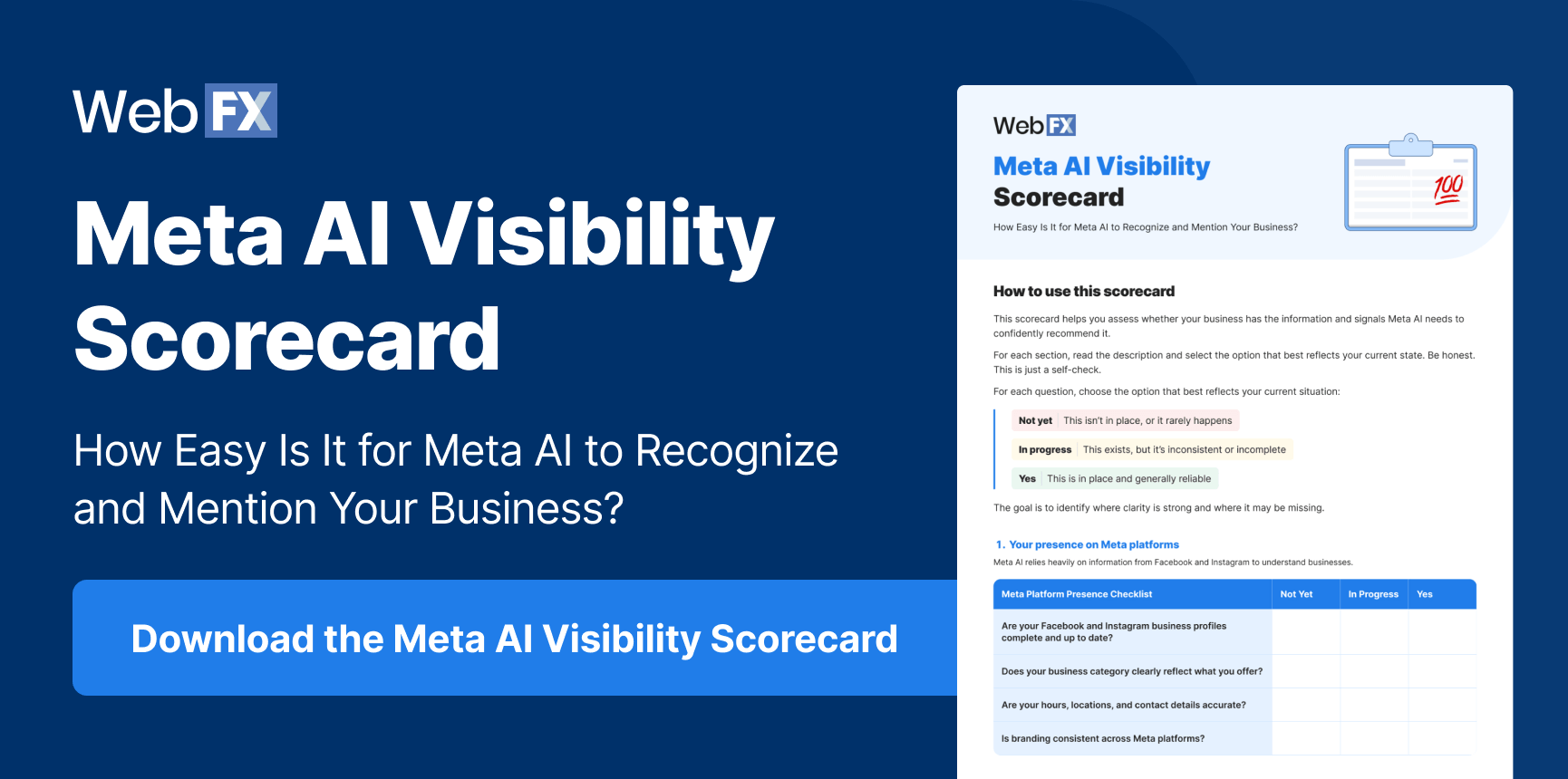
This Meta AI Visibility Scorecard is a practical way to evaluate whether your business has the signals Meta AI needs to recognize and mention you.
Instead of focusing on technical details, the scorecard helps you answer a simple question: If Meta AI were asked to recommend a business like mine, am I providing it enough clear information to confidently mention my brand?
The scorecard looks at five areas that consistently influence how visible a business is across Meta’s AI-driven experiences:
- Your presence on Meta platforms
- Customer activity and social proof
- Messaging and responsiveness
- Website clarity and alignment
- Niche focus and brand consistency
Let’s go through each one:
1. Your Meta platform presence
This area looks at how complete and accurate your business profiles are on Facebook and Instagram. Meta AI is more likely to mention businesses when:
- Profiles are fully filled out
- Categories accurately reflect services
- Hours, locations, and contact details are current
- Branding is consistent across platforms
Common issues include outdated information, vague descriptions, or profiles that haven’t been reviewed in years. These gaps create uncertainty and reduce your visibility.
2. Social proof and customer activity
Meta AI considers signals that show real customer interaction. This includes:
- Reviews and ratings
- Comments on posts
- Tagged photos or mentions
- Evidence of ongoing engagement
You don’t need constant activity, but long periods of silence or zero reviews can send signals to Meta AI that you may no longer be an active business, so it might not mention you.
3. Messaging and responsiveness
Many Meta AI interactions are conversational. Users ask questions, look for recommendations, and want quick answers. It’s easier to recommend businesses when:
- Their messaging is enabled on relevant platforms
- Their customers receive timely replies or clear automated responses
- Information shared via messages is accurate and consistent
4. Website clarity and consistency
Your website should clearly support what appears on Meta platforms. That means:
- Services are easy to understand
- Business details match your Meta profiles
- Content reflects your actual offerings and niche
Ensure your website reinforces the information Meta AI sees elsewhere.
5. Niche clarity and brand consistency
Businesses are easier to recommend when their positioning is clear. If your messaging is overly broad or inconsistent, Meta AI may struggle to determine when you’re relevant.
Clear niche focus, consistent language, and reinforcing third-party mentions all help reduce that ambiguity.
What the scorecard can (and can’t) tell you
Use the scorecard as a self-check. Review each of the five areas to look for patterns and gaps. The scorecard is meant to help you identify gaps and what you need to improve first.
It helps you understand:
- Where your business information is clear or unclear
- Which areas may be limiting discoverability
- How to prioritize improvements
It does not tell you:
- Whether Meta AI will feature your business
- How often you’ll appear in AI responses
- How you compare to specific competitors
How to use your results to improve visibility
Once you’ve reviewed the five areas, the next step is prioritization.
If you marked “Not yet” for several questions, start with the basics:
- Update and complete your Meta profiles
- Align business details across platforms
- Enable messaging and prepare clear responses
If most of your answers were “In progress,” focus on consistency:
- Tighten descriptions
- Encourage and respond to reviews
- Ensure your website reflects your current offerings
If most of your answers were “Yes,” your foundation is likely solid. At that point, the priority is maintenance:
- Keep information up to date as your business changes
- Monitor engagement and messaging regularly
- Revisit the scorecard periodically to catch gaps early
No matter where you land, avoid shortcuts like prompt manipulation or one-off tactics. Those approaches don’t address the real issue.
Visibility improves when your business is easier to understand across platforms over time.
FAQs about Meta AI visibility
Can I submit my business to Meta AI?
No. There is no submission process for Meta AI.
Does Meta AI replace Google search?
No. Meta AI serves different discovery experiences within Meta platforms such as Facebook, Instagram, Messenger, and WhatsApp.
How long does it take to see results?
There is no fixed timeline. Improvements help Meta AI better understand your business, but visibility depends on context and user queries.
Is this something I need to revisit?
Yes. Business information changes, and platforms evolve.
It’s best practice to regularly review and update (when needed) your business information on your website, social media pages, and online listings.
Improving visibility on Meta AI starts with clarity
If your audience uses Meta platforms, being visible in Meta AI matters. While there’s no way to control AI-driven recommendations, there are ways to make your business easier to recognize, understand, and cite.
Use the visibility scorecard to help you maintain consistency and clarity, so you put your business in a stronger position to be discovered on Meta AI platforms.
If you need help improving your online visibility on Meta platforms, organic searches, or answer engines, let WebFX assist you. Improving your visibility on Meta AI is part of a larger strategy, and our team will be glad to help.
OmniSEO®, our holistic approach to search optimization, is meant to help you improve your visibility across all platforms, so your audience can discover you wherever they search.
Contact us online or call us at 888-601-5359 to speak with a strategist to learn more!
-
 Savannah is a content marketer with editorial experience spanning several businesses. Specializing in social media and marketing trends, she loves talking about the latest developments in online marketing. When she’s not writing, Savannah loves traveling, hoarding books and coffee mugs, and adoring her cat. Please don’t ask her about famous true crime cases, or else she’ll tell you all about her theories and get absolutely no work done.
 -

WebFX is a full-service marketing agency with 1,100+ client reviews and a 4.9-star rating on Clutch! Find out how our expert team and revenue-accelerating tech can drive results for you! Learn more
Try our free Marketing Calculator
Craft a tailored online marketing strategy! Utilize our free Internet marketing calculator for a custom plan based on your location, reach, timeframe, and budget.
Plan Your Marketing Budget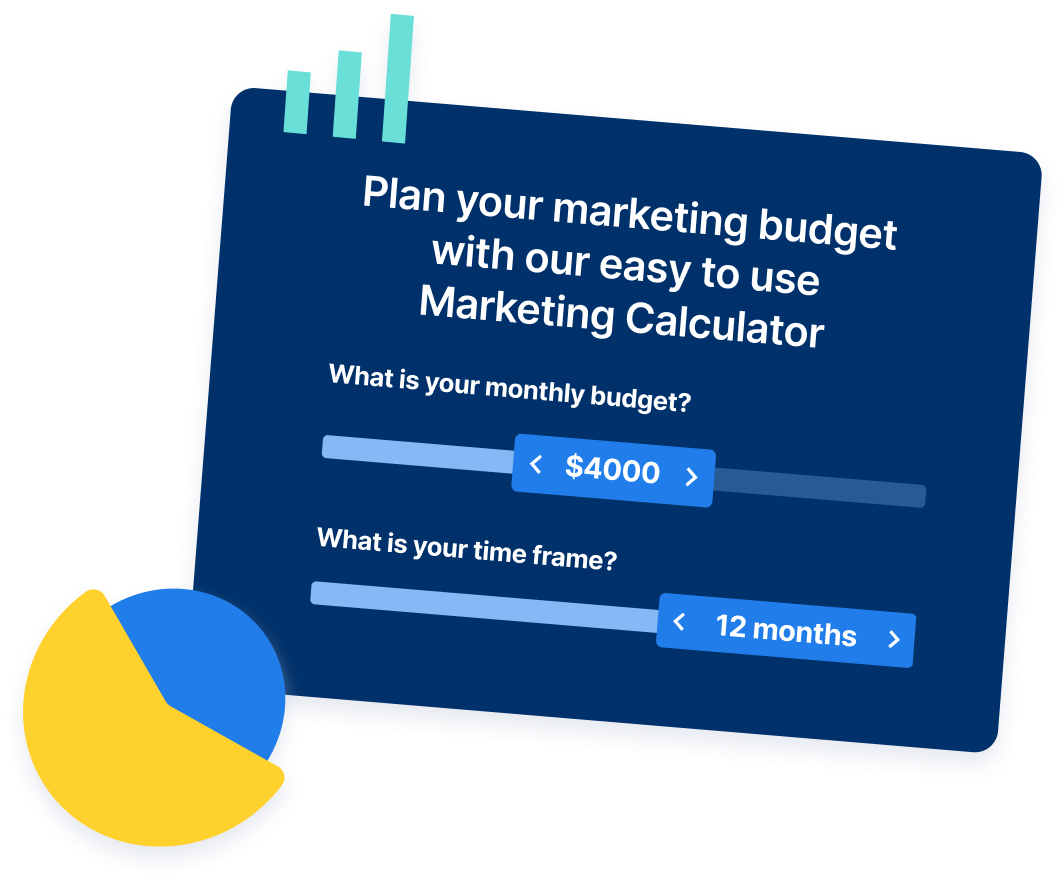
Table of Contents
- How Meta AI mentions and recommends businesses today
- The Meta AI visibility scorecard
- 1. Your Meta platform presence
- 2. Social proof and customer activity
- 3. Messaging and responsiveness
- 4. Website clarity and consistency
- 5. Niche clarity and brand consistency
- How to use your results to improve visibility
- FAQs about Meta AI visibility
- Improving visibility on Meta AI starts with clarity
Share this article


SEO Success with KOA
Try our free Marketing Calculator
Craft a tailored online marketing strategy! Utilize our free Internet marketing calculator for a custom plan based on your location, reach, timeframe, and budget.
Plan Your Marketing Budget