
Does SEO Really Work? Yes (But You'll Need to Adapt to Succeed)
Does SEO work?
SEO works when it’s effectively managed and maintained.
SEO is not an exact science. The best practices for SEO evolve frequently because it’s based on ever-changing algorithms set up by the search engines to give people the best results.
For example, at one point, having a mobile-friendly website was optional, but now it’s a requirement — and our SEO FAQ emphasizes why factors like this directly affect rankings.
The point here is that SEO is constantly evolving, and companies that don’t keep up will feel like search engine optimization is no longer working for them.
Why can it feel like SEO isn’t working?
It can feel like SEO isn’t working when you’re using outdated practices, failing to adapt to industry shifts (like AI search), or are unaware of issues that are affecting your site’s performance.
How long does SEO take to work?
SEO typically takes 3–6 months to start working, and 6–12 months to show major results.
SEO is a long-term strategy, so it takes time to show results.
You won’t see an immediate change the minute you make an update to your website. It takes time for search engines to crawl your website and note the updated changes.
Some outside factors can influence how soon you see results, too. The competitiveness of your industry and your site’s starting point (before making SEO updates) can influence the time it takes to see results.
The expectation and reality of SEO working
If you’re still feeling skeptical whether SEO works, let’s tackle some common objections and debunk them:
1. They don’t see immediate results
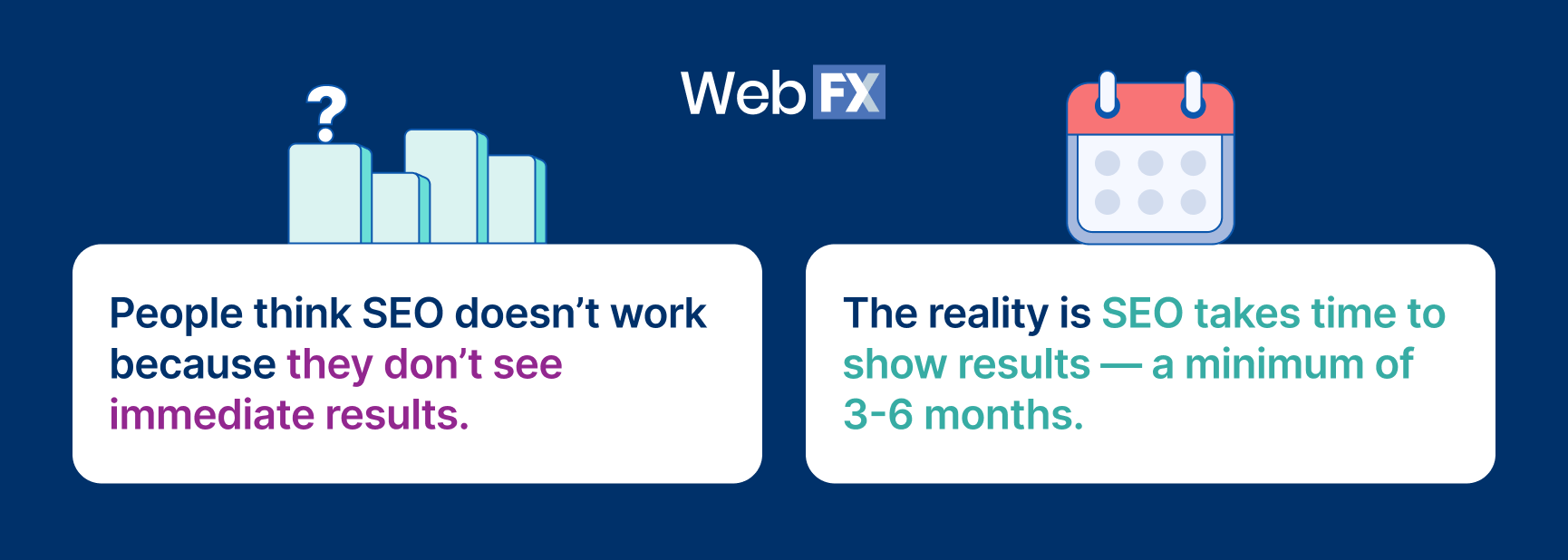
The loudest objection to SEO is people claiming they don’t see results. They try SEO for a couple of weeks, check it, and don’t see improvements. So, they throw in the towel and assume it doesn’t work.
The reality
SEO takes time. Trying it out for a few weeks and not seeing results is normal. As mentioned above, it can take 6–12 months to see major results, and most sites won’t see results for at least 3–6 months.
SEO does work if you have the patience to wait for search engines to crawl and index the changes you’ve made.
2. Their expectations for SEO aren’t met
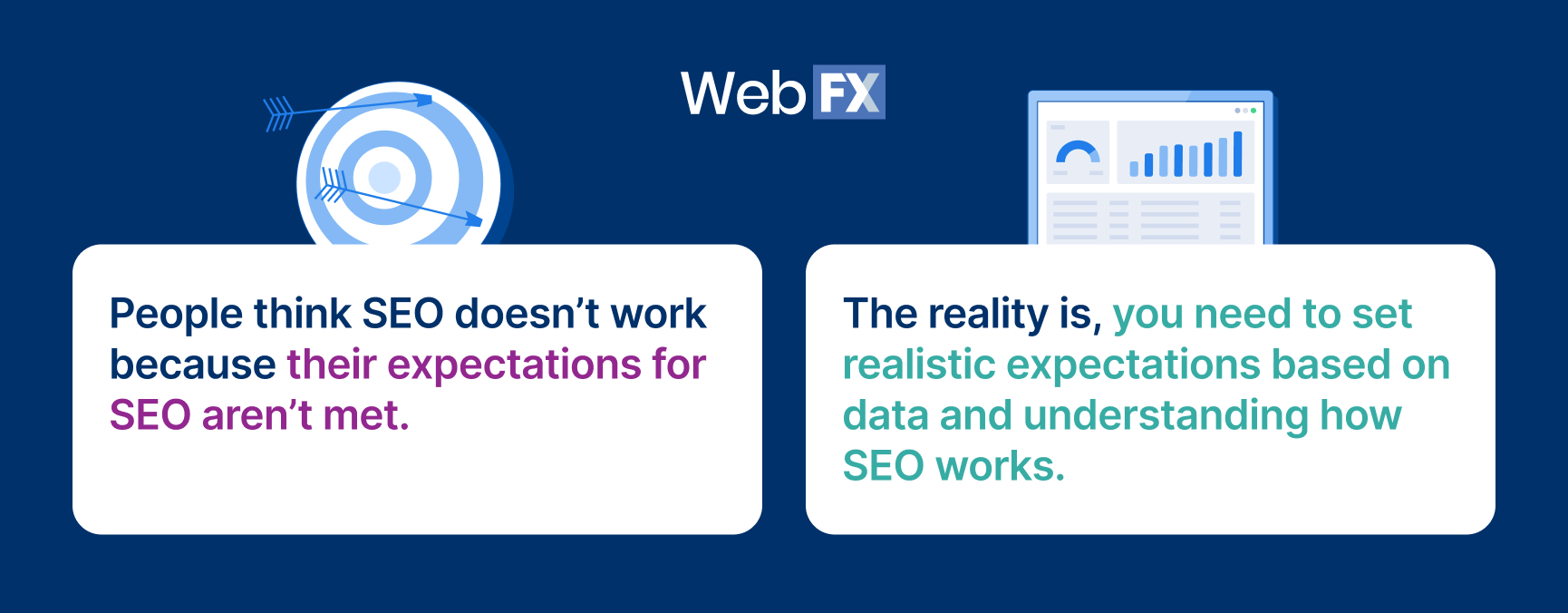
There’s no denying that SEO is an intricate topic. It requires doing dozens of on-page optimizations, off-page optimizations, content creation, and much more. And with Google’s algorithm being mostly a secret, it can make it even harder to see how SEO works.
As a result, businesses set unrealistic expectations when it comes to improving their search performance. Then, when they fall short of those expectations, they don’t think SEO works.
The reality
You need to set realistic expectations with your SEO and monitor the right metrics, like visibility, leads, and sales from organic search.
Here’s a great example:
A business that just started SEO decides to monitor bounce rate when tracking their SEO performance. After all, bounce rate indicates how quickly someone left your website, so it’s an indication of the relevancy and value of your pages, right?
Well, now let’s say that business sees that a chunk of their pages have a 55% bounce rate, despite their SEO efforts, and their goal was to have a 10% bounce rate. Now that company is disappointed in their results and feels like SEO isn’t working for them.
But here’s the thing: The average bounce rate across all industries is 44–65%.
So, they’re actually in the average range for bounce rate!
And on top of that, bounce rate is not a sole indicator of the relevance of your pages. People will often visit your website and find the exact information they need, and then leave. It doesn’t mean your page isn’t relevant — it could indicate, instead, that you provided the exact information they needed!
So not only did this company set the wrong expectation for bounce rate, but they also didn’t understand that bounce rate isn’t a sole indicator of the success or failure of a page. These unrealistic expectations lead businesses, like the one in this example, to believe SEO doesn’t work.
It’s important to have an understanding of how SEO works, so you can set realistic expectations and goals that help you see the actual impact of SEO.
3. Their implementation is poor (unknown to them)
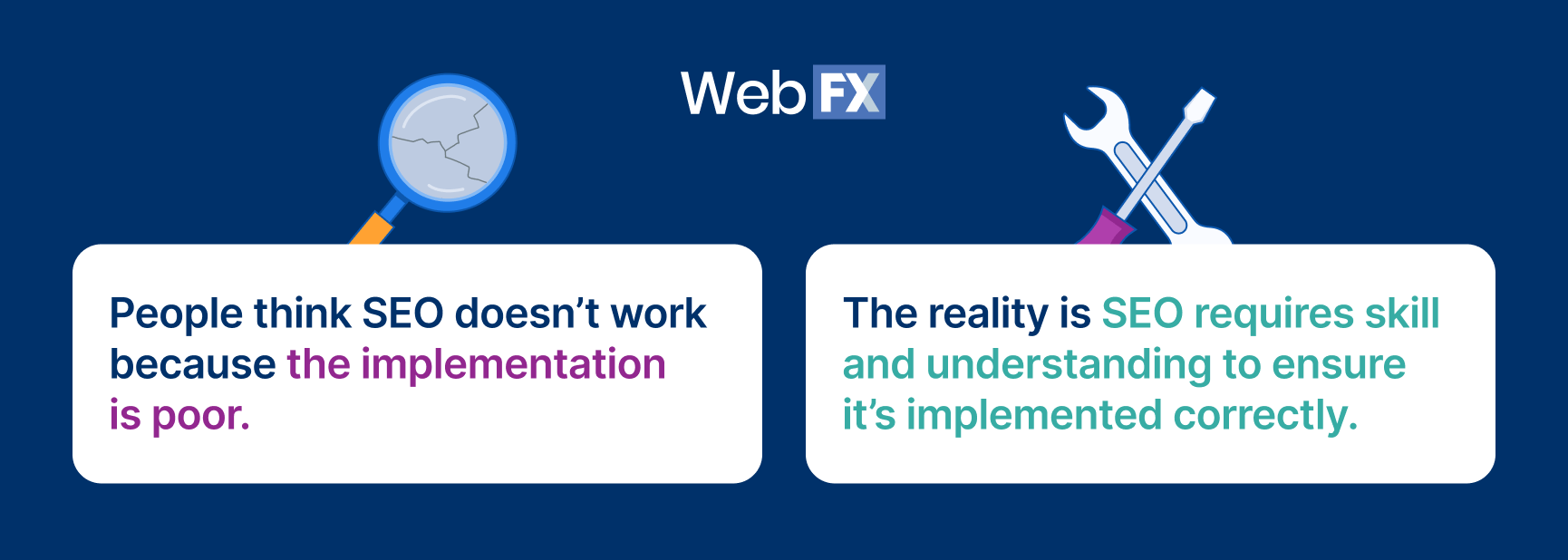
Another big cause for people to question if SEO really works? Poor implementation.
Some people may initially believe that SEO works and dive right in trying to improve their website. Maybe they don’t have a ton of experience with SEO, but believe it’ll help their business regardless.
But, fast-forward nine months later, and they’re not seeing good results from their SEO. Now, that person has become a skeptic as to whether SEO works.
The reality
SEO does require skill and understanding of the strategy. SEO will generate poor results if the person/people who implemented the SEO strategy:
- Lacks expertise or experience in SEO
- Uses outdated techniques that don’t keep up with the changing algorithm
- Neglects important factors like user experience
- Leverages black-hat SEO techniques that go against Google’s policies
- The SEO work is sporadic and not consistent
That’s why, if you want to see good results from SEO, it’s best to go with an agency that knows how SEO works and can use the strategy to drive better results for your business.
4. They focus on quantity over quality
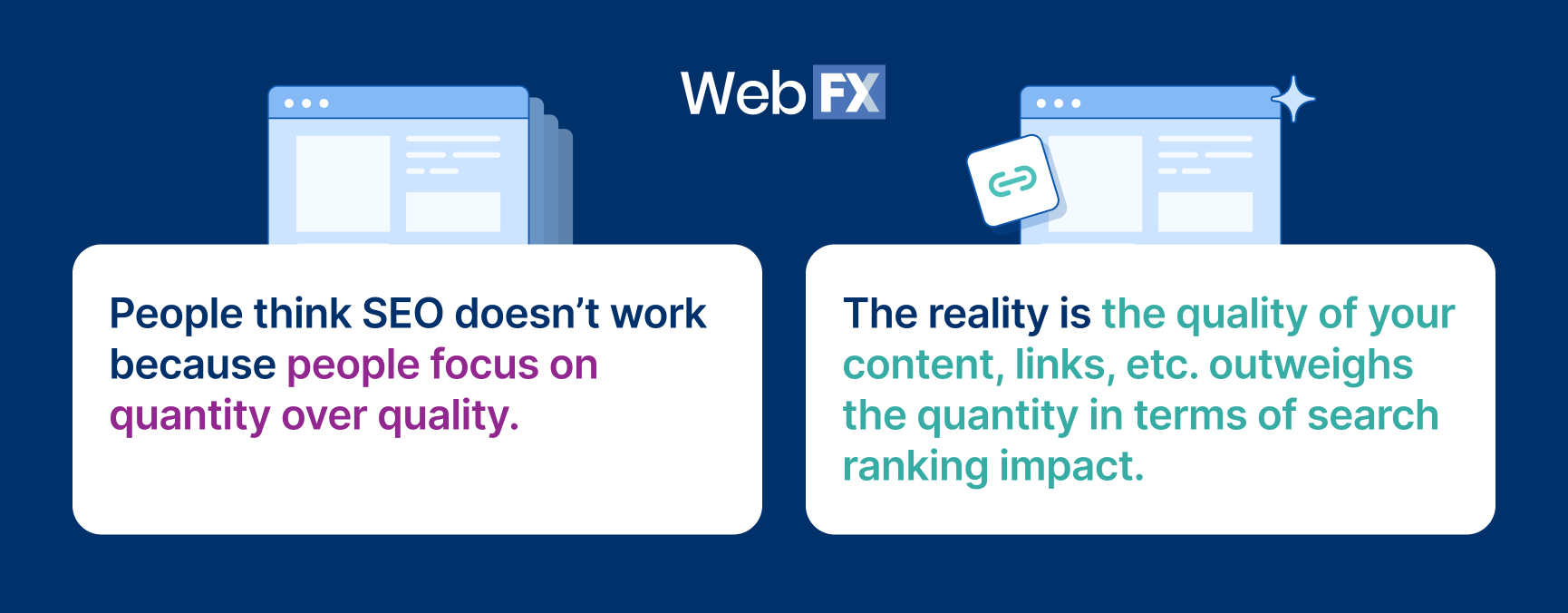
When starting out with SEO, many businesses approach it with a “go! go! go!” attitude. They want to hit the ground running and start doing everything they can to start performing better in search results. They start pumping out content, building up internal links everywhere, and reaching out to anyone in their industry to get backlinks.
This is known as a quantity over quality approach — they just want to put out as much content as possible, rank for as many keywords as possible, and earn tons of links.
But then, when they check their SEO a year later, the performance is poor. So, these businesses don’t believe SEO works because they put in all that effort for no return.
The reality
Quality will always outweigh quantity when it comes to SEO. While the ideal scenario is to have both (a large quantity of high quality links, content, etc.), it’s always better to shoot for having high quality over high quantity.
With the rise of generative AI and AI-generated content, Google’s emphasis on the quality is even stronger. Google wants to deliver helpful content that’s original, informative, and answers users’ queries.
If you focus on the quality of your content and backlinks, you’ll see SEO work for your business.
How do you know if SEO is working?
You know SEO is working when your visibility in search results and AI answers, your organic leads, and your sales grow over a 6–12 month window. Clicks are no longer the full picture because Google answers many questions directly on the results page.
A page can earn visibility in that answer without earning a click.
That’s why traffic alone undercounts what your SEO is doing.
Matt Moorut, a senior director analyst at Gartner, said at the 2026 Gartner Marketing Symposium/Xpo that marketers “will need to stop relying on traffic alone and start judging search through the lens of business outcomes.”
To judge SEO that way, track these signals together:
- Report impressions and clicks separately. Google Search Console counts an impression whenever your link appears on a results page, so rising impressions show SEO is working before clicks catch up.
- Check whether AI answers mention you. OmniSEO®, WebFX’s AI search visibility platform, tracks how often ChatGPT, Perplexity, and Google AI Overviews cite or mention your brand and your competitors. Use those gaps to decide which pages to refresh first.
- Tie organic visits to leads and sales. Set up key events in Google Analytics 4 (GA4) for form fills, calls, and purchases, so organic leads and revenue sit next to your visibility numbers.
Does local SEO work?
Yes, for all types of local businesses.
For businesses that serve their community, local SEO is a crucial component for business growth. It helps you optimize your local presence online, so you can drive more customers through the door or get more people to hire your company.
Searches with phrases like “near me” or “close by” have grown sharply, and local searches keep getting more popular. Local SEO is the strategy that can help you rank for these queries.
But don’t just take it from us — 79% of marketers consider local SEO a highly effective marketing strategy.
Local SEO works because it puts your business in the local pack, Google Maps, and AI answers that recommend nearby providers when people are ready to call or visit.
FAQs about SEO and how it works
Is SEO a long-term strategy?
Yes!
We can’t emphasize this enough — SEO takes time.
It’s not an overnight success. It takes time to see results.
Even when you have an established SEO strategy, it’ll still take time to see how your updates impact your SEO performance. It may be three months before you see the true impact of the changes you’ve made.
That’s why SEO is a long-term strategy. It requires continual work and upkeep to drive the best results for your business.
Is SEO dead?
No.
This is a big question in 2026 with the rise of AI and generative engines. More people are using generative engines like ChatGPT and Google AI Mode, social media, and other platforms to conduct searches.
It’s led some people to say, well, SEO must be dead.
That couldn’t be further from the truth. In WebFX’s analysis of 2.3 billion website sessions, generative AI accounted for just 0.18% of total sessions in 2025, while organic search drove 27.12%.
If anything, SEO is evolving. Since the way people search is changing, search engines are adapting. Google, for example, added AI Overviews and AI Mode to help create an easier search experience that allows people to get answers fast.
So no, SEO isn’t dead — it’s just changing as user search behavior changes, so it’s important to keep up.
What is black hat SEO and how does it impact my business?
Companies or individuals who knowingly engage in dishonest SEO practices are said to use “black-hat SEO.” This form of SEO is designed to cut corners to deliver the desired results. And it’s frowned upon by search engines.
Sites engaging in black-hat SEO will be punished. They may even receive manual penalties from Google, which are very difficult to recover from, and result in their site being kept out of search engine results.
If you want SEO to work, avoid using any black-hat SEO techniques.
Why is SEO important?
Consider your own Google habits for a moment — How often do you scroll past the first page of results? You’re probably thinking, well, not very often. And you’re not alone in that. Most searchers find what they need on the first page.
And with the addition of AI Overviews and the increase in zero-click searches, there’s even less chance that people will go to the second page for information. In WebFX’s 2025 study of 2.37 million U.S. keywords, 25.8% of queries showed a Google AI Overview.
SEO is important because it helps you get on that first page of results and into AI answers, so people visit your website and learn more about your business and offerings.
How does SEO benefit my business?
If you’re starting to think that SEO works, you may wonder how it can impact your business. Here are some benefits you can reap from SEO when it’s done right:
- Increased brand recognition in search results and AI answers
- More traffic to your website
- Increased credibility and trust with prospects
- More leads
- More sales
Does SEO work? We’ll prove to you it does!
SEO works when you use the right strategies and approaches in your marketing. When you follow best practices and keep up with the changing algorithms, SEO can work well for you.
Our client, Hurst Pediatric Dentistry, is a prime example of what happens when you invest in SEO. They saw 39X (3872% increase) more sessions and 6X (540% increase) more leads from investing in SEO and local SEO services.
When done the right way, SEO will work for your business.
Getting it to work starts with the right partner.
With over 30 years of experience in digital marketing, WebFX is a trusted partner for businesses that want to get SEO to work for them. We’ve driven over $91M in revenue through SEO for businesses like yours.
Ready to grow your revenue through SEO? Contact us online or call us today at 888-601-5359 to speak with a strategist about our SEO services!
