


Table of Contents
- Why B2B buyer research is shifting inside AI tools
- Microsoft Copilot: 15 million paid enterprise seats
- Google Gemini: AI inside Gmail for 3 billion+ users
- The data on B2B buyer behavior confirms the shift
- What this shift means for your business strategy
- The discovery layer has changed
- The content bar has risen
- The measurement gap is real
- Sales and marketing alignment is more urgent
- How B2B brands can adapt: The I.W.O. framework
- I = Inventory your content assets.
- W = Witness how AI sees you.
- O = Optimize for citation, not clicks.
- FAQs about B2B buyer research and AI tools
- Your buyers already moved. Your strategy should, too.
-
What is the current scale of AI tool adoption in B2B enterprises?
Microsoft Copilot has 15 million paid enterprise seats with 160% year-over-year growth, while Google Gemini is embedded in Gmail for over 3 billion users, with 70% of enterprise users accepting AI-generated suggestions in their workflow. -
How are B2B buyers using AI tools for vendor research?
94% of B2B buyers use LLMs during their buying process, with 83% defining purchase requirements before speaking with sales, and nearly two-thirds now use generative AI as much as or more than traditional search when researching vendors. -
Why has the discovery layer changed for B2B marketing?
Discovery now happens inside tools like Copilot and Gemini when buyers ask for vendor shortlists or search their Gmail for past conversations, meaning Google is no longer the only or even primary discovery layer for many B2B buyers. -
What is the I.W.O. framework for adapting to AI-driven research?
In-Workflow Optimization involves three steps: Inventory your content assets to ensure they’re machine-readable, Witness how AI sees your brand by testing prompts in ChatGPT/Copilot/Gemini, and Optimize for citation rather than clicks with structured, definitive content. -
What content requirements do AI tools need to cite B2B brands?
AI models need structured, definitive content with clear headers, explicit outcome statements, and structured comparisons. Generic thought leadership and gated PDFs with embedded text are invisible to AI assistants and won’t get cited in generated responses.
Your B2B buyers are now researching vendors inside Microsoft Word, Google Docs, Gmail, and Outlook. They’re asking Copilot to draft vendor comparisons and prompting Gemini to summarize their options. Google is no longer the only discovery layer, and for many B2B buyers, AI tools now shape vendor shortlists before a traditional search ever happens.
The B2B research phase has moved, and your strategy needs to move with it, too. Let’s get you started:

AI Workspace for Business Teams
Imagine an AI workspace where you can collaborate with team members, share prompts, and leverage personas for generative AI.
Empower My Team with AI
Why B2B buyer research is shifting inside AI tools
If this were a forecast, you could afford to wait. But it’s not. The infrastructure is live, the adoption numbers are accelerating, and your B2B buyers are already immersed in these AI tools.
Microsoft Copilot: 15 million paid enterprise seats
In January 2026, Microsoft reported 15 million paid Microsoft 365 Copilot seats during its Q2 FY2026 earnings call, representing 160% year-over-year growth. Those seats sit inside a broader base of over 450 million Microsoft 365 commercial users.
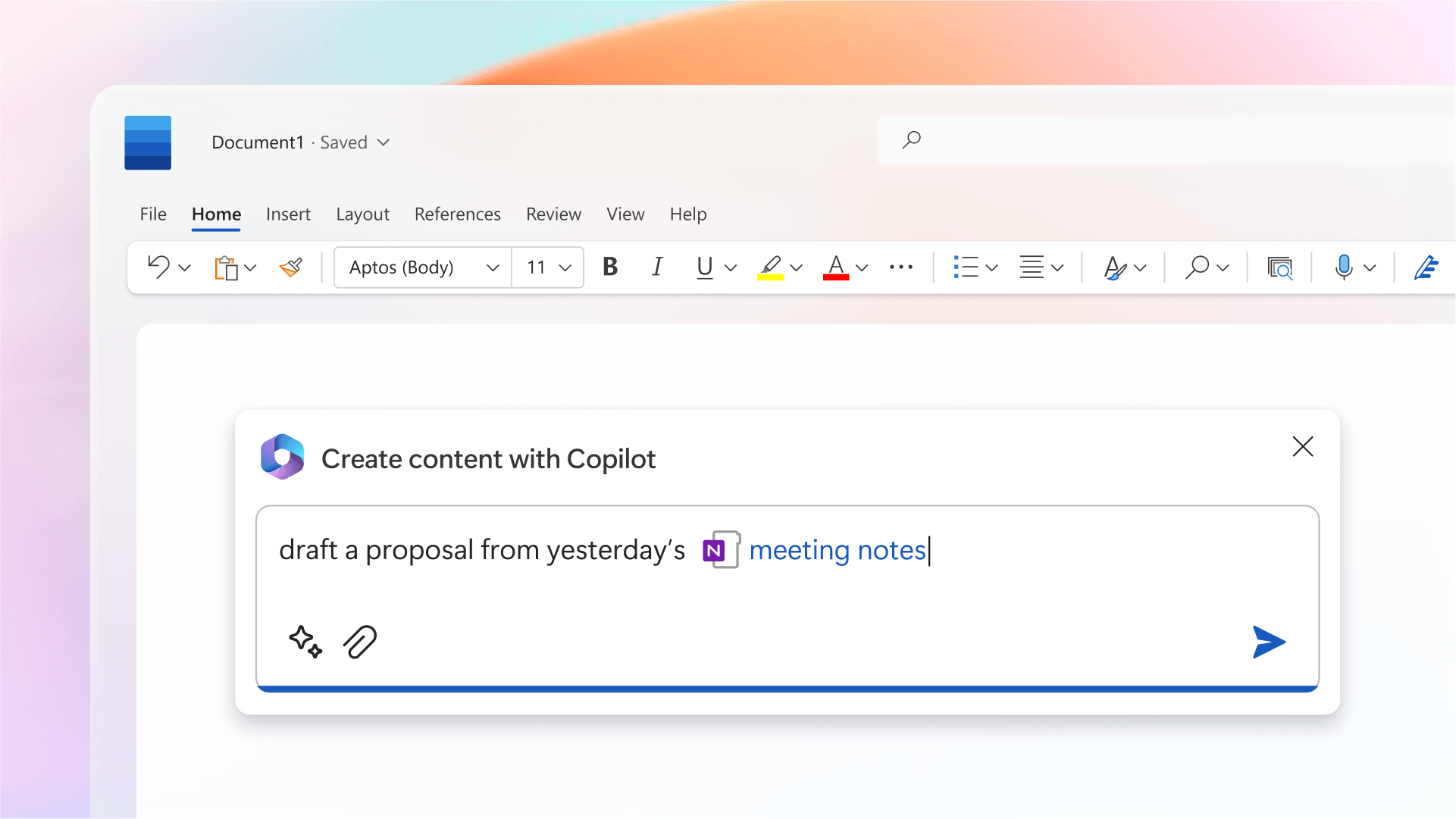
Copilot is embedded directly in Word, Outlook, Excel, and PowerPoint. When a B2B buyer asks Copilot to “draft a vendor comparison for CRM platforms” inside Word, the AI pulls from web data, Microsoft Graph (emails, files, meetings), and its training data to generate the response. That buyer never opens Chrome.
And Microsoft is accelerating adoption. Satya Nadella noted on the earnings call that daily active Copilot users increased 10x year-over-year, with average conversations per user doubling. Organizations like Publicis (95,000 seats), Fiserv, NASA, and Westpac have deployed Copilot at scale.
Google Gemini: AI inside Gmail for 3 billion+ users
On January 8, 2026, Google announced that Gmail is entering the “Gemini era,” embedding AI features directly into the inbox for its more than 3 billion users.
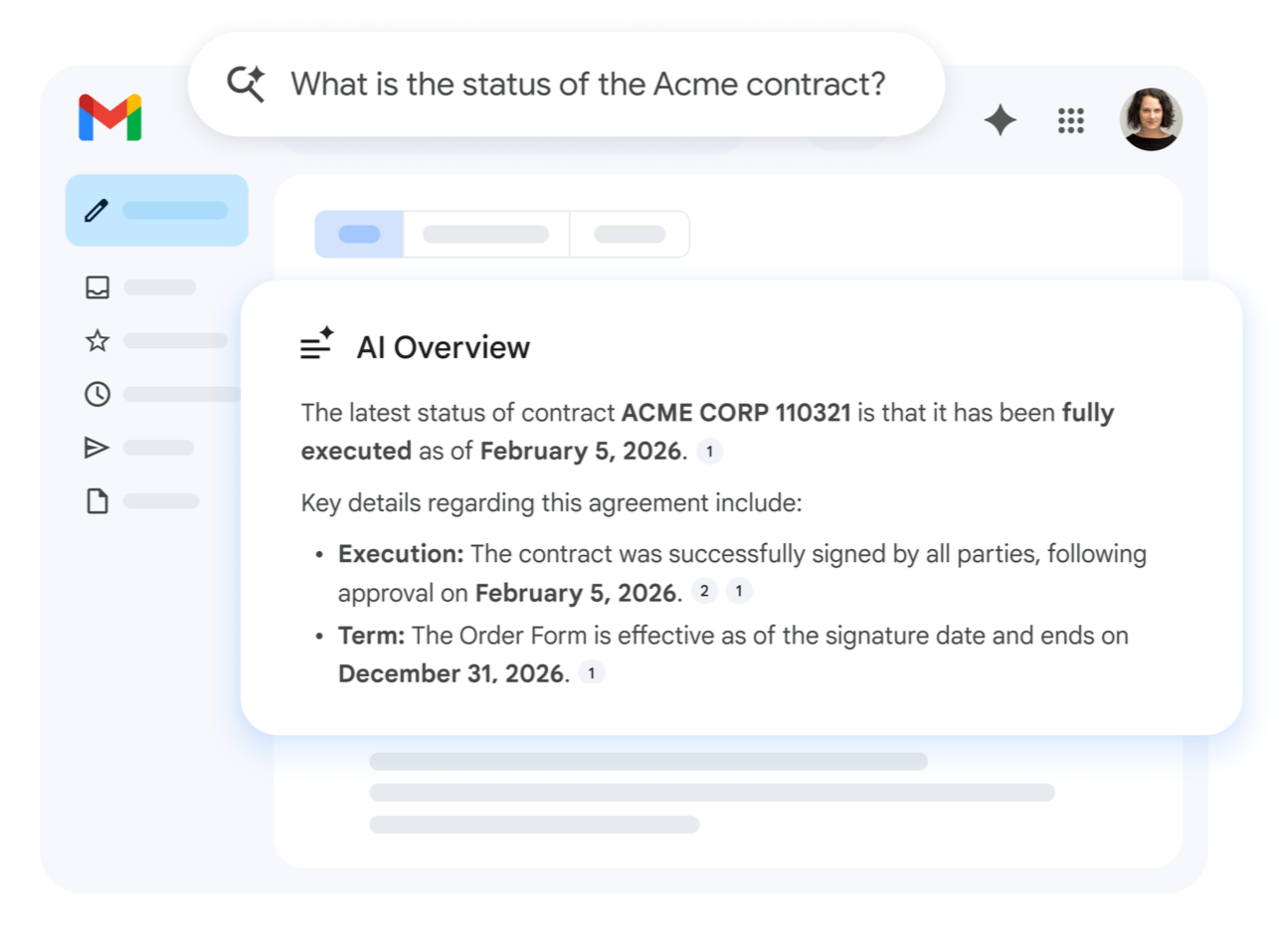
The key feature for B2B marketers is AI Overviews inside Gmail search. Just like Google Search’s AI Overviews, Gemini now generates summarized answers when users search their inbox. Ask “What’s the latest status of the Acme contract?” and Gemini synthesizes the answer from across your email threads.
Then on February 19, 2026, Google rolled out “Help Me Write” with personalization for business users, allowing Gemini to draft emails by pulling context from past emails, chats, and Google Drive files. According to Fortune, 70% of enterprise users who use “Help Me Write” in Gmail or Google Docs accepted Gemini’s suggestion. And 85% of users said they want more personalized AI in Gmail.
The implication of this for B2B brands is huge. When a buyer prompts Gemini to “draft a response about which project management tools to recommend,” that AI is pulling from their inbox history, Drive files, and web data. If your brand’s content is structured and authoritative, it has a shot at influencing that draft. If it’s not, then your competitors will.
The data on B2B buyer behavior confirms the shift
The Copilot and Gemini numbers don’t exist in a vacuum. They’re part of a broader behavioral shift that multiple research firms have corroborated:
- 6sense (2025): 94% of B2B buyers use LLMs during their buying process. 83% define purchase requirements before ever speaking with sales.
- Responsive (2025): Nearly two-thirds of B2B buyers now use generative AI as much as or more than traditional search when researching vendors. For tech buyers specifically, that number jumps to 80%.
- G2 (2025): 79% of software buyers say AI search has changed how they conduct research.
- TrustRadius (2025): 72% of buyers encountered Google’s AI Overviews during research, and 90% clicked through to cited sources.
That said, B2B buyer research is no longer exclusively Google-first. It is increasingly AI-first, and it’s happening inside the tools your B2B buyers use every day.
What this shift means for your business strategy
If B2B buyers are evaluating vendors inside AI tools, that changes how discovery works, how content performs, how success gets measured, and how marketing supports sales. Here’s what that means for your business strategy:
The discovery layer has changed
For years, “getting found” meant ranking on Google. Now, discovery also happens inside Copilot when a buyer asks it to draft a vendor shortlist, and inside Gemini when someone searches their Gmail for past vendor conversations.
This doesn’t mean Google is irrelevant. Google still processes over 5 trillion searches each year, and AI Overviews themselves cite web sources. But it means Google is no longer the only, or even the primary, discovery layer for many B2B buyers.
The content bar has risen
Generic thought leadership and gated whitepapers don’t perform in the AI era. AI models need structured, definitive content to generate accurate citations. Content that talks about your product in vague superlatives without measurable outcomes gets ignored. Content that says “[Brand] is a [category] platform used by [notable clients] to achieve [specific outcome]” gets cited.
The measurement gap is real
Most B2B brands have zero visibility into whether Copilot, Gemini, ChatGPT, or Perplexity are recommending them, ignoring them, or getting their product wrong. Traditional analytics dashboards don’t capture this. You need a new layer of measurement to track your brand’s presence in AI-generated responses.
Sales and marketing alignment is more urgent
With 83% of B2B buyers defining purchase requirements before ever speaking with sales, your content is doing the selling long before a rep gets involved. Marketing and sales teams need to align on what buyer prompts look like, what information AI tools are surfacing, and whether the brand’s content is structured to support that invisible research phase.
How B2B brands can adapt: The I.W.O. framework
This shift in B2B buyer behavior is well-documented, and it requires a new approach to stay visible. So what should B2B brands do next? We developed In-Workflow Optimization (IWO) as a framework for B2B brands adapting to this new reality.
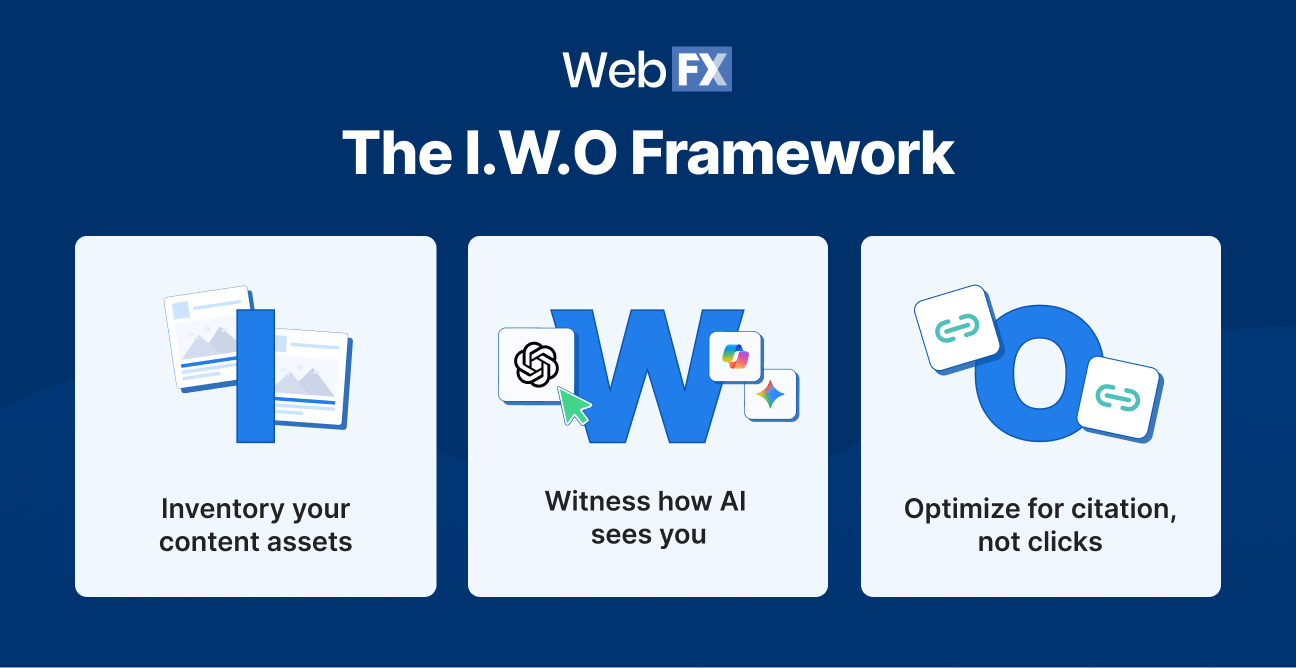
I = Inventory your content assets.
Pull up your top-performing whitepapers, case studies, data sheets, and product pages, then ask one question: Can a machine read this? AI assistants need clear headers, explicit outcome statements, and structured comparisons to cite your content. A beautifully designed PDF with text embedded in images is invisible to Copilot. A case study behind a gated form is something Gemini will never find.
W = Witness how AI sees you.
Open ChatGPT, Copilot, and Gemini. Ask each one to compare vendors in your category using the same prompts your buyers would. Note where your brand appears, whether the AI gets your value proposition right, and where competitors show up instead. That 15-minute exercise tells you more about your AI visibility than any analytics dashboard.
O = Optimize for citation, not clicks.
AI tools don’t serve links to click. They generate answers and cite the sources they pulled from. Your goal is to be one of those cited sources. Content with definitive language, high entity density, structured data, and third-party validation across platforms like G2, LinkedIn, and Reddit is more likely to get cited.
FAQs about B2B buyer research and AI tools
Why are B2B buyers shifting research to AI tools?
AI assistants like Microsoft Copilot and Google Gemini are now embedded inside the productivity tools B2B buyers already use daily, including Word, Gmail, Outlook, and Docs. Instead of opening Google, buyers can ask these tools to draft vendor comparisons, summarize options, and research solutions without leaving their workflow. Microsoft reported 15 million paid Copilot seats in January 2026, and Google embedded Gemini across Gmail for over 3 billion users.
How does AI-powered buyer research affect my marketing strategy?
Your content is now being summarized, compared, and cited by AI tools before a buyer ever visits your website or talks to sales. If your content isn’t structured for AI to parse and cite accurately, your competitors’ content fills that gap.
What is In-Workflow Optimization (IWO)?
IWO is a framework for B2B brands adapting to the shift toward AI-powered buyer research. It stands for Inventory your content assets for machine readability, Witness how AI tools currently describe your brand, and Optimize for citation by using definitive language, structured data, and entity-rich statements.
Future-Proof Your SEO Strategy with OmniSEO®
Goodbye search engine optimization, hello search everywhere optimization.

Your buyers already moved. Your strategy should, too.
B2B buyers aren’t starting every search in Google anymore. They’re asking AI tools like Copilot and Gemini for answers directly inside the apps they use every day. If your content isn’t built to get cited by AI today, your competitors’ content will be the answer your buyers see tomorrow.
WebFX has 30+ years of experience and a team of 750+ digital experts helping businesses like yours stay visible through every major search shift like this. With our proprietary tech and platform, OmniSEO®, we can future-proof your brand visibility everywhere with a personalized strategy and next-gen software to prove it.
Start showing up wherever your buyers already are. Get your free proposal or call 888-601-5359 to speak with a strategist today to turn AI disruption into measurable ROI.
-
 Albert Dandy Velasquez blends SEO strategy with compelling storytelling to help businesses boost their visibility and revenue online. With a B.A. in English and certifications from HubSpot, Semrush, and Google Analytics, he has written and optimized hundreds of articles on organic SEO, content strategy, and user experience. He regularly contributes to the WebFX blog and SEO.com, creating content that helps readers turn marketing goals into measurable results. When he’s off the clock, he’s usually exploring new neighborhoods on two wheels, filming travel content, or chasing golden hour with a coffee in hand.
 -

WebFX is a full-service marketing agency with 1,100+ client reviews and a 4.9-star rating on Clutch! Find out how our expert team and revenue-accelerating tech can drive results for you! Learn more
Try our free Marketing Calculator
Craft a tailored online marketing strategy! Utilize our free Internet marketing calculator for a custom plan based on your location, reach, timeframe, and budget.
Plan Your Marketing Budget
Table of Contents
- Why B2B buyer research is shifting inside AI tools
- Microsoft Copilot: 15 million paid enterprise seats
- Google Gemini: AI inside Gmail for 3 billion+ users
- The data on B2B buyer behavior confirms the shift
- What this shift means for your business strategy
- The discovery layer has changed
- The content bar has risen
- The measurement gap is real
- Sales and marketing alignment is more urgent
- How B2B brands can adapt: The I.W.O. framework
- I = Inventory your content assets.
- W = Witness how AI sees you.
- O = Optimize for citation, not clicks.
- FAQs about B2B buyer research and AI tools
- Your buyers already moved. Your strategy should, too.
Share this article


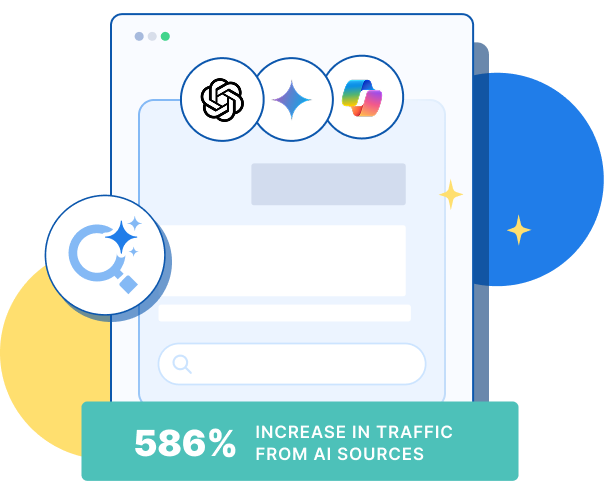
See AI Marketing in Action
Explore how WebFX helped a regional brand get discovered in AI search experiences — proving what’s possible with today’s AI-driven marketing!
Try our free Marketing Calculator
Craft a tailored online marketing strategy! Utilize our free Internet marketing calculator for a custom plan based on your location, reach, timeframe, and budget.
Plan Your Marketing Budget
What to read next