


Table of Contents
- Trend watch: Gen AI giants went supersonic with a triple frontier model release
- The November 2025 frontier model lineup (at a glance)
- Gemini 3: The multimodal reasoning machine
- GPT-5.1: The conversational intelligence upgrade
- Claude Opus 4.5: The coding and agentic powerhouse
- So, which model for what?
- Tactic talk: Personalization is your new conversion multiplier (here’s why it works)
- What personalization actually looks like (beyond 'Hi [First Name]')
- The personalization implementation checklist
- Tool tip: Stop guessing your AI Overview visibility. Measure it in seconds now!
- What the AI Overview Checker actually does
- Here’s how fast it works
- Who should use it
- FAQs about our December 2025 drop
- CTRL + C your game plan
- What major AI model releases happened in November 2025? Google released Gemini 3 (November 18), OpenAI launched GPT-5.1 (November 12), and Anthropic shipped Claude Opus 4.5 (November 24) — three frontier models with breakthrough capabilities in reasoning, coding, and multimodal tasks that are redefining AI-powered workflows.
- How does Gemini 3 stand out from competitors? Gemini 3 achieves a 1501 Elo score on LMArena Leaderboard with PhD-level reasoning, multimodal capabilities across text, images, video, audio, and code, a 1 million-token context window, and Deep Think mode that pushes performance to 41% on Humanity's Last Exam.
- What makes GPT-5.1 more conversational? GPT-5.1 introduces adaptive reasoning that decides when to think deeply versus respond quickly, features a warmer and more natural tone, offers six customizable personality presets, and follows instructions more reliably than previous versions while maintaining speed on simple tasks.
- Why is Claude Opus 4.5 called the coding powerhouse? Claude Opus 4.5 leads on SWE-bench Verified for real-world software engineering, uses 48-76% fewer tokens than predecessors while maintaining performance, scored higher than any human on a performance engineering exam, and demonstrates state-of-the-art computer use capabilities for autonomous workflows.
- How does website personalization improve conversion rates? Personalization adapts content based on visitor segments (traffic source, funnel stage, behavior) by dynamically changing headlines, images, and CTAs — addressing the fact that 71% of customers are frustrated by impersonal experiences and 61% expect brands to tailor content to their preferences.
December isn’t when Q4 gets easier. It’s when it gets real.
Your budget’s under scrutiny, your attribution’s a mess, and somewhere between “we need more leads” and “why aren’t these leads closing,” you realize the playbook you’ve been running all year isn’t built for the finish line.
AI’s rewriting the rules faster than you can learn them, personalization went from “nice-to-have” to “why is our conversion rate half of theirs,” and you’re probably ranking #1 organically while being completely invisible in AI Overviews.
This month’s CTRL + FX is your reset button. Here are the digital marketing trends, tools, and tactics that are actually tipping the scales while everyone else scrambles:
- Trend watch: Gen AI giants went supersonic with a triple frontier model release
- Tactic talk: Personalization is your new conversion multiplier (here’s why it works)
- Tool tip: Stop guessing your AI Overview visibility. Measure it in seconds now!
Let’s get going.
Don’t miss our Revenue Weekly emails!
Join 200K smart marketers for the hottest marketing news and insights in your inbox.
Inline Subscription Form
"*" indicates required fields
Trend watch: Gen AI giants went supersonic with a triple frontier model release
December is feeling the full impact of what happened last month.
Between November 12 and November 24, the three leading AI labs shipped their most capable models yet. GPT-5.1 learned to sound human. Gemini 3 learned to think deeper and code faster. Claude Opus 4.5 learned to build entire workflows without breaking.
“Better chatbots” is an understatement. We’re talking models that can research competitors, write production-ready code, debug multi-system problems, and execute complex tasks from start to finish with less hand-holding than ever before.
The question isn’t whether you should use them. It’s which one for what, and how fast you can adapt your workflow before your competitors do.
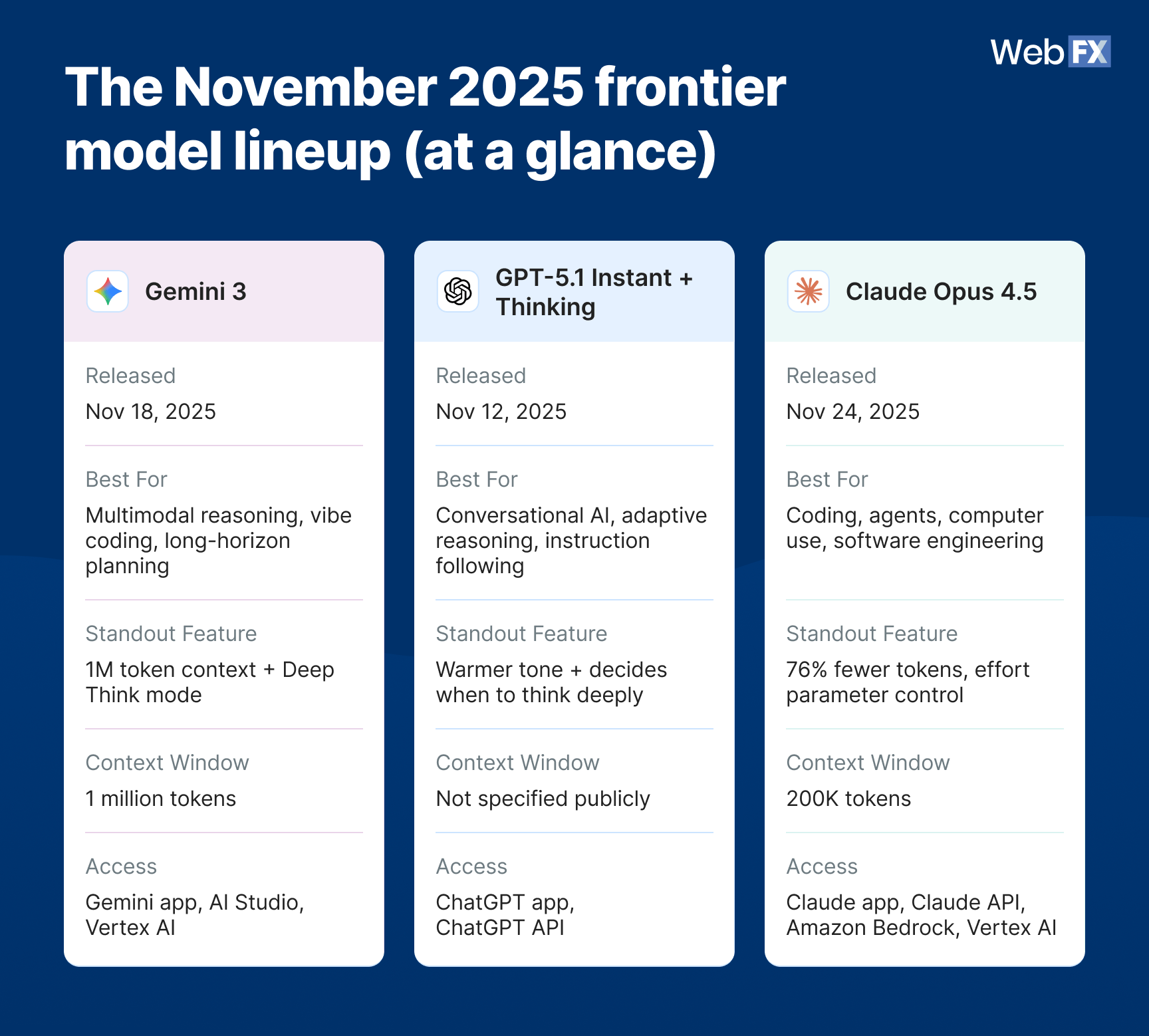
The November 2025 frontier model lineup (at a glance)
Source data
| Model | Released | Best For | Standout Feature | Context Window | Access |
| Gemini 3 | Nov 18, 2025 | Multimodal reasoning, vibe coding, long-horizon planning | 1M token context + Deep Think mode | 1 million tokens | Gemini app, AI Studio, Vertex AI |
| GPT-5.1 Instant + Thinking | Nov 12, 2025 | Conversational AI, adaptive reasoning, instruction following | Warmer tone + decides when to think deeply | Not specified publicly | ChatGPT app, ChatGPT API |
| Claude Opus 4.5 | Nov 24, 2025 | Coding, agents, computer use, software engineering | 76% fewer tokens, effort parameter control | 200K tokens | Claude app, Claude API, Amazon Bedrock, Vertex AI |
Gemini 3: The multimodal reasoning machine
What’s new:
Google shipped Gemini 3 on November 18, 2025, calling it “our most intelligent model” and backing that up with a breakthrough 1501 Elo score that tops the LMArena Leaderboard. Gemini 3 redefines what frontier models can do with multimodal reasoning, combining state-of-the-art performance across text, images, video, audio, and code in a single model with a 1 million-token context window.
Gemini 3 Pro demonstrates PhD-level reasoning, scoring 37.5% on Humanity’s Last Exam and 91.9% on GPQA Diamond. For multimodal tasks, it achieves 81% on MMMU-Pro and 87.6% on Video-MMMU.
It also sets new standards in mathematics (23.4% on MathArena Apex) and factual accuracy (72.1% on SimpleQA Verified). The model’s responses are direct and insightful, “telling you what you need to hear, not just what you want to hear” with reduced clichés and flattery.
Key features to note:
- Deep Think mode: Enhanced reasoning that pushes performance even further on complex problems (41.0% on Humanity’s Last Exam, 93.8% on GPQA Diamond)
- 1M token context window: Analyze entire research papers, long video lectures, customer datasets, or multi-page documents in one session
- Vibe coding excellence: Tops WebDev Arena leaderboard (1487 Elo) for generating richer, more interactive web UI from natural language prompts
- Agentic capabilities: Scores 54.2% on Terminal-Bench 2.0 for tool use and 76.2% on SWE-bench Verified for coding agents
- Long-horizon planning: Leads Vending-Bench 2 for maintaining consistent decision-making over extended workflows
- AI Mode in Search: Generates immersive visual layouts, interactive tools, and simulations on the fly based on queries
Available now in:
Gemini app (650M+ monthly users), AI Studio, Vertex AI, and Google Antigravity (new agentic development platform)
What users are saying:
Gemini 3 Pro first impressions
byu/Embarrassed-Way-1350 insingularity
Tried Gemini 3 for coding and I think it just gaslit my entire repo
byu/Positive-Nail6009 invibecoding
GPT-5.1: The conversational intelligence upgrade
What’s new:
OpenAI released GPT-5.1 on November 12, 2025, with a focus on making AI smarter and more enjoyable to talk to. The update includes two variants: GPT-5.1 Instant (the most-used model, now warmer and more conversational) and GPT-5.1 Thinking (the advanced reasoning model that adapts thinking time based on task complexity).
GPT-5.1 Instant introduces adaptive reasoning for the first time, as it decides when to think before responding, resulting in more thorough answers for complex questions while maintaining speed on simple ones. This shows up in significant improvements on AIME 2025 (math) and Codeforces (coding) benchmarks.
GPT-5.1 Thinking varies its thinking time dynamically: Roughly 2x faster on simple tasks, 2x slower on complex ones. The model’s responses are clearer with less jargon and better instruction following. It now more reliably answers the question you actually asked.
Key features to note:
- Warmer, more natural tone: Responses feel conversational and human, not robotic or overly formal (based on feedback that “great AI should be enjoyable to talk to”)
- Adaptive reasoning: Model decides when to think deeply vs. respond quickly, optimizing for both accuracy and speed
- Better instruction following: More reliably executes specific requests (like “respond in 6 words” or custom formatting)
- Customizable personalities: Six preset styles (Default, Professional, Friendly, Candid, Quirky, Efficient) plus fine-tuned controls for conciseness, warmth, and emoji use
- Improved clarity: GPT-5.1 Thinking produces more understandable explanations with less technical jargon
- API access: Both Instant and Thinking are available via API (gpt-5.1-chat-latest), rolling out this week
Available now in:
ChatGPT (rolling out gradually to paid users first, then free users) and ChatGPT API
What users are saying:
After a full day of testing, GPT-5.1 is not as good as GPT-5
byu/Proper_Community_199 inGithubCopilot
Honest opinion on the new GPT-5.1: too much text, not enough soul
byu/MARIA_IA1 inChatGPT
Claude Opus 4.5: The coding and agentic powerhouse
What’s new:
Anthropic released Claude Opus 4.5 on November 24, 2025, positioning it as “the best model in the world for coding, agents, and computer use.” The model is state-of-the-art on SWE-bench Verified (real-world software engineering tasks) and uses 76% fewer tokens than Sonnet 4.5 at medium effort while matching performance, and 48% fewer tokens at high effort while exceeding it by 4.3 percentage points.
Opus 4.5 scored higher on a notoriously difficult performance engineering take-home exam than any human candidate ever (within the prescribed 2-hour time limit). It leads across 7 out of 8 programming languages on SWE-bench Multilingual and demonstrates creative problem-solving that goes beyond scripted responses.
Anthropic calls it “the most robustly aligned model we have released to date,” with substantial improvements in resisting prompt injection attacks compared to other frontier models.
Key features to note:
- Effort parameter control: Choose to minimize time/cost or maximize capability to adjust thinking intensity based on task complexity
- Dramatically more efficient: Uses 48-76% fewer tokens than predecessors while maintaining or exceeding performance
- Best-in-class coding: State-of-the-art on software engineering benchmarks; writes production-ready code with less back-and-forth
- Computer use capabilities: Can navigate spreadsheets, browsers, and multi-system workflows autonomously
- Agent coordination: Effective at managing teams of subagents for complex, multi-step tasks
- Enhanced safety: Most robust against prompt injection attacks; better aligned to avoid unintended harmful behavior
- Accessible pricing: $5/$25 per million tokens makes Opus-level capabilities available to more users
Available now in:
Claude apps, Claude API, Amazon Bedrock, Google Cloud Vertex AI, and Claude Code (desktop + browser)
What users are saying:
New benchmark: Claude Opus 4.5 broke the efficiency wall.+21% intelligence while getting 66% cheaper
byu/BuildwithVignesh insingularity
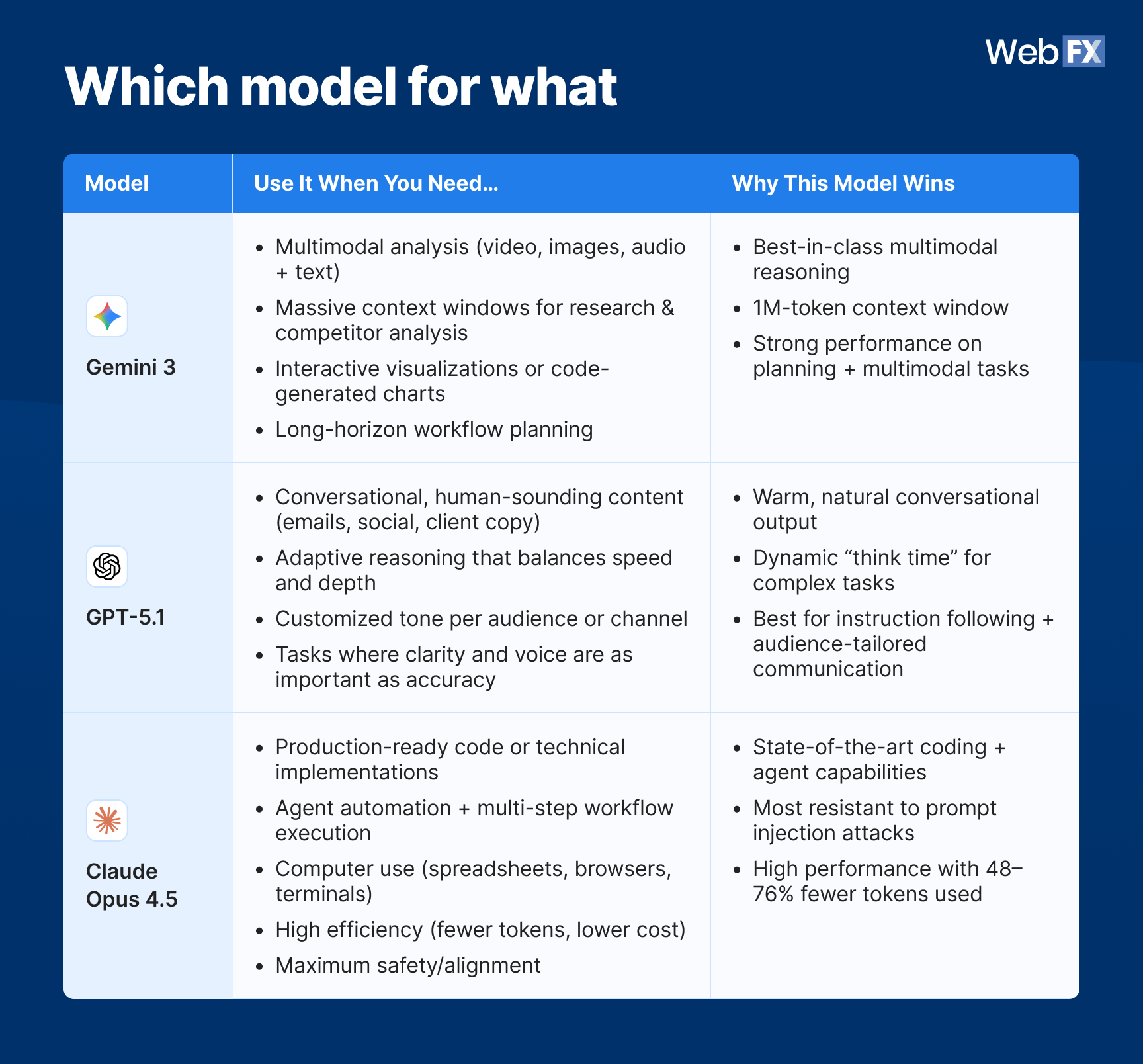
So, which model for what?
Well, you don’t really have to pick just one. You can use all three strategically.
Source data
| Model | Use It When You Need… | Why This Model Wins |
| Gemini 3 |
|
|
| GPT-5.1 |
|
|
| Claude Opus 4.5 |
|
|
Tactic talk: Personalization is your new conversion multiplier (here’s why it works)

90% of marketers say personalization significantly contributes to business profitability, and 89% see a positive ROI when using it.
In case you haven’t noticed, your competitors are targeting the same prospects. Same pain points. Same keywords. Same ad placements. The only difference between you and them? Whether your site feels like it was built for that specific visitor or for everyone at once.
Personalization is how you convert while your competitors watch traffic bounce. In fact, 71% of customers are now frustrated by impersonal shopping experiences, while 61% expect brands to tailor what they see based on their preferences.
If your homepage looks identical to a first-time visitor from Google, a returning customer who abandoned cart, and a high-intent lead who downloaded three whitepapers, you’re making it easier for visitors to leave than to convert.
Here’s how to fix it.
What personalization actually looks like (beyond ‘Hi [First Name]’)
Most marketers think personalization means slapping someone’s name in an email subject line or using “Hi {{first_name}}” on a landing page. By now, you should know that it’s already table stakes. Real personalization adapts what visitors see based on who they are, where they came from, and what they’ve done.
Here’s the framework:
1. Segment your audience beyond demographics
Don’t just split by industry or company size.
Segment by:
- Traffic source: Paid search visitors see ROI-focused messaging; organic visitors see educational content
- Funnel stage: First-time visitors get explainer content; returning visitors get case studies and demos
- Behavior: Cart abandoners see product benefits + urgency; whitepaper downloaders see next-step CTAs
2. Personalize headlines, images, and copy dynamically
A healthcare SaaS company shouldn’t show the same hero image to a hospital CFO and a clinic administrator. Swap the visuals. Change the headline. Adjust the pain points mentioned in your copy.
Examples:
- For CFOs: “Cut operational costs by 30% with automated patient intake”
- For clinic admins: “Reduce no-shows and streamline scheduling in one platform”
Same product. Different angles. Massively different resonance.
3. Use interaction history to guide the next step
If someone watched your product demo video but didn’t book a call, show a testimonial from their industry on the next visit. If they browsed pricing but left, trigger a comparison chart or limited-time offer.
Personalization tools (like PersonalizeFX) use tracking pixels to identify which segment a visitor belongs to, then serve the tailored version of your page in real time, no manual work required.
The personalization implementation checklist
Here’s your action plan to move from generic to tailored:
- Audit your current traffic segments: Pull data on where your visitors come from, what pages they hit, and where they drop off. Identify 3-5 high-value segments to start with (e.g., paid traffic, returning visitors, high-intent keywords).
- Map content to each segment: What messaging resonates with each group? What objections do they have? What proof points matter most? Build a content matrix: Segment → Headline → Image → CTA.
- Create personalized assets: You don’t need 50 variations. Start with 3-5 versions of your highest-traffic pages. Swap headlines, hero images, and CTAs based on segments.
- Deploy a personalization tool: Manual personalization doesn’t scale. Tools like PersonalizeFX use tracking pixels to identify visitor segments and serve dynamic content automatically, so your pages adapt in real time without you manually switching things.
- Test and iterate: Track conversion lift by segment. Which personalized experiences are outperforming? Double down on those. Which ones aren’t moving the needle? Refine the messaging or imagery.
- Expand to email and retargeting: Once on-site personalization is working, extend the same segmentation logic to your email nurture sequences and retargeting ads. Consistency across touchpoints compounds results.
Tool tip: Stop guessing your AI Overview visibility. Measure it in seconds now!
AI Overviews now appear in 1 of every 4 US searches and shoot past 50% when a query reaches seven words or longer.
Q4 wake-up call: Your site might rank #1 organically and still be invisible in Google’s AI Overviews. And since AI-generated answers are disrupting how users search and click, that invisibility is costing you traffic you don’t even know you’re losing.
AI Overviews trigger for a significant percentage of searches, and if your content isn’t cited in those answers, you’re missing out on visibility, authority, and clicks even when you dominate traditional SERPs. The problem is that most marketers have no idea whether they’re showing up in AI Overviews or not.
SEO.com’s AI Overview Checker solves exactly that (for free!).
What the AI Overview Checker actually does
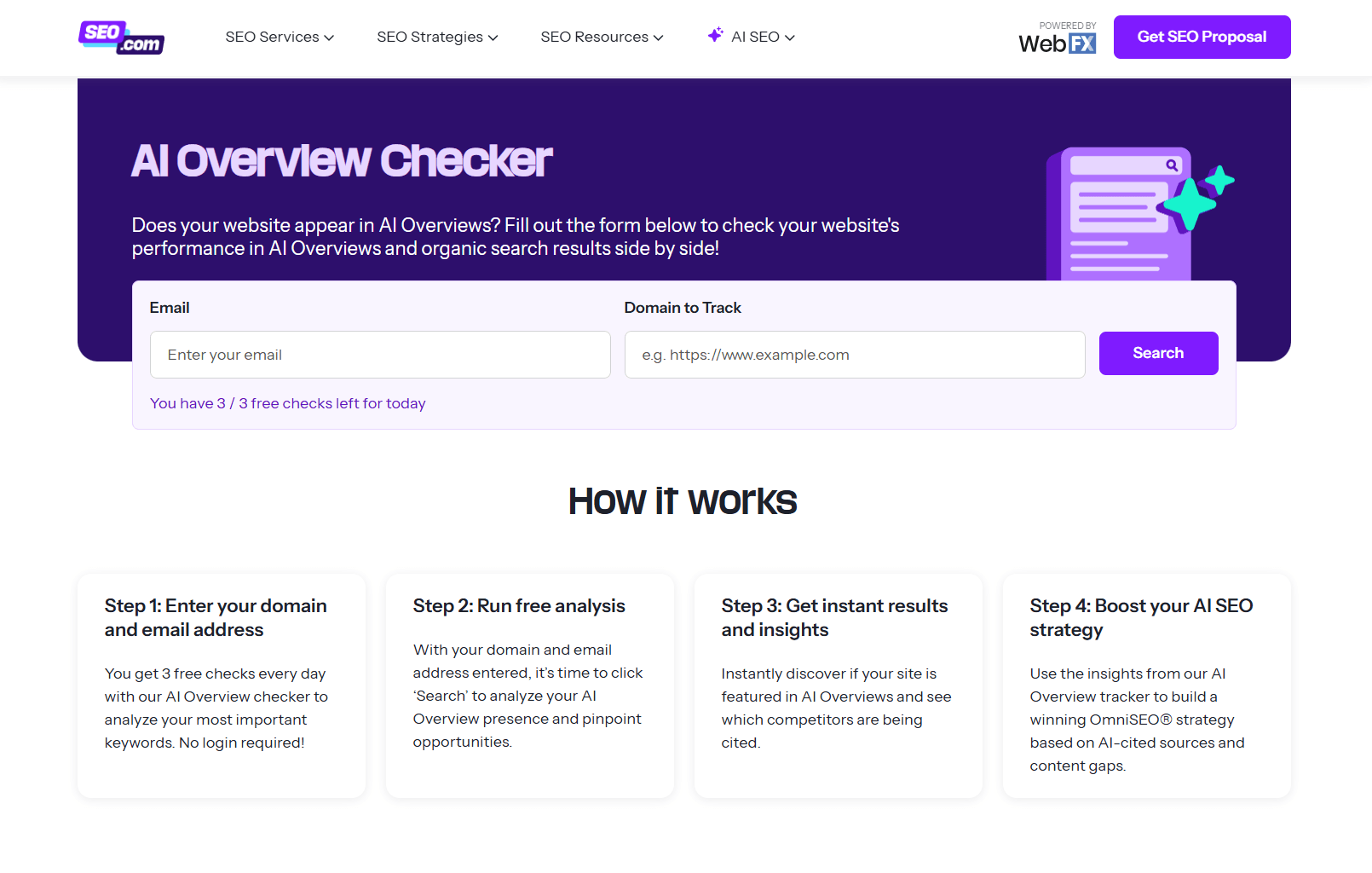
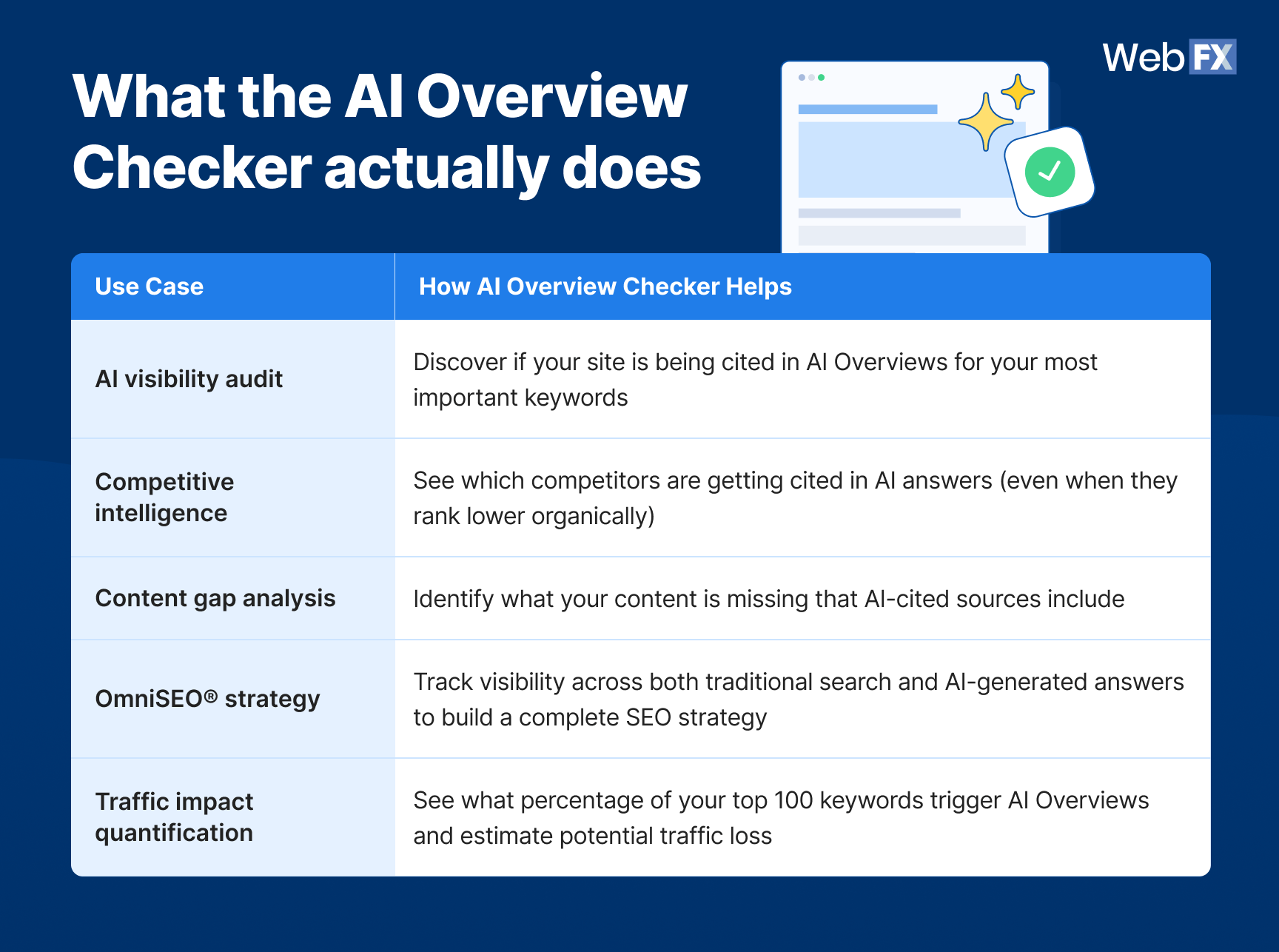
The AI Overview Checker (powered by SEO.com) is a free tool that shows you exactly what Google’s AI-generated answer is for any keyword, side-by-side with organic results. You get 3 free checks per day, and the best part: No login, no setup, no API key needed.
Source data
| Use Case | How AI Overview Checker Helps |
| AI visibility audit | Discover if your site is being cited in AI Overviews for your most important keywords |
| Competitive intelligence | See which competitors are getting cited in AI answers (even when they rank lower organically) |
| Content gap analysis | Identify what your content is missing that AI-cited sources include |
| OmniSEO® strategy | Track visibility across both traditional search and AI-generated answers to build a complete SEO strategy |
| Traffic impact quantification | See what percentage of your top 100 keywords trigger AI Overviews and estimate potential traffic loss |
Here’s how fast it works
- Enter your domain, email, and target keyword
- Run the analysis to see if your site appears in the AI Overview
- Get instant results showing which competitors are being cited
- Build your AI SEO strategy based on AI-cited sources and content gaps
Who should use it
- SEO teams tracking AI’s impact on organic visibility
- Content marketers optimizing for AI citations and generative search
- Enterprise brands monitoring visibility across all search surfaces (traditional + AI)
- Anyone seeing unexplained traffic drops despite strong organic rankings
The AI Overview Checker gives you visibility into a search space most marketers aren’t even monitoring yet. Use it to identify where you’re being cited, where your competitors are beating you, and what content gaps you need to fill to show up in AI-generated answers.
Check your AI Overview visibility now: SEO.com’s AI Overview Checker
FAQs about our December 2025 drop
What are the biggest digital trends in December 2025?
Three major shifts are reshaping marketing right now: Frontier AI model releases, personalization as a conversion driver, and AI Overview visibility.
Between November 12-24, OpenAI, Google, and Anthropic all released their most capable models yet: GPT-5.1, Gemini 3, and Claude Opus 4.5. These aren’t incremental upgrades; they’re models that can write production code, analyze multimodal content, and execute complex workflows with minimal supervision.
On the personalized marketing front, 71% of customers are now frustrated by generic experiences, and 61% expect brands to tailor content based on their preferences. Tools that dynamically adapt headlines, images, and CTAs based on visitor segments are driving 11%+ conversion lifts.
Finally, Google’s AI Overviews now appear in 1 of every 4 US searches, and over 50% when queries reach seven words or longer. That means ranking #1 organically no longer guarantees visibility if Google’s AI doesn’t cite your content.
Which AI model should I use: Gemini 3, GPT-5.1, or Claude Opus 4.5?
You don’t have to pick just one. You can use all three strategically based on what you need.
Use Gemini 3 when: You need multimodal analysis (video, images, audio + text), massive context windows (1M tokens for research reports or long transcripts), interactive visualizations, or long-horizon planning for complex workflows.
Use GPT-5.1 when: You need conversational, human-sounding content like emails or social posts, adaptive reasoning that balances speed and depth automatically, or customizable tone for different audiences.
Use Claude Opus 4.5 when: You need production-ready code, agent automation, computer use across spreadsheets and browsers, maximum efficiency (uses 48-76% fewer tokens), or enhanced safety against prompt injection.
How does personalization actually increase conversions?
Personalization works by reducing friction and increasing relevance at every touchpoint.
When a visitor lands on your site, personalization tools (like PersonalizeFX) use tracking pixels to identify their segment (traffic source, funnel stage, behavior history), then dynamically serve tailored content like different headlines, images, and CTAs based on who they are and what they need.
The impact is measurable: 90% of marketers say personalization significantly contributes to business profitability, and 89% see positive ROI. The reason? A first-time organic visitor needs educational content, while a returning visitor who abandoned cart needs urgency and product benefits. Showing both the same generic homepage makes it easier for them to leave than convert.
Why does my site rank #1 but not appear in AI Overviews?
AI Overviews don’t automatically feature the #1 ranked page as they prioritize content that’s easy to extract and cite.
Google’s AI looks for clear, direct answers in formats like bulleted lists, short paragraphs, and structured data. If a competitor’s page has simpler formatting or better schema markup, the AI may cite them instead, even if you rank higher organically.
What digital marketing tactics and tools should I prioritize in Q4 2025?
Two priorities are delivering results right now: Dynamic personalization and AI Overview optimization.
Personalization tools: Segment your audience by traffic source, funnel stage, and behavior (not just demographics). Deploy tools like PersonalizeFX that dynamically swap headlines, images, and CTAs based on visitor segments. Start with 3-5 versions of your highest-traffic pages and track conversion lift.
AI Overview visibility: Check if you’re being cited using free digital marketing tools like the AI Overview Checker. If you’re not showing up, optimize your content with clear answer blocks, proper schema markup, and formats AI can easily extract.
How do I check if my site appears in AI Overviews?
Use SEO.com’s AI Overview Checker. It’s free and takes seconds.
Enter your domain, email, and target keyword, then run the analysis. You’ll instantly see:
- Whether your domain is cited in the AI Overview
- Which competitors are being cited (even if they rank lower organically)
- What percentage of your keywords trigger AI Overviews
- Which organic results does Google use as sources
You get 3 free checks per day with no login or setup required.
CTRL + C your game plan
That’s Q4 2025 wrapped. Three frontier models shipped in November, personalization became non-negotiable, and AI Overviews claimed over 25% of search real estate. If you’re heading into 2026 with last year’s playbook, you’re not just behind — you’re invisible.
January’s CTRL + FX is already cooking with 2026 planning frameworks, new-year budget strategies, and the tools that proved their worth in 2025. Got a Q4 move that actually worked or a tool that needs a shoutout? Send it over. We might just break it down next month.
Stay sharp between drops. Follow WebFX on Instagram, LinkedIn, and YouTube for insights that hit before they’re trending. Ready to turn 2025’s insights into 2026 pipeline and closed deals? Check out our next-gen website personalization services and AI SEO services to see how we’re executing agentic commerce readiness, dynamic personalization, and AI visibility strategies for clients right now.
Same shortcut next month. Start 2026 ahead.
-
 Albert Dandy Velasquez blends SEO strategy with compelling storytelling to help businesses boost their visibility and revenue online. With a B.A. in English and certifications from HubSpot, Semrush, and Google Analytics, he has written and optimized hundreds of articles on organic SEO, content strategy, and user experience. He regularly contributes to the WebFX blog and SEO.com, creating content that helps readers turn marketing goals into measurable results. When he’s off the clock, he's usually exploring new neighborhoods on two wheels, filming travel content, or chasing golden hour with a coffee in hand.
 -

WebFX is a full-service marketing agency with 1,100+ client reviews and a 4.9-star rating on Clutch! Find out how our expert team and revenue-accelerating tech can drive results for you! Learn more
Join our mission
to provide industry-leading digital marketing services to businesses around the globe - all while growing as an individual and leaving the world a better place.
I Want to Apply!
Table of Contents
- Trend watch: Gen AI giants went supersonic with a triple frontier model release
- The November 2025 frontier model lineup (at a glance)
- Gemini 3: The multimodal reasoning machine
- GPT-5.1: The conversational intelligence upgrade
- Claude Opus 4.5: The coding and agentic powerhouse
- So, which model for what?
- Tactic talk: Personalization is your new conversion multiplier (here’s why it works)
- What personalization actually looks like (beyond 'Hi [First Name]')
- The personalization implementation checklist
- Tool tip: Stop guessing your AI Overview visibility. Measure it in seconds now!
- What the AI Overview Checker actually does
- Here’s how fast it works
- Who should use it
- FAQs about our December 2025 drop
- CTRL + C your game plan
Share this article


Join our mission
to provide industry-leading digital marketing services to businesses around the globe – all while growing as an individual and leaving the world a better place.
I Want to Apply!
What to read next