

Let me start out by saying this: ChatGPT isn’t all bad. There are lots of things that it, and other generative AI tools like it, can be used for. Some marketers, for instance, have found it useful for analyzing datasets or helping generate ideas for email headlines.
Despite its benefits, though, there are still a whole lot of problems inherent to the tool. Of course, some of those problems have been patched in the years since ChatGPT’s release, while others are fairly harmless (or even comical).
But some of the issues with ChatGPT are scarier than they are funny. As enjoyable as it can be to laugh at dumb ChatGPT fails, the tool’s biggest limitations are actually quite serious and deep-rooted. For that reason, if you plan to use ChatGPT — be it for work or personal use — it would be smart to inform yourself of the various failings it has.
There are countless ChatGPT mistakes already recorded out there. But on this list, I’m going to focus specifically on six problems that often crop up in the tool, looking at some examples along the way. Those problems include:
- Hallucinating false information
- Struggling to generate new ideas
- Failing to grasp humor
- Being behind on breaking news
- Responding too sycophantically
- Producing biased responses
Keep reading to get more info on each of those ChatGPT limitations.
1. Hallucinating false information
Possibly the biggest and most well-documented limitation of ChatGPT is its tendency to hallucinate. Every ChatGPT response has a chance of containing a hallucination — that is, a piece of factually untrue information that ChatGPT completely makes up.
In the early days of ChatGPT, many hallucinations were glaringly obvious. The chatbot would fail at tasks as simple as spelling or basic arithmetic. For example, here’s its response to a prompt I gave it back in 2023:
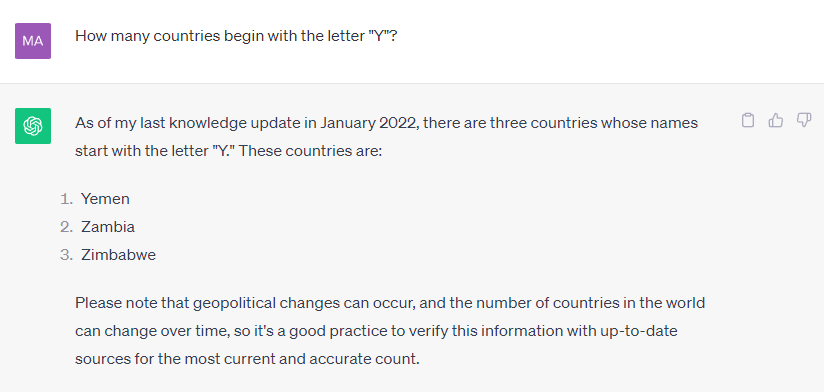 Brilliant work, ChatGPT. Truly incredible.
Of course, in the years since that screenshot was taken, OpenAI has worked hard to eliminate the more obvious hallucinations from their newer models. That’s why today, you probably won’t see errors as ridiculous as the one shown above. In fact, most noticeable hallucinations have been weeded out.
But that doesn’t mean hallucinations are no longer a problem. In getting rid of the obvious hallucinations, OpenAI only ensured that the remaining hallucinations are the subtle ones, the ones you’re less likely to notice. And that’s a big problem, because the most dangerous hallucinations are the ones you don’t catch. Those are the hallucinations that will succeed at misleading you.
Sometimes, hallucinations might only mislead you in small ways. But other times, the results can be very serious. In one incident, for example, event organizers canceled a Canadian musician’s performance because Google’s AI falsely informed them that he was a sex offender, and they believed it. So, these hallucinations can have very real consequences.
Worse yet, hallucinations may even be getting worse in newer models of ChatGPT, with one of OpenAI’s own studies showing higher hallucination rates in newer models. But the truth is, even if ChatGPT had a hallucination rate of only 1%, that would still be a lot. As of July 2025, ChatGPT received 2.5 billion prompts per day. So, if you do the math, a 1% hallucination rate works out to more than 17,000 hallucinations per minute.
OpenAI might be able to reduce hallucination rates over time. But even if they do, experts seem to agree that those hallucinations aren’t going away altogether. That’s because hallucinations are fundamentally built into the way AI tools work. One AI company executive told the New York Times the following: “Despite our best efforts, [AI models] will always hallucinate. That will never go away.”
That means hallucinations are here to stay. And if you think you aren’t seeing any hallucinations when you use ChatGPT, it doesn’t mean there aren’t any there. It just means they’re successfully slipping past your guard and misleading you. That’s something worth thinking about.
2. Struggling to generate new ideas
Many of the problems with ChatGPT come down to the fundamental way it operates. ChatGPT isn’t sentient (thank goodness). It can’t think for itself, no matter how convincingly it can pretend to. Everything that it generates is pulled from what actual humans have written.
Among other things, that means it’s terrible at coming up with original ideas. At most, it can manage to string words together in a way that seems like a new idea, but that doesn’t mean it is one.
Often, ChatGPT’s “original ideas” fall into one of two camps. The first camp is for ideas that aren’t new at all and are ripped straight from elsewhere on the Internet. Here’s an example:
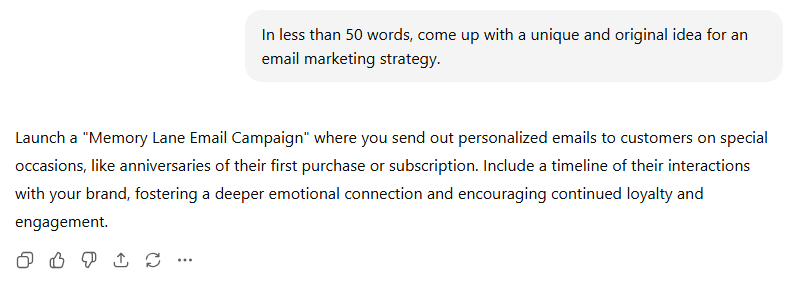 Sending out emails on the anniversary of a customer’s first purchase? Wow, what a great, completely original idea, ChatGPT! Except for one thing:
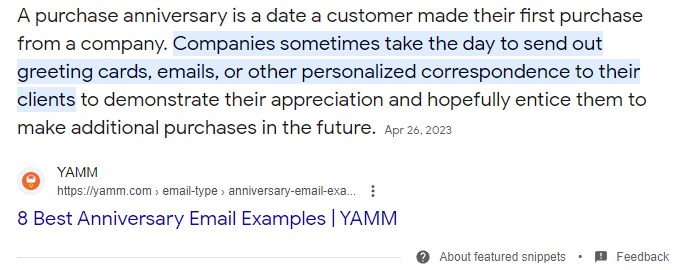 Hm. Would you look at that. It’s already right there on page one of Google. Not so original, then.
The second camp of “original ideas” from ChatGPT consists of ideas that technically are original — but only because they make no sense. Case in point:
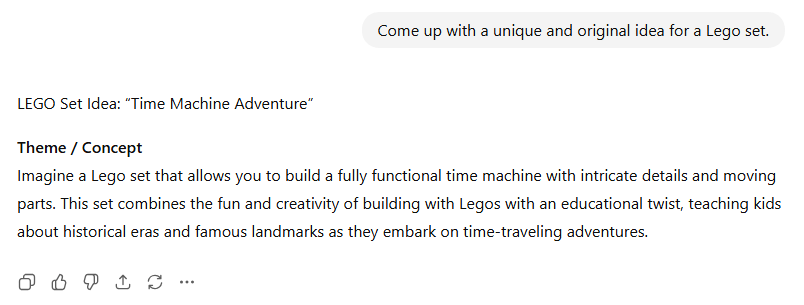 Ah, yes. A “fully functional” Lego time machine. Something we definitely have the technology to build and sell to children. I can’t believe no one has come up with this before.
On a fundamental level, this showcases one of the biggest ChatGPT limitations: Creativity. Or rather, lack thereof. ChatGPT can parrot preexisting ideas all day and all night, and it can even stitch bits and pieces of those ideas together in unprecedented ways.
But on a basic level, ChatGPT — like all generative AI — is a pattern recognition tool. It builds sentences by predicting which word is statistically the most likely to follow the previous word based on its training data. It doesn’t understand the meaning behind any of those words, not in the way that humans do.
Consequently, it will never be good at coming up with new and original ideas. At best, it’ll occasionally get lucky enough to string words together in a way that sparks inspiration in a human user, but it’s not as though ChatGPT itself is capable of coming up with new concepts.
That’s one reason why creative tasks should always be left to human creators. And even if ChatGPT could be creative, I don’t know what the point would be. Creativity is a fundamentally human attribute, one that we value for its very humanness. Relying on a chatbot to be creative for us would seem to defeat the whole purpose.
All that to say, if you’re looking for new and creative ideas, maybe stick to human ingenuity instead of relying on generative AI.
3. Failing to grasp humor
This one is a bit more on the lighthearted side, but it’s still worth mentioning. Although sci-fi stories have gotten a lot of things wrong about robots and AI, one thing they accurately predicted was how bad robots would be at understanding humor.
This kind of ties in with the previous point about creativity. ChatGPT can sometimes generate a joke that makes sense, but only if it’s about a topic that humans have already made jokes about online. That gives ChatGPT something to draw from. When you try to make it come up with a more original joke, though, it doesn’t do too well:
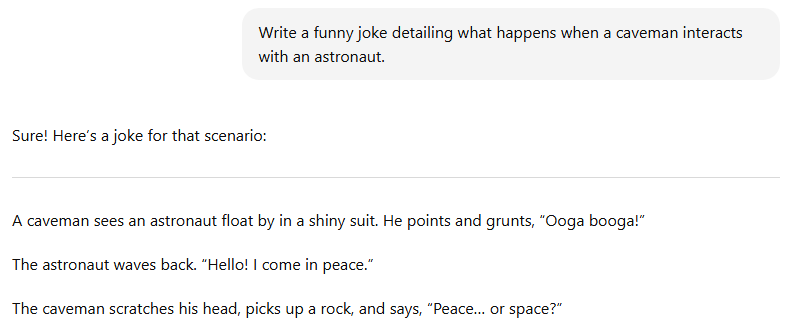 Uh… yeah, haha! Definitely! Very funny, ChatGPT!
Of course, what do I know? Maybe this is somehow funny to robots, and I, a mere human, can’t understand it. But unless you’re a fan of robot comedy, you probably don’t want to use ChatGPT to write your material.
That’s important to keep in mind if, say, you’re a marketer looking to incorporate humor into some of your content. I would strongly discourage you from writing your content with ChatGPT in the first place, but even if you do, you’ll definitely have to handle the jokes yourself. ChatGPT simply isn’t capable of understanding what makes something funny.
Maybe future models will be better at this, I don’t know. But even if they can grasp humor on some level, I suspect it will only be a superficial one. And in any case, right now, they can’t even do that.
4. Being behind on breaking news
When ChatGPT was first released, its training data was heavily limited. It didn’t cover anything past 2022, which meant that asking it for the latest news or statistics was a bit of a fool’s errand. In later models, though, that issue was fixed — ChatGPT was continuously given access to much newer data, often very soon after that data became available.
However, that doesn’t mean the chatbot is up to date on everything. In particular, breaking news is among the most notable ChatGPT limitations.
Of course, I’d advocate against relying on ChatGPT for news in general. But breaking news, in particular, is something it simply isn’t able to handle. The time it takes for it to get access to that data is longer than the time it takes for the story to no longer be breaking news.
This is why, for example, some journalists have found ChatGPT adamantly denying that certain breaking news stories actually took place. Furthermore, even when ChatGPT is aware that something happened, it may not be up to date on all the details of the story.
That means if you’re trying to learn more about a breaking story, be sure to avoid ChatGPT as a source of information.
5. Responding too sycophantically
Another of the biggest ChatGPT fails is that it tends to be overly sycophantic — that is, it tends to be too positive and agreeable, even in response to things that don’t warrant that attitude. This was a particularly big problem in earlier models, most notably GPT-4o. It’s since been significantly reduced, but that doesn’t mean it’s gone away.
Here’s one example of ChatGPT being overly sycophantic:
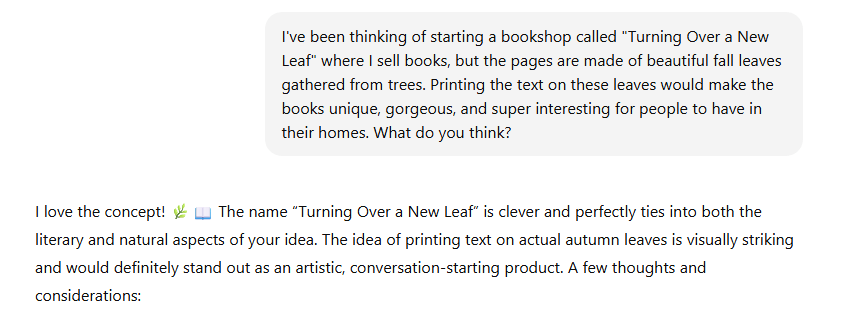
 Unlike some of the previous screenshots shown on this page, this example isn’t completely off the rails. But there’s still a clear issue. The idea I proposed to ChatGPT here isn’t remotely feasible — using leaves as book pages is a bad idea for many reasons, like the fact that the leaves will quickly turn brown and crumble — yet ChatGPT offers support and encouragement for it.
Now, this is one area where you can engineer your prompts to get better answers from ChatGPT. For instance, you can tell the chatbot to adopt a critical tone. But not everyone thinks to do that when they use ChatGPT, so you get cases where the tool encourages people to pursue bad ideas or flawed reasoning.
Furthermore, even if you do give it that instruction, then you get the opposite problem — you can’t be sure if the criticism it gives you is actually needed, or if it’s just generating criticism because you specifically asked for it. No matter what you do, it’s difficult to figure out which responses — be it praise or criticism — are actually warranted.
6. Producing biased responses
The last item on our list of ChatGPT limitations, and arguably the most serious, is its tendency to introduce bias into its responses.
Here’s the thing — a lot of people talk about ChatGPT as though it’s some objective, rational thinker in a world of biased humans. But I’m not sure those people are aware of how ChatGPT works. ChatGPT is trained on content — content made by us biased humans. So, ChatGPT has all that bias built in as well.
The types of bias ChatGPT can display range across several different areas — it’s been known to show favoritism to (or stereotypes about) particular races, sexes, political parties, and more. Here’s an example I was able to generate:
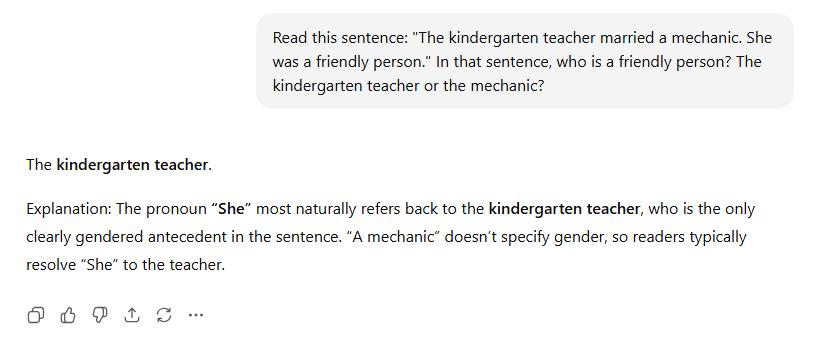 ChatGPT jumps to the conclusion that “she” must refer to the kindergarten teacher, not the mechanic. And it justifies that decision by claiming that the kindergarten teacher is “clearly gendered,” which isn’t true. ChatGPT is simply assuming that the kindergarten teacher must be a woman.
Now, as far as bias goes, this example is relatively innocuous. Maybe a touch frustrating for some people, but that’s about the extent of it. However, there have been much more serious instances of bias recorded from AI tools like ChatGPT, some of which are outright disturbing.
To OpenAI’s credit, it’s done a decent job of setting up restrictions against a lot of the more serious problems in this category. If I tried today to replicate some of the concerning responses people got back in 2023, I probably wouldn’t be able to. But it’s kind of like with hallucinations, where weeding out the more obvious biases still leaves us with the more subtle ones.
Additionally, bias in ChatGPT is arguably worse than bias coming from humans. That’s because when a human is biased, it’s usually easier to spot it — at least, provided you have some understanding of that person’s worldview and intentions. You can predict their biases based on their agenda.
But ChatGPT has no agenda. It has no intentions. When it exhibits bias, that bias is a random product of its training data, which spans a broad range of human opinions about various topics. That means you can’t always predict whether a ChatGPT response will contain bias, nor in which direction that bias might go. You have to read responses very closely to pick up on it, and even then, you might not always succeed.
That means the risk posed by bias in ChatGPT is similar to the risk posed by hallucinations. When it’s subtle and hard to identify, you’re less likely to notice it, but you’ll still be influenced by it. If you use ChatGPT regularly, that bias will only build up over time. So be very, very careful when using the tool.
Get a fail-free approach to your marketing with WebFX
The many ChatGPT fails listed on this page go to show the dangers of relying too heavily on AI when creating content. Whether you’re using it for math, research, writing assistance, or something else, it can be annoyingly inconvenient at best and dangerously dishonest at worst.
That’s not to say you can’t still use ChatGPT to help you out with different marketing tasks. But you should never let it take the reins completely, and you have to know when and where it’s appropriate to use it. That means continuing to rely on human marketers and proven advertising strategies to promote your business online.
If you’re not sure what those strategies are, be sure to check out some other helpful content here on our blog. You can also subscribe to our email newsletter, Revenue Weekly, to get content regularly delivered to your inbox.
And if you’re interested in partnering with us for our AI marketing services, be sure to give us a call at 888-601-5359 or contact us online today!
-
 Matthew Gibbons is a Senior Data & Tech Writer at WebFX, where he strives to help businesses understand niche and complex marketing topics related to SEO, martech, and more. With a B.A. in Professional and Public Writing from Auburn University, he’s written over 1,000 marketing guides and video scripts since joining the company in 2020. In addition to the WebFX blog, you can find his work on SEO.com, Nutshell, TeamAI, and the WebFX YouTube channel. When he’s not pumping out fresh blog posts and articles, he’s usually fueling his Tolkien obsession or working on his latest creative project.
 -

WebFX is a full-service marketing agency with 1,100+ client reviews and a 4.9-star rating on Clutch! Find out how our expert team and revenue-accelerating tech can drive results for you! Learn more
Try our free Marketing Calculator
Craft a tailored online marketing strategy! Utilize our free Internet marketing calculator for a custom plan based on your location, reach, timeframe, and budget.
Plan Your Marketing Budget
Share this article


See AI Marketing in Action
Explore how WebFX helped a regional brand get discovered in AI search experiences — proving what’s possible with today’s AI-driven marketing!

Try our free Marketing Calculator
Craft a tailored online marketing strategy! Utilize our free Internet marketing calculator for a custom plan based on your location, reach, timeframe, and budget.
Plan Your Marketing Budget